Genocide (昆虫大戦争, Kazui Nihonmatsu, 1968)

In the early 1960s, tokusatsu movies had begun to slide towards something which was much less serious than the early days of the genre, but as the decade went on others edged in the direction of the ‘70s paranoia thriller expressing a nihilistic view of contemporary Cold War geopoliticking. Given the rather provocative English title Genocide (昆虫大戦争, Konchu daisenso), as opposed to the more recognisably genre-inflected “great insect war”, Kazui Nihonmatsu’s wasp-themed disaster film is part anti-nuclear eco-treatise and part anti-US spy movie.

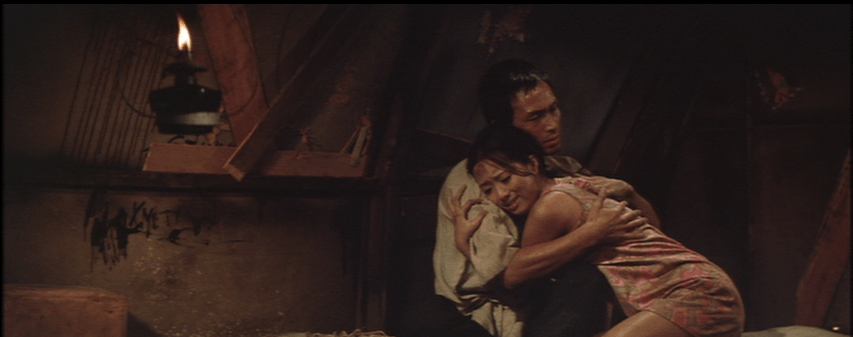
Then again, the film’s secondary hero, Joji (Yusuke Kawazu), a Japanese man obsessed with collecting rare insects he sends alternately to a researcher in Tokyo and a foreign woman living locally, cannot exactly claim the moral high ground. When he spots a US bomber falling out of the sky and runs to investigate the descending parachutes, he’s in the middle of tryst with Annabelle (Kathy Horan) while his wife waits for him patiently at home. Not only that, he picks up an expensive watch dropped by one of the airmen and attempts to sell it, he later claims to buy something nice for his wife, Yukari (Emi Shindo). Meanwhile, the voice of reason Dr. Nagumo (Keisuke Sonoi) is also seen conducting experiments on animals, injecting insect venom into a squirming guinea pig while explaining that the toxin affects the nervous system and causes madness and death. 

For all his own moralising, it’s this callous and selfish disregard for life which caused so many problems. The insects have apparently become fed up with human volatility and have decided that they don’t care what humans do to each other but they won’t go down with us in a nuclear war so the only solution is total eradication. The film’s true moral centre, the innocent Yukari, had tried to stop Joji capturing insects, reminding him that “insects have babies too,” while unbeknownst to him the insects he’d been capturing for Annabelle had been used for her sinister experiments to “breed vast numbers of insects that drive people mad and scatter them across the world.”

Annabelle’s quest is one of revenge, claiming that she doesn’t trust humans and likes insects because they don’t lie. She’s currently working with Communist spies supposedly researching deadly nerve toxins but with no loyalty to the regime, only the desire for the eradication of humanity in revenge for the murder of her parents in the holocaust. The Americans, meanwhile, only care about getting the H-bomb that the downed bomber had been carrying, eventually admitting that they’re considering simply detonating it to wipe out the insect threat in total indifference to the lives of those who live on the islands. When Nagumo challenges him, the American officer pulls a gun. One of the soldiers refuses the command to detonate, but is then killed. 

The Americans reject the idea that it was “insects” that brought the plane down, but tell on themselves on insisting that the airman onboard was hallucinating having become addicted to drugs to help him overcome his fear of combat situations. The insects do indeed cause him to hallucinate but with flashbacks back to his time in Vietnam, loudly exclaiming that he won’t go back there before asking for more drugs and being injected by a medic. The American officers claim they’re fighting for “freedom and independence,” but it rings somewhat hollow and is immediately challenged by Nagumo. “Sacrifices must be made in war,” they retort when he points out that detonating the bomb will not only kill everyone on the islands but irradiate the rest of Japan, wiping out the Japanese as if they too were merely insects. 

Even so, Nagumo too wants to wipe out the insects rather than consider the implications of their concern or find a way to live with them. Annabelle might have had a point when she said that human beings only knew hate despite her entirely twisted and exploitative plan to use the insects to complete her mission of eradicating humanity. In any case, in contrast to other similarly themed films, Nihonmatsu keeps things fairly realistic despite the outlandishness of the narrative, frequently cutting back to closeup footage of an insect biting into human flesh with its pincers before ending on an image of a nihilistic and internecine destruction that suggests there may be no real hope for us after all.
Tora-san, Our Lovable Tramp (男はつらいよ, Yoji Yamada, 1969)

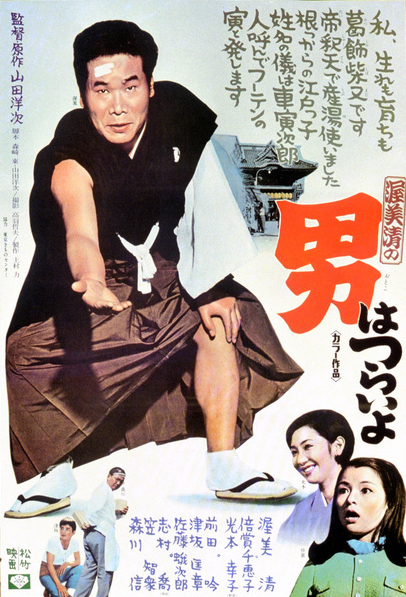
“It’s tough being a man” according to the Japanese title of the long running series affectionately known as “Tora-san” to its many fans. Tora-san began as a TV drama broadcast in 1968-9 in which the hero died of a snakebite in the very last episode much to viewers’ disappointment. Director Yoji Yamada then resurrected the loveable travelling salesman and made him the star of a reboot movie which proved so popular that it spawned a 48-film series which lasted until the death of star Kiyoshi Atsumi at the age of 68 in 1996. 

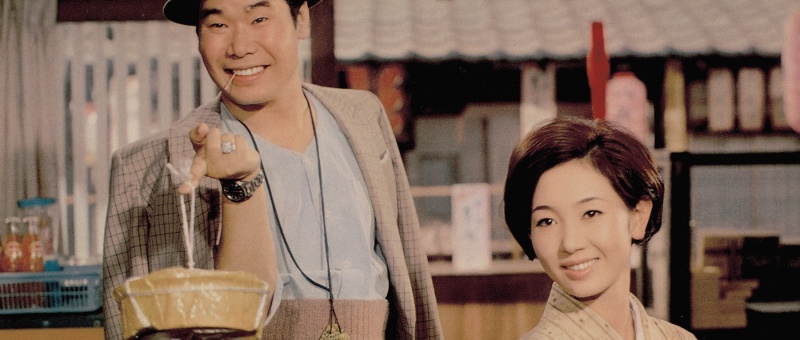
Yamada directed all but two instalments in the series each of which broadly follow a similar pattern to that introduced in the first film following the eponymous Tora as he gets himself mixed up in some kind of trouble, returns home to visit his family in Shibamata, and falls in love with a beautiful but unobtainable woman known as the “Madonna” in the series’ “mythology”, if you can call it that. At the beginning of Tora-san, Our Lovable Tramp (男はつらいよ, Otoko wa Tsurai yo), Torajiro Kuruma (Kiyoshi Atsumi) or “Tora-san”, explains that he’s been in a wistful mood thinking about his hometown while viewing the cherry blossoms and has decided to go back to Shibamata for the first time in 20 years having left swearing never to return after arguing with his father who has since passed away as has his brother. Tora-san’s only remaining family members are his younger sister Sakura (Chieko Baisho), a small child when he left but now a grown woman in her mid-20s, and an uncle (Shin Morikawa) and aunt (Chieko Misaki) who’ve been looking after her and run a small dango shop. 

Being away for 20 years necessarily means that Tora has been on the road since he was a young teenager back in 1949 when Japan was still very much in the throws of post-war chaos, in contrast to the increasingly prosperous nation it has since become. On his return to town he is relieved to discover that the local priest (Chishu Ryu), as well as his aunt, still remember and recognise him but shocks them all with an incongruous, and frankly over the top, show of politeness as he expresses gratitude and filial piety towards his uncle and aunt for having raised his sister but then immediately afterwards tries to sell them some of his tacky sales goods including some kind of electronic bracelet with supposed health benefits. Nevertheless, the family, including his sister Sakura who works as a typist at an electrical goods company, are very glad to seem him after all these years. 

Hardly in the house five minutes before peeing in the garden instead of using the bathroom like a regular person, Tora is already undercutting the image he first presented and causing trouble with the neighbours. The major drama occurs when he ends up accompanying Sakura to an omiai arranged marriage meeting set up by her boss in a fancy hotel. Sakura hadn’t been keen to go to the omiai, her uncle and aunt assume because arranged marriages are already outdated, but as we later discover she’s developed a fondness for factory worker Hiroshi (Gin Maeda) who lives in the house directly behind theirs. The uncle and aunt encourage the match because it’s an opportunity to marry up, viewing it as better than Sakura could otherwise hope for as an orphan with no dowry. Tora agrees with them, encouraging his sister not to write off tradition, but he has little understanding of the etiquette for these kinds of situations and quickly scandalises the refined, upper-class family by drinking far too much, making bawdy jokes about the composition of Chinese characters, and using vulgar language. As expected the suitors decide not to take things further, though luckily Sakura’s boss does not seem to mind or hold Tora’s behaviour against her.

On the road since he was little more than a child, perhaps it’s no wonder that Tora struggles when trying (or not) to adapt to the rules of civilised society though as he later tells us, he also had a traumatic childhood beaten by his father who resented him for being illegitimate, conceived during a drunken indiscretion with a geisha (Sakura is a half-sister born to his father’s legal wife). At one point he loses his temper completely and finds himself slapping Sakura, accidentally starting a mass brawl in their courtyard, though it’s obvious afterwards that he deeply regrets his behaviour and despite being forgiven by his ever patient sister feels as if it might be better to leave again before he makes even more trouble for his family. 

Tora is, however, perhaps good trouble in that his heart is (broadly) in the right place even if he makes a lot of mistakes. He meddles in Sakura’s love life and almost destroys her chance of romantic happiness, but it all works out in the end and he might have a point in implying that without his mistaken intervention she and Hiroshi would have just gone on in silent longing. Nevertheless, he remains a romantically naive figure, falling for the elegant daughter of the local priest (Sachiko Mitsumoto) who surprises him by expressing a fondness for low entertainment but in real terms is never going to marry a man like Tora. “Mine’s a hard world” he explains to a boatman, sadly making his way back towards the road filled with a deep sense of despair but pressing on all the same, trying his luck wherever he goes just another plucky, though no longer so young, guy, left behind by the rapid pace of the post-war economic miracle.  


Tora-san, Our Lovable Tramp streamed as part of this year’s Japan Cuts.

Original trailer (English subtitles)