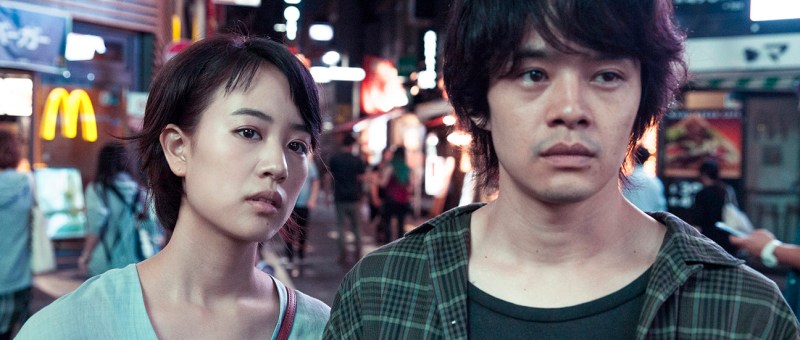
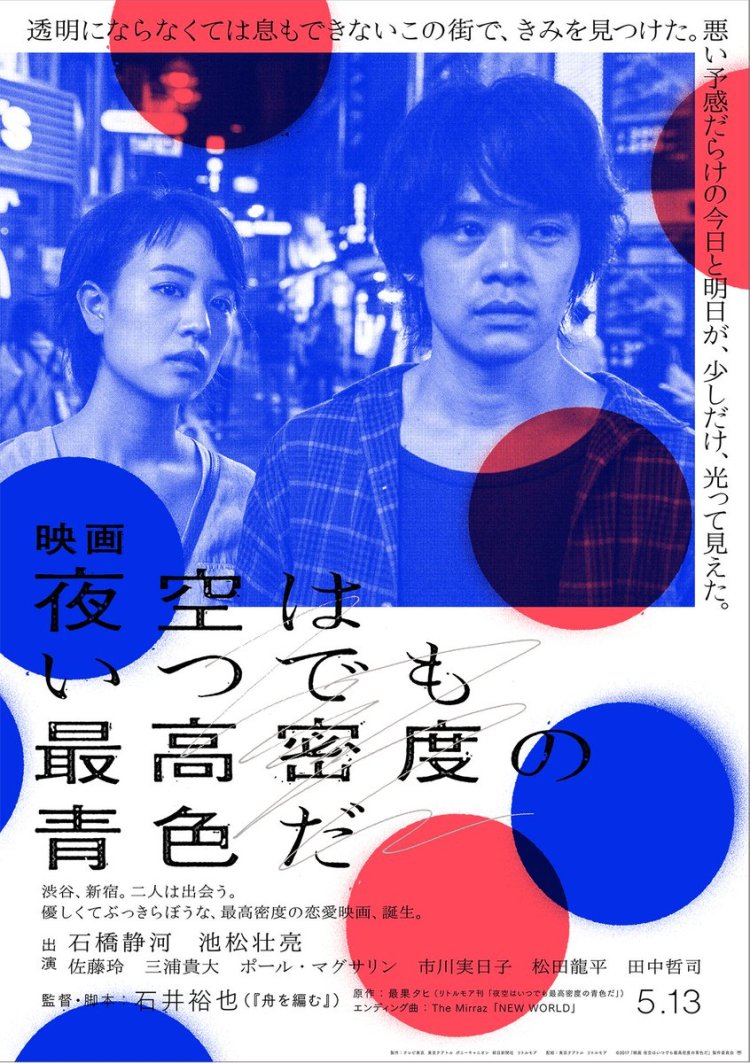
 Learning to love Tokyo is a kind of suicide, according to the heroine of Yuya Ishii’s love/hate letter to the Japanese capital, The Tokyo Night Sky is Always the Densest Shade of Blue (夜空はいつでも最高密度の青色だ, Yozora wa Itsudemo Saiko Mitsudo no Aoiro da). This city is a mess of contradictions, a huge sprawling metropolis filled with the anonymous masses and at the same time so tiny you can find yourself running into the same people over and over again. Inspired by the poems of Tahi Saihate, The Tokyo Night Sky is at once a meditative contemplation of city life and an awkward love story between two lost souls who somehow find each other in its crowded backstreets.
The heroine, Mika (Shizuka Ishibashi), works as a nurse by day and supplements her income by night as a bar tender in a “girls bar” (basically a normal bar where all the bartenders are female and you have to pay an entrance fee on top of your overpriced drinks). Depressed and anxious, she wanders the city with a poetic interior monologue expressing her constant loathing for its indifferent soullessness. Meanwhile, Shinji (Sosuke Ikematsu) is a casual day labourer working on various projects in the run up to the 2020 Olympics. He describes himself as odd and is over sensitive about being blind in one eye. Unlike his friends and colleagues, Shinji prefers literature to parties and solitude to company.
The two first catch sight of each other in a crowded bar where Mika is trying to buy time before having to head back to a dull double date with her drunken friend and the lewd guys she’s invited to come along, and Shinji is trying to read away from the noise and chaos of his lodging house. They meet again when one of Shinji’s colleagues suggests going to the girls bar, and then seem to be constantly running into one another for no particular reason.
Though romance would seem to be the natural outcome of the “pointless miracle” of their repeated meetings, the process is a slow one. It’s obvious the pair share a deep, innate understanding of each other but they each have various problems which conspire to keep them apart. Shinji, describing himself as odd and assuming he’s annoying, is prone to nervous babbling which Mika correctly guesses is less down to a love of his own voice than a fear of awkward silence. For her part Mika is anxious all the time, brittle and insecure she instinctively rejects attempts at intimacy but somehow warms to Shinji responding to his confession of oddness with a comforting “well then, you’re just like me.”
The pair advance and retreat as they wander around the city they both claim to hate but as much as they keep each other at a distance their lives begin to overlap and run in parallel. Mika receives a text from an ex (Takahiro Miura) with a confused declaration of love while Shinji receives one from an old high school classmate (Ryo Sato) with much the same effect. Mika insists that love makes you boring, that you’ll never find someone who is prepared to love the most pitiable part of you, and that there is no such thing as love on this planet, but her protestations point more towards a kind of soul-searching and buried hope than they do of active rejection.
Ishii marries the romantic undercurrent with an ambivalent portrait of the stratified city. Mika, a nurse by profession, needs to take a second job to make ends meet while the more traditionally working class Shinji is a sensitive intellectual relegated to dangerous and insecure employment. As a day labourer he gets no employment benefits like sick pay or insurance – hence when he’s injured on the job he avoids letting anyone know for as long as possible because it means both loss of wages and a doctor’s bill. An older friend (Tetsushi Tanaka) has ruined his back through long years of overwork and is now left with nothing while a Filipino migrant worker (Paul Magsign) pines for home and the wife and child waiting for him there.
Shinji’s anxieties are partly economic – trapped in insecure employment which may well, as his older friend points out, dry up once the Olympics rolls around but the greater problem is inertia. During their journeys around the city, Shinji and Mika run into the same busker (Yoshimi Nozaki) who is always singing the same strange song about her underarms sweating which seems to echo their shared anxiety. Yet the song she offers them also provides a note of hope as she enthusiastically reaches the “Ganbare!” chorus, cheering the pair of frightened lovers on and encouraging them to pursue their dreams and desires rather than waiting around for something to happen.
Waiting has been Mika’s problem. Saddled with intense abandonment issues stemming from childhood trauma, Mika is always sure something bad is about to happen. Shinji partly shares her anxiety often claiming that he has “a bad feeling” about something or other but conversely, he begins to believe that the “something” could be good as well as bad. Rather than try and argue with her, Shinji concedes most of Mika’s points, nobody knows what will happen in the future, nobody can make any promises, and everything ends someday but that’s OK – it’s only life.
Ishii’s Tokyo is a soulless place filled with the melancholy and the empty but there’s beauty here too, if only people would look up from their smartphones every now and then to see it. Mika is afraid of being swallowed by the city and becoming one of its faceless masses but her listlessness and depression stand for the city itself as she refuses and rejects the process of living with all of its attendant risks. Ishii paints the city in all the colours of the night, but for all of its beautiful sadness it’s also a place of noise and chaos where existence is exhausting and the price of living high. It is, however, also a place of ordinary miracles offering hope to the hopeless if only they are willing to accept it.
The Tokyo Night Sky Is Always the Densest Shade of Blue was screened at the 17th Nippon Connection Japanese Film Festival.
Original trailer (no subtitles)

 Below average student buckles down and makes it into a top university? You’ve heard this story before and Nobuhiro Doi’s Flying Colors (ビリギャル, Biri Gyaru) doesn’t offer a new spin on the idea or additional angles on educational policy but it does have heart. Heart, it argues is what you need to get ahead (if you’ll forgive the multilevel punning) as the highest barriers to academic success are the ones which are self imposed. Arguing for a more inclusive, tailor made approach to education which doesn’t instil false hope but does help young people develop self confidence alongside standardised skills, Flying Colors is the story of one popular girl’s journey from anti-intellectual teenage snobbery to the very top of the academic tree whilst healing her divided family in the process.
 No names, no strings. That’s the idea at the centre of Daisuke Miura’s adaptation of his own stage play, Love’s Whirlpool (愛の渦, Koi no Uzu). Love is an odd word here as it’s the one thing that isn’t allowed to exist in this purpose built safe space where like minded people can come together to experience the one thing they all crave – anonymous sex. From midnight to 5am this group of four guys and four girls have total freedom to indulge themselves with total discretion guaranteed.
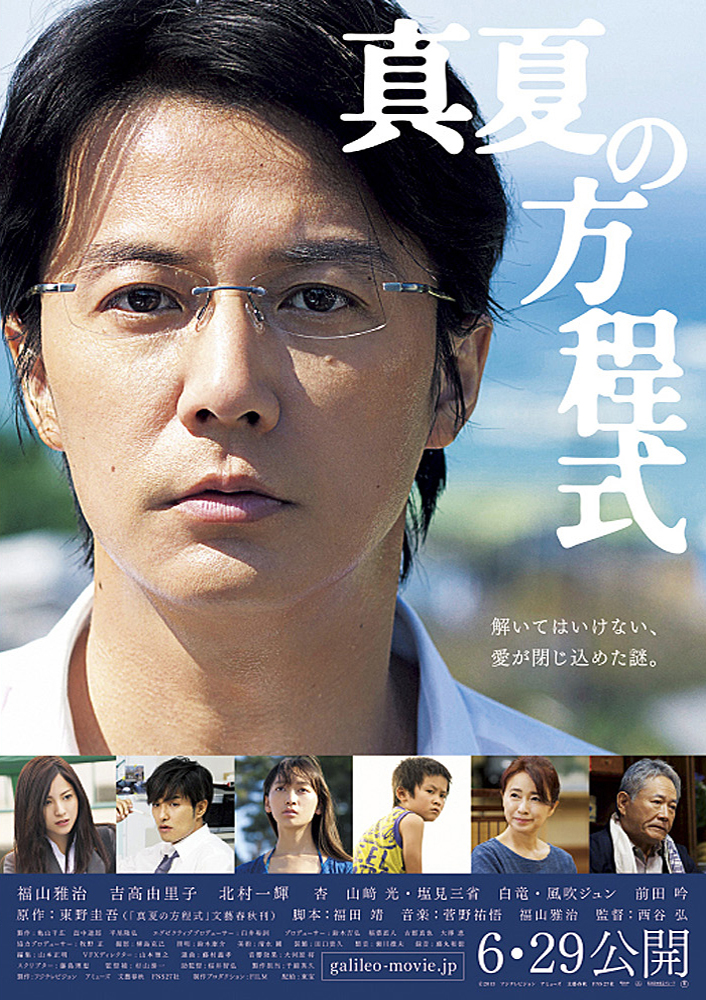 Sometimes it’s handy to know an omniscient genius detective, but then again sometimes it’s not. You have to wonder why people keep inviting famous detectives to their parties given what’s obviously going to unfold – they do rather seem to be a magnet for murders. Anyhow, the famous physicist and sometime consultant to Japan’s police force, “Galileo”, is about to have another busman’s holiday as he travels to a small coastal town which is currently holding a mediation between an offshore mining company and the local residents who are worried about the development’s effects on the area’s sea life.
 Windows on Worlds