
Ya Boy Kongming! The Movie (パリピ孔明 THE MOVIE, Shuhei Shibue, 2025) [Fantasia 2025]

Why in this world does war never cease? Reincarnated in modern-day Shibuya, third-century military strategist Zhuge Liang, known by his courtesy name Kongming, finds himself fighting a different battle in becoming the manager of an aspiring singer whose music he feels could unite the world in peace. Adapted from the manga by Yuto Yotsuba and illustrated by Ryo Ogawa, Ya Boy Kongming! (パリピ孔明 THE MOVIE, Paripi Koumei the Movie) is both a surreal advocation for the power of music and satirical take on the cutthroat entertainment industry.

Having decided to become Eiko’s (Moka Kamishiraishi) strategist, Kongming (Osamu Mukai) has already advanced her career with an appearance at a major festival. He’s also turned himself into a mini celebrity appearing on TV to offer his strategic opinions and starring in a number of adverts. Now he wants Eiko to enter a joint competition between the three leading music labels which ironically echoes his own Three Kingdoms era and requires him to make use of his classic strategies. But he’s also facing his greatest challenge yet in the form of Shin, a street singer whose music calls out to him in a similar way to Eiko’s yet not, he fears, in a good way. He’s plagued by strange visions of his past life and his old lord Liu Bei before being told that his dreams are of something called the “Yumi door” that leads to the afterlife and that he will want to step through it the next time he hears Eiko’s music. 

As some point out to him, perhaps he just shouldn’t listen, then, but to Kongming that would be the same as death and if it helps realise his dream of bringing about universal peace through Eiko’s music then he’ll gladly give up this strange second life he’s been given. Of course, this produces a conflict in Eiko who, on realising that Kongming is actually serious, isn’t sure if she should just not sing ever again to avoid accidentally killing him even though he tells her that her music has the power to save people. Meanwhile, she loses confidence in herself, thinking that he’s gone off her and is about to jump ship to Shin who is currently being managed by a descendent of Kongming’s old enemy Sima Yi, Sima Jun. 

Jun’s mission is then one both of familial revenge and a quest to make his sister a star. But whereas Kongming’s strategies are clever, Jun’s are underhanded and it’s clear he’s gone to the dark side in trying to advance Shin’s career. At the end of the day, Shin might not want to “cheat” either, but even so the teased battle of wits comes to pass as the two men attempt to outflank each other and win the coveted championship which is Kongming’s way of ensuring Eiko will be able to continue after he’s gone. Though her songs are all becoming independent and able to go on alone after someone important is no longer around, Eiko still values Kongming’s support and friendship and obviously doesn’t want him to go anywhere.

Yet what Jun ends up rediscovering is the joy of music and that it really can change people’s lives, a realisation that all the label bosses came to some time ago. Despite the cutthroat nature of their business, they do it because they believe in music too, whether it’s a girl with a guitar in the street or a Chinese boy band making a surprise appearance during their world tour. Jun and Kongming want the same thing, and Shin and Eiko aren’t really rivals but allies fighting for universal peace through music. Boasting excellent production values, the film lends a sense of melancholy nostalgia to the Three Kingdoms era and Kongming’s vaguely homoerotic relationship with the famed Liu Bei whose voice he once thought could unite the world in peace before he lost his life on the Wuzhang Plains and woke up in Shibuya clubland on Halloween thousands of years later. Endlessly surreal, there’s a childlike quality to the warring strategies of Kongming and Jun as they attempt to outflank each other with elaborate schemes, but also a genuine sense of warmth and joy in the love of music, which just might, after all, bring peace throughout the land.


Ya Boy Kongming! The Movie screened as part of this year’s Fantasia International Film Festival.

Original trailer (no subtitles)
Seven Days War (ぼくらの七日間戦争, Hiroshi Sugawara, 1988)

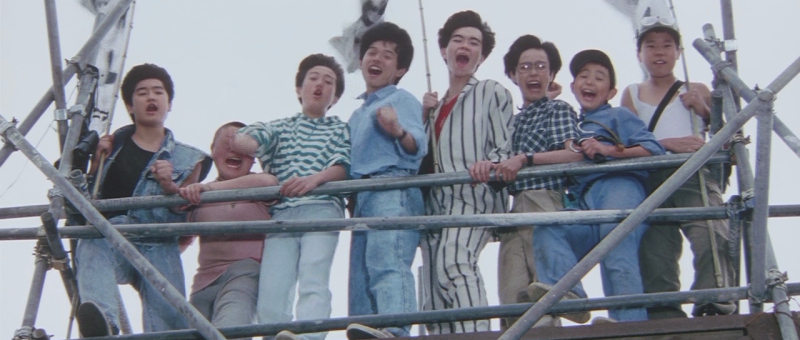
“What’s wrong with a little happiness?” one of the “eight heroes” of Aoba Jr. High Class 1-A asks, retreating from the duplicitous adult world into a teenage paradise. Another Kadokawa teen movie, Seven Days War (ぼくらの七日間戦争, Bokura no Nanoka-kan Senso) adapts the first in a series of Kadokawa novels by Osamu Soda and situates itself very much in the throws of the Bubble era in which the young rail not only against a rigid, conformist society but familial disappointment and the enduring legacy of the authoritarian past. 

According to the principal’s assembly speech, at Aoba Jr. High the motto for the day is “intellect, morality, and physique”. While he’s busy talking, another teacher, Yashiro (Shiro Sano), is patiently going through students’ bags and confiscating things he doesn’t like, even such innocent items as hairbrushes lest they should be used “to attract boys” rather than to maintain one’s appearance as the school would doubtless wish seeing as we later see the same teacher taking a ruler to make sure all the girls’ skirts are at regulation length. A boy late for assembly is also taken to task over his hair, accused of having had a perm and physically dragged towards a water butt by violent P. E teacher Mr. Sakae (Yasuaki Kurata) who later beats another overweight student for not performing well enough on the monkey bars. 

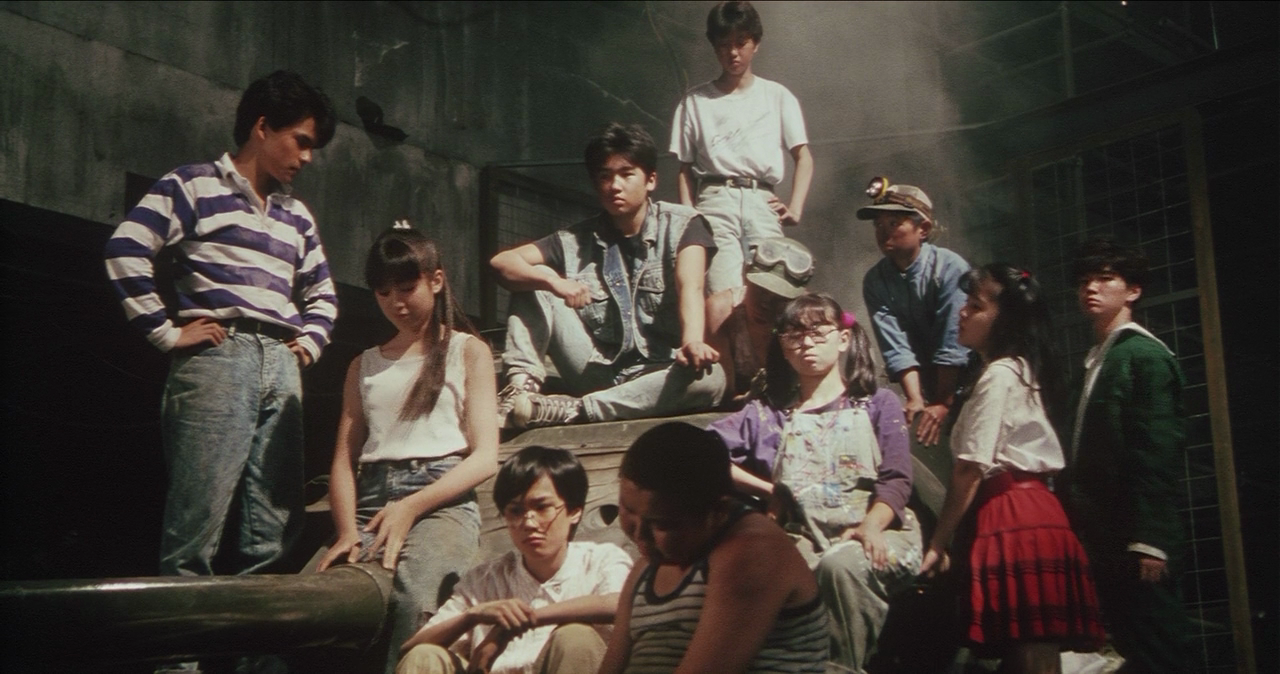
It’s small wonder the kids want to rebel. Eight of the boys in Yashiro’s class suddenly disappear one day, seceding to form their own society hiding out in a disused factory. Discovered and questioned, their only demands are to have the bad teachers fired and for all the students to be treated equally, but as expected their requests fall on deaf ears. Mindful of the school’s reputation, the principal tries to calm the anxious mothers but his underling, Nozawa (Yasuo Daichi), cooly absolves himself of all responsibility insensitively telling the parents that their children’s actions are obviously a reflection of poor parenting rather than a reaction to conditions at the school. 

As crude as that sounds, it’s accidentally echoed in another of the children’s demands in that they reject the idea that “children are robbers of parents’ lives”. Many of them are dealing with some degree of familial discord, often caused by the socio-economic stresses of the Bubble era in which everyone works all the time. The parents of ringleader Eiji (Kenichiro Kikuchi) are always arguing because his father is never around to help out at home, claiming that his golf weekends etc are essential work activities while his mother complains she’s worn out expected to handle the domestic responsibilities all alone. The broody Hiroshi (Toshitada Nabeshima) resents his mother for never being home, forever off working and communicating with him largely through answerphone messages. Nakao (Ken Ohsawa), the most studious of the boys, complains that he doesn’t really like the subjects he’s forced to study and only goes to cram school to please his parents. Hitomi (Rie Miyazawa), a female student who ends up joining the group later, is often left to her own devices with her father away working in Mexico and her mother always off “playing golf” which she seems to suspect is a euphemism for some other activity. 

What the kids want is to be free to be themselves, rejecting the salaryman straitjacket the mainstream world seems to be preparing for them. This being 1988, it goes without saying that the older teachers were children themselves during wartime and the legacy of militarism seems to have endured in their extreme love of order and discipline which has also infected the slightly younger and especially scary Yashiro. The wartime echoes are driven home by the very random find of a WWII tank for some reason hidden in the factory which the kids eventually repurpose and weaponise as part of their resistance, fortifying their hideout with a series of otherwise non-lethal booby traps to keep the authorities out even after the principal orders armed troops in. In the final confrontation, Nozawa turns up wearing a WWII German uniform only to be humiliatingly defeated by one of the gang’s Mousetrap-esque devices. 

Their rebellion, however, remains temporary and goodnatured, culminating in a beautiful fireworks display that has the adults admiring their artistry, while they later appear dressed once again in their school uniforms apparently considering their next revolutionary act. A Bubble-era time capsule, Seven Days War has much in common with other ‘80s kids movies, but positions its contemporary teens at the intersection of the authoritarian past and the consumerist present each of which conspire to rob them of their freedom but in their own way fighting back for their right to be themselves in a still conformist society.


Music video (no subtitles)