
Ya Boy Kongming! The Movie (パリピ孔明 THE MOVIE, Shuhei Shibue, 2025) [Fantasia 2025]

Why in this world does war never cease? Reincarnated in modern-day Shibuya, third-century military strategist Zhuge Liang, known by his courtesy name Kongming, finds himself fighting a different battle in becoming the manager of an aspiring singer whose music he feels could unite the world in peace. Adapted from the manga by Yuto Yotsuba and illustrated by Ryo Ogawa, Ya Boy Kongming! (パリピ孔明 THE MOVIE, Paripi Koumei the Movie) is both a surreal advocation for the power of music and satirical take on the cutthroat entertainment industry.

Having decided to become Eiko’s (Moka Kamishiraishi) strategist, Kongming (Osamu Mukai) has already advanced her career with an appearance at a major festival. He’s also turned himself into a mini celebrity appearing on TV to offer his strategic opinions and starring in a number of adverts. Now he wants Eiko to enter a joint competition between the three leading music labels which ironically echoes his own Three Kingdoms era and requires him to make use of his classic strategies. But he’s also facing his greatest challenge yet in the form of Shin, a street singer whose music calls out to him in a similar way to Eiko’s yet not, he fears, in a good way. He’s plagued by strange visions of his past life and his old lord Liu Bei before being told that his dreams are of something called the “Yumi door” that leads to the afterlife and that he will want to step through it the next time he hears Eiko’s music. 

As some point out to him, perhaps he just shouldn’t listen, then, but to Kongming that would be the same as death and if it helps realise his dream of bringing about universal peace through Eiko’s music then he’ll gladly give up this strange second life he’s been given. Of course, this produces a conflict in Eiko who, on realising that Kongming is actually serious, isn’t sure if she should just not sing ever again to avoid accidentally killing him even though he tells her that her music has the power to save people. Meanwhile, she loses confidence in herself, thinking that he’s gone off her and is about to jump ship to Shin who is currently being managed by a descendent of Kongming’s old enemy Sima Yi, Sima Jun. 

Jun’s mission is then one both of familial revenge and a quest to make his sister a star. But whereas Kongming’s strategies are clever, Jun’s are underhanded and it’s clear he’s gone to the dark side in trying to advance Shin’s career. At the end of the day, Shin might not want to “cheat” either, but even so the teased battle of wits comes to pass as the two men attempt to outflank each other and win the coveted championship which is Kongming’s way of ensuring Eiko will be able to continue after he’s gone. Though her songs are all becoming independent and able to go on alone after someone important is no longer around, Eiko still values Kongming’s support and friendship and obviously doesn’t want him to go anywhere.

Yet what Jun ends up rediscovering is the joy of music and that it really can change people’s lives, a realisation that all the label bosses came to some time ago. Despite the cutthroat nature of their business, they do it because they believe in music too, whether it’s a girl with a guitar in the street or a Chinese boy band making a surprise appearance during their world tour. Jun and Kongming want the same thing, and Shin and Eiko aren’t really rivals but allies fighting for universal peace through music. Boasting excellent production values, the film lends a sense of melancholy nostalgia to the Three Kingdoms era and Kongming’s vaguely homoerotic relationship with the famed Liu Bei whose voice he once thought could unite the world in peace before he lost his life on the Wuzhang Plains and woke up in Shibuya clubland on Halloween thousands of years later. Endlessly surreal, there’s a childlike quality to the warring strategies of Kongming and Jun as they attempt to outflank each other with elaborate schemes, but also a genuine sense of warmth and joy in the love of music, which just might, after all, bring peace throughout the land.


Ya Boy Kongming! The Movie screened as part of this year’s Fantasia International Film Festival.

Original trailer (no subtitles)

Not Quite Dead Yet (一度死んでみた, Shinji Hamasaki, 2020)

©2020 Shochiku Co., Ltd. Fuji Television Network, Inc.

“What’s important is purpose, to live for something. Without it you’re as good as dead” according to the hero of madcap existentialist farce Not Quite Dead Yet (一度死んでみた, Ichido Shinde Mita). The feature debut from ad director Shinji Hamasaki pits a rebellious student against her overly literal, authoritarian dad as the pair begin to come to a kind mutual understanding only once he “dies” after being tricked into taking an experimental drug in order to unmask conspiracy within his own organisation. 

College student Nanase (Suzu Hirose) intensely resents her father (Shinichi Tsutsumi), the CEO of Nobata Pharmaceuticals which he has long been pressuring her to join. She’s currently the lead singer in death metal band Soulzz only according to a record scout at one of their shows their problem is that they’re all “zz” and no soul. Meanwhile, Nobata has assigned an underling, Matsuoka (Ryo Yoshizawa), to shadow her partly because Matsuoka too has very little presence and is in fact nicknamed “ghost” for his essential invisibility. The trouble starts with the escalation of a corporate feud as Nobata’s old buddy Tanabe (Kyusaku Shimada) starts manoeuvring to get his hands on the company’s research into an anti-ageing serum codenamed “Romeo”, planting a mole inside the organisation. As a consequence of his research another of the scientists nicknamed “Gramps” has stumbled on another drug which renders someone temporarily “dead” for a period of two days, naming it “Juliet”. Watabe (Yukiyoshi Ozawa), a consultant Nobata has brought in to streamline the business, convinces him to take the experimental drug in order to flush out the mole while secretly working with Tanabe to take over the company by forcing through a merger while Nobata is out of action. 

A typical socially awkward scientist, Nobata believes that life is about experiment and observation, a belief system which has thoroughly irritated his daughter who still lives at home but has divided the territory in half with clearly marked red tape. Nanase’s animosity towards her father apparently stems back to the death of her late mother Yuriko (Tae Kimura), angry with him that he never left his desk and didn’t make it to the hospital in time to see her before she passed away. “Life’s not a lab experiment” she sings, recalling her childhood during which her overly literal father took away life’s magic by patiently over explaining fairytales, scoffing that Prince Charming probably didn’t revive Sleeping Beauty with a kiss but a transfer of static electricity, while continuing to order her around in fatherly fashion now she’s all grown up. Perhaps still stuck in a petulant adolescence she started the band to vent her frustrations with the world in the form of a death metal “mass”, but she’s growing up. Her bandmates are getting jobs or getting married, she’s still stuck with no real clue about what it is she actually wants to do with her life except that she doesn’t want anything to do with Nobuta Pharmaceuticals.  

Once her father “dies”, however, she begins to gain a new appreciation for his life philosophy able to see but not hear his “ghost” while his body lies on a table in the office cafeteria. Nobata went into pharmaceuticals to help people, but has been led on a dark and vacuous path pursuing anti-ageing technology which is in itself a rejection of change and transience. Ending all her sentences with the word “death”, that’s not something Nanase can get behind. She believes in growing old gracefully, that they make drugs not to cheat death but to be able to spend longer with those they love. As her father had advised Matsuoka to do, she begins to find her purpose, rediscovers her soul, and figures out what it is she’s supposed to do with her life.

Matsuoka, however, seems to be permanently “invisible” despite the tentative romance that develops as he and Nanase attempt to subvert the conspiracy to stop them doing her dad in for good, brushing up against the venal Tanabe who seems set to muster all his corporate advantages against them partly because of an old grudge against Nobata. Of course, you have to wonder why the conspirators didn’t just poison him rather than having him go Juliet and then entering a race against time to cremate him before he wakes up, but as Nobata reminds us there are many things which science cannot explain. A cheerfully silly Christmas tale of rediscovering what it means to be “alive” in the presence of death, Not Quite Dead Yet is zany seasonal fun but with plenty of soul as its heroes learn to shake off cynical corporatism for a healthy respect of the values of transience.


Not Quite Dead Yet screened as part of Camera Japan 2020.

Original trailer (English subtitles)

Images: ©2020 Shochiku Co., Ltd. Fuji Television Network, Inc.

My Dad is a Heel Wrestler (パパはわるものチャンピオン, Kyohei Fujimura, 2018)

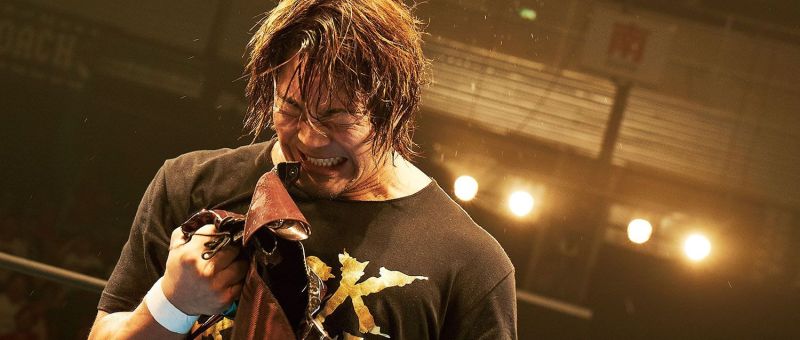
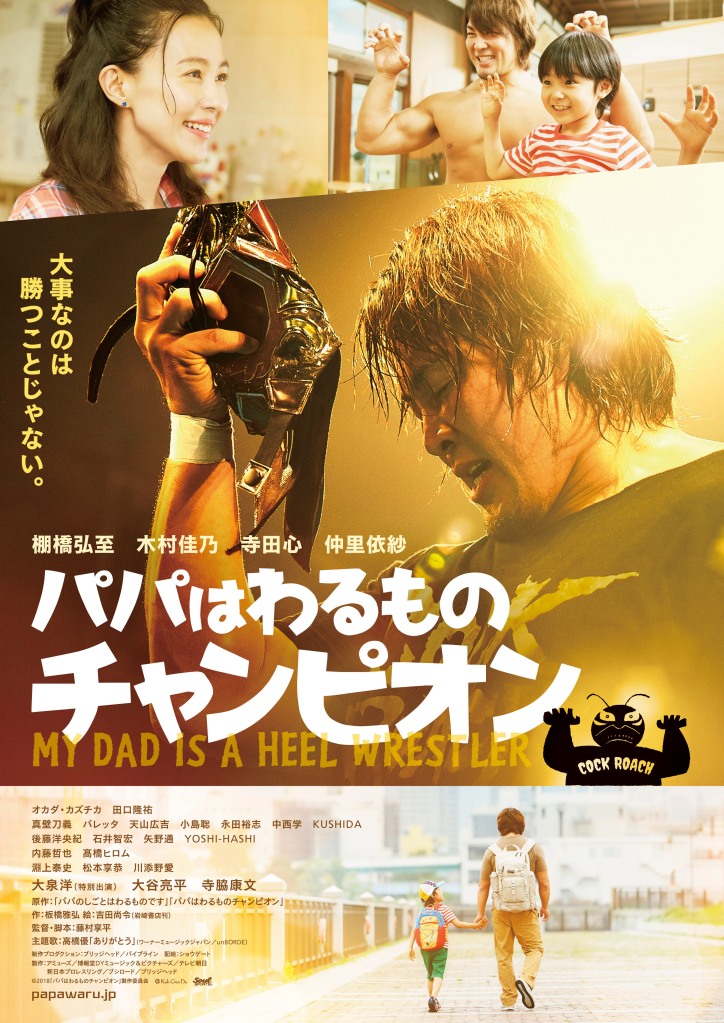
“Your job embarrasses me” little Shota (Kokoro Terada) coldly tells his actually quite lovely father, slowly closing the door on his well meaning attempt at connection. Self evident from the title, My Dad is a Heel Wrestler (パパはわるものチャンピオン, Papa wa Warumono Champion), Shota’s dad Takashi (real life wrestler Hiroshi Tanahashi) is a former champ reduced to playing the “heel”, a masked villain fans love to hate whose signature move is comic relief. Like all little boys, Shota really looked up to his father and wanted to be just like him, and so he gets a dose of paternal disappointment a little earlier than expected in realising that he is in a sense a professional loser with a degree of internalised shame regarding his failure to get back in the ring under his own identity. 

10 years previously, just before 9-year-old Shota was born, Takashi was a champion but a knee injury cost him his career. To stay in the game and provide for his family, he decided to become a heel as a temporary measure until he was well enough to return to being a “face”. A decade later however he’s still “Cockroach Mask” working with “Bluebottle” as a comedy villain known for pulling all sorts of unscrupulous tricks like using “Roach Spray” on his opponents or extracting gadgets from a Doraemon-esque interdimensional portal in the shape of a garbage can. Ashamed of himself, Takashi has avoided telling Shota what exactly it is he does for a living, promising that he’ll explain everything when he’s older. 

But Shota’s at the age when everyone at school is boasting about their dads and it’s niggling at him that he doesn’t really know, especially when one of his friends jumps to the conclusion he must be a yakuza. Determined to find out, Shota does some detective work and secretly follows him, only to wind up surrounded by beefy guys backstage at the ring. Bumping into a wrestling obsessive classmate (Maharu Nemoto) there with her father (Yasushi Fuchikami), Shota is horrified to realise his dad’s that jerk that everyone hates so when she somehow jumps to the conclusion that his dad’s her idol, reigning champ Dragon George (real life wrestler Kazuchika Okada), he doesn’t bother to correct her. 

The irony is, Takashi is a genuinely nice guy. He’s desperate to make it to Shota’s parents’ morning at school, but misses it because he stops on the way to help an old lady who was struggling with her shopping. When the kids are asked to compose a speech about their dreams for the future, Shota says that he wants to get big and strong like his dad in the hope that being big will also make him kind. Shota, however, is still too young to understand the way that wrestling works. He only sees his dad degrade himself, do “bad” things to win, and act in an underhanded, dishonourable way that is completely at odds with his offstage personality. Yet as much as it is that he’s disappointed to think his dad’s a “loser”, the real cause of his resentment is seeing that he’s not being true to himself. Shota’s mother tells him that wrestling is Takashi’s passion, but he pointedly asks her if his dream was being a heel, which it obviously wasn’t. 

While Shota picks up on his dad’s internalised sense of shame over the failure to achieve his dreams, he indulges in a little subterfuge himself in keeping up the pretence that his father is not the hated Cockroach Mask but the universally loved Dragon George. Failing to clear up the misunderstanding makes him an unexpected class hero, but it also unbalances the social hierarchy with snooty rich kid and all-round popular boy Yuta irritated at Shota stealing his thunder. When some of his friends start to doubt his story, it’s not the fact that Takashi is Cockroach Mask that upsets them only that Shota lied. Having a pro wrestler dad is cool in itself, he didn’t need to worry about what people would think and he shouldn’t have anyway because he should have stuck by his father rather than rejecting him completely and changing his dream to boring salaryman like the odious Yuta. 

Takashi, meanwhile, needs to think through why he’s doing a job that he’s essentially ashamed of. Bluebottle, his partner, who entered the trade as a heel and loves the strange thrill of being booed by the crowd, is offended at his insinuation that being a heel is somehow embarrassing. Michiko (Riisa Naka), an eccentric journalist and wrestling obsessive, tries to explain to Shota that the heel is an essential part of the game – you can’t have a fight without a villain after all, but Takashi still wants to be the face and regain his rightful place as a champion. He can’t let go of past glory and struggles to accept that there are new ways to win. “Wrestling’s not about winning or losing, it’s a way of life” an exasperated Michiko tells her editor (Yo Oizumi), trying to get him interested in the soap opera drama by way of investment in Takashi’s struggle. You don’t have to win, all you have to do is keep getting back up and make sure you put on a good show. Shota figures out that just because his dad’s a “bad guy” doesn’t make him a bad person, while Takashi figures out the only way to be the champ is to embrace his inner roach. Turns out, what wrestling’s all about is authenticity, just not quite in the way you were expecting it. 


Screened as part of the Japan Foundation Touring Film Programme 2020.

Hong Kong release trailer (English/Traditional Chinese subtitles)