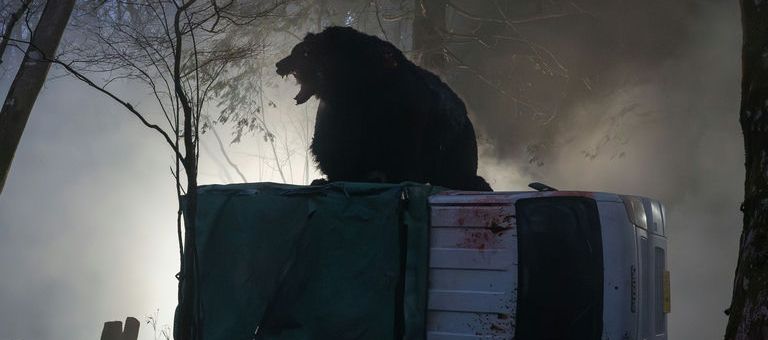

Last year Japanese society was sent into an existential panic due to a severe increase in the number of bear attacks as the creatures were forced to venture beyond their natural habitat due to climate change and the impacts of human behaviour on the rural environment. Eisuke Naito’s Higuma!! The Killer Bear (ヒグマ!!) then arrives at an apt time, though in this case, the bear seems to symbolise something else acting as a kind of karmic supernatural entity attacking those encroaching on its territory while drawn away from the safety of the city by greed and desperation.
The cities are, it seems, in quite a bad way. Eighteen-year-old Sora (Fuku Suzuki) is an aspiring game developer, though the complaints that his retro 3D-platformer is too hard with janky character design might equally apply to the challenges of modern life. He’s just got into university, but his happiness is short-lived as his father takes his own life shortly afterward having been scammed out of all his savings and therefore unable to pay his son’s tuition fees. While his mother tries to make the best of the situation and insists she’ll figure something out so he can continue with his education, Sora is resentful and angry until unwisely agreeing to a shady job ad promising a large amount of money for delivering “an envelope” to an unspecified location. It’s after this that he’s plunged into a confusing world of backstreet crime, scams, and exploitation that he cannot otherwise escape.
Yet at the same time, this otherworld feels oddly like a video game and is often framed like an old-school arcade scroller, classic first-person shooter, or RPG as Sora is dragged further into this morally compromised sector of society. After being witness to his boss scamming an old lady out of her cash card and ink stamp, he’s charged with retrieving a precious gem from an agent turned rogue that looks a bit like a rupee from the world of Zelda and feels like a video game MacGuffin. The young woman, a former SDF member, decided to keep it for herself having been offered only 30,000 yen to steal it though it’s apparently worth ten million. It turns out that she’s a kind of victim too. Not only was she kicked out of the SDF for punching a superior officer who was sexually harassing her, but has become hooked on a live-streaming host and fallen into financial ruin. This has become such a common problem lately that legislation has been introduced specifically to stop hosts exploiting women and forcing them into sex work. Though Wakabayashi (Wan Marui) knows intellectually that this relationship is entirely one-sided and not actually real, she feels compelled to keep supporting him in part because he was the only person who listened to her worries and accepted her as she was even though she knows this is just part of his job.
That her desire for connection and acceptance can only be fulfilled through a transactional arrangement speaks of an increasing sense of disconnection and alienation just as Sora is dragged into this hellish world through an online ad, never having met his handler who goes by the ironic handle of “Angel”. It’s the need to get rid of Wakabayashi that forces the gang out of their natural habitat and into the bear’s territory of the forest where the human civility that marks urbanity is largely dissolved. Yet there’s a sense of human solidarity that emerges between Sora and Wakabayashi in which they call each other by their own names as they try to battle the bear even if they also give in to their greed by staying in the mountains longer than they need to in order to retrieve the gemstone which the bear has swallowed.
Another kind of human connection is brokered by Sora’s interaction with a young boy who is playing the game he designed. The boy has been told not to talk to strangers or his games will be taken away, but decides to trust Sora and ironically gives him some bear-shaped snacks. He ends up fulfilling the role of a wizard in an RPG, gifting Sora some much needed special items after he manages to beat his own game. This newfound senes of achievement allows Sora to regroup and decide to do the right thing, not only calling his mother to explain what’s going on honestly, but going back to confront the bear and save Wakabayashi. On his way back to the mountain, he passes a collection of elderly people who are running an anti-scammer drill which seems to be organised much like the bear catching drills being run various cities, only in that case, Sora would also be a kind of bear. Filled with darkly absurd humour, the film seems to say man is the most deadly predator and the cities are the place of real danger, but allows Sora to overcome his sense of despair in using his unique and specialist knowledge along with a sense of human solidarity to finally beat back the existential threats of an exploitative society.
HIGUMA!! The Killer Bear screens as part of this year’s New York Asian Film Festival.
Trailer (English subtitles)


 Windows on Worlds