The Green Music Box (緑はるかに, Umetsugu Inoue, 1955)

An incredibly surreal musical kids adventure, The Green Music Box (緑はるかに, Midori Haruka ni) saw the film debut of future Nikkatsu star Ruriko Asaoka who in fact took her stage name from the character she plays in the movie. She was born in Manchuria in 1940 as Nobuko Asai (she retains the first character of her surname but the second “oka” or “hill” is also inspired by the “faraway” in the Japanese title). Her father was a political secretary but the family was extremely poor and her entry into the film world came about through an open audition for the role of Ruriko in the film adaptation of a serialised novel for children by Makoto Hojo which would be produced by Takiko Mizunoe and directed by Umetsugu Inoue. Junichi Nakahara who handled the costume design for the film personally picked Asaoka out from the 3000 applicants reportedly saying “this is the girl” after seeing her in makeup. 

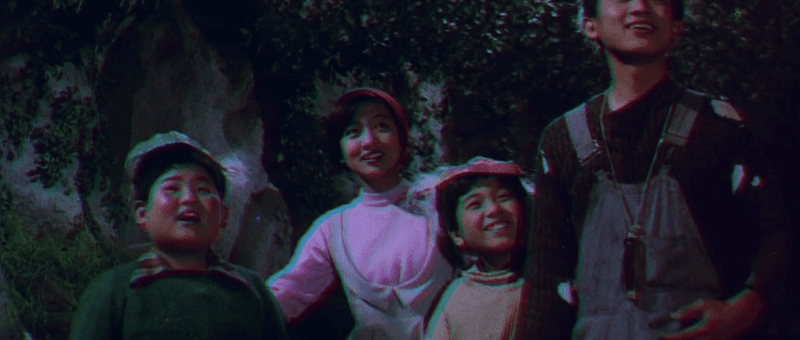
A classic children’s adventure movie, the film nevertheless has a strong theme of loneliness and displacement as each of the young protagonists either has no parents or has in some way been separated from them. Ruriko’s father is a scientist who left for a research project in Hokkaido a year previously and has since stopped responding to her letters. Missing him, Ruriko uses a green music box he had given her as a present as a means of floating off into a surreal dream world on the moon filled with children dressed as bunny rabbits who sing and dance with her. Later she teams up with a trio of orphans who have left their orphanage in search of adventure as well as another girl a little younger than herself, Mami (Noriko Watanabe), who has run away from the countryside to look for her mother in Tokyo. At the film’s conclusion all the children have happy family homes, Mami now living with her mother and the three boys adopted by Ruriko’s family meaning that she’s no longer lonely with her brothers now beside her as they all take a trip to the moon and a nation ruled by love, justice, and peace. 

Before all that, however, Ruriko and her mother are kidnapped by a spy, Tazawa (Kenjiro Uemura), claiming to be a colleague of her father’s. Explaining that Professor Kimura (Minoru Takada) has been taken ill, he bundles the pair into a car but takes them to a secret lab in the middle of nowhere where Kimura is being held and attempts to use them to blackmail him into giving up the scientific research he burned on learning that Tazawa belonged to a foreign power explaining that his creation could greatly benefit the world if used peacefully but cause great destruction if not. He manages to sneak the key to his research into Ruriko’s music box and tells her to escape with it though at the film’s conclusion he’ll decide to burn it anyway resolving that it’s too dangerous were it to end up in the wrong hands. 

Such dark events are not exactly unusual in children’s films, though the level of violence is surprising. Ruriko’s mother is taken off and hanged by her wrists while the foreign spies whip her. Though much of it occurs off screen, the whip cracks and screams are audible to Ruriko and her father while we also see her spin and twist, writhing in agony before falling silent perhaps having died as Ruriko comes to infer from the eerie quiet. Later, during the chaos at a circus which is also a front for international espionage a large goon slams the head of one of the children, Fatty (Hideaki Ishii), repeatedly into a table though he appears relatively unhurt and soon fights back cartoonishly by hitting him on the head with an iron bar. 

It’s not really clear why the spies operate out of a weird circus which is also seemingly guilty of copyright infringement given the various Disney-inspired papier-mâché masks lying around, but it is strangely scary for something meant to entertain small children including a surreal performance by Frankie Sakai in a brief cameo as a clown beckoning the kids towards the circus tent. The film was also Nikkatsu’s first colour movie using the short-lived Konicolor method and has a slightly sickly, washed out effect that lends an additional layer of discomfort to the brightly decorated circus environment. In any case, Ruriko and her friends are eventually able to triumph, regaining the music box and even convincing the police that the circus guys really are foreign spies even if it’s partly down to the otherwise unexplained reappearance of her parents who are in fact alive and well. In some ways melancholy, appealing to a sense of loneliness in post-war children who either may have become orphaned or are otherwise separated from their parents, the film ends on a more hopeful note in championing the sense of family that emerges between the children themselves through generational solidarity in offering a happy ending that might seem overly optimistic but nevertheless returns the kids to the kingdom of the Moon Queen and a happy world of love, justice, and peace. 

One Wonderful Sunday (素晴らしき日曜日, Akira Kurosawa, 1947)

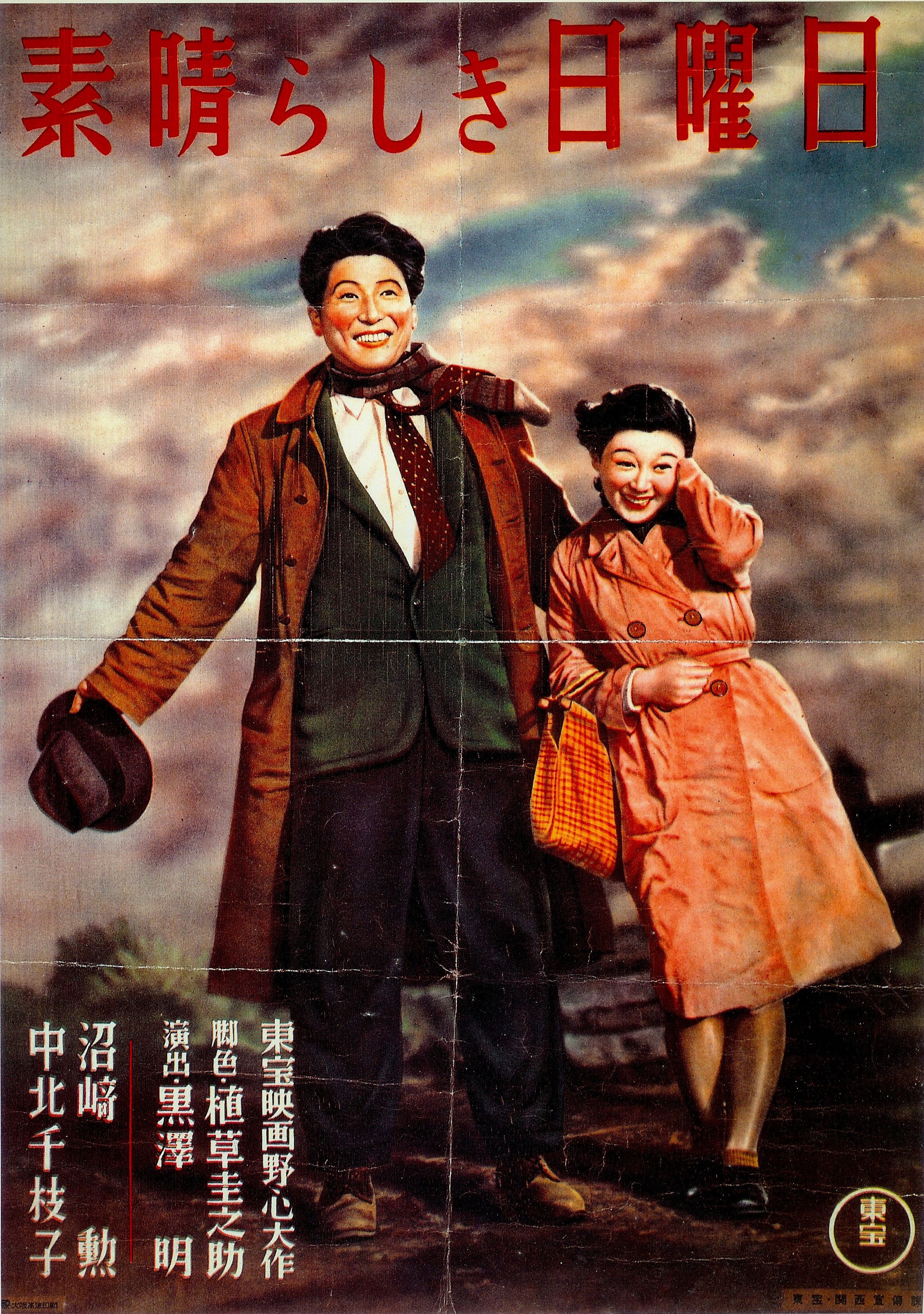
A young couple attempt to have a nice day out in Tokyo for only 35 yen but eventually discover something much more valuable in Akira Kurosawa’s surprisingly upbeat voyage through the backstreets of the post-war city, One Wonderful Sunday (素晴らしき日曜日, Subarashiki Nichiyobi). Though it may begin with frustration and progress to abject despair, the film allows its dejected heroes to find renewed hope for the future in the ashes of their defeat if only through the power of make-believe. 

Yuzo (Isao Numasaki) and Masako (Chieko Nakakita) are a young(ish) couple who’ve been together since before the war but are unable to marry because their precarious financial situation prevents them from finding a home in which they can live together. Though they are each in full employment, Masako currently lives with her sister and Yuzo with a friend. They can only spend Sundays together, but this particular Sunday Yuzo is fulled with frustration and resentment. He has only 15 yen, not much of a date as he tells Masako with irritation explaining that she’s had a wasted journey. She reveals that she has 20, but Yuzo has his male pride and is reluctant to take “a woman’s money” while internally humiliated not to be able to take her out on the town. Just before she had arrived, Yuzo had stared at an abandoned cigarette butt on the pavement. His desire soon overcame his shame. He picked it up and smoked it, only for Masako to bat it out of his hand as if insisting that he’s better than that. 

For her part, Masako is defiantly upbeat. Perhaps she’s putting on a brave face for Yuzo, but does her best to buoy his spirits so they can have a nice day together. It may be her only nice day all week. While she looks forward, he cannot move beyond the dissatisfying present. Masako begins by suggesting they check out a show home advertised on a billboard as a new kind of residence which is cheaper to build and available for only 100,000 yen for the first 100 buyers. She imagines how their life might be together in this space, while Yuzo merely sulks in the corner and points out the shoddiness of the build amid declining modern standards. It’s advertised as affordable, but they can’t afford it. Meanwhile, another man wanders in with a woman who is clearly his mistress. She exclaims that the place is a dump, “I hate matchbox houses”, while he agrees that it’s cheap for a reason and you get what you pay for. Presumably he already owns a home where his wife and family live and is about to drop a small fortune on a discreet love nest while his mistress, not unreasonably, attempts to haggle her way up to something a bit more fancy. Yuzo knows he won’t ever be able to afford even this “inexpensive” home that a wealthy man disdains as not worthy of his bit on the side. They’ve just come from seeing a crummy flat a few streets away which Masako asks directions to only to be put off by the doorman who warns them that the flat isn’t even really habitable and the landlord is heartless but they couldn’t afford that either even on the assumption they would both keep working (which depending on Masako’s job might not possible once she marries).

The landscape around them is in ruins. Yuzo and Masako wander through a bombed out city not yet ready for reconstruction looking for somewhere to stay out of the cold without eating into their 35 yen. He wants to give up and go home, but she convinces him to attend a concert of the music they heard on their first date before the war only when they get there all the cheaper tickets have been bought up by touts who sell them on at 50% markup. Beaten up for challenging the touts’ uncompromising cynicism, Yuzo hits rock bottom returning to his flat in a rundown tenement where a woman mopping the corridor gives Masako serious side eye. Frustrated, he tries to pressure her into premarital sex, her rock bottom coming a few minutes later when she firstly leaves in outrage and then returns as if admitting that their situation will never improve. 

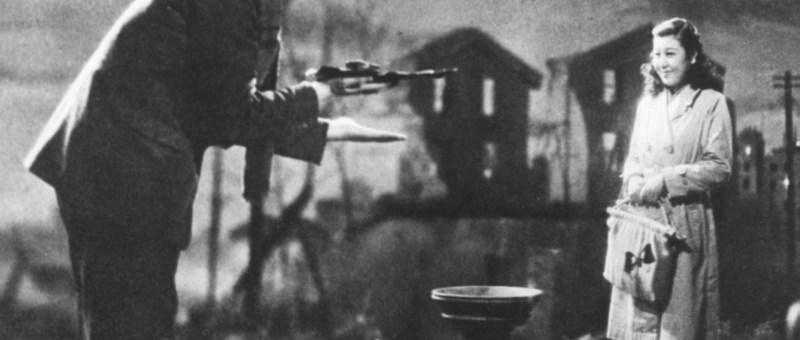
“The war destroyed that dream” Yuzo had said of Masako’s attempt to rekindle his hopes for the future in the plan they made to open a cafe together after they married, but the reality of their mutual defeat finally seems to inspire defiance in the face of the world’s hostility. On their journey through the city, they’d encountered a ragged street kid who thought them fools after they refused his offer of ten yen for one of their rice balls and simply gave it to him out of human kindness. Yuzo felt himself a fool after trying to visit an old friend who’s done well for himself with a swanky cabaret bar only to be rebuffed and see his own image reflected in a mirror with his threadbare overcoat and battered hat juxtaposed with the image of a fine young couple eyeing him with disdain and suspicion. In the end Masako can only appeal to us, breaking the fourth wall in a moment reminiscent of Peter Pan asking us to clap if we believe in fairies as she tries to revive Yuzo’s sense of naive possibility to conduct an unfinished symphony of their imagined life together in a happier future of post-war Japan. Refusing to give in to their baser instincts, to become cynical and selfish or else simply to give up, this wonderful Sunday does seem to have given them a childish sense of hope that better days are on their way and until then there’s always next week. 


One Wonderful Sunday screens at the BFI Southbank, London on 3rd & 15th January 2023 as part of the Kurosawa season.