The Lost World of Sinbad: Samurai Pirate (大盗賊, Senkichi Taniguchi, 1963)

Seemingly drawing influence from the series of Arabian fantasy films from Hollywood, Senkichi Taniguchi’s Lost World of Sinbad: Samurai Pirate (大盗賊, Dai Tozoku), sees the director reunite with Toshiro Mifune who had made his debut in the director’s Snow Trail which could not be more different from this crowd-pleasing adventure movie. The film is loosely based on the life of 16th century merchant Luzon Sukezaemon who eventually fled to Cambodia after all his possessions were seized by Hideyoshi Toyotomi and he was condemned on some trumped up charges.

The film’s opening scenes perhaps reflect this incident as Luzon (Toshiro Mifune) is branded a pirate and set to be burned at the stake, narrowly escaping after bribing an official with drugs. Resentful, Luzon decides he might as well become a pirate after all as he’s pretty sick of Japan and fancies seeking his fortune on the open seas only his ship is quickly destroyed in a storm and all his crew killed while the treasure he was carrying is seized by the fearsome Black Pirate (Makoto Sato). Washing up in a mysterious place aesthetically a mashup between South East Asia and the Middle East, Luzon is cared for by a hermit and then becomes embroiled in intrigue on finding out that the tyrannical king has been seizing local women in exchange for unpaid taxes and imprisoning them within his harem.

Luzon’s dreams are for riches and status so his sudden discovery of a love of justice is a bit of a surprise, but then he’s also most interested in the princess Yaya (Mie Hama) because he spotted one the necklaces from his treasure chest around her neck which suggests she might have a lead on the Black Pirate. Princess Yaya is engaged to a prince from the Ming kingdom which threatens a wider kind of geopolitical destabilisation should anything go wrong with this marriage which is a distinct possibility seeing as the corrupt Chancellor (Tadao Nakamaru) has been colluding with an evil witch to kill the king and seize the kingdom.

Rather than a pure pirate movie the film contains fantasy elements such as the presence of a Western-style castle which is clearly modelled on the one from Disney’s Snow White along with a weird hermit whose powers are weakened every time he sees an attractive woman. It is not, however, the kind of tokusatsu the English title bestowed by the US release implies as it contains no real monsters instead focussing its special effects on the magic used by the witch, who can turn people to stone with her eyes, and the hermit who can turn himself into a fly or disappear in a puff of blue smoke. Despite the prominent inclusion of SFX master Eiji Tsuburaya these effects are repeated several times are really the only ones featured in the film. 

In any case, what’s in play is famous merchant Luzon’s redemption arc in which he recovers the treasure but gives it back to the people, symbolically abandoning his dreams of wealth and status for something a little more community minded in vowing to sail the seven seas pursuing justice throughout the world. Having been a victim of authoritarianism in Japan, he rises up against tyranny abroad while teaming up with a group of local bandits and several times proudly proclaiming himself as Japanese though in a movie conceit everyone speaks his language including the Black Pirate who is later exposed as a snivelling fool tricked by the Chancellor on the promise of a chance to marry the Princess Yaya. Most of the derring do is reserved for the final sequence in which Luzon and the bandits storm the castle to defeat the evil chancellor but the screenplay also packs in genre elements such as trap doors and secret dungeons which keep Luzon busy as he does his best to overthrow an oppressive regime if only to put the rightful king back on the throne in the hope that might be better. Taniguchi certainly makes the most of his elaborate sets and costumes, creating a sense of tempered opulence along Middle-Eastern themes while adding a touch of the mythic in the attempt to weave a legend around the real life figure of Luzon Sukezaemon as a bandit revolutionary selling dreams of freedom on the sea as a pirate more interested in justice than money in otherwise corrupt society.


Beast Alley (けものみち, Eizo Sugawa, 1965)

In the opening title sequence of Eizo Sugawa’s Beast Alley (けものみち, Kemonomichi), a thick blob of inky blackness gradually expands over an aerial view of the city until it obscures it entirely. The title card which then appears is written in plain white, but will reappear at the film’s conclusion this time ashen as if it too had been singed by the deeply ironic flames with which the film ends. Based on a novel Seicho Matsumoto and scripted by The Beast Shall Die’s Yoshio Shirasaka, the film similarly takes an incredibly cynical view of the modern post-war society in which it is revealed the militarists are still basically in charge and presiding over a deeply corrupt social order. 

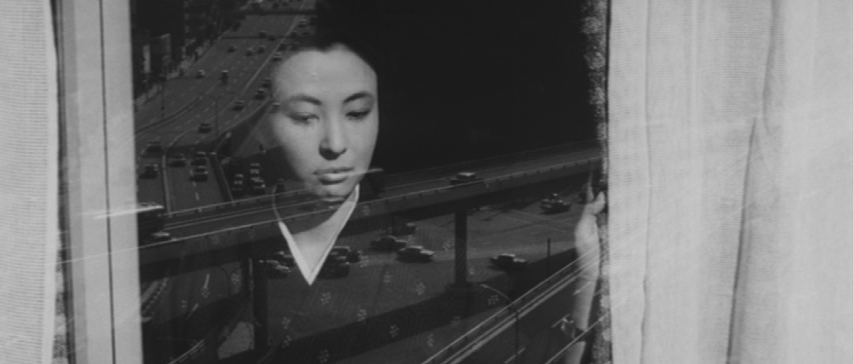
The big bad, Kito (Eitaro Ozawa), says as much when he states the need for reforming the nation’s “rotten political system” by which he means post-war democracy. Kito made his made his money doing deeply dodgy things in Manchuria in addition to running an exploitative coal mine in Japan. Now mainly bedridden, he basically runs the country as a far-right political fixer working in tandem with big business and the yakuza who have traditionally been big supporters of conservative and nationalist forces. Early on we see one of his underlings negotiating with politicians to ensure that Taiyo Roads will be hired be hired for a large scale construction project planning to put highways all the way through Tokyo. As we later discover, he’s prepared to go to great lengths in order to achieve his goal, going so far as to have a sex worker murdered to implicate the uncooperative CEO of a rival construction film into resigning by threatening to frame him for the crime so they can install their stooge in his position. 

It’s into this world that everywoman Tamiko (Junko Ikeuchi) is drawn while working as a hotel maid at a traditional Japanese inn. Trapped in a bad marriage to a man who is also bedridden yet still attempts to rape her when she returns home to find him in bed with the housekeeper, Tamiko longs for escape and is therefore ripe for the picking when approached by Kotaki (Ryo Ikebe), the manager of an upscale Western hotel, to join him in an unspecified enterprise which will apparently make her very rich. The only catch is that she will have to “get rid” of her “dependent”, which she probably wanted to do anyway, by burning down her house with him inside it. Once she’s done this, there is no turning back for her even if she had not developed complicated feelings for Kotaki who is both her salvation and damnation. 

Tamiko’s husband had failed to give her the comfortable life that he had promised, something which she thinks Kotaki can deliver even if it requires her to become the plaything of Kito whom does she actually seem to like even if aware of the precarity of her position and still in thrall to Kotaki. Leaving the hotel so abruptly was however a strategic error as it arouses the suspicious of (originally) earnest cop Hisatsune (Keiju Kobayashi) who quickly realises that Tamiko set the fire to kill her husband. Though he seemed to be motivated by justice, Hisatsune too is soon corrupted explaining to Tamiko that he has become cynical and jaded. Years of police work have shown him that true criminals know how to break the law and get away with it so he can’t do anything about them, but “good” people, like he implies Tamiko, are pushed into crime by desperation and are easily caught. Tamiko wields her sexuality against him by agreeing to a tryst, though when it doesn’t go to plan he tries blackmail and then rape before she, ironically, manages to escape from his bungled crime. 

Hisatsune’s corruption is gradual and self serving. He starts with suspicion, tailing Tamiko in the interests of justice but also because he desires her, before stumbling on the conspiracy, putting the pieces together, attempting to use them for his own gain and trying to blow a whistle mostly out of resentment. Kito’s reach is all encompassing. Hisatsune is warned off investigating certain aspects of the crime by his senior officers and is then fired on Kito’s instructions for fiddling his expenses after harassing Tamiko. He tries to give his findings to his boss but it goes nowhere and then tries the press but is given the brush off, the editor his reporter friend refers him to gently implying he’s just a crank with an axe to grind. Of course, it turns out that the reporter is already in league with dodgy lawyer Hatano (Yunosuke Ito) who is Kito’s right-hand man. 

The connections between the three men, Kotaki who was once a communist, Hatano, and Kito go back to Manchuria and the corruptions of militarist era which it becomes clear has never really ended. Kito has only one rival and it’s another faction of the conservative ruling party who are probably just waiting for him die. Attempts are made on his life and they don’t go well for those who make them. Even if Hatano hoped to simply inherit an empire he, as he points out, put in much of the work to build he is sorely mistaken while Tamiko may intellectually understand that Kito’s death would place her in a precarious position but carries on regardless. “You never know who will betray you in this world” Kotaki laments, echoing Kito’s later claim that his Buddhist statues are the only ones will never betray him even as sleeps next to a statue of Aizen Myo whom he ironically claims protects mankind from their lust and desire. 

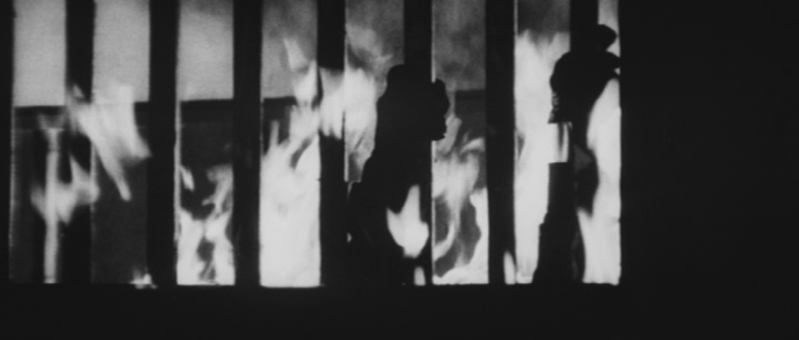
It could be said that desire is Tamiko’s undoing, but as Hisatsune had suggested perhaps you couldn’t blame her for longing to be free of the bedridden husband who had not delivered what he promised her. As she said, she was doing what could to survive even if you’d think she’d know putting on a ring taken from the finger of a murdered woman is akin sealing your own fate. Sugawa shoots with a noirish sense of dread, tracking Tamiko with her coat drawn up around her face as she tries to leave the scene of her crime, and makes the most of his fiery imagery before ending on a note of cynical laughter amid the inescapable hell the of post-war society. 


Original trailer (English subtitles)

Ironfinger (100発100中, Jun Fukuda, 1965)

Ironfinger posterBy 1965, Japan was back on the international map as the host of the last Olympics. The world was opening up, but the gleefully surreal universe of Toho spy movies isn’t convinced that’s an entirely good thing. Jun Fukuda had begun his career at Toho working on more “serious“ fare but throughout the 1960s began to lean towards comedy of the absurd, slapstick variety. 1965’s Ironfinger (100発100中, Hyappatsu Hyakuchu) boasts a script by Kihachi Okamoto – Okamoto might be best remembered for his artier pieces but even these are underpinned by his noticeably surreal sense of humour and Ironfinger is certainly filled with the director’s cheerful sense of cartoonish fun with its colourful smoke bombs, cigarette lighters filled with cyanide gas, and zany mid-air rescues. The English title is, obviously, a James Bond reference (the Japanese title is the relatively more typical “100 shots, 100 Kills”) and the film would also get a 1968 sequel which added the spytastic “Golden Eye” (though it would be given a more salacious title, Booted Babe, Busted Boss, for export). Strangely the unlikely villains this time around are the French as Tokyo finds itself at the centre of an international arms smuggling conspiracy unwittingly uncovered by a “bumbling vacationer”.

We first meet our hero as he’s writing a postcard to his mum in which he details his excitement in thinking that he’s made a friend of the nice Japanese man in the next seat seeing as he’s finally stopped ignoring him. When they land in Hong Kong, our guy keeps shadowing his “friend” until he decides to ask him about “Le Bois” to which his “friend” seems surprised but is gunned down by bike riding assassins before he can answer though he manages to get out the word “Tokyo” before breathing his last. Picking up his friend’s passport and swanky hat, our guy becomes “Andrew Hoshino” (Akira Takarada) – a “third generation Japanese Frenchman” and “possibly” a member of Interpol.

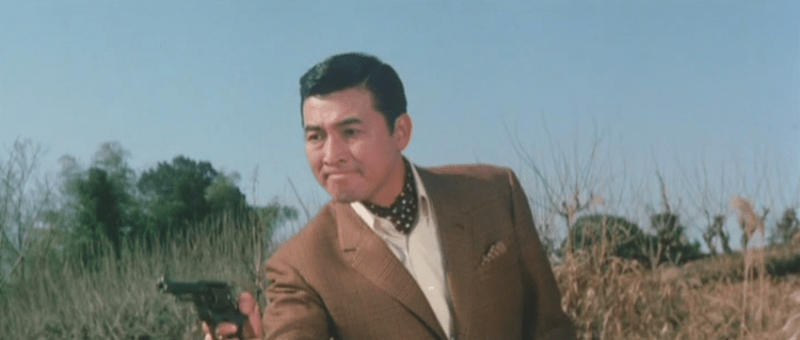
The bumbling “Andy”, who can’t stop talking about his mother and is very particular about his hat (for reasons which will become clear), is obviously not all he seems. Despite his penchant for pratfalls and cheeky dialogue, he also seems to be a crack shot with a pistol and have an ability to talk himself out of almost any situation – at least with the aid of his various spy gadgets including his beloved cigarette lighter and a knife concealed in his wristwatch for cutting himself free should he get tied up. Andy “said” he was just here on holiday, but are all those postcards really for his dear old mum waiting for him in Paris or could they have another purpose? Why is he so keen on finding out about “Le Bois” and why does he always seem to end up at the centre of the action?

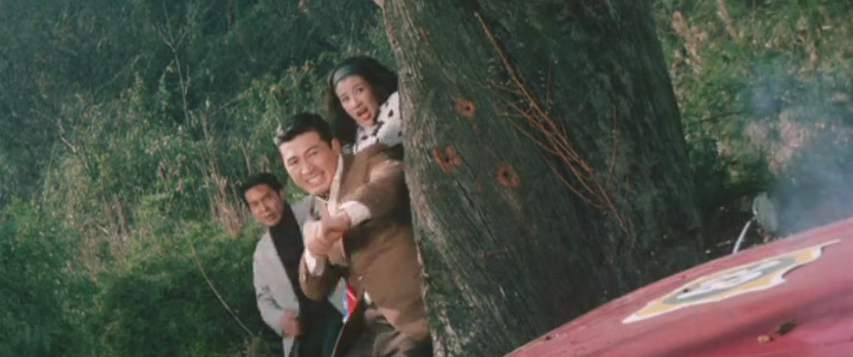
These are all questions which occur to one of his early antagonists – Yumi (Mie Hama), the ace explosives expert who often feels under-appreciated in the otherwise all male Akatsuki gang. Apprehending Andy, Yumi originally falls for his bumbling charm only to quickly see through his act and realise she might be better hedging her bets with him – hence she finally teams up with Andy and straight laced streetcop Tezuka (Ichiro Arishima) who’s been trying to keep a lid on the growing gang violence between the Aonuma who now run the town and the Akatsuki who want to regain control. Andy doesn’t much care about sides in a silly territorial dispute, but it might all prove helpful in his overall mission which is, it turns out, very much in keeping both with that of the gang-affiliated Yumi and law enforcement officer Tezuka.

There isn’t much substance in Ironfinger, but then there isn’t particularly intended to be. There is however a mild degree of international anxiety as our heroes become, in a sense, corrupted by French sophistication whilst “relying” on “Interpol” to solve all their problems (“Interpol” is frequent presence in Toho’s ‘60s spoofs providing a somewhat distant frontline defence against international spy conspiracies). Fukuda keeps things moving to mask the relative absence of plot as the guys get themselves into ever more extreme scrapes before facing certain death on a mysterious island only to save themselves through a series of silly boys own schemes to outwit their captors. Perhaps not as much fun or not quite as interesting as some of Toho’s other humorous ‘60s fare, Ironfinger is nevertheless a good old fashioned espionage comedy filled with zany humour and a cartoonish sense of the absurd.


Akira Takarada shows off his French