
Stranger (夜のストレンジャー 恐怖, Shunichi Nagasaki, 1991)

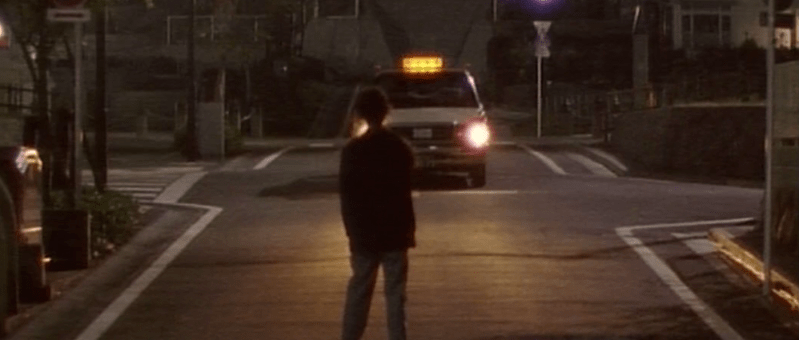
Driving through the city by night, a young woman finds herself plagued by a mysterious force while struggling to break out of her self-imposed inertia in Shunichi Nagasaki’s moody thriller, Stranger (夜のストレンジャー 恐怖). The film’s Japanese title, “night stranger terror”, perhaps more clearly hints at a sense of urban threat while surrounded by so many unfamiliar people, yet it is in many ways Kiriko’s (Yuko Natori) mistrust and suspicion that isolates her from the surrounding society and keeps her trapped in a kind of limbo unable to escape her past.

It might be tempting to read her aloofness as a direct consequence of her experiences, but in an early scene when she was still a bank employee we hear a colleague criticise her for being “anti-social” while Kiriko’s rejection of her seems born more of contempt than shyness or a preference for solitude. Working as a cashier at the bank at the tail end of the bubble is a pretty good job, especially given the still prevailing sexism of the working environment, that positions Kiriko firmly within an aspirant middle-class. She still lives at home surrounded by her family, but is in a relationship with a man who pressures her for money to invest in the stock market. She begins embezzling and lives as if there’s no tomorrow, splashing out on fancy sunglasses before meeting her boyfriend having left work early feigning illness. Unfortunately for her, she gets caught and her boyfriend predictably abandons her.

Just like the asset bubble, her life implodes and plunges her into a lower social stratum as a woman with a criminal conviction for financial impropriety and a hefty debt in needing to pay back the money she stole from the bank for her ex’s harebrained stock speculation schemes. All in all, you could say she’s been betrayed by economic forces, but also as she later admits, but her own uncertain desires in being wilfully deceived by Akiyama (Takashi Naito) and making a clear choice to defraud the bank. She realises that it might not have been a desire to please Akiyama that led her to do it, but the illicit thrill she felt in tapping away on her keyboard stealing the money and otherwise being in a position of economic power over a man, buying him things and taking him out for fancy food. Her sense of malaise is only deepened when she meets Akiyama by chance and tries to tell him all this, but he isn’t really interested. He seems to have moved on and planning to marry another woman. 

Kiriko tries to look at his hands to see if he has burn scars like the man who attacked her in her taxi, but he doesn’t. Perhaps there was a small part of her that wanted it to be him. At least if it was, it would mean he still felt something for her, which would also prove that he ever did. And it would make sense, which is less frightening than her stalker just being a nutty fare, another irate man with a nondescript grudge wandering the city. Taxi driver is one of the few jobs open to her with a criminal record, but it’s also an unusual profession for a woman which further isolates her in her working environment. Her boss keeps calling her “little lady,” while patronisingly offering to put her on the day shift because it’s less dangerous. Kijima (Kentaro Shimizu), an obnoxious colleague, picks at Kiriko for thinking everyone who strikes up a conversation must be sexually interested in her. But the truth is that they are and like Kijima demand her attention. When they don’t get it they’re pissed off. The cab is perhaps the place she feels the most safe, though she faces her fair share of weird fares from drunk men trying to flirt to religious maniacs proselytising from the back seat. 

Now living alone in an apartment, her aloofness is both a personal preference and means of punishing herself. When her brother calls, he encourages her to come home but she says she can’t even though she wants to because she hasn’t yet dealt with her past or taken steps towards being able to forgive herself. She tells Kijima, who in truth behaves in an incredibly creepy way that suggests she’s right to avoid him, that she wonders if she isn’t the only one who can see the mysterious Land Cruiser, as if she were really imagining it. The Land Cruiser does indeed come to stand in for the buried past by which Kiriko is haunted and her eventual besting of it is a symbolic act that suggests she’s finally managed to overcome her guilt and shame to be able to leave the past behind.

As she told Kijima, this was something only she could do by her own hand or none. Akiyama’s dismissiveness of her reflects the fact that he couldn’t give her this absolution either, she needed to find it for herself. Kijima accused her of still being hung up on the guy that scammed her, but that wasn’t quite it. The resolution might hint at his being right when he told her that she needed to learn to trust people more in that it seems to lead to a greater willingness to open herself up to the world. Once again, her sunglasses get broken as a new truth becomes visible to her. A lonely little boy she meets who, like her, enjoys driving in circles and going nowhere, probes her lack of human connection by suggesting that she doesn’t know what it’s like to love someone which is why she can’t understand his obviously inappropriate love for her, though it’s a fact that Kiriko has to acknowledge is truth in interrogating the reality of her relationship with Akiyama.

Nevertheless, in the end, she saves herself and embraces her solitude and independence looking out at the peaceful bay in a city that no longer seems so threatening even if the unseen threat in this case did turn out to be random and have no rational explanation. Nagasaki never again worked in the realms of V-Cinema and his entry is fairly atypical in starring an older, established actress as an action lead while requiring no nudity or sexual content, instead quite literally allowing her to grab the wheel and take control of her life to claim freedom and independence rather than solely romantic fulfilment.
The Island of Cats (ねことじいちゃん, Mitsuaki Iwago, 2019)

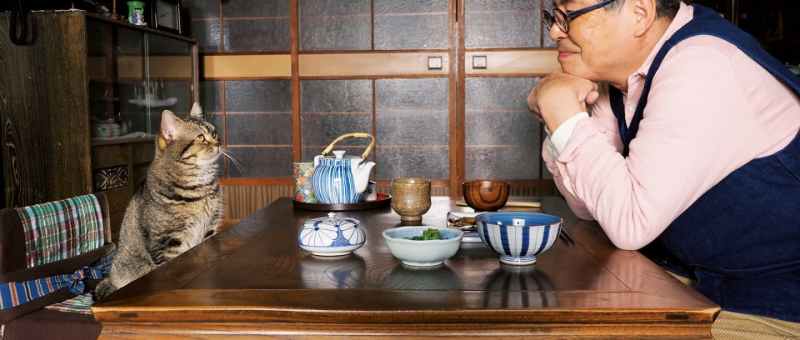
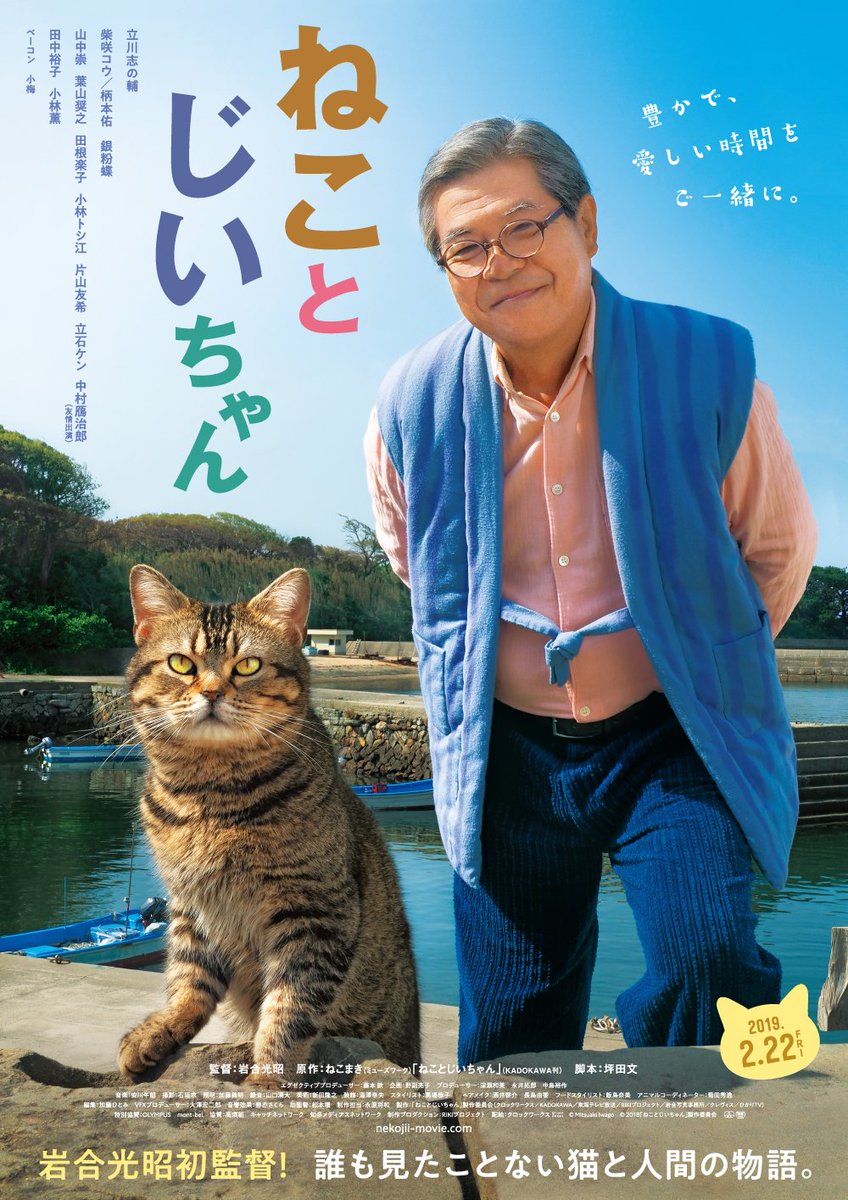
Island of Cats Poster“The best is yet to come” resolves 70-year-old Daikichi (Shinosuke Tatekawa) at the conclusion of The Island of Cats (ねことじいちゃん, Neko to Jiichan). Inspired by the manga by the appropriately named Nekomaki, the debut feature from wildlife photographer Mitsuaki Iwago is a decidedly laidback affair, neatly fusing two genres of Japanese comfort cinema – cats and cuisine. It’s also another in the recent run of films deliberately targeting the older generation in its quiet celebration of community and late life serenity, but it’s very existence is also perhaps a mild dig at cold and frenetic Tokyo which can’t help but pale next to the island’s inherent charms.

Daikichi has lived alone with his cat, Tama (who neatly introduces himself using the exalted “Wagahai” in a reference to Soseki’s famous novel), since his wife Yoshie (Yuko Tanaka) passed away two years previously. He has a grown-up son (Takashi Yamanaka) who is married with a teenage daughter of his own in Tokyo, but mostly spends his life hanging out with his old friends and playing with the island’s many cats. His peaceful days begin to change, however, when a pretty middle-aged (“young” to Daikichi and his friends) woman, Michiko (Kou Shibasaki), arrives from Tokyo and opens a cafe – the island’s first. In fact, the older generation find the cafe slightly intimidating, thinking such modern innovations are only for the youngsters, but are finally tempted in when directly invited by Michiko herself who serves up a selection of cream sodas and tasty ice creams in addition to slightly more rarefied treats like fish carpaccio.

In contrast to many an island drama, though the bulk of the population is older there are a fair few youngsters around and plenty of children too – at least enough to keep the local school open and the ferries running frequently. It is true however that most leave when they come of age either heading off to university on the mainland or seeking their fortunes in the cities. Nevertheless, the despite the absence of family the elderly are well cared for by the recently arrived young doctor (Tasuku Emoto) who takes his responsibility extremely seriously and is grateful for the opportunity to come to the island because it’s enabled him to become the kind of doctor he always wanted to be.

Michiko, meanwhile, has come to the island in search of relief from city life which she felt was gradually crushing her. An instant hit with the local cats as well as Daikichi and his friends, her presence adds a new energy to the island as the older generation start to enjoy both trying new things they thought perhaps were “inappropriate” when you’re old, and revisiting those they missed out on in their youth. Friends reconnect, bickering is exposed as an odd kind of affection, and cats just generally make everything better. The island may be dull compared to the bright lights of Tokyo, but it has its charms and those that live there are one big family taking care of each other and enjoying the laidback rhythms of coastal life.

Daikichi’s son, visiting when he can, is keen for him to come and live with the family in Tokyo but he and Tama are happy enough on the island just muddling through the way they always have surrounded by friends and happy memories. Reconnecting with his late wife through the recipe book she left behind, he resolves to learn a few dishes of his own – filling the rest of the pages with recipes learned from Michiko, his friends, newspapers and TV, determined to go on learning as long as he can. Sharing his life with others on the island, Daikichi too finds a new zest for living even as his days pass much as before, resolving that there is still plenty more to enjoy as he enters his twilight years. Gentle and mellow in the extreme, The Island of Cats is not promising much more than living up to its name but does its best to sell the charms of serene island life as Daikichi and his friends rejoice in the simple pleasures of shared cuisine and admiring “everybody’s” cats as they continue to do pretty much whatever they please while warming the hearts of the kindly islanders as they enjoy their days of fun and sunshine with nary a care in the world.


The Island of Cats screens in New York on July 20 as part of Japan Cuts 2019. It will also screen in Montreal as part of the 2019 Fantasia International Film Festival on July 28.

Original trailer (English subtitles)

The Black House (黒い家, Yoshimitsu Morita, 1999)

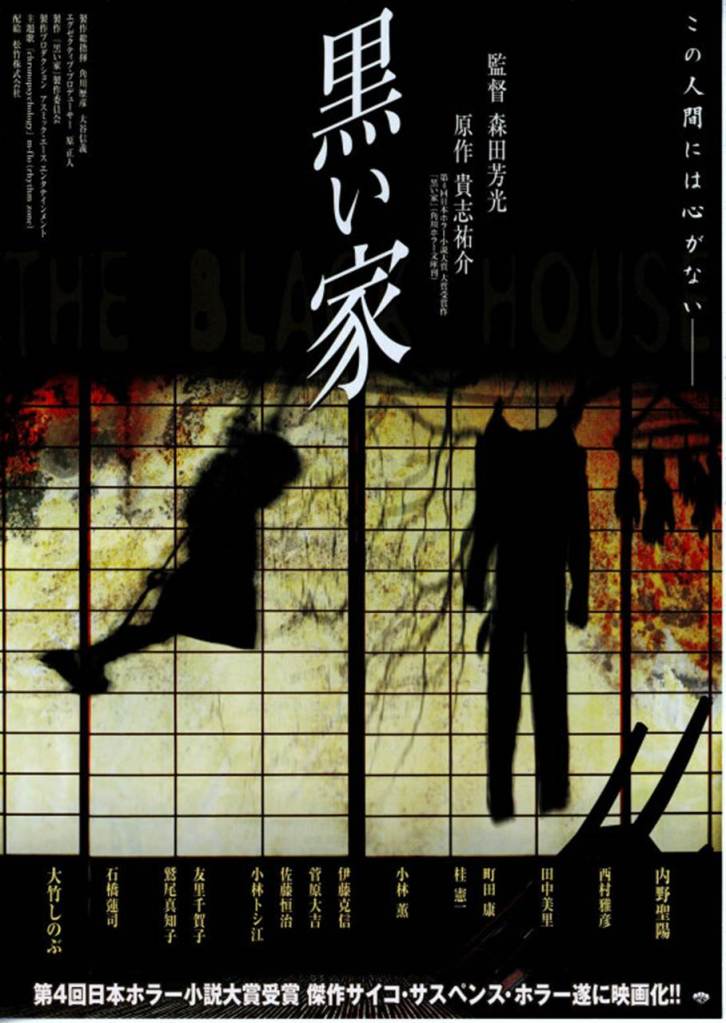
black house posterYoshimitsu Morita, though committed to commercial filmmaking, also enjoyed trying on different kinds of directorial hats from from purveyor of smart social satires to teen idol movies, high art literary adaptations and just about everything else in-between. It’s no surprise then that at the height of the J-horror boom, he too got in on the action with an adaptation of Yusuke Kishi’s novel of the same name, The Black House (黒い家, Kuroi Ie). Though tagged as “J-horror” you’ll find no long haired ghosts here and, in fact, barely anything supernatural as the true horror on show is the slow descent into madness taking place inside the protagonist’s mind.

Wakatsuki (Masaaki Uchino) is a nice young man with a good job investigating claims at an insurance office. Unfortunately, this gives him a slightly dim view of humanity as he comes into contact with scamsters and even people willing to maim themselves just so that they can claim on their policies. One day, he receives a strange phone call from a woman who wants to know if her insurance policy will pay out in case of suicide. Wakatsuki, slightly panicked, tells her that it really depends on the circumstances and, jumping to the conclusion she plans to kill herself, urges her to get help and talk things over with someone before doing anything rash.

The next thing he knows, Wakatsuki is despatched to her house to sort things out whereupon he makes an extremely gruesome discovery – the woman’s son, though only a child, has hanged himself in the back room. Obviously extremely shocked and distressed, Wakatsuki heads home with the nagging suspicion that Sachiko (Shinobu Ootake) and her husband Komoda (Masahiko Nishimura) have done something truly dreadful. The couple take turns coming into the office to find out what’s taking so long with their claim and gradually the situation begins to spiral desperately out of control.

Always one for irony,  Morita’s tone varies widely here. There’s an oddly Twin Peaks-like vibe with the jolly jazz score giving way to synths at moments of high tension, not to mention the run down industrial town setting. If that weren’t enough Lynchery, there’s even a moment where a severed hand is found in a patch of grass, crawling with ants just like the ear found by Jeffrey at the beginning of Blue Velvet. Morita seems to be telling us not to take any of this too seriously yet his subjects include parents harming or even murdering their children to claim on an insurance policy as well as bloody violence and dismemberment of corpses.

In fact, the insurance guys don’t spend too long trying to figure out if the boy actually killed himself but Wakatsuki becomes preoccupied by the idea the husband, Komoda, is behind the whole thing (the boy was only his step-son after all) and will now try and kill his wife to claim her insurance too. The couple are certainly both very strange people and the insurance company also have a problem as the policy was signed off on during a campaign drive in which a now dismissed employee made use of a personal connection to try and meet her unrealistic quota. Wakatsuki eventually engages an equally eccentric psychology professor who takes him out on a weird nighttime odyssey to a seedy strip club where he expounds on a epidemic of psychopathy among the younger generation. Even Wakatsuki’s girlfriend, Megumi, has some off the wall ideas based on an essay Sachiko wrote in elementary school (though actually Megumi’s view has some merit).

Things hit a more conventional note from this point on landing us with a familiar slasher villain who begins stalking Wakatsuki, even trashing his apartment before kidnapping his girlfriend and keeping her prisoner in the “Black House”. Wakatsuki heads to the den of evil by himself in the dark (in true horror movie fashion) where he finds a whole bunch of other dismembered corpses (and a few other surprises). He might think he can put his troubles behind him after this extremely traumatic incident, but this is still a horror movie so the killer gets away to strike again by throwing a bright yellow bowling ball at his head through the office toilet window.

Morita is not being serious at all, even for a second, but somehow he still manages to create an oddly threatening atmosphere of suspense despite the extremely weird things which are going on. He creates a complex set of visual cues from the recurring sunflower motif repeated on Sachiko’s shirt to the glistening yellow bowling ball, goldfish (in a toilet bowl if not a percolator), repeated sounds of cockroaches and old fashioned reel printers, and even the green glow from both old fashioned computer systems and the company’s insurance documents. Undoubtedly bizarre, The Black House is mind bending psychological-horror-movie-cum-Freudian-slasher that is primed for both head scratching puzzlement and confused chuckling as Morita has a lot of fun messing with our senses.