The Black Tavern (黑店, Teddy Yip Wing-Cho, 1972)

One of the reasons that martial arts films are so popular is that it’s often easy to tell who is good and who is bad. In general, the just hero vanquishes the source of evil and corruption, thereby restoring a sense of moral order to a world that may in other ways be chaotic. But chaotic is probably the best way to describe the world of The Black Tavern (黑店) in which the titular inn becomes a nexus of greed and villainy where it is impossible to tell who, if anyone, is good, while almost everyone is actually bad and the heroine only really intervenes in the closing scenes.

One way you can tell that something is very rotten at the Gao Family Inn is that the cook suddenly emerges from a pit underground carrying someone’s leg, which he then chops up and uses to make buns. No one ever mentions this again. It’s a just symbol of how corrupt and hellish this world has become. The inn is apparently the only staging post on this route, which is presumably how they continue to get custom despite bumping off their guests, taking all their stuff, and then chopping them up to put in buns to serve to the next unfortunate person who arrives in search of a bed for the night. 

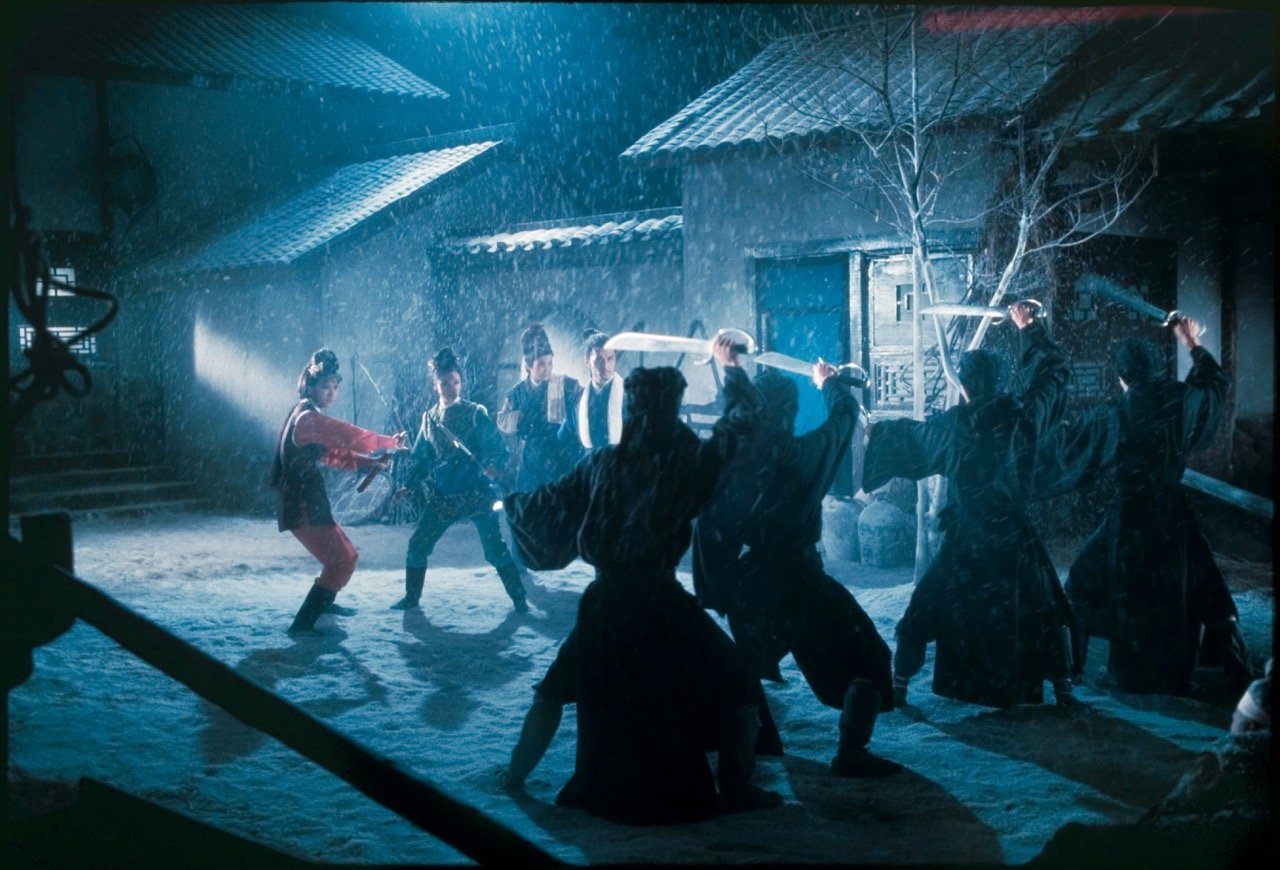
But the reason so many venal bandits are drawn here is that a beggar monk (Dean Shek) tells them he saw vast riches fall out of a chest belonging to Hai Gangfeng, a former official returning to his home province with all his ill-gotten gains from accepting bribes. Assuming Gangfeng will be stopping at the inn, everyone who heard the monk is on their way there. Only, as it turns out, the man we thought was Hai Gangfeng is actually a bandit, “Whipmaster” Zheng Shoushan (Ku Feng), who cunningly pretended to be him to take over the inn and wait for the real Gangfeng’s arrival. He does not, however, seem to have anticipated so many other bandit gangs each more outlandish than the last having the same idea.

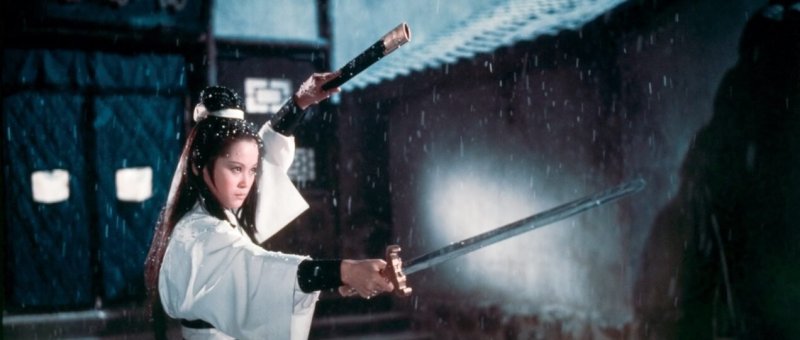
One turns up with a band of hopping vampires who turn out to be crooks in disguise, while another is wearing a horned helmet that gets stuck in things when he’s trying to fight. Of course, they’re all trying to kill each other so they can be the ones in control when Gangfeng finally arrives. What they don’t realise is that the whole thing’s a honeytrap designed to lure them all to the inn for just this purpose, so that they’ll all kill each other and spare the forces of justice some trouble. Those would be Zhang Caibing (Shih Szu), a disciple of the Lady Hermit making this a kind of extended universe film of the Cheng Pei-Pei classic. Continuing her mentor’s mission, she’s out to skim off the “scum of the martial arts world,” explaining to Shoushan that if he doesn’t like it, he should have thought of that before committing so many “evil deeds”. 

On the other hand, Caibing does seem to be enjoying this quite a lot so perhaps she’s not quite so entitled to the moral high ground as she’d like to think. While taking a leaf out of King Hu’s book, Yip adds an edge of slapstick absurdity in setting up elaborate action sequences with well-deserved pay offs and indulging in goreless yet extreme kills such as a series of surprise decapitations. Shoushan’s bladed whip becomes a versatile weapon but also an extension of his character in his cowardliness and lack of morality. It’s only really any good at long range, which means that he keeps his opponents at arms’ length rather than confront them directly as in the typical tests of skill that define a martial arts battle. He coils it around their necks, snake-like, then either pops their heads off or strangles them to death. Just like the innkeeper he killed off at the start, he seems to have genuine affection for his female companions but eventually meets a similar fate as his trademark whip is ironically turned against him. 

There’s also a genuine, if underplayed, sense of ambiguity in the attraction between the mysterious swordsman (Tung Li ) and Shoushan’s daughter that prevents him from killing her while suggesting that he too was on some level attracted to banditry. Even if he rides off in the end with Caibing, it does not appear that their relationship is romantic. Nor is he allowed to claim victory by swooping in when all seemed lost for Caibing during the final fight, immediately encountering difficulty with Shoushan who puts up a good fight that again seems contrary to his moral character in the amount of skill and effort needed to beat him. Indeed, it often seems as if he will win after all. This world will fall to men like him and turn into one giant Black Tavern. In the end, it’s a team effort that takes him down, including the strange intrusion of the beggar monk who was after all the person who started all this by repeating the rumour in the last rest stop and may or may not actually be working with Caibing. In any case, the incredibly fast-paced action sequences and the dark humour that accompanies them lend the film an epic quality despite its tight duration along with an ironic kind of cynicism that insists this world is simply too silly to be evil but that the scum of the martial arts world will pay all the same.


The Black Tavern screened as part of this year’s Focus Hong Kong.

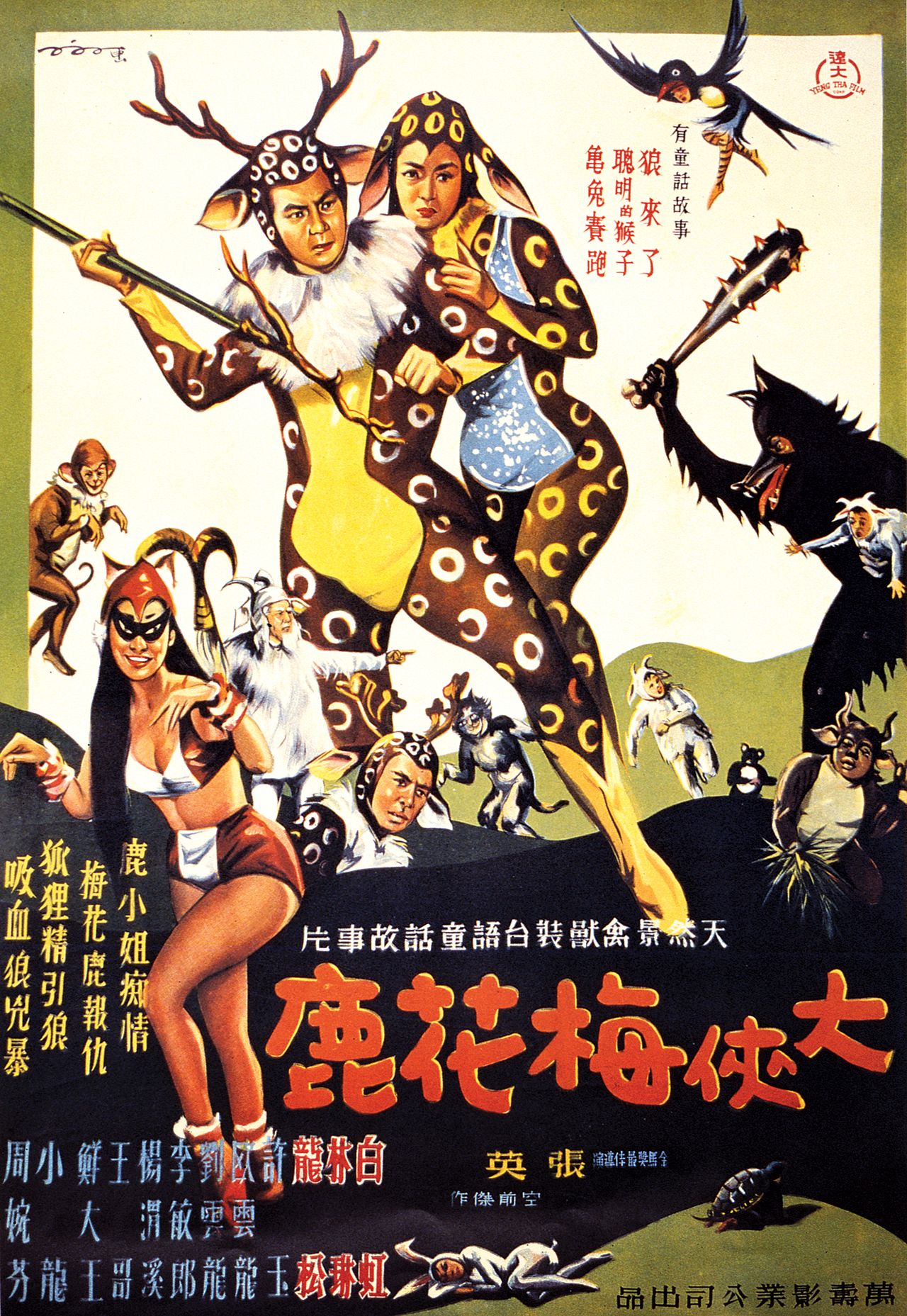
The Fantasy of Deer Warrior (大俠梅花鹿, Chang Ying, 1961)

A fearless warrior’s solipsistic priorities and obsession with male pride begin to endanger his community in Chang Ying’s incredibly bizarre Taiwanese-language forest fable, The Fantasy of Deer Warrior (大俠梅花鹿). Seemingly aimed at children with its series of moral messages and anthropomorphised animal characters, Chang’s drama is surprisingly violent not to mention a little on the raunchy side for a family film while ending on a note entirely at odds with the prevailing wisdom of children’s cinema as the righteous hero takes bloody revenge on his bound and defenceless enemies but is nevertheless embraced by his innocent love interest for having brought “justice” back to the forest. 

Opening with a surreal scene of children in animal outfits dancing to jingle bells in the middle of the forest, the cheerful atmosphere is soon disrupted by an incursion of “wolves” carrying nailed bats. An emissary is dispatched to fetch “Sika Deer” (Ling Yun), the forest’s most fearsome warrior, but he is busy having fight with love rival Elk (Li Min-Lang) over the beautiful “Miss Deer” (Pai Hung) who according to the mischievous Foxy (Lin Lin) has been kind of dating both of them. Foxy is incredibly jealous of Miss Deer and stirs the pot by suggesting that Elk and Sika Deer continue in a formal duel with the winner taking Miss Deer’s heart. Shockingly this is what they do and Sika Deer wins only to be immediately called away to the wolf attack, discover his father is already dead, and decide the best thing to do is not see Miss Deer again until he’s finished avenging his father’s death by killing Bloody Wolf. 

As you can see, Sika Deer has his priorities all wrong. First of all, he was off pointlessly fighting Elk while his family were eaten by wolves, then he decides to take the manly path by leaving Miss Deer alone and vulnerable not to mention his community largely defenceless. Later he does something similar when Miss Deer is kidnapped, stopping to lock horns with his love rival rather than devoting all their resources to tracking Bloody Wolf and saving Miss Deer. He does belatedly think to send her a letter explaining he’s busy with important revenge business and will call her later which foils Foxy’s plan to convince her he’s dead so she’ll date Elk instead (unclear why she wants this) but the fact remains that he basically just abandons everyone to selfishly pursue his own revenge ironically leaving the village vulnerable to attack.

Despite this and being absent for most of the picture, Sika Deer is still held up as the hero even when he marches Bloody Woolf and minion to his father’s grave and executes them with surprising violence while they are bound and gagged. Where most children’s films would end with some kind of forgiveness, a restoration of the forest’s harmony brokered by the hero’s magnanimity which in itself causes the villains to reform, Deer Warrior ends with quite the reverse which would seem to run contrary to most of the other moral messages presented throughout the film. 

Then again, “There is no justice in this world” Miss Deer is told on appealing first to a tree and then an elderly buffalo for a moral judgement on whether or not the wolf should be allowed to eat her even though she saved his life. As the tree points out, people took shelter under him but then they cut him down for firewood, while the buffalo complains that he’s been exploited all his life but as soon as he’s too old to work he’ll be killed and eaten. Miss Deer’s moral conundrum is as to whether a kindness ought to be repaid, convinced that Bloody Wolf is in the wrong for wanting to eat her and should let her go to repay the kindness of her saving his life. But Bloody Woolf is a wolf which is to say a creature without morals the only surprising thing being that he patiently waits while she makes all her petitions rather than just eating her as he pleases. Even so, the film seems to say not so much that Miss Deer is at fault for her innocent naivety in having trusted a wolf, but the world itself is wrong because one should never suffer for having been kind to another for kindness should always be repaid. 

Mildly critical as it is of an increasingly selfish society in which justice has become a casualty of increasing economic prosperity, Fantasy of Deer Warrior nevertheless ends on an uncomfortable note with the hero essentially delivering justice as vengeance. Meanwhile it’s also clear that prior to the arrival of the wolves which could perhaps be read either as a metaphor for Mainland China or indeed the KMT government threatening the natural harmony of the native Taiwanese society as represented by Sika Deer, the forest was not altogether harmonious before as evidenced by the rivalries between Miss Deer and Foxy and Elk and Sika Deer. These divides perhaps hint at a wounded unity, suggesting that the Taiwanese people are ill-equipped to defend themselves against external threat while preoccupied with petty disputes and personal concerns. 

Such messages are most likely above the heads of the target audience but then again, the film is curiously transgressive including several scenes of Foxy living up to her name, performing sexy dances and off “having fun” with Bloody Woolf in the forest while at one point talking Elk into attempting to rape Miss Deer to force her to marry him which whichever way you look at it is fantastically dark for a children’s film even if the metaphorical quality of the wolf as representing animalistic lust is still very much present in his determination to “eat” Miss Deer. To that extent it is also transgressive sexual energy which destabilises forest society in Foxy’s resentment of Miss Deer even if her implication that she’s been two-timing Elk and Sika Deer undercuts her otherwise innocent and pure nature which is in such contrast with Foxy’s chaotic and classically tricksy personality. 

Perhaps more of an ironic take on a kids film aimed at jaded adults, Fantasy of Deer Warrior is undeniably bizarre starring actors dressed in onesies mimicking their animal characters, deer with antlers on their heads fighting with antler staffs, and bird messengers hanging from obvious wires flapping their arms to mimic flight. Adopting the style of a classic fairytale, Chang incorporates several of Aesop’s fables such as a musical number themed around a strangely militarised tortoise and a cocky rabbit, or a literal instance of a boy crying wolf and never having the opportunity to learn his lesson. Yet the kind of justice with which the film concludes is disquieting suggesting perhaps that all is not so well in the forest after all. 


Remaster trailer (Traditional Chinese / English subtitles)