Kitty the Killer (อีหนูอันตราย, Lee Thongkham, 2023)

“You might be the stupidest killer I ever met” an ice cool assassin says of the bumbling hero at the centre of Lee Thongkham’s comic book action comedy Kitty the Killer (อีหนูอันตราย). She might indeed have a point, though as Charlie (Denkhun Ngamnet) points out killing is not strictly part of his job description which is more akin to a baby sitter for the “high school girl from hell” under his care, Dina (Ploypailin Thangprapaporn). In part a story of self-transformation, the film ironically plays with a series of genre tropes while providing a point of origin for an ongoing universe. 

As the film opens, Charlie is a feckless young man who can’t seem to get it together and is struggling to make a mark in his job as an “accounts manager” where he is semi-aware that everyone thinks of him as a bit useless. He muses on the difficulties of changing the way that others see him, but never quite takes the first step towards realising that what he needs to change is himself. Nevertheless, his life is changed for him when he runs into top assassin Grey Wolf shortly after The Agency tried to off him when he told them he wanted out of the game. Fearing he’s not long to live, Grey Wolf hands Charlie his trademark ring and tells him that he’s taken out a contract on his mum so if he doesn’t manage to rescue his associate Dina his whole family will be killed. 

Dragged into a world of assassins and conspiracy, Charlie has little option than to rise to the occasion shaking off his boring office boy persona to become a stylish handler perfectly equipped to face off against vicious killers as the gang chase vengeance for Grey Wolf and battle another faction of their own organisation which has apparently cut a deal with the Japanese which is why they all wear masks and carry katana. Lee Thongkham plays with a kind of re-imported orientalism in clear references to Kill Bill, even echoing a famous line in the film when assassin Nina the Faceless says to Charlie, “silly boy like you likes to play with swords.”

The line also hints at the subversion of traditional roles in play as Charlie becomes a male intruder in what in an otherwise a female space. Known as “Kitties” all the assassins are female though aside from villainess Violent all the handlers are men who are otherwise placed in a paternal role yet sidelined as nannies to the super-powered killers over whom they have almost total control. As Violet says, The Agency also has its rules and they are nothing if they do not obey. Charlie is to a degree raised by the four assassins under boss Makin (Vithaya Pansringarm) who train him to become to a capable handler allowing him to transform himself as he said he wanted to do in his opening voiceover while his mother otherwise pampers him at home. 

Nevertheless, the film also sympathises with the constrained lives of the Kitties who are told to have no emotions and that they must eliminate anyone who gets too close to them or witnesses them going about their business. As one of Dina’s “sisters” Tina remarks, she’s “just tired” of her emotionless life and lack of freedom, while Nina who already turned to the dark side tries to seduce them with false promises of greater autonomy under female boss Violet if simultaneously telling them they’d have to kill their friends and “family” in order to win it. In any case, it’s the sense of solidarity between the Kitties and the deeper than expected bond with their handlers that becomes the best weapon against Violet’s hostile take over of The Agency. Well, that and a magic stone that has the power to grant immortality, anyway. Filled with a good deal of deliberately silly dialogue and zany humour, the film also features a number of innovatively choreographed action sequences along with elaborate production design and the occasional use of onscreen graphics and animation. The depth of the world building hints at the potential for an ongoing series with a post-credits epilogue teasing a sequel offering further intrigue for the Kitties and their distinctly goofy handler in an expanding comic universe of retro charm. 


Kitty the Killer screened as part of this year’s New York Asian Film Festival

Original trailer (English subtitles)

Paradox (殺破狼・貪狼, Wilson Yip, 2017)

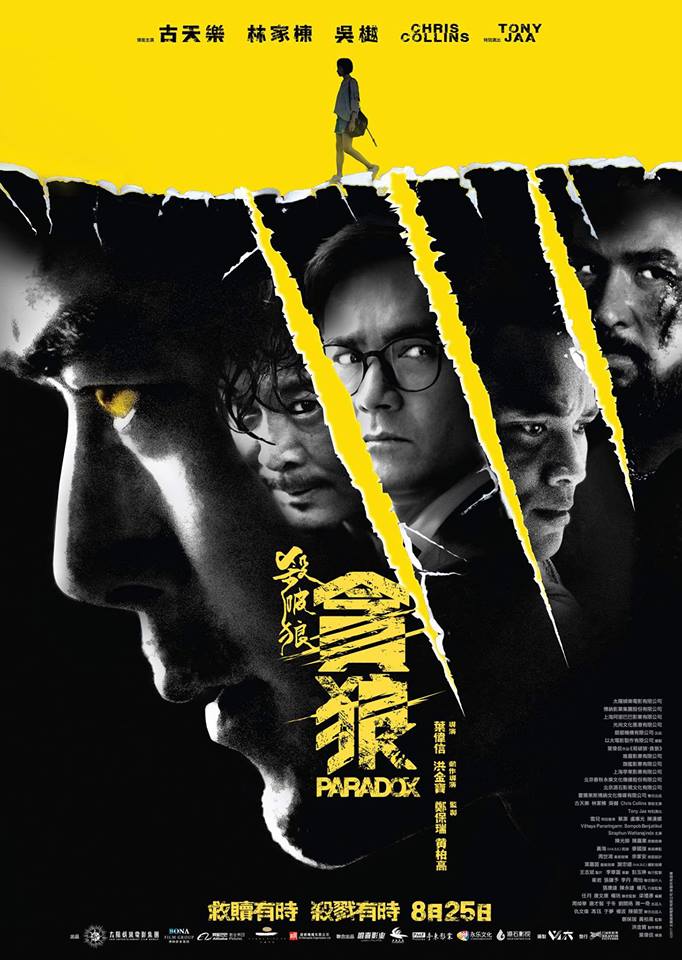
paradox posterLouis Koo, possibly the hardest working actor in Hong Kong, has played his fair share of heroic (and not so heroic) cops but you’d be hard pushed to describe him as an action star. Proving nothing if not his dedication, Koo gives it his all as the lead in Paradox (殺破狼・貪狼), the latest in the SPL franchise directed by Ip Man’s Wilson Yip. Yip also directed the first in the series but stepped away for the second, though there is no narrative continuity with any of the films and, confusingly enough, the SPL tag seems to have been dropped from the international title altogether. In any case, what Paradox shares with instalments one and two is a series of intensely kinetic action scenes built around a storm of three incompatible personality types coupled with a quest narrative as Koo searches for clues in the disappearance of his 16 year old daughter.

Yip begins the film inside the memories of Hong Kong cop Lee Chung-Chi (Louis Koo) as he remembers the golden time when his daughter was young and worshipped her dad, crawling into his bed in the morning with a video camera ready for a whole day of birthday fun. Lee buys a cute a silver bracelet with a teddy bear charm but it’s the 16 year old Wing-Chi (Hanna Chan) he gives it to. Lee and his daughter are in a restaurant, not at home, and the air between them is tense. A boy turns up and Wing-Chi introduces him as her boyfriend but if Lee is annoyed things are about to get worse. The pair want to get married because Wing-Chi wants “to keep the baby”. Lee barely reacts save for abruptly stepping away from the table. When he returns he seems as if he’s composed himself, but in reality he has already made a catastrophic error of judgement which will force his daughter away from him.

Wing-Chi goes to Thailand to visit a friend and disappears. Lee goes to look for her, breaking out his best investigator skills and teaming up with local cop Chui Kit (Wu Yue) who is soon to be a father himself, but what he finds there leads him onto a dark path of paternal guilt, regret, and suffering whilst wading through the corruption and cruelty of the Thai underworld.

Though the narrative is, in a sense, unimportant, Yip homes in on the nature of fatherhood and the sometimes difficult or conflicted position a father finds himself in when trying to protect his child. Lee may think he’s “doing the right thing” when he clamps down on his teenage daughter’s plans to start a family of her own way ahead of schedule, but then again perhaps this was not his decision to make and ruining three lives to suit himself is nothing more than selfishness masquerading as love. It is his own actions which send his daughter into the path of danger, and then later decide her fate on a split second decision.

Later, Kit’s father-in-law (Vithaya Pansringarm) faces a similar dilemma when he’s threatened by government big wigs and fears his own daughter (and unborn grandchild) may be in danger if he does not play along. Lee’s quest to find Wing-Chi runs in parallel with that of the local mayor to win re-election, only the mayor has a bad heart which causes him to collapse before an important rally. Shady fixer Cheng (Gordon Lam) decides the mayor needs a heart transplant (seemingly unaware of the complexity of the operation and the time needed for recovery) which all links back to a dodgy American ex-pat (Chris Collins) who operates a large scale meat factory as a front for illegal organ trafficking.

The stories of Kit and Lee are linked by the curious use of the classic Chinese pop song The Moon Represents My Heart made famous by Teresa Teng. The song with its constant references to the “heart” which is also visually represented by the cheerful cards around the mayor’s bed perhaps over does things in the metaphor stakes but does its best to tug at the heartstrings in its insistence on a fathomless love in this case of fathers for their children. Koo’s rage only intensifies the more desperate he becomes as his quest hits continual dead ends punctuated by the discovery of various unpleasant characters lurking not just in the backstreets but in the police stations and political institutions of Pattaya.

The action scenes are visceral and kinetic though Koo makes the most impact when acting with stone cold efficiency, leaving the most memorable sequences to rising star Wu and Tony Jaa whose extremely brief appearance as a psychic / extremely buddhist cop may disappoint those deceived by his top billing into expecting his role to be more than a cameo. Nevertheless, Paradox delivers what it promised in Koo’s unexpected metamorphosis into an ultra cool action star whilst sending his moody cop on a dark journey of the soul as he confronts the depths of his own complicity in the corruption which is consuming him.


Screened as the opening film of Creative Visions: Hong Kong Cinema 1997 – 2017

Original trailer (English subtitles)

Co-stars Louis Koo and Wu Yue recorded a new version of The Moon Represents My Heart especially for the film

Teresa Teng’s The Moon Represents My Heart