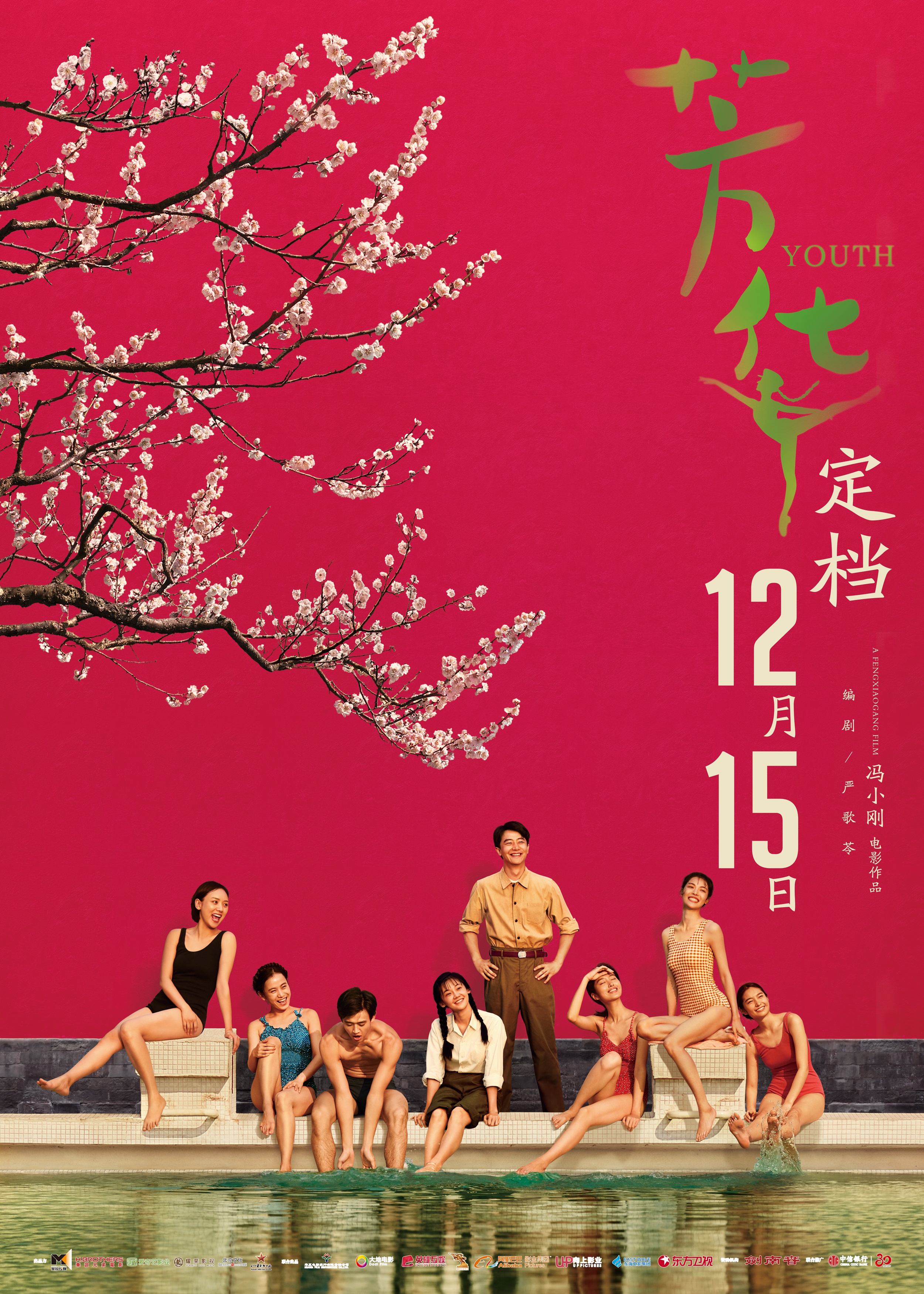
Chasing Dream (我的拳王男友, Johnnie To, 2019)

“You gotta give everything to get everything” according to an intense rocker in Johnnie To’s musical boxing romance, Chasing Dream (我的拳王男友). What turns out to be most important however is not physical endurance but emotional authenticity, if you want to be taken seriously then you have to take yourself seriously first and that means learning to find the courage to embrace your authentic self. A tale of two crazy kids chasing the Chinese Dream, To’s colourful fantasy world is not without its bite as he leans in hard to what it costs to succeed and not in what is often a merciless society.

Our hero Tiger (Jacky Heung Cho), “The Gluttonous Boxer”, is a young man who broke with his boxing master to step into the MMA ring but is also an enforcer for a shady local loansharking gang run by his manager. Aware he is approaching the end of his career – a doctor later tells him he’s in danger of going blind, rupturing his liver, and getting Parkinson’s – Tiger’s life changes one day when he recognises one of the ring girls, Cuckoo (Wang Keru), as the granddaughter of an old woman who used to sell noodles back when he studied boxing in his rural hometown. Unfortunately, Tiger’s boss has also recognised her because she is in deep debt with the mob. Some of the guys want to cut their losses and sell her on to the sex trade but Tiger, seemingly indifferent, claims he can find her a way to work off her debt and thereby kickstarts his rescue not only of her but of himself from the increasingly empty life of an ageing prize fighter. 

What he discovers is that Cuckoo is harbouring intense resentment over being seduced and betrayed by one of China’s biggest pop stars who made himself a name as the “king of originality” after stealing all of her songs and leaving her in the lurch. Qu Fengfeng (Ma Xiaohui) is now a judge on China’s biggest TV singing competition Perfect Diva and Cuckoo has a plan to confront him by getting on the show, the only snag being that she is extremely unpolished as a performer. Tiger, meanwhile, wants to get out of the ring and has a plan to start his own hotpot empire essentially by copying all the best bits of the major chains and bringing them together. He vows to help Cuckoo train by having her mimic the performance styles of major stars, but what she quickly discovers is that there is no substitute for emotional authenticity. A fellow constant decides to switch her routine at the last minute after catching sight of Cuckoo rehearsing, but is unceremoniously voted off by judges who’d rather she “performed a tacky fan dance” (as she was originally planning to do) than simply copycatting famous artists. Challenged that her songs are too similar to Qu Fengfeng’s Cuckoo snaps back that it’s his style that’s close to hers, earning the admiration of astute female judge Zhao Ying (Wu Yitong) who can perhaps detect the artist inside her beginning to free itself from her sense of insecurity. 

Achieving your dreams can however come at a heavy cost. Pearl “the kick ass rocker” (Kelly Yu Wenwen) has an intense, aggressive performance style but in a running gag turns up at each consecutive audition with a new incapacity, eventually using a wheelchair and wearing a back brace only able to move her arms. “Totally worth it in the name of music!” she cheerfully explains, literally destroying herself to get to the top. Tiger does something much the same exploited as he is by his unscrupulous gangster manager, shouting out “it doesn’t hurt” as he trains by having people jump on his belly, but the battering he takes is not so much for himself as for others, stepping back into the ring in defence first of Cuckoo and then of his dejected master, Ma Qing (Shao Bing), whose attempt to defend the dignity of the noble art of boxing against the modern upstart MMA goes horribly wrong. But Tiger cannot fight others’ battles for them, and the only way he can win is by being himself while honouring their legacy. 

Finally finding how to bare their souls for all to see and “have someone share the fatigue of loneliness”, the pair learn to recalibrate their dreams while falling in love discovering that mutual support is their guiding light as they give each other the strength to be all they can be. Ostensibly somewhere in Mainland China, To’s make believe, retro future city has a colourful comic book intensity that adds a mythic quality to the saga of Tiger and Cuckoo that is perfectly in tune with his dreamy romanticism in which sudden flights of fancy including a full-blown Bollywood-style dance sequence seem entirely natural. A surprisingly moving, wilfully absurd musical love story between wildly grinning pugilist and a young woman learning to sing from the the heart, Chasing Dream is a delightful sugar pop confection in which two crazy kids find love in the ring and with it the power to believe in themselves and a better future.


Chasing Dream streamed as part of this year’s Udine Far East Film Festival.

Original trailer (Cantonese, no subtitles)
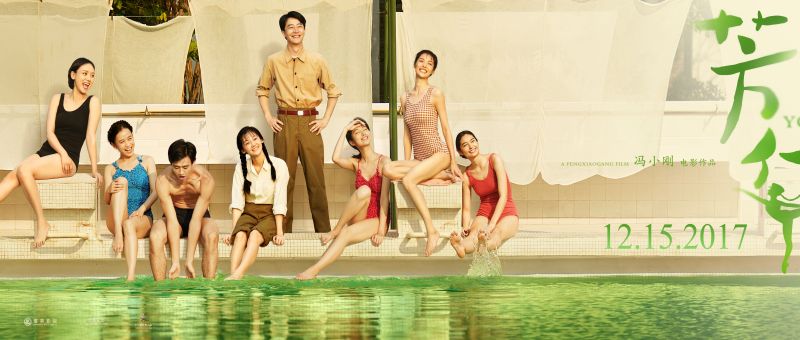
Youth (芳华, Feng Xiaogang, 2017)

youth posterOn the surface of things, one might be forgiven for thinking that Feng Xiaogang, “China’s Spielberg” – the director of such fluffy hits as If You Are the One and the prestige picture The Banquet, might not be the one to look to for nuanced takes on the state of his nation but, as he proved with the irony filled I am Not Madame Bovary, there has always been a persistent resistance in his superficially crowd-pleasing filmography. The exact nature and extent of that resistance is however harder to assess. Youth (芳华, Fāng huá), Feng’s latest historically probing epic, made headlines when its mainland release was blocked at short notice immediately before its international premiere at the Toronto International Film Festival and in some respects it’s easy to see why it may have raised an eyebrow or two at the censor’s board. A literal story of “youth” and the various ways that the concept becomes romanticised even when one’s own coming of age took place in otherwise difficult times, Feng’s film is also the story of modern China, baptised in the fire of the Cultural Revolution only to finally succumb to the consumerist one 15 years later.

Narrated by bystander Suizi (Zhong Chuxi), later a successful author apparently looking back on her own “youth” with a writerly eye, the tale begins in the early 1970s with two pillars of the arts division of the People’s Liberation Army. Suizi informs us the the protagonists of this story are Lui Feng (Huang Xuan) – a model soldier, and Xiaoping (Miao Miao) – a poor girl mercilessly tormented by everyone throughout her entire life. Xiaoping’s birth father has long been languishing in a re-education camp but as she’s taken her step-father’s name, Liu Feng assures her that he’s kept her bad class background off her record and will make sure no one else knows about it.

Performing propaganda ballets, the arts division is at its zenith at the height of the Cultural Revolution. The troop as a whole enjoys extreme privilege – they are well fed and cared for, evade the dangerous front line work many other members of the armed forces are subject to, and receive the respect due to them as the embodiment of a revolutionary ideal. They are, however, still guilty of the various hypocrisies coded into the system. Though many of the dancers have family members with “bad class backgrounds”, undergoing re-education or otherwise better not mentioned, the top guys and girls are the ones with parents high up in the party who use their untouchable status to paper over cracks in their own development with inherited superiority.

Lui Feng is perhaps an aberration. Nicknamed “Lei Feng” – a mythical figure created for propaganda purposes to embody the “ideal” revolutionary soldier in his selfless dedication to his comrades and communist virtues, Lui Feng is indeed a model party member whose goodness and kindness know no bounds. Unlike Lei Feng, however, he is a real man of flesh and blood not some far off and untouchable god. Having sanctified him in this way, the collective has effectively raised Lui Feng up to an unfair and unattainable ideal and is then “betrayed” on realising that Lui Feng is a man with a man’s hopes and desires. Lui Feng’s transgression is inappropriate to be sure but also somehow innocent in its naivety and his counter betrayal by the system to which he has dedicated his life all the more difficult to bear because of the unfair deification his better qualities have earned him.

Xiaoping meanwhile, who expected only betrayal, betrays the system through passive resistance in resentment of the way it has treated her friend. “Abandoned” by the collective which is the arts troop, Xiaoping exiles herself from a society she thinks has little need of her yet she then continues to serve it fully as a frontline nurse. The “youthful” idealism of Lui Feng and Xiaoping is tested as they find themselves caught up in a far off war while their former comrades dance around with wooden swords on a painted stage. Wounded in body and mind, the pair continue onwards even as their nation conspires to leave them behind.

Shifting into the ‘90s and then the 21st century, Feng’s messages become muddier and harder to grasp. In one sense what is celebrated is “youth” itself which, in this case, happened to take place against the backdrop of terrible events (albeit it ones from which many of the protagonists save Lui Feng and Xiaoping were largely shielded) enabling the growth of a generational family destroyed by a change in the political wind. It is however hard not to infer that everything was better during the turbulent ‘70s in which the delusion of innocence, if not its actual existence, was easier to bear than the soulless march into the future of Coca-Cola signs, Transformers toys and fathers who never come home because they’re too busy making money. Feng’s heroes are the ones who exiled themselves from the reality of China as a modern economic superpower, holding fast to their innate senses of honour and justice, yet in this Feng does to them exactly what he criticises his society for doing – he makes them martyrs, mythologises them as embodiments of revolutionary ideals, a pair of real life Lei Fengs all over again. In telling a story of how the revolution betrays and is betrayed, Feng makes the heroes emerge damaged but unbroken, chaste children trapped by the “innocence” of the pre-capitalist age, but whether their survival is victory or defeat remains unclear. 


Youth is currently screening at selected cinemas across the UK courtesy of CineAsia.

UK release trailer (English subtitles)