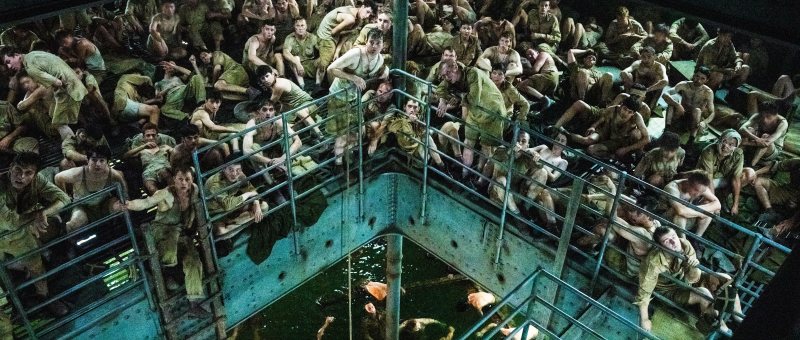
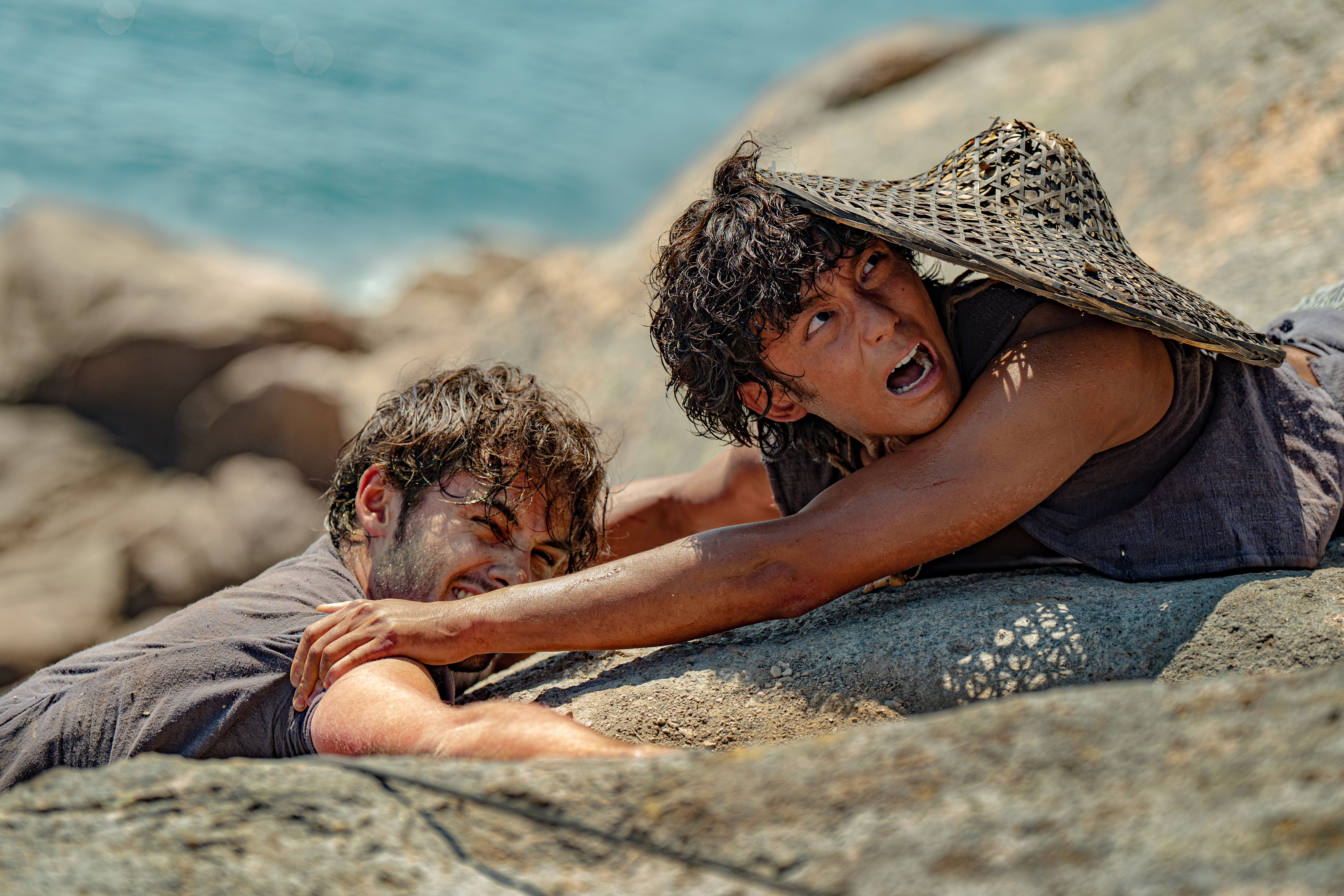
If someone’s drowning, then you save them no matter what language they speak or where they come from. Such is the simple logic of the Dongji fisherman who risked their lives to rescue British prisoners of war when the boat they were travelling on was torpedoed in the waters near Zhoushan. Inspired by this historical event, Guan Hu and Fei Zhenxiang spin a tale of resistance and righteousness with an unexpected advocation for borderlessness and freedom as the two orphaned pirate brothers at the film’s centre finally find their way back to their home in the sea.
It’s Ah Dang (Wu Lei), the younger of the brothers, who fishes a British soldier out of the water and tries to rescue him, while the older, Ah Bi (Zhu Yilong), refuses and tries to throw the man back. Ah Bi may appear heartless, but considering the risk the presence of the British soldier poses to the islanders perhaps Ah Bi’s callousness is perfectly understandable. Nevertheless, Ah Dang stashes the young man, Thomas Newman, in their cabin and seems fascinated by his blue eyes and a vision of the wider world that he seems to represent. Thomas desperately tries to communicate with Ah Dang but though he knows some Cantonese cannot get through to him that there are men trapped on the sinking boat. Meanwhile, Japanese troops turn up on the nominally occupied island erroneously looking for a blond, blue-eyed man missing from the ship. Convinced the islanders must be harbouring him, they start taking hostages and executing villagers until Thomas finally knocks out Ah Dang so he can give himself up to save them.
Though the island was not in fact occupied in real life, here the villagers are placed under incredibly oppressive rule despite there only being two Japanese soldiers standing guard. The fishermen are no longer allowed out to fish and are, they say, stuck on land like turtles unable to practise their traditional crafts or way of life. Old Wu led the resistance before, but didn’t end well and now even he has been cowed into submission. The rescue is then as much for the islanders as anyone else as an act of resistance to authoritarian oppression in their following their belief that those in peril on the sea must be saved in defiance of the Japanese’s prohibition on sailing. The same is doubly true of Ah Bi’s girlfriend Ah Hua (Ni Ni), Old Wu’s adopted daughter who takes up his place and breaks a taboo about women going to sea to lead the rescue mission.
She, Ah Bi, and his brother are all technically outsiders on the island who were never fully embraced by the community. The brothers were held at arms’ length because of their possibly pirate origins, while Ah Bi’s dream had been to escape to Shanghai with Ah Hua. Ah Dang is then touched by Thomas’ constant attempts to talk to about “home” though he perhaps doesn’t quite have one while Ah Bi’s “home” more than anything else is simply Ah Dang. Rather than the expected definition of a homeland of the greater China, the brothers’ “home” is later redefined as “the sea” which is to say a place of boundless freedom where national borders don’t exist.
These elemental origins also give the brothers a mythical quality that adds to the sense of heroism in the rescue as Ah Bi goes after the Japanese and attempts to save the remaining POWs, some of whom can’t swim, marooned in the middle of the sea. The Japanese, meanwhile, are intent on covering the incident up which means everyone must die from the POWs to the residents of Dongji Island, though it isn’t really clear who the islanders would tell anyway considering that they live on a fairly remote island. In any case, the heroism of the Chinese fisherman is directly contrasted with the craven callousness of the Japanese who are still trying to pick off the POWs like fish in a barrel and only stop on realising that there are too many Chinese fisherman and if they were to kill them all it would get out and they’d look very, very bad. Epic in scope and impressively staged with some truly stunning underwater photography, there is a sense of genuine poignancy and human solidarity in standing up to oppression and cruelty no matter how ironic or jingoistic it might otherwise seem as ordinary villagers rise to up to help those from a distant land they don’t even know at the risk of their own lives and livelihoods.
Dongji Rescue opens in UK cinemas 22nd August courtesy of CineAsia.
Trailer (English subtitles)
 Windows on Worlds