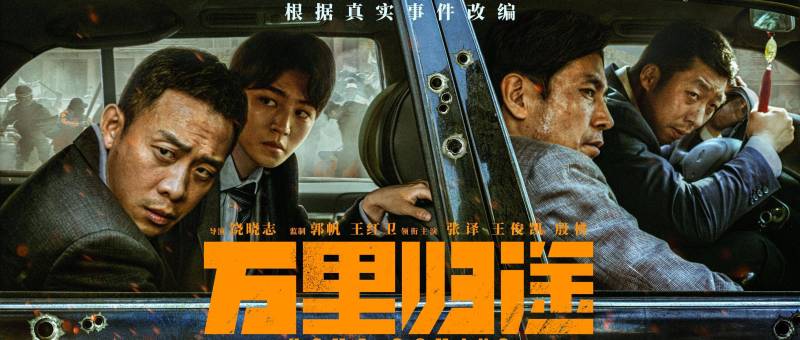
Home Coming (万里归途, Rao Xiaozhi, 2022)

A pair of Chinese diplomats find themselves the last hope of stranded construction workers when civil war erupts in a middle-eastern nation in Rao Xiaozhi’s visually impressive action drama, Home Coming (万里归途, Wànlǐ Guītú). A “Main Melody” National Day release, the film is less heavy on jingoistic patriotism than might be expected if slotting neatly into the recent trend of celebrating various branches of officialdom, this time foreign service consular staff, but nevertheless leans into the recurrent “just stay in China” message of government-backed big budget cinema in insisting that nowhere is the Chinese citizen safe other than at “home”. 

According the closing titles inspired by a series of real life events, the film opens in the fictional nation of Numia which is currently experiencing a period of instability with widespread protests against the government. As tensions quickly rise amid a full-scale uprising led by rebel warlords, consular staff are tasked with evacuating Chinese citizens. Jaded consular attaché Zong (Zhang Yi) has a heavily pregnant wife at home, but gives up his seat on the last plane out to a “Taiwanese compatriot” in what can only be read as a less than subtle advocation for a One China philosophy. Booked on the next boat out, Zong nevertheless ends up staying behind to help rescue a contingent of construction workers who are unable to cross the border as they have lost their documentation and require consular assistance to secure exist visas to a neighbouring nation. 

The message of the film might in some ways seem confusing. The by now familiar inclusion of stock footage featuring Chinese citizens overjoyed to arrive home thanks to the assistance of the consular officials emphasises that the Chinese government will always be committed to protecting the interests and safety of Chinese citizens abroad, but it’s also clear that the safest thing of all is not to leave or else to return home as quickly as possible. “Let’s go home” becomes a recurring motif as the construction workers and diplomats will themselves forward fuelled by hometown memories and a desire to see their families as much as simply to survive. Then again, there is also a subtle defence of the role of Chinese corporations overseas. An elderly driver from the local area makes a point of defending his friends and employers to a warlord as he points a gun at his head, reminding him that the Chinese do them a service by building railways and hospitals though it seems this corporate intrusion is one of the things the warlord is rising up against.

No information is really given as to why there is animosity towards the ruling regime, but the film nevertheless goes out of its way critique dissent by suggesting that it is the rebels who are in the wrong. Bodies are frequently seen hanging from billboards and bridges, and rebel leader Mufta tortures and pillages while playing sadistic games with captives. A secondary plot strand seems to suggest that a good leader must sometimes mislead those around them for their own good. Zong finds himself in conflict with his young and naive partner Lang who thinks they should be honest and admit that even if they make it to the next town there may be no one waiting for them while Zong knows that if they tell the construction workers that they’ll never reach it anyway in which case there’s nothing else to do but stay still and die. Zong is proved right, implying that Lang’s problem was that he had insufficient faith in China to protect them (which they can largely because of their massive satellite surveillance network) and endangered the lives of others because of it. But then Mufta also makes a strategic error in a bit of showmanship that effectively unmasks him in front of his men as a duplicitous coward rather than the grizzled revolutionary they thought they were following. 

In any case the closing news reports emphasise the rescue’s value in demonstrating that China is a strong and reliable country capable of protecting its people abroad, though the flip side of that is also seen in Zong’s insistence to the warlord that China will retaliate if any of his people are harmed. Meanwhile, Zong also seems keen to prove that China is a more inclusive place than many others, offering to take their driver back with them if he wanted to come. When the rebels finally concede the Chinese can leave, they refuse permission for an orphaned local girl who had been adopted by a Chinese couple but Zong refuses to leave without her insisting that as she has been adopted she is now incontrovertibly Chinese and he will protect her too. Rao shoots with a gritty roving camera drawing inspiration from the paranoid thrillers of the 1970s along with similarly themed contemporary pictures such as Korea’s Escape From Mogadishu and Hollywood’s Argo, while making the most of incredibly high production values with a series of explosive action sequences but does his best to mitigate the jingoistic undertones through his uncertain, battle weary hero even if ending on a slightly ironic note with an unexpected, post-credits appearance from a National Day movie icon.


international trailer (English / Simplified Chinese subtitles)
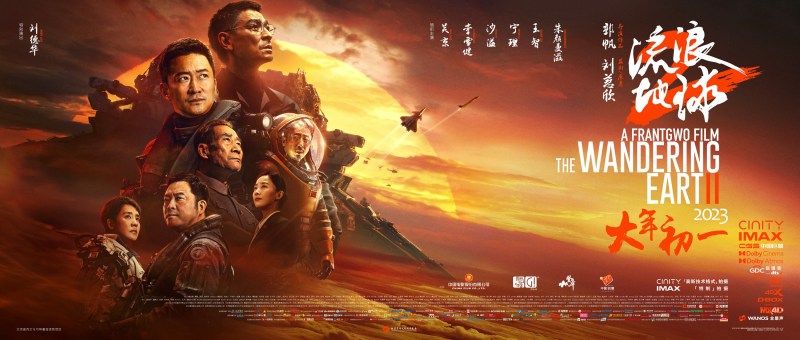
The Wandering Earth II (流浪地球2, Frant Gwo, 2023)

Back in what now seems like another world, Frant Gwo’s The Wandering Earth became a Lunar New Year box office smash and was described by some as China’s first foray into big budget sci-fi. Adapted from a novel by Liu Cixin, the film was much about fathers and sons as it was about sacrifice and solidarity in the face of oncoming apocalypse all of which are quite traditional New Year themes. Arriving four years later, The Wandering Earth II (流浪地球2, liúlàng dìqiú 2) largely drops overt references to the Spring festival bar the repeated motif of journeying home, but does once again stress the importance of international cooperation in safeguarding the future of the planet.

Then again, it seems that many feel it’s not a good use of time or resources to address a problem that will occur in a hundred years when they are long dead. A prequel to the first film, Wandering Earth II begins in the early days of the Moving Mountain Project which is the plan to push the Earth onto a different orbit to escape the sun’s eventual implosion. Given its enormous expense and the reality that much of the population will simply be left to die, the majority of the public back the rival Digital Life program in which humanity would be saved by relocating to a new virtual reality. Where this virtual reality is supposed to be stored is not exactly clear if there is no Earth for it to exist on, but it’s clear that some consider the possibilities of the digital existence preferable to allowing millions to die in the tsunamis which will engulf the Earth as it uncouples from the moon’s gravitational pull. 

Chief among them is software engineer Tu (Andy Lau Tak-wah) who is griefstricken by the loss of his wife and child in a traffic accident and has been secretly working on creating a fully fledged AI simulacrum of his daughter Yaya. He tells his more practically minded colleague Ma (Ning Li) that he doesn’t have the right to define what is “real” while eventually jeopardising the Moving Mountain Project by prioritising his desire to save Yaya over saving the Earth and eventually creating the AI system that will become Moss, a possibly dangerous entity which decides the best way to save humanity is to destroy mankind. 

The first film’s hero, Liu Peiqiang (Wu Jing), meanwhile is a rookie astronaut caught up in a terrorist incident carried out by militant opponents of the Moving Mountain project while enjoying an incongruously goofy courtship with fellow astronaut and future wife, Duoduo (Wang Zhi). This time around, he’s a dutiful son rather than conflicted father serving alongside his own dad who eventually becomes an example of intergenerational sacrifice as the old begin to make way for the young whose responsibility it now is to preserve the Earth. A nervous young aid serving the current premier later takes over the reigns and finds herself giving the same advice to a similarly nervous young man as they prepare to carry on the Wandering Earth project despite knowing that it will take thousands of years to complete. 

The ultimate message is therefore to choose hope, as Peiqiang later does striving to save the world even if it all turns out to be hopeless, rather than giving up and resigning oneself to one’s fate as many suggest doing when faced with the potential failure of their mission. As in the first film, the plan requires cooperation between nations and this time even more so as world powers must surrender their nuclear weapons to help blow up the moon. The Chinese premier looks forward to a day when governments can work on solving future problems rather than preparing for war, but then in an echo of the ongoing climate crisis some just don’t seem to see the point in dealing with something that won’t happen for a hundred years despite likely being among the first to complain no one did anything sooner when it finally affects them. Gwo adds a little whimsy in the technically pre-apocalypse setting with charming details such as Tu’s warm relationship with his dog-like robot helper and the general goofiness of Peiqiang’s attempt to court Duoduo while improving on the already polished visuals of the first film through several high impact set pieces but finally returns to its messages of hope and solidarity perhaps intended for a weary world attempting to find its own way out of a period of protracted strife.


The Wandering Earth II is in UK cinemas now courtesy of CineAsia.

International trailer (English voice over, Simplified Chinese / English subtitles)

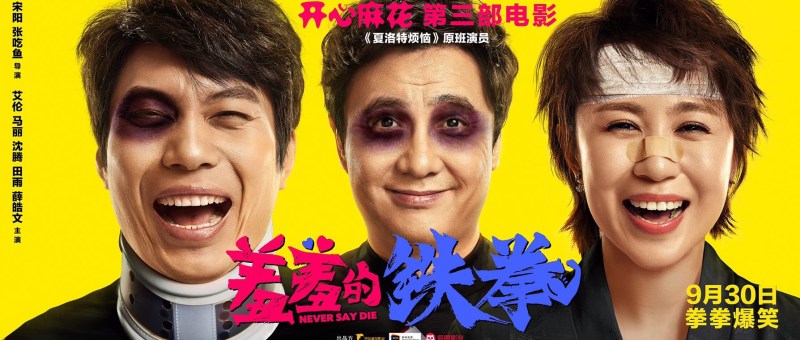
Never Say Die (羞羞的铁拳, Song Yang & Zhang Chiyu, 2017)

Never say die posterBody swapping drama seems to have come back in style of late, though they’ve rarely been as funny as the surprisingly laugh out loud Chinese comedy Never Say Die (羞羞的铁拳, Xiūxiū de Tiěquán). Based on a stage play by the Chinese theatre company Mahua whose last effort Goodbye Mr. Loser did something similar only with time travel, Never Say Die is a story of never giving up, always getting even, and learning to understand yourself through someone else’s eyes.

Edison (Ai Lun) was once an MMA champion, but a scandal three years previously has left him disgraced and reduced to taking dives for his shady boss, Dong (Tian Yu). Edison has a reputation for being good at taking dives because he can make them look so “realistic”, and believes his special talent ought to earn him a few more dollars. Seconds after dramatically hitting the mat, Edison gets a call reminding him he’s late for a weigh-in at a “real” fight. When he gets there he’s confronted by a bulldog reporter, Xiao (Ma Li), who questions him about his history of taking bribes. Reacting angrily, Edison soon realises Xiao’s boyfriend is none other than top MMA fighter and arch-rival Wu Liang (Haowen Xue).

Just to make things more complicated, Xiao is also the daughter of Edison’s manager, Dong, whom she hates and is determined to expose for his corrupt dealings. Edison chases after Xiao when he and Dong discover her recording a very compromising conversation but after ignoring a warning sign the pair end up on a rooftop during a thunderstorm. Edison bumps into Xiao, kissing her by mistake and pushing her into the pool in which they then both get struck by lightning. Waking up in hospital, each of them discovers they’ve come back a little different than they remembered.

This being China with its relatively stringent censorship laws, the body gags are kept to a minimum with Xiao suddenly dropping her reporter’s poise for “manly” roughness and Edison becoming subtly effeminate. Both are horrified by the sudden colonisation of their own bodies and resentful that in order to look after it properly someone they intensely dislike is going to have to be very aware of their most intimate features. This is especially true of Edison who reacts to his new found femininity in the predictable way by fondling his own breasts and then having a fantastic time in a ladies’ only bathhouse (an extended set piece ironically set to YMCA).

The gag is simple enough but actors Ai Lun and Ma Li commit so totally to their new roles that the increasingly absurd situations ring true right up until the trio end up learning Kung Fu from a possibly gay, resentful deputy chief monk (Teng Shen) at a mountain retreat. Veering off from the standard rom-com route, Never Say Die makes a brief sojourn in revenge genre after Xiao finds out some unpleasant facts about Wu Liang (through being Edison) and decides she needs to get her own back by humiliating him in the MMA ring. Edison may have been a champ, but despite his physical training, Xiao is still an elegant female reporter who’s not exactly used to being in the middle of a fight.

Never Say Die does not manage to escape the inherently sexist bias of the gender swap movie, but it does its best to mitigate it. It is problematic, in one sense, that Xiao needs to “man up” to get revenge on her dreadful boyfriend and then is sidelined when it comes time for Edison finish the job for her, but on the other hand she is the more capable and pragmatic of the pair who teaches Edison how to get himself together whilst playing a supporting rather than leading role. Perhaps betraying its comedy stage show routes, the script may appear episodic and meandering but it’s all brought together in grand fashion at the end with nary a gag wasted. The lesson is that eventually you have to get off your high horse and really look at yourself and others whilst resolutely refusing to back down to dishonest bullies if you really want to earn the right to be happy in yourself. Hilarious and emotionally satisfying in equal measure, Never Say Die is an unexpected comic delight which proves surprisingly subversive even in its superficial innocence.


Currently on limited release in UK cinemas courtesy of Chopflix.

Original trailer (Mandarin, no subtitles)