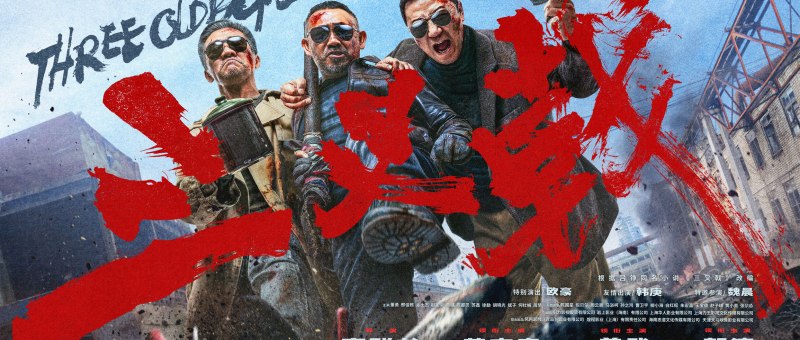
Three Old Boys (三叉戟, Gao Qunshu, 2024)

In a surprising development of Chinese propaganda cinema, the once untouchable subject of police corruption has become a prominent feature albeit often in tales of righteous cops who stand up for real justice against the few bad apples who’ve allowed themselves to be corrupted by contemporary capitalism. Then again, its subject matter might explain why TV police procedural veteran Gao Qunshu’s Three Old Boys (三叉戟, sānchājǐ) has been languishing on the shelf since at least 2020 if it were not also for the inevitable effects of the pandemic. 

In any case, Gao’s film has a distinctly retro vibe with use of classic Chinese pop and very ‘70s soundtrack while its maverick cop heroes all dress in the fashions of 40 years previously. All born in the late 1960s, they are products of an even more authoritarian era and began their careers in the late 1980s. Like any other old cop movie, they bemoan the restrictions of the contemporary society and suggest modern notions of appropriate police behaviour prevent them from doing their jobs which has its degree of awkwardness on the one hand implying the modern police force is now not so hardline but also that it should be because that’s what gets the job done. 

As they contemplate retirement, the trio are offered positions as part of a new squad set up to tackle economic crimes and specifically international money laundering, the chief problem with being that the criminals had the effrontery to move the money out of China which is stealing from honest, hardworking, Chinese citizens aside from having already ripped them off with fraudulent investment schemes and good old-fashioned blackmail operations. Of course, as it turns out, the case has a connection to something that happened 20 years earlier and police officer Cui’s (Huang Zhizhong) desire for revenge on the gangster king pin, Huang Youfa (Jin Shijie), who caused the death of his younger brother murdered by gangster Donzgi who was then shot dead by fellow officer Big G (Jiang Wu). 

The convoluted narrative is heralded by a homeless man who takes the police chief hostage and mutters something about a sword of justice that sounds like something right out of a wuxia serial before being updated to the present day. The sword does actually make a reappearance and is wielded by Big G against a young whippersnapper out for revenge and to take care of what he sees as corruption in the earlier generation. When the trio are first put on the case, they are given a young rookie to help them because he’ll be able to do the tech stuff which the old guys probably can’t because their idea of policing was largely rooted in their fists and a capacity for intimidation. But this doesn’t really work with the youth of today who are for some reason fond of reminding them they aren’t their fathers so they don’t have to do what they say. This is particularly true of young thug Blondie who is caught between Ghost, the old gangster king, and Qing an upstart who is actually working for Huang but in pursuit of his own particular goals. 

Huang has his claws well and truly embedded in the modern society and has it seems manoeuvred favourable people into the police force ensuring that Cui and his team are neutered before they get the chance to do anything. Then again, Big G seems to have a very co-dependent relationship with Ghost who tells Blondie off for getting into a fight with him because cops are off limits. Nevertheless, the point is to dismantle Huang’s networks of influence to restore the integrity of the police force so they can enforce the law which exists for the protection of the people. It’s all rather confusing, but generally lightened by the intense action sequences designed by Yoo Sang-Seob which are also suitably retro but make good use of sword play along with a motorcycle chase. Perhaps ironically inspired by Hollywood hero cop dramas, the film ends with a regime change and a new photo being taken of the guys in their more modern uniforms receiving a commendation with the clear indication that something has been put to rest and the rebellion suggested by Qing’s attempt to steal power from the old quelled while the old boys seemingly decide that justice requires they put off their retirement just a little longer.


International trailer (English subtitles)
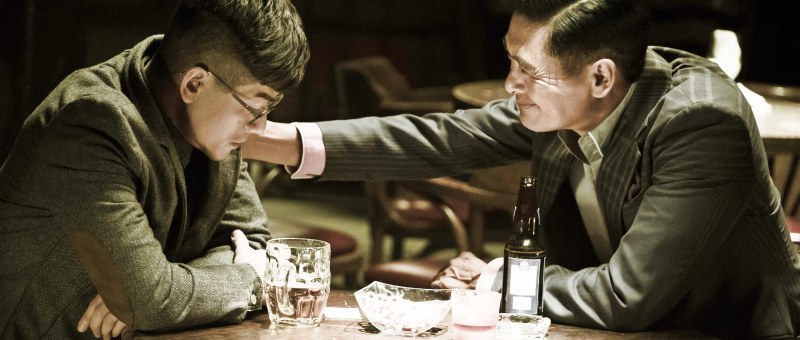
Project Gutenberg (無雙, Felix Chong, 2018)

Project Gutenburg poster“Sometimes a fake can be better than the real thing” intones mild mannered counterfeiter Lee Man in Felix Chong’s cineliterate thriller Project Gutenberg (無雙) . At first glance, Project Gutenberg would seem to have nothing at all in common with the archival programme from which it takes its name but perhaps there is something in its continual questioning of whether a facsimile can replace an original. Chong plays with perception, narrative, and a human need for authenticity but most of all with the legacy of heroic bloodshed as a melancholy young man attempts to rewrite his own history with himself in the lead.

In the late ‘90s, Lee Man (Aaron Kwok) is languishing in a Thai jail from which he manages to get himself rescued by scraping blue powder off the walls and creating an expert forgery of a postage stamp to send a letter of help. Soon after he gets himself picked up by the Hong Kong police who want his help tracking down a notorious counterfeit currency trafficker known only as “Painter” (Chow Yun-fat). Lee is scared witless because Painter has a habit of ruthlessly hunting down associates who talk – something which is well known to HK police inspector Ho (Catherine Chau) who is after him because he killed her Canadian policeman boyfriend. Painter also murdered the fiancé of Lee’s old flame Yuen (Zhang Jingchu) who is the woman he sent the letter to and who has come to his rescue. Which is to say, the situation is much more emotionally complicated than one might expect.

Through flashback, Lee elaborates on how he came to get mixed up with crime. He and Yuen were living on love in 80s Vancouver trying to make it in the art world. While Yuen’s work began to gain traction, Lee’s was going nowhere. Technically proficient, his paintings were thought soulless and derivative but his talent for mimicry soon brings him to the attention of master forgers and thence to Painter who needs someone with expert skills for his next project – forging the US $100 bill.

Lee tells his tale with melancholy relish, dwelling on his days of youthful abandon with Yuen to the extent that Ho interrupts to declare herself disinterested, advising he skip the prologue and get to the bit where Painter shows up. Painter, a suave yet unpredictable criminal type, determines to help Lee become “the leading man” he knows he can be, but to be fair all anyone is ever interested in is the intensely charismatic Painter. As it turns out, there are more reasons for that than it might at first seem, but in the end Lee’s internalised feelings of inadequacy are still the fuel to his fire. Unable to find artistic success, forgery offers Lee the life of a skilful craftsman and he feels himself to have found his niche but in betraying his artistic integrity he also risks forever losing the woman he loves.

Painter has a weird obsession with Lee’s love life, assuring him that once the deal is done he will help him win back Yuen. “A man who gives up on love is destined to fail at everything” Painter tells him. Lee, however, repeatedly gives up on love. He refuses to fight, embraces his own sense of inferiority, and resolves to live on in misery falling ever deeper into Painter’s world of surrealist crime. Leaving aside Painter’s strangely homoerotic relationship with his protege, Lee’s life gets still more complicated when he becomes involved with a woman, Sau-ching (Joyce Feng), who falls in love with him in Thailand and, for complicated reasons, ends up with Yuen’s face thanks to plastic surgery and name thanks to a fake passport. Painter taunts him with a facsimile of his love but berates him for settling for a substitute while Sau-ching resents getting the Vertigo treatment from a man who refuses to let a failed love fade.

Almost offended by her betrayal of true love, Inspector Ho probes Yuen about her fiancé, asking if he was merely a “substitute” for Lee. Yuen asks if the next man Ho will fall in love with will merely be a “substitute” for her fallen colleague to which Ho fires back that there will never be anyone else because her love is “irreplaceable”. Yuen scoffs at her strangely naive romanticism and Ho does indeed appear to meet an echo of her former love in someone new carried once again on noirish cigarette smoke. If you can’t be with the one you love, love the one you’re with the old adage goes but it turns out that inauthentic romance is the hardest kind to bear.

Chong lets Lee’s retelling of his history play out like a heroic bloodshed movie in which Chow re-inhabits the classic characters of his youth. An unreliable narrator, the movie in Lee’s mind is one of honour and glory in which he still cannot allow himself to take the lead. Chong over eggs the pudding with a series of twists and reversals, undercutting all that’s gone before and muddying his message in the process but there’s no arguing with his high stakes style as he turns a simple crime story into an interrogation of authenticity and the power of personal myth making.


Screened as part of the 2018 London East Asia Film Festival.

Original trailer (English subtitles)