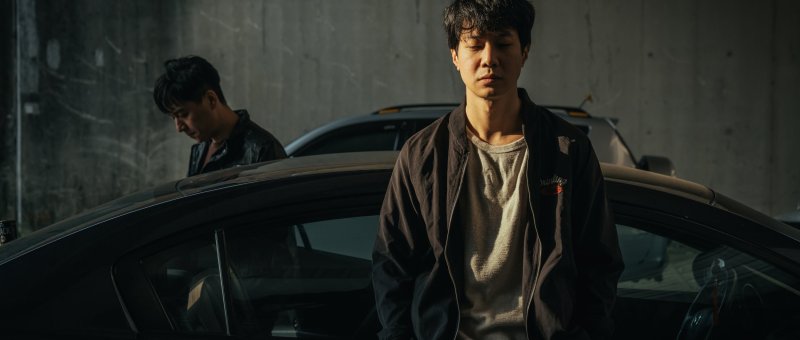
You Have To Kill Me (我是自願讓他殺了我, Chan Chun-Hao, 2021)

An earnest policeman discovers nothing is quite as he thought it to be in Chan Chun-Hao’s adaptation of the novel by Feng Shi, You Have to Kill Me (我是自願讓他殺了我, wǒ shì zìyuàn ràng tāshā le wǒ). Drawn into a dark web of intrigue which eventually points to abuse of power and a low regard for human life, he is forced into a realisation that even as a law enforcement officer he can never be certain of what is real and what is not while caught in the middle in a battle of between parents each trying desperately to protect their sons. 

About to propose to his live-in girlfriend Kai (Janel Tsai), Shing’s (Cheng Jen-shuo) world comes crashing down when he and his partner Ye-ze (Xue Shi Ling) are dispatched to the mountains and discover that she is the victim of the homicide they’ve been sent to investigate. Shing apprehends the apparent killer, Li Zi-jian (Snoopy Yu), running away from the scene, but the situation is complicated when it turns out that Zi-jian is the son of a local politician, Chairman Li (Yin Chao-Te), and while he admits to the killing claims that he did it at the instigation of Kai who was suffering from terminal cancer and wanted him to help her escape her suffering. A look at Kai’s medical records bears out his story, but on closer examination Shing realises the documents don’t add up. His suspicions are confirmed when Kai’s parents, whom he had seemingly never met, arrive and fail to identify the body claiming instead that it is another woman who had been harassing their daughter, Lin Jing. 

Shing is forced to accept that he might not have known the woman he wanted to marry and that their relationship was founded on a lie, uncertain how much of any of it might have been real. Meanwhile he runs into a series of bureaucratic roadblocks as the chairman continues to disrupt the investigation in order to protect his son, eventually having Shing taken off the case leading him to investigate all alone discovering even more uncomfortable truths that cause him to question his reality. Leaving aside the minor plot hole that it seems unusually easy to live under an assumed name in contemporary Taiwan even if you’re involved in activities which would generally require an extensive background check, Shing has good reason to be confused as he dives ever deeper into an amoral morass in which those with power are prepared to manipulate it for their own ends without much thought for the lives of others. “That’s how much a person is worth” the chairman baldly states signing a settlement agreement over something else his son may or may not have done, later claiming that it doesn’t matter if he caused someone’s death “accidentally” and he’d do it all again to save his son. 

Even so, the chairman may have limits in that his attempts to manipulate the system are bureaucratic in nature and seemingly unnecessary at least it seems as if there would be easier ways to achieve his aims without directly harming others even if they would risk lives indirectly. Meanwhile his accomplice is also seemingly involved in order to protect their family, willing to compromise themselves morally to protect their elderly relatives while believing nothing that bad would come of their actions. Then again, Shing finds himself on the receiving end of further recriminations accused of having failed to protect the woman he knew as Kai from herself leaving her with only a dark path to ensure that justice would be done and corruption exposed. 

While Zi-jian feared he was a burden to his father feeling himself unloved even as he went to such drastic lengths to protect him, Kai/Jing was also afraid to fully trust Shing fearing she’d one day disappoint him unable to move on from her traumatic past without putting it to rest. Taking aim firmly at the societal corruption that allows the rich and powerful to misuse their position for their own gain while ordinary people suffer Chan’s noirish drama situates itself in a murky world of constant uncertainty in which even an earnest policeman can be largely oblivious of the lives of those around him while the purest of motivations can lead to only darkness and misery.  


You Have To Kill Me streams in the US April 4 – 10 as part of the 14th season of Asian Pop-Up Cinema.

Original trailer (English subtitles)
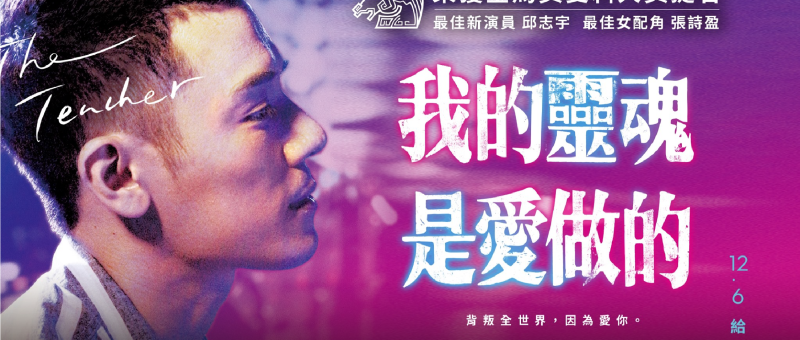
The Teacher (我的靈魂是愛做的, Chen Ming-Lang, 2019)

Taiwan became the first Asian nation to legalise same-sex marriage on 24th May, 2019. That does not however mean that the LGBTQ+ community is universally accepted or that entrenched conservative social attitudes simply evaporated over night. As Chen Ming-Lang’s The Teacher (我的靈魂是愛做的, Wǒ de Línghún Shì Ài Zuo de, AKA My Soul is Made of Love) makes plain, not even those within the community are entirely free of prejudice especially when comes to issues such as HIV and the complicated give and take of what it means to be “out” when personal concerns may conflict with those of an employer or industry. 

Those are perhaps questions that politically engaged civics teacher Kevin (Oscar Chiu) has largely resisted asking. On his off days, he campaigns for marriage equality and for gender equality in education as well as attending pride rallies, but is warned about including LGBTQ+ issues in his teaching programme for fear of offending parents. Director Lin (Lin Chin-Yu), the headmaster, makes offhand comments about Kevin’s perfectly respectable haircut while reminding him that while he works at the school he’s also its representative and he’d prefer it that he keep a low profile to avoid bringing its name into disrepute. Lin is careful to couch his complaints in neutral language, stressing that he personally is fine with Kevin’s sexuality, but is required to be mindful about the reactions of others, deflecting responsibility for at least failing to counter homophobic attitudes in and around the school. Nevertheless, Kevin tries to sidestep him by continuing to include the topics he’d like to talk about by framing them in less problematic terms, for example discussing the upcoming referendum on marriage equality by debating the vote itself, asking if it’s even ethical to give people the option to vote to deny a specific sector of their society the same rights that everyone else has that should be accorded to all without question. 

Kevin’s worldview is challenged, however, when he starts dating a slightly older man, Gao (Chang Chin-hao), whom he met in a gay bathhouse. Kevin tells him that he’s looking for a longterm relationship, wanting to settle down and eventually get married but is currently living with his hairdresser single mother. Moving in with him quite quickly after Gao went temporarily incommunicado following a minor illness, Kevin is later shocked to discover not only that Gao’s relationship with his ex-wife is not quite as over as he implied, but that he is also HIV+. Learning that Gao has HIV exposes Kevin’s rather shallow grasp of his sexual health. Not only does he not know where to go to get tested, but he conflates HIV and AIDS, convinced that he’s been given a death sentence after noticing that his gums are bleeding. 

While beginning to resent Gao for exposing him to the virus, Kevin is also confused by his admittedly complicated family situation. At some point in the past, Gao evidently opted for a heterosexual marriage to please his conservative family who still don’t seem to be aware that the relationship is over or that Gao is gay. At an awkward family gathering, Kevin is invited but introduced as Gao’s friend while his former wife, Wei, sits on the other side of him being quietly needled by her judgemental mother-in-law for failing to provide a grandchild. Gao apparently promised to father a child with Wei through IVF as a condition for dissolving the marriage which is why she’s still overly present in his life and in Kevin’s eyes laying claim to him. Yet Kevin’s major preoccupation isn’t so much with the results of everyone’s choices or how best to support his new partner and his extended family in this unusual situation but with his own reluctance to think of himself as a “home wrecker” the fact that the marriage ended two year’s previously seeming not to occur to him. 

It’s at school, however, where he faces the greatest challenges not only in the homophobic bullying from his immature students with whom he never seems to have much of a rapport, but from his colleagues when he becomes the subject of an internet rumour about a teacher with AIDS. Faced with a dilemma Kevin’s reluctance to confirm his sexuality while insisting that the rumour is false (despite suspecting it might not be) is more personal than political even as his female colleagues attempt to stand up for him by countering a belligerent, older male teacher who wants him sacked that no one should be expected to submit themselves to invasive medical procedures or be denied their right to privacy simply because of a malicious rumour. Lost and afraid, Kevin shuts down, giving in to passivity while succumbing to misplaced rage about his marginalised place in society as he’s denied access to a hospital where he believes Gao has been taken for treatment after an accident assuming they won’t tell him if he’s there because he’s not a legal relative. 

Chen closes with a brief coda explaining that same-sex marriage will be legalised later in the year, Kevin declaring that it will be on his syllabus as if confirming something has changed, yet it’s clear that attitudes may not have shifted as much as hoped while there is still a widespread lack of awareness about HIV issues combined with a social stigma compounded by homophobia. Nevertheless The Teacher presents a complex picture of LGBTQ+ lives at a moment of social transition in which the promise of a coming equality brings with it both anxiety and hope for those who’ve had to accommodate themselves to life on the margins of a now less hostile society. 


The Teacher is available to stream in the UK as part of the Iris Prize Film Festival in collaboration with Queer East.

Original trailer (no subtitles)