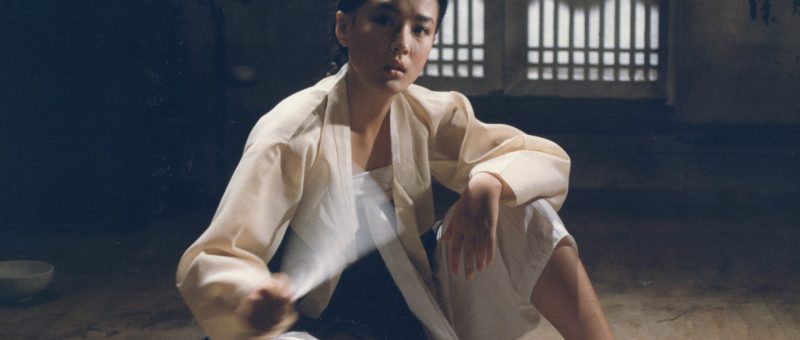
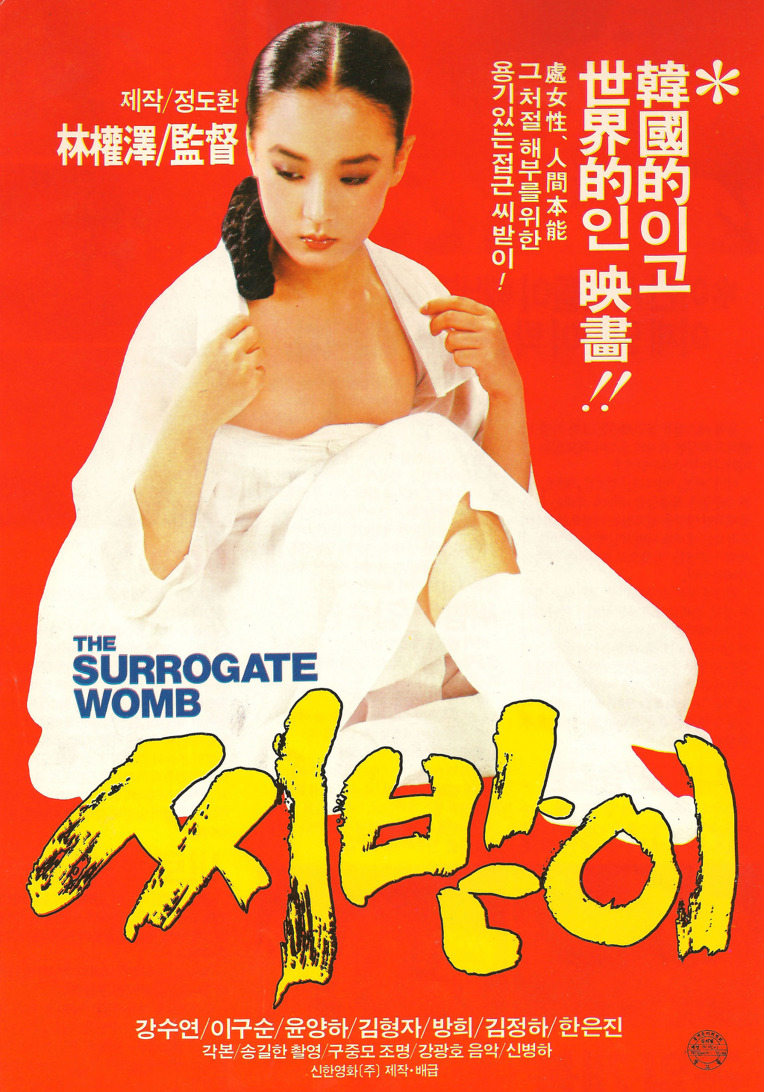
“They seem to live for honouring the dead” the bemused heroine of Im Kwon-taek’s Surrogate Woman (씨받이, Ssibaji) explains to her visiting mother of the noble society she has been unwittingly plunged into but still struggles to understand. A condemnation both of a society which continues to value sons over daughters and of the absurdity of ancestral rites along with the hierarchies of the feudal order, Kwon’s impassioned historical drama speaks directly to the contemporary era in which in many ways nothing has changed.
In any case, Ok-nyeo (Kang Soo-yeon) is fated to become a surrogate woman. As the woman who seems to be in charge in a small community ensconced in a valley which from a certain vantage point seems to resemble female genitalia explains, surrogate mothers who bear daughters are expected to raise them themselves but the children are considered undesirable for marriage and generally end up becoming surrogate mothers themselves. Ok-nyeo’s mother had not wanted such a fate for her daughter, but is in the end powerless to prevent it especially given the allure of the generous payment promised on the birth of a male child. Ok-nyeo thinks she can endure anything for the promise of a comfortable life afterwards but is simply too young and naive to understand the emotional consequences of her decision, that her child will be removed from her seconds after birth and handed to another woman to raise.
The situation is not much better for the wife who is made to feel as if she has failed in not having conceived a child during her 12 years of marriage. Both she and the grandmother who is so insistent on ensuring the existence of a male heir now that her husband has died and their only son is childless, express anxiety about Ok-nyeo’s youth, as did the women in the village, fearing that at 17 she is not yet physically or emotionally mature enough to bear a healthy child. The man they sent to select her seems to have done so out of personal preference, explaining that of all the women he picked a virgin though this raises several practical issues given the nature of surrogacy. Even so there is something quite perverse in the fact that it is the grandmother, the wife of a noble family of Confucianist scholars, who is actively participating in this system that renders women little more than wandering wombs now that she has the only real power that she will ever experience in her life as a widow turned head of household.
On the other hand, it’s clear that this isn’t an ideal arrangement for the man either. The husband, Sang-kyu, is reluctant. He thinks it’s morally wrong and against his Confucianist philosophy while he is also attached to his wife and has no desire to sleep with other women. Nevertheless, he becomes attached to Ok-nyeo to a degree that is regarded as inappropriate by his family members and advisors, sneaking out to sleep with her for reasons other than conceiving an heir. When Ok-nyeo becomes pregnant they send him away to a temple in an attempt to sever their emotional connection, though he immediately sleeps with her again on his return despite the fact that she is already pregnant. For this transgression, Ok-nyeo’s mother is beaten while Ok-nyeo herself had earlier been punished for seducing him though she is completely confined to a single room for the entirety of her stay at the house lest anyone find out the embarrassing secret that the family have hired a surrogate.
While Ok-nyeo and Sang-kyu make love in the bushes, drunken men from the party he’d been attending have a dull conversation about the nature of ancestral rites which is in its own way transgressive as they ask themselves where these ancestral spirits actually are, trying to make sense of what the rituals are for and what they mean but emerging with only confusion for they are largely meaningless. They praise women for rescuing the ancestral tablets at the expense of their children and constantly incur vast expense sacrificing food for those who can no longer eat. As someone remarks, the dead dislike their world and long to stay in ours but the living hardly live at all and spend all their time in service of those who are no longer here. All of it, this vast system that traps women like Ok-nyeo along with men like Sang-kyu the Confucian scholar, stems from this desire to placate departed souls at the expense of those still breathing.
Yet Ok-nyeo is almost like a ghost herself, an invisible presence locked up in a backroom concealed as a dirty secret. Her mother reminds her that Sang-kyu is an aristocrat and she is not, they do not really regard her as human and what she is is stabled like a horse brought for mating to be taken home once the foal is born. They snuck her in by night and will insist that she leaves in darkness mere hours after her son’s birth. Meanwhile, she will be tortured by her captors who burn her stomach and force her to drink strange potions in the name of having a son. Sang-kyu too is forced to drink deer blood to improve his manliness while Ok-nyeo is advised to stare at the moon to the point of dizziness. She perhaps falls for Sang-kyu because he is her only real human contact though it appears they never actually speak to each other, while he discovers a kind of liberation in the permission to dispense with the sublimation of his sexual desire normally demanded by his Confucianist teachings.
But few of them acknowledge the cruelty with which Ok-nyeo and the surrogate women are treated, the pain and despair her mother had tried to warn her of. Ok-nyeo had said anything was worth the price of 10 fields, but soon cries out that she’d give them all up for her son unable to accept that the boy will never be hers for to be a surrogate woman is to be denied one’s own existence. Caught in the night, she can only stare back through the fog as the carriage departs forever separating her from her child and the man she had unwisely come to love. As the closing titles explain, returning to the funereal scenes with which the film had opened, Ok-nyeo has become a victim of a society that prizes sons over daughters as have so many women like her even centuries later in which enlightenment has brought little freedom for those oppressed by class and patriarchy.
The Surrogate Woman screened as part of this year’s London Korean Film Festival.
Trailer (no subtitles)
 Windows on Worlds