Wicked Priest 3: A Killer’s Pilgrimage (極悪坊主 念仏人斬り旅, Takashi Harada, 1969)

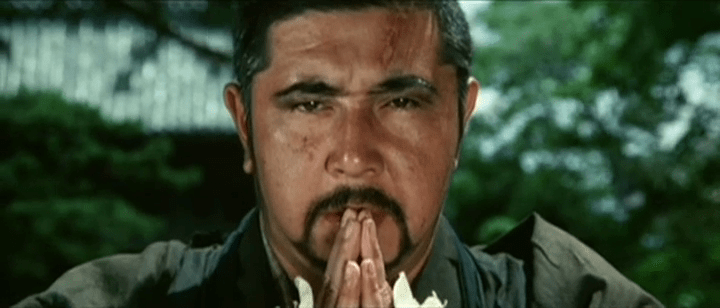
Three years on from his arrest at the end of the previous film, Shinkai (Tomisaburo Wakayama) returns for more lecherous adventures across Japan in Wicked Priest 3: Killer’s Pilgrimage (極悪坊主 念仏人斬り旅, Gokuaku Bozu: Nenbutsu Hitokiri Tabi). This time he finds himself mixed up with revolutionary pirates planning to overthrow the government with weapons smuggled in from Singapore, but it isn’t so much politics that bothers Shinkai as injustice as he tries to help the townspeople defend themselves against politicised bandits and a weird new religion while dealing with the fallout from the last time he found himself enacting justice. 

As usual however the film opens with an odd prologue in which a randy Shinkai is invited to the home of a man who tells him there’s a strange local custom in which women soon to be married think it good luck to be deflowered by a passing stranger and even better if he’s a monk. Of course, Shinkai nearly gets a little more than he bargained for before heading off towards the central fishing village which is at this time of the year home to only women and old men with all the husbands and sons off chasing tuna for the foreseeable future. Taking a liking to a widow named Omine (Hiroko Sakuramachi), Shinkai’s plans are scuppered when she realises that he’s the man who killed her admittedly no good, violent drunk of a gambling husband. Being the charmer that he is, Shinkai manages to talk her round only her brother-in-law Ryuji (Tatsuo Terashima), who’s supposed to marry her sister Otae (Eiko Ito), is hellbent on revenge. Meanwhile, the town is invaded by cruel pirates who commandeer the local well and keep the villagers prisoner. 

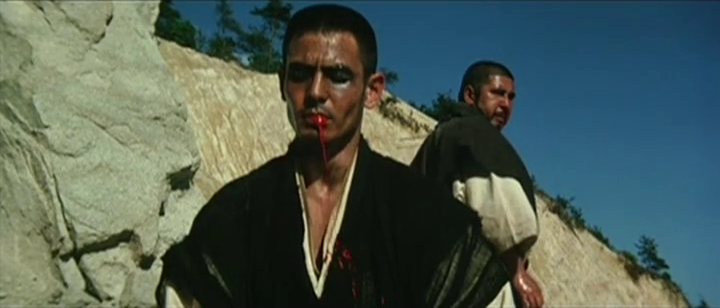
“Helping people is my duty,” Shinkai had told the man who weirdly wanted him to sleep with his daughter and true enough he’s never been one to turn away from those in need even if he’s not all that keen on taking responsibility for them. He feels bad for Omine that he ended up killing her husband even if he thinks her husband brought it on himself because of his behaviour, and even after encountering Ryuji tries to talk him down from his revenge rather than simply fighting him even though Ryuji still refuses to forgive him even after Shinkai is nearly fed to sharks in his place by the cruel leader of the pirates. He is later saved by Yamanami (Minoru Oki), a fugitive on the run for killing a politician in Tokyo presumably as part of his revolutionary activities but has become disillusioned with the gang whom he thinks have lost sight of their cause and are now no better than bandits. Shinkai had claimed he could see Yamanami was a good man because of his all-seeing monk eyes, and later praises him as someone who held fast to his beliefs while bravely standing up to his sociopathic gang boss. It isn’t so much that Shinkai has much opinion on their political stance and desire to overthrow the government, only about the way they conduct themselves, callously throwing dynamite around and hassling the local women. Yamanami asks his boss what the point of winning is if everyone resents you, but his boss simply tells him to think about winning first and ideological purity later. 

In a bizarre subplot, meanwhile, Shinkai also finds himself squaring off against a weird sex cult/fake religion on an island connected with the pirates who are also planning to sell off the village women as payment for their Singaporean weapons. Once again, the randy monk becomes a staunch defender of women, saving Otae from becoming the weird priest’s sex slave and shutting down the trafficking plot by indulging his strange love of eye gouging. Meanwhile he’s still being pursued by Ryotatsu (Bunta Sugawara), the blind monk from the previous two films. Blow for blow, there may not be as much action for the warrior monk despite his heroic attempt to reach the well while under fire and eventual descent on the bandit hideout in a single-handed bid for justice, but there is something in Shinkai’s demands for a just world despite his lasciviousness that overcomes his fixation on women even if this time it seems as if the sun may have set on his travels. 


Horrors of Malformed Men (江戸川乱歩全集 恐怖奇形人間, Teruo Ishii, 1969)

Horrors of Malformed Men poster

The line between madness and sanity is often a thin one, entirely dependent on a series of social perceptions themselves dictated by a vague concept of time and morality. Horrors of Malformed Men (江戸川乱歩全集 恐怖奇形人間, Edogawa Rampo Zenshu: Kyofu Kikei Ningen), loosely inspired by an Edogawa Rampo short story The Strange Tale of Panorama Island as well as a series of similarly themed tales from East and West, is set in 1925 – the end of “Taisho” which is to say immediately before the problematic “Showa” era marked by its own kind of madness and defeat if also by a gradual rebirth. Nevertheless, madness reigns in here though it’s madness of a very particular kind as those excluded from a fiercely conformist society seek to remake the world in their own image and take a horrifyingly poetic revenge on the rest of humanity for their failure to embrace difference.

The tale begins with amnesiac medical student Hirosuke (Teruo Yoshida) who finds himself inside a cage at a mental institution surrounded by screaming, half naked women one of whom attacks him with a knife. Luckily, the knife turns out to be a stage prop with a retractible blade presumably given to the unfortunate woman wielding it as a kind of calming device. Eventually rescued by the warden who attacks the mad with whips as if they were mere cattle, Hirosuke retreats to his cell to ponder on his current circumstances, if he is really “mad” or the only sane man in an insane world. Meanwhile, he is plagued by the memories of a long forgotten lullaby and the vision of a woman’s face suddenly contorting, transformed into a horrifying monstrosity.

Managing to escape, Hirosuke gets a lead on the lullaby that takes him to a coastal village where he discovers that a man who looks eerily like himself has recently passed away. Hoping to solve a series of mysteries, he fakes his own death and manages to convince the other villagers that he is the recently deceased Genzaburo somehow resurrected and risen from the grave. Where all this takes him is to a mysterious island where Genzaburo’s father Jogoro (Tatsumi Hijikata) – a hideously deformed man with webbed fingers, has been trying to create his own bizarre society.

Horrors of Malformed Men was technically “banned”, or perhaps it’s better to say suppressed in an act of self censorship by a nervous studio, but not so much for its gleefully surreal grotesquery as for the “malformed” in the Japanese title which is in fact an extraordinarily offensive word. In any case it adopts a typically difficult position towards those it calls “malformed” as warped both in body and mind. Our mad scientist, Jogoro is a man driven insane by his society’s consistent rejection of him. When the beautiful wife he has somehow managed to win displays only disgust towards his twisted body and finally betrays him by sleeping with her handsome, sensitive cousin, Jogoro’s mental stability is forever fractured leading to his dark desire to take revenge on the “perfect” world by creating his own “malformed” creatures mirroring his own spiritual decline.

Jogoro’s island is a place of “madness” where spiritual corruption leads only to a kind of devolution in which animalistic desires exist only to be sated. Here there is no love or community, only a cold and individual progress towards oblivion. Hirosuke enters a nightmare of a waking sort in which he must confront himself, his family legacy, and a potential conflict between his own desires and the rules of society. Yet he is also haunted by the image of an as yet unseen future of where such ugliness may lead. Jogoro’s otherworldliness and deformities, his singleminded to desire to remake the world with himself on top and others all below, speak of a madness yet to come and the terrible retribution which would be exacted for it.

As if to reinforce his own message, Hirosuke declares himself not of this kind – he chooses to remove himself from a world with which his personal desires are incompatible, maintaining their purity in refusing to live on indulging in a practice most would regard as so taboo as to constitute a kind of “madness” all on its own rather than honouring civilisation by living on in denial. Something tells him, this is where he’s been heading all along. Deeply strange, surreal, and perhaps questionable in its final moment of capitulation which lays the blame for the entire sad and sorry escapade at the feet of a scornful woman rather than the society which both forced her to marry a man she didn’t like and encouraged her to reject him on the grounds of his “ugliness”, Horrors of Malformed Men is not a story about madmen and weird islands but of the evil that men do and the pain it leaves behind.


Horrors of Malformed Men is available on blu-ray from Arrow Films. The set includes two audio commentaries – one featuring film critic Mark Schilling ported from a previous release, and the other a new commentary by film scholar Tom Mes, as well as interviews with Shinya Tsukamoto and Minoru Kawasaki on Ishii’s career, and footage of Ishii visiting the Udine Far East Film Festival. The first pressing also comes with a booklet featuring a wide ranging essay by Jasper Sharp plus shorter essays by Tom Mes on Ishii’s career and Grady Hendrix on Edogawa Rampo.

Original trailer (English subtitles)