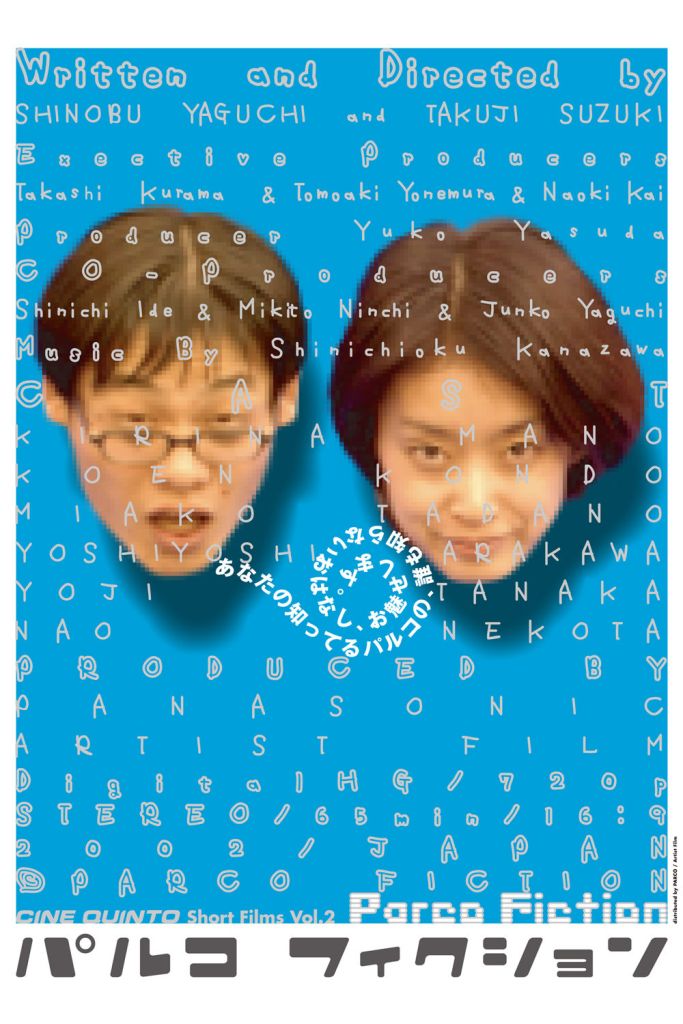
Parco Fiction (パルコ フィクション, Takuji Suzuki & Shinobu Yaguchi, 2002)

1000x1500sr

Since making 2002’s Parco Fiction, directors Shinobu Yaguchi and Takuji Suzuki have both gone on to bigger and better things but for this under seen portmanteau movie, they found themselves uniting to create something which seems to be a strange advert for the Parco department store in Tokyo’s trendy Shibuya district. The film is divided into five different short episodes loosely connected to the department store plus opening, closing and linking segments each filled with the kind of whimsical, absurd humour usually found in these kinds of films.

Opening with a planning meeting for the building of the department store in which its unusual name is decided after the chain smoking consultant finds it written on his scarred lungs after a medical emergency, the story moves on to a young lady who is undergoing an interview for a job at the store. Unfortunately, the young man being interviewed alongside her is an ideal candidate – a Tokyo university graduate who seems to have completely charmed the panel. However, the girl is given a job with the instruction not to open the envelope she’s been given but she can’t resist and finds herself setting off on a strange quest.

This only continues in part two as we come into contact with a soon to be middle school girl who has the misfortune of having a slightly dotty grandma by the name of “Harco”. Every time the Parco ad comes on, grandma gets very excited because she thinks someone’s calling her name even though the last person to call her “Harco” died, years ago. The little girl sets off to solve this problem by stopping grandma seeing the ads, but then something even stranger happens.

Tale three is set during a sale in which a young woman has her heart set on a particular dress and will stop at nothing to get it. This introduces us to the security guard at the Parco who takes us into story five as a shop worker has an unusual medical problem which prevents her from looking up. The security guard has a crush on the shopgirl, but he’s on the taller side so all he can do is stay close by and prepare to catch her every time she’s about to swoon after slightly raising her head. The film then closes with another mini sequence featuring the “standing room only” screening of Parco Fiction at a public cinema.

As is common with these kinds of films, some of the segments are more successful than others. The first perhaps goes on too long and the episode with the little girl and her grandma gets a little too surreal for its own good but the overall tone is zany, quirky humour. Sometimes very off the wall and filled with a good deal of slapstick too, Parco Fiction feels like a fairly low-key, frivolous effort but none the less enjoyable for it. Having said that, the entire duration of the film lasts only 65 minutes, and, truthfully, feels a little long despite the variation of stories involved.

Not a landmark film by any means, Parco Fiction still has plenty to offer particularly as a fairly early effort from these two directors who’ve since gone on to carve out fairly interesting careers. Sure to interest fans of quirky comedies, each of the segments has a zany, studenty humour vibe that often proves extremely funny. The film is undoubtedly low budget (and obviously filled with references to the Parco department store) but earnest enough and filmed in an accomplished and interesting manner.


This is another one you can randomly buy on UK iTunes with English subtitles.

Unsubbed trailer:
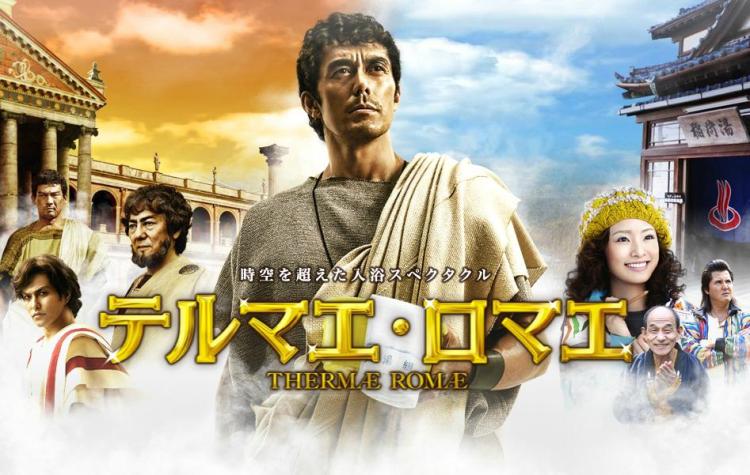
Thermae Romae

THERMAE ROMAE-T

Lucius ambulat in Tokyo? Review of improbable time travel comedy Thermae Romae up at UK-anime.net.


Pop quiz – what do modern day Japan and Ancient Rome have in common? Fish sauce? Emperor worship? Sandals? More than you thought, wasn’t it? Well, the correct answer is public bath houses and sure enough the people of modern day Tokyo still love going to the public bath even though they enjoy the luxury of being able to bathe at home! Of course, bath house culture with all its social and political uses and divisions was one of the things the Roman Empire took with it wherever it went. However, there must have been a time when some Romans began to feel their baths were getting a bit stale and in need of a new ‘modern’ twist, but what to do? What if they could leap forward in time and learn from the 21st century bath culture of modern Japan! Enter down on his luck architect Lucius who suddenly finds himself in a strange land full of strange looking people who seem to have taken bath technology to its very zenith.

Lucius Modestus (Hiroshi Abe) is a once successful bath architect with a case of serious designer’s block. Replaced on a prime project because he’s been unable to come up with any ideas he decides to go for a soak at the local bath house but whilst clearing his head underwater he finds himself sucked through a passage way only to reappear in a very strange looking place – it’s a bath house alright, but not as we know it! As they’re speaking a strange language he doesn’t understand, Lucius assumes the elderly men bathing here must be slaves and he’s been sucked into the “slaves only” part of the baths. Some of this stuff is kind of cool though – what are these funny spigot like things for, and these handy little buckets? Wait – they have baskets for their clothes?! We could do with some these in our bit! And so Lucius experiences the wonder of public bathing in Japan to the extent that it makes him cry with joy at which point he returns to Ancient Rome and begins to put some of these techniques to use in his designs. Travelling back and fore, Lucius always seems to run into the same Japanese girl who wants to make him the star of a manga and group of kindly old men. Can Lucius finally build the bath house of his dreams and stop a conspiracy against his beloved Emperor Hadrian at the same time?

Based on Mari Yamazaki’s manga of the same name (which also received an anime treatment from DLE), Thermae Romae sticks fairly closely to a fish out of water format for the the first half of the film as Lucius becomes by turns confused and then entranced by the various pieces of modern bathing technology he encounters on his travels. As a Roman encountering other people who are obviously not Roman, he of course adopts a superior attitude and assumes these people are either slaves or ought to be and so is extremely bewildered that their advancements seem to have eclipsed those of his own beloved Rome. These situations obviously provide a lot of room for humour as Lucius encounters various things that seem perfectly normal to us but strange and alien to him – his pure joy at discovering the wonder of the multifunctional Japanese toilet being particularly notable. It does though become fairly repetitive as Lucius finds himself in different situations which are essentially the same joke in different colours but then when the plot element begins to kick in later in the film it too fails to take off and feels a little too serious when taken with the wacky time travelling antics we began with.

Aided in his quest Lucius meets several amusing supporting characters including the group of elderly men from the baths who didn’t really need the help of an improbable ancient Roman to get themselves in trouble and Mami who functions as a kind of love interest who’s cast Lucius as the hero in her next manga. Mami begins learning about the Roman Empire and takes a course in Latin which helps a lot when she too finds herself in Ancient Rome and facilitates a kind of cross cultural exchange as she steals ideas from Rome for her manga as Lucius stole for the baths. However, the romantic comedy element never really comes together and even as Mami continues to pine over her noble Roman, Lucius remains aloof in the universal belief that all non-Romans are inferior. Though he does come to grudgingly acknowledge that the ‘flat faced people’ as he calls them have particular strengths such as their willingness to work as a team and put collective success ahead of personal gain, he never quite sheds his Roman arrogance.

It’s all very silly but undeniably quite funny if often absurd. We hear everyone in Rome speaking in Japanese and Lucius continues to think in Japanese wherever he actually is but obviously once he gets to Japan he can’t understand what anyone’s saying and attempts to communicate with them in Latin (whilst still giving his interior monologue in Japanese). Likewise, when Mami learns Latin she uses it to communicate with Lucius in Japan but once they get to Rome, all their ‘Latin’ is Japanese too which causes problems when the old men arrive because they’re speaking the same language as everyone else yet can’t understand anyone or be understood – which might be why they don’t get to say very much other than to Mami. It’s all quite strange and disorientating but kind of works as does the largely Puccini based score which screams 19th century Italy much more than Ancient Rome but helps to give the film the air of classical pomposity it’s aiming for. Big, ridiculous, silly fun – no one could accuse Thermae Romae of having any kind of serious message but it does provide genuinely entertaining silliness for the majority of its running time.