Kazuo Umezu’s Horror Theater: Present (楳図かずお恐怖劇場 プレゼント, Yudai Yamaguchi, 2005)

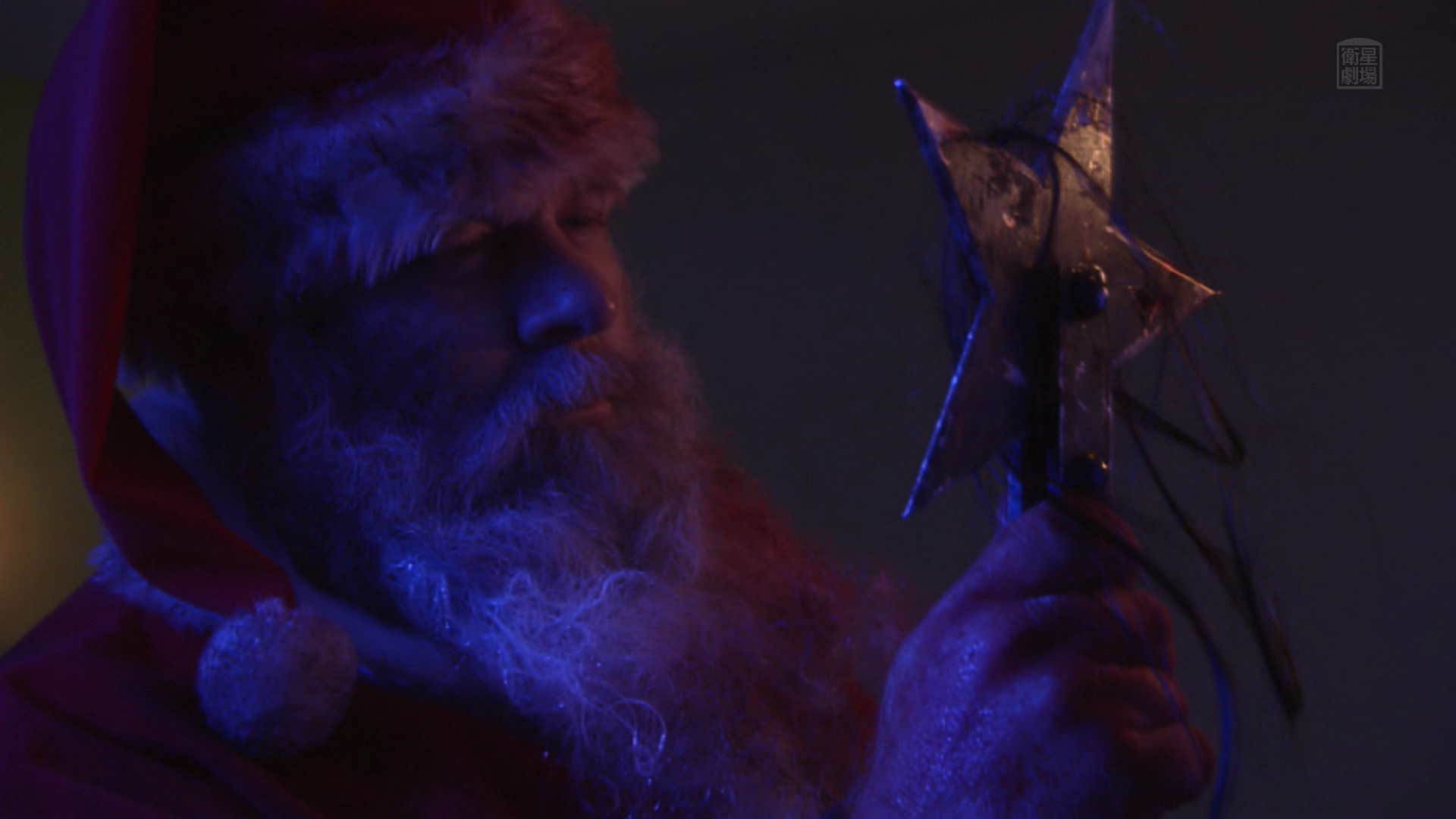
Generally speaking, Santa is quite a benevolent figure. Even the children who are naughty usually just get left out or else awarded a single piece of coal or some other worthy yet dull gift that lets them know how badly they’ve behaved. Not so in the world of Kazuo Umezu, however. You don’t want to get on the wrong side of this Santa, though in other ways it’s less “Santa” that is haunting these youngsters than the disappointed spectres of the children they once were.

As a small child, Yuko (Seiko Iwaido) had a funny dream, though her parents reassured her that Santa would come to save her. However, if she did anything wrong, he’d come after her too. Years later, when Yuko is a student, she writes a Christmas card to a boy she likes and goes to spend the night at a hotel with her friends. But the hotel looks weirdly like her doll’s house from when she was little, and other things from her childhood bedroom seem to turn up here and there. In case that wasn’t weird enough, the reception desk is manned by a creepy Santa, while the atmosphere inside couldn’t really be called “jolly” so much as mildly depressing.

Meanwhile, it almost seems as if Yuko is being bullied by her female friends and has been set up in some way as a figure of fun, though it turns out that Ryosuke (Takamasa Suga) seems to like her too. Only, that’s largely because she seems “pure” in comparison to her friends, which is a bit of a red flag. In any case, though this is a slasher film, it doesn’t really seem to be the case that Yuko is a “bad” girl for getting it on with Ryosuke but for some other transgression. As one of the kids says, they’re all apparently guilty of “desecrating” Christmas, which is what has annoyed Santa to the extent that he’s decided to take back all the gifts he previously gave them. What he actually takes, however, is most of their limbs and internal organs which he feeds to his reindeer.

How they “desecrated” this non-religious event isn’t really clear, but on the other hand it’s true that they don’t make much of an attempt to save each other apart from Ryosuke who is protective of Yuko suggesting that he did actually have feelings for her and wasn’t just looking for a bit of festive nookie. Yuko, by contrast, is revealed to be not quite all she seems and there are other reasons someone, like Santa, might judge her to have been “bad” not least in her rather callous disregard for her parents who were looking forward to seeing her over Christmas. The contrast with her younger self couldn’t be starker, while in her dream, the young Yuko believes herself to have beaten “the evil one” by pulling out her rotten brain which is either a fantastically grim paradox and metaphor about the various ways we disappoint our younger selves, or a kind of course correction in which the young Yuko “became Santa” and removed all the “rotten” parts of her future self’s mind so she won’t end up turning out like that.

The fact that everyone sees a different version of Santa also lends weight to the idea that they’re coming out of their own psyches and Santa is really a manifestation of their own fears and anxieties, though Yuko’s is a fairly conventional take based on what her mother told her Santa looked like. Her mother also attributes young Yuko’s rather gory dream to watching too many splatter films and reflects that perhaps she shouldn’t be letting her do that. “Who on earth would make such films?” she ironically asks in a meta moment while Yuko cheerfully plays “hide and seek” with her new stuffed toys of Santa and Rudolph smiling sweetly while her mother adds that she’s sure Yuko will grow up to be as gentle a woman as she is a child. Meatball Machine director Yudai Yamaguchi, however, indulges in some surreal Christmas gore as Santa goes on his killing spree utilising festive items to hack off the kids’ limbs before stuffing them in his sack and retreating to his decidedly unjolly grotto with his psychotic reindeer. The Christmas spirit is it seems alive and well.

Chin-yu-ki: The Journey to the West with Farts (珍遊記, Yudai Yamaguchi, 2016)

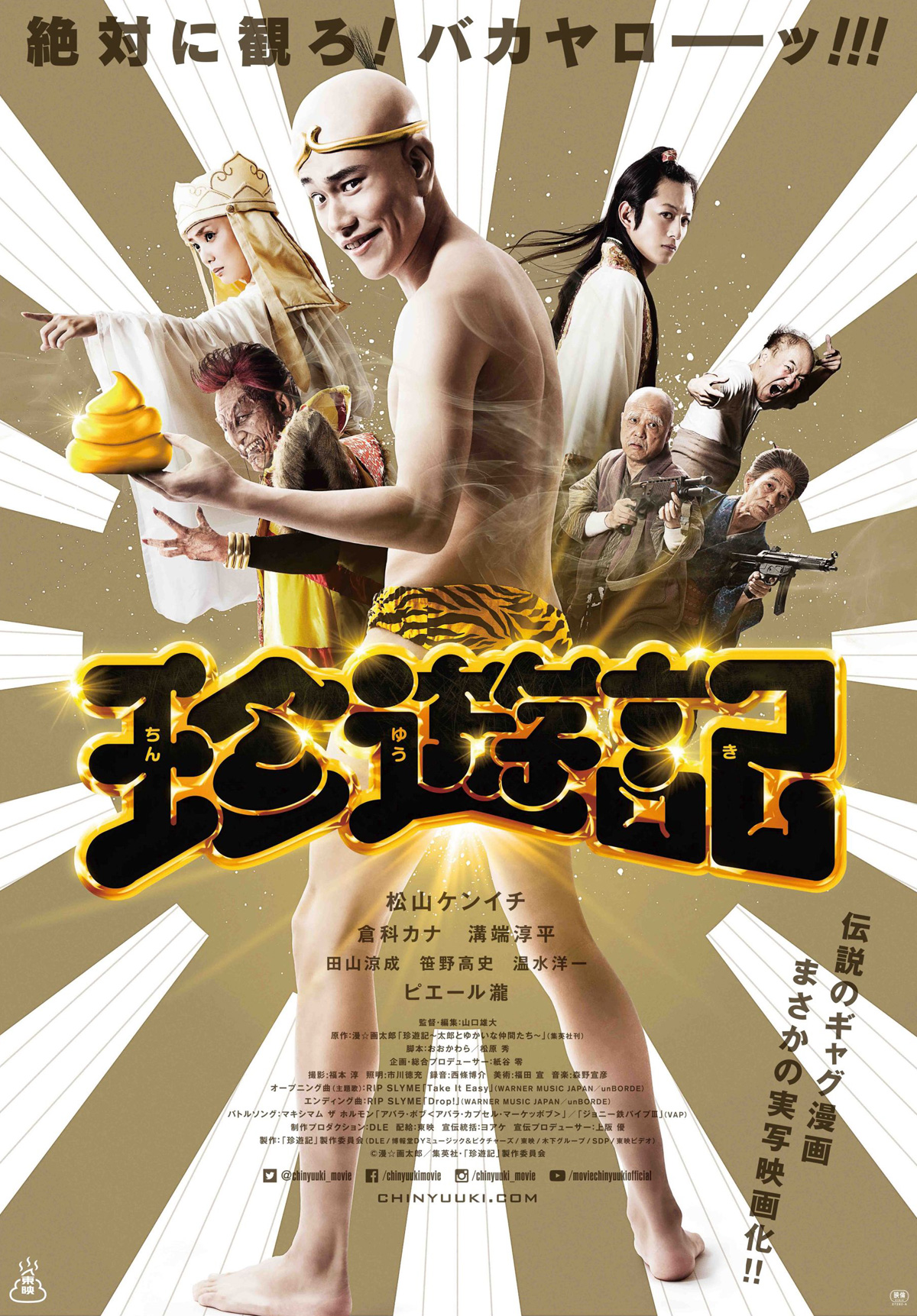
Chin-yu-ki posterWhen a film tells you what it is, you should believe it the first time. Many fine films are undone by unwise titles, but if you were expecting anything more than what is promised by the title of Chin-yu-ki: Journey to the West with Farts (珍遊記), you have only yourself to blame. Director Yudai Yamaguchi is known for his distinctly lowbrow, zany humour and it seems he’s met his match in adapting the much loved Journey to the West parody manga, Chin-yu-ki – Taro to Yukaina Nakamatachi. Set in Japan in an indistinct period possibly somewhere around the Meiji restoration, Chin-yu-ki is a bawdy story of penis power, fantastic farts, romantic disappointments, and the ongoing path to enlightenment of its slightly more than cheeky hero.

Beginning as it means to go on, the film opens with a Buddhist nun, Genzo (Kana Kurashina – renamed “Shenzang” in the subtitles on this HK blu-ray to match the original Journey to the West), talking to an older couple referred to as “Old Fart” (Ryosei Tayama) and “Old Bag” (Takashi Sasano). The couple were never blessed with children of their own and so when they notice a great flash and something falling to Earth, they are delighted to find a lovely baby boy lying in the crater. Unfortunately, Taro Yamada (Kenichi Matsuyama), as the baby is called, is a wrong ‘un. Now 16 years old, Taro is a fiery demon who has robbed the entire area to build himself a giant mansion where he lives on his own and has provided his adoptive parents with a small hovel on the outskirts of town. Old Fart and Old Bag try to warn Genzo that Taro is not your average sinner – he controls people with his giant penis and stinky farts.

Genzo is undeterred and demonstrates her various skills which, strangely, centre around the ability to unping a bra at 20 paces (yes, apparently in this version of the Meiji era, people wear bras). Her other trick is magically hurling buns into people’s mouths which does at least shut them up for a bit. Against the odds she manages to tame Taro, reducing him to his basic, naked state in which she manages to shove a magic crown on his head which allows her to control him and stop him doing naughty things. Genzo determines to take Taro to Tianzhu to purify his soul and so the pair walk off together towards their joint destiny.

The road trip format provides plenty of scope for set piece gags as Genzo and Taro encounter various strange characters along the way who often make surprising returns. This is no character drama, but Taro does indeed learn a few things even as he remains as wilfully naughty as in his unreformed state. As it turns out, the major narrative event revolves around a grudge held by a man who previously encountered Taro at his most cruel. Ryusho (Junpei Mizobata), now a famous pretty boy actor, is still nursing a broken heart after Taro ruined his true love dream which had proved so difficult for him to win as a shy young schoolboy. Now backed by a series of strange companions including a dominatrix-type assistant who dresses in shiny leather and carries a whip, a woman in Cheongsam, and a man in anachronistic Chinese PLA uniform, Ryusho is still a hopeless romantic and develops an unlikely crush on Genzo, which she returns but is unable to act on because of her vows and her mission to reform Taro.

Misunderstandings abound and it has to be said, the crosstalk between Ryusho who has been abandoned by his buddies and has hired a series of Vietnam-era American mercenaries, Genzo, and Taro as they argue about an unclear subject is genuinely quite funny as is the reaction when Taro unmasks himself in a local bar full of bounty hunters who don’t believe he is who he says he is because he’s wearing a shirt with the name of a guy he just robbed on it. The rest of the humour is, however, of a lower order even if the penis and fart jokes fade out in the middle section of the film which does have a few amusing jokes of its own. Matsuyama delivers a surprisingly energetic performance which is in strong contrast with the distant, inscrutable characters he often plays but as cheerful as his Monkey King stand in is, he can’t compensate for the film’s otherwise disposable quality which seems primed to appeal to those seeking zany, lowbrow humour but offers very little else.


Original trailer (no subtitles)

https://www.youtube.com/watch?v=Mwpro6w8z3o