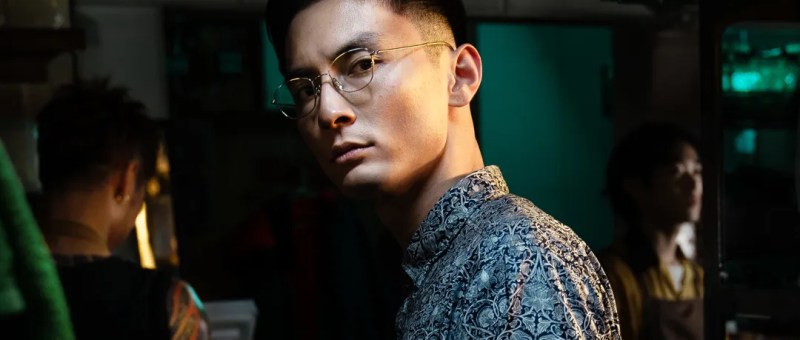
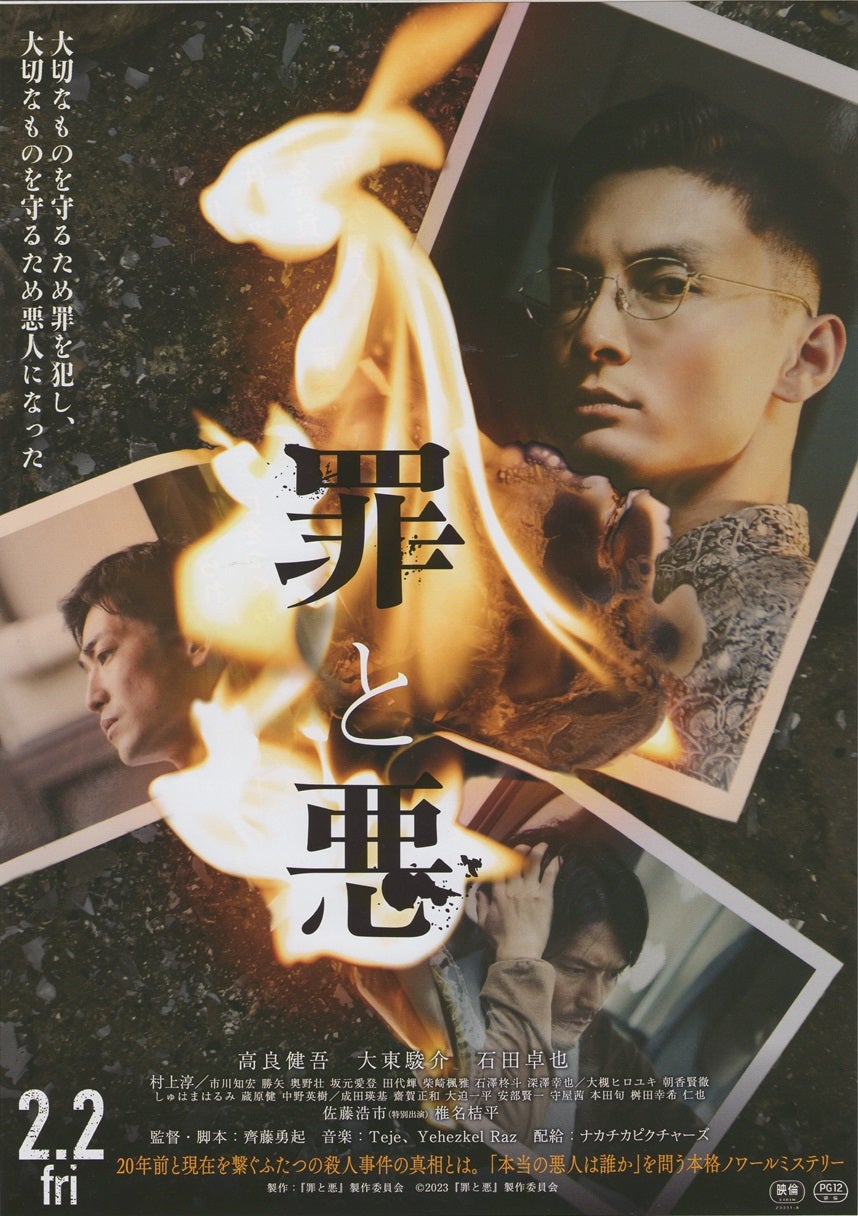
Sin and Evil (罪と悪, Yuki Saito, 2024)

A man not quite a yakuza and perhaps even what might be termed an ethical gangster tells one of his underlings that it isn’t a sin unless you believe it it is, which might in a sense be true in same way as Socrates says that no one does wrong willingly. Yet the heroes of Sin and Evil (罪と悪, Tsumi to Aku), Yuki Saito’s small-town crime drama, are marked by their guilt while trying to come to terms with traumatic events of 20 years earlier and their mutual decision to cover them up.

Echoing similarly themed films such as Stand By Me, Saito opens with idyllic scenes of the boys riding their bikes with the only hint of darkness offered by a disturbing conversation about an elderly man who is rumoured to be abusing children. However, it seems that Haru is living in a difficult domestic situation following the death of his sister with an abusive father and apparently neglectful mother. His best friend, Akira, is the son of a local policeman while the boys are also friends with a pair of twins, Saku and Naoya, whose family operate a tomato farm. Rounding up the group is Masaki who also seems to be living in difficult circumstances though his backstory is never fully fleshed out as he’s eventually found dead in a local river. Saku jumps to the conclusion that the old man must have abused Masaki, who was known to be friendly with him, and then killed him to keep him quiet. He drags Haru and Akira to the old man’s shack where he attacks and eventually kills him with a shovel. Haru decides to take the blame and torches the place, telling the other two boys to flee the scene.

20 years later, it’s clear that each of them are still marked by what happened that day though Haru (Kengo Kora) appears to have built a good life for himself after serving time in juvenile detention even if the construction company he runs is friendly with local yakuza and gets its contracts through small-town corruption. He also operates a cafe where he employs delinquent boys while secretly using them as thieves but also in a more genuine sense looking after them and concerned for their welfare. His machinations are seen to be key in keeping order, working in tandem with police Inspector Sato (Kippei Shiina) who explains to a more idealistic Akira (Shunsuke Daito) how things are done around here which is essentially keeping ordinary people safe by managing crime rather than punishing or preventing it. The balance is only disrupted by some of Haru’s boys who stupidly steal far too much money from the local yakuza. Haru attempts to protect the young man concerned, but his body soon ends up in the river in exactly the same place as Masaki raising a series of questions about the nature of the earlier crime. 

What the film is trying to do is paint the world in shades of grey while looking for the parts where it’s darkest. It seems it’s not in doubt that the old man abused local children, though Haru and Akira now doubt he killed Masaki raising further questions about their killing of him. As the yakuza underling had said, it’s not a sin unless you think it is and Haru feels that he deserved to die for what he did to other kids so doesn’t feel any remorse for his actions even if he didn’t kill Masaki. But for Akira, the trauma lingers in other ways and he’s disturbed on learning his father may have been involved in covering up their crime and at least complicit in police corruption essentially teaching Sato how things are done in small-town policing. The conclusion Haru comes to is that they are all victims of the town itself, unable to break free of its provincial mores and petty prejudices.

Those would largely be a lingering homophobia and deep shame stemming from suffering sexual abuse as a child. As usual with these kinds of mysteries, the solution lies in the desire to prevent the truth being exposed though in this case the resolution is not entirely convincing when using one killing to cover up another couldn’t help but expose the truth anyway even when attempting to pin it on someone else who can no longer defend themselves. It also sidesteps the themes of small-town corruption and the dark heart of suburbia even as Haru points out that someone should have stepped in to support both himself and Masaki when they could see their families were struggling rather than just closing their curtains and pretending not to notice. The disruption of the friendship, which ought to be the heart of the drama, therefore lacks poignancy muddied by the various overlapping plot lines from the present day yakuza drama to the lost paradise that Haru longs to reclaim despite the otherwise apparently happy life he seems to be living now. Sin, the film seems to say, is in the eye of the beholder along with justice and retribution, and evil maybe just the same or merely invisible to those who choose not to see it.


Sin and Evil screened as part of this year’s Camera Japan.


International trailer (English subtitles)
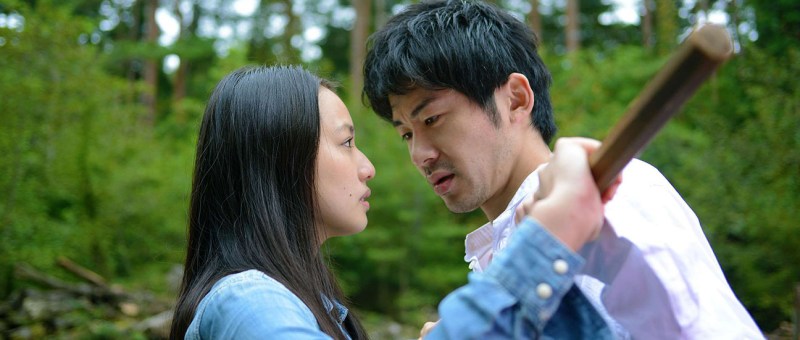
Wet Woman in the Wind (風に濡れた女, Akihiko Shiota, 2016)

wet woman in the wind poster largeBack in the early ‘70s, Nikkatsu reacted to the gradual box office decline of Japanese cinema by taking things one step further than their already edgy youth output in rebranding themselves as a purveyor of softcore pornography known as Roman Porno. Unlike the familiar “pink film”, Roman Porno was made with the assets of a major studio behind it including better actors, production values, and distribution power but it still obeyed strict genre rules calling for speedy turnarounds, minimal running times and the requisite amount of nudity (to the permitted parameters) at set intervals. 45 years later Roman Porno is back in a series of films directed by some of today’s most interesting directors who attempt to recreate the genre anew for modern audiences whilst paying homage to the originals.

Akihiko Shiota’s Wet Woman in the Wind (風に濡れた女, Kaze ni Nureta Onna) starts as it means to go on with hapless protagonist Kosuke (Tasuku Nagaoka) sitting by a river looking sad just as a strange young woman suddenly rides her bicycle directly into the nearby lake before climbing out and stripping off her T-shirt (which, amusingly enough reads “you need tissues for your issues”), revealing her bare breasts to a complete stranger. Kosuke is baffled and confused. He tries to leave but the woman follows him, asking if she can stay with him tonight because she has nowhere else to go. Kosuke is resolved, he’s given up girls and wants nothing whatsoever to do with weird women from ponds but Shiori (Yuki Mamiya) is not one to take no for an answer.

It’s never made clear but something unpleasant has obviously happened to Kosuke that has made him retreat from the city with his tail between his legs (so to speak). A respected playwright, Kosuke seems to have had something of an existential crisis and has decided to condemn himself to a life of self-imposed isolation because “you have to be alone if you really want to think deeply about things”. His isolation is, however, only up to a point. Kosuke’s semi-primitive lifestyle sees him living in a shack in the woods but he has electric lighting provided by generator batteries and grinds his own coffee beans by hand after buying them from a local cafe owned by a man Kosuke went to university with but claims not to have known at the time. The cafe owner’s wife has recently left and he blames Kosuke for reawakening a desire in her that had apparently lain dormant with her husband.

In a shocking coincidence, Shiori has also taken a job at the cafe and has set about seducing the recently lonely owner who has now become fixated and jealous, once again afraid Kosuke in particular is going to steal away his new plaything just like he stole his wife. This is a fallacy on several levels, not least that Shiori is not a woman to be constrained by any man but a true free spirit who gives her love freely to whomever that she chooses.

Spirit might be the best way to describe Shiori who arrives and departs with the wind, a force of nature with the sole intent of freeing her targets of the burden of repressed desires. A radio broadcast later reveals that a tiger has been on the run from the nearby zoo and if this were a fable, you could almost believe the tiger to be Shiori, sinking her teeth into soft centre of human weakness and leaving right after she tears its throat out.

Free spirit as she is, Shiori does find herself in moments of danger as the the threat of sexual violence rears its ugly head. Kosuke likes to think of himself as an enlightened kind of man, an intellectual, but he’s also a self-involved womaniser not above attempting to force himself on a woman he feels to be his for the taking or, half in jest, threatening to rape a former lover. Yet for Shiori much of this is sport – she sees through Kosuke and neatly undercuts all of his self delusions and neuroses, but she’s also merely toying with him.

Finding himself literally kicked out of bed and rendered redundant when Shiori finds more pleasure in getting together with his former lover Kyoko, Kosuke wanders outside in confusion and seduces, with a degree of tenderness, Kyoko’s shy, bespectacled assistant, Yuko. When the morning comes, however, he feels he made a mistake. Yuko has become attached to him, sharing a traumatic childhood story only for Kosuke to brush it aside and encourage her to go out into the world to explore the rich pleasures on offer now that he has “awakened” her. Kosuke remains as self-centred as ever, but Yuko at least does perhaps find something in his words of “wisdom”.

As in all good sex comedy, the men are pathetic slaves to desires they find themselves unable to express, whether out of fear or cultural ideals of masculinity, while the women remain in control and must guide the men either towards a healthier outlook or their own destruction. Both Kosuke and the cafe owner conspire in their own downfall in misguided battles for possession or conquest. Having already suffered defeat, Kosuke has retreated from the field dejected and humiliated, but in his all out impassioned attempt to re-enter the world of carnality he literally brings his entire universe crashing down around his ears. Forced to realise his own ridiculousness, Kosuke is left alone with little else to do than survey the scale of the destruction his various delusions have wrought. A fun loving pastiche, Wet Woman in the Wind is an oddly whimsical tale, witty yet insightful even its seeming lightness.


Currently available to stream via Mubi.

Original trailer (English subtitles) NSFW!