Death at an Old Mansion (本陣殺人事件, Yoichi Takabayashi, 1975)

death at an old mansion posterKousuke Kindaichi is one of the best known detectives of Japanese literature. There are 77 books in the Kindaichi series which has spawned numerous cinematic adaptations as well as a popular manga and anime spin-off starring the grandson of the original sleuth. Sadly only one of Seishi Yokomizo’s novels has been translated into English (The Inugami Clan which has the distinction of having been filmed not once but twice by Kon Ichikawa), but many Japanese mystery lovers have ranked his debut, The Murder in the Honjin, as one of the best locked room mysteries ever written. Starring Akira Nakao as the eccentric detective, Yoichi Takabayashi’s Death at an Old Mansion (本陣殺人事件, Honjin Satsujin Jiken) was the first of three films he’d make for The Art Theatre Guild of Japan and updates the 1937 setting of Yokomizu’s novel to the contemporary 1970s.

Beginning at the end, Kindaichi (Akira Nakao) arrives at a country mansion with a sense of foreboding which borne out when he realises that the young lady he’s come to see, Suzu (Junko Takazawa), has died and he’s arrived just in time to witness her funeral. It’s been a year since he first met her, though he did so under less than ideal circumstances. As it happened, Suzu’s older brother, Kenzo (Takahiro Tamura), was married to a young woman of his own choosing, Katsuko (Yuki Mizuhara), despite strong familial opposition. On the night of their wedding, the couple were brutally murdered inside a private annex to the main building. The doors were firmly locked from the inside and there was no murder weapon on site. The only clue was bloody three fingered handprint made by someone wearing the “tsume” or picks used for playing the koto. Kindaichi, already a well known private detective, was summoned to investigate because of a personal connection to Katsuko’s uncle, Ginzo (Kunio Kaga).

The original novel was published in 1946 and it has to be said, some of its themes make more sense in the pre-war 1937 setting than they do for the comparatively more liberal one of 1975 though such small minded attitudes are hardly uncommon even in the world today. The Ichiyanagi family live on a large family estate (apparently not the “Honjin” – a resting place for imperial retinues in the Edo era, of the title but the ancestral association remains) and enjoy a degree of social standing as well as the privilege of wealth in the small rural town. Katsuko, by contrast, is from a “lowly” family of well-to-do farmers – mere peasantry to the Ichiyanagis, many of whom believe Kenzo is making a huge and embarrassing mistake in his choice of wife. Kenzo, a middle-aged scholar, has shocked them all with his sudden determination to marry, not to mention his determination to break with family protocol and marry beneath him.

Japanese mysteries are much less concerned with motive than their Western counterparts, but class conflict is definitely offered as a possible reason for murder. Other clues have more menacing dimensions such as the repeated mentions of a scary looking three fingered man who apparently delivered a threatening letter to the mansion on the night of the murder, and Suzu’s constant questions about her recently deceased cat who liked to listen to her play the koto. Suzu is 17 but has some kind of learning difficulties and is arrested in a childlike state of innocence which leads her to utter simple yet profound words of wisdom whilst also believing that her recently deceased cat, Tama, is some kind of god. Suzu’s “innocence” is contrasted with her brother’s coldhearted rigidity in which he’s described as a sanctimonious snob who believes himself above regular folk and treats his servants with contempt. This same rigidity in fact aligns him with his sister as both share an “atypical” way of thought and behaviour. Kenzo’s unexpected romance turns out not to be middle-aged lust for domination but an innocent first love arriving at 40 with all the pain and complication of adolescence.

Kindaichi arrives to solve the crime and makes an instant partner of the police inspector in charge who’s glad to have such esteemed help on such a difficult case. Putting two and two together, Kindaichi soon comes up with a few ideas after rubbing up against a mystery novel obsessed suspect and numerous red herrings. Once again coincidence plays a huge role, but the business of the murder is certainly elaborate given the pettiness of the reasoning behind it. Takabayashi never plays down the typically generic elements of this classic mystery, but adds to them with eerie, occasionally psychedelic camera work, shifting to sepia for imagined reconstructions and making use of repeated motifs from the fire-like imagery of the water wheel to a shattered photo of Kenzo shot through the eye. Strangely framed in red and gold the murder takes on a theatrical association that’s perfectly in keeping with its well choreographed genesis, and all the more chilling because of it. A satisfying locked room mystery,  Death at an Old Mansion is also a tragedy of out dated ideals equated with a kind of innocence and purity, of those who couldn’t allow their dreams to be sullied or their name besmirched. Perhaps not so different from the world of 1937 after all.


Original trailer (no subtitles)

Temple of the Golden Pavilion (金閣寺, Yoichi Takabayashi, 1976)

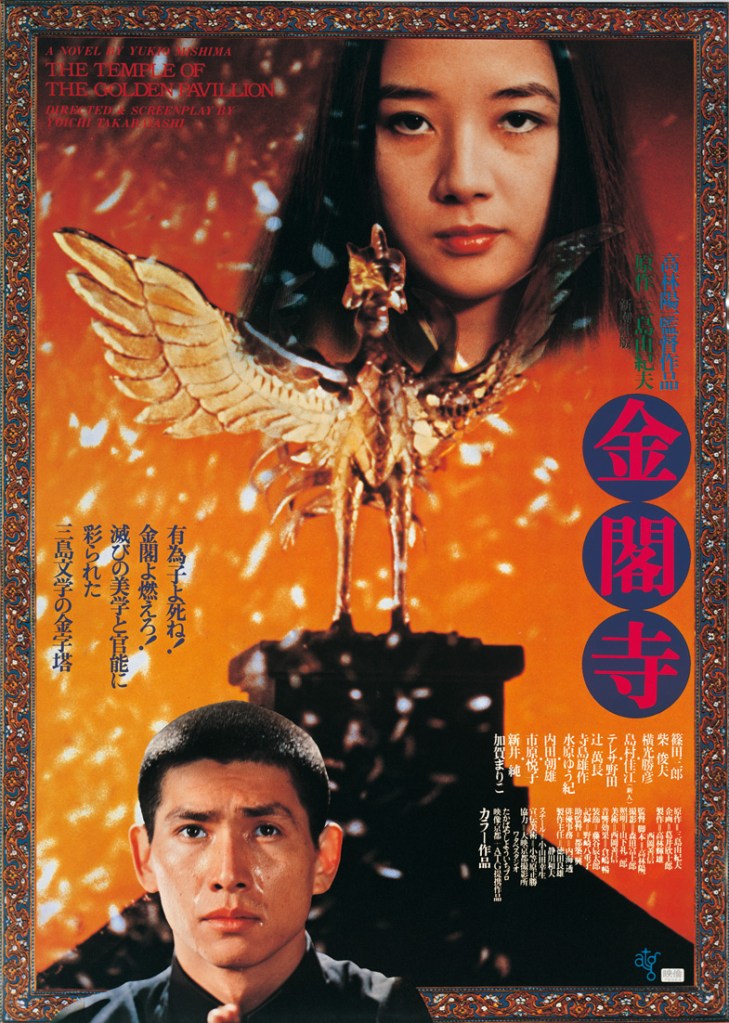
temple-of-the-golden-pavilionYukio Mishima’s Temple of the Golden Pavilion has become one of his most representative works and seems to be one of those texts endlessly reinterpreted by each new generation. Previously adapted for the screen by Kon Ichikawa under the title of Enjo in 1958,  Yoichi Takabayashi’s 1976 ATG adaptation Temple of the Golden Pavilion (金閣寺, Kinkakuji) moves away from Ichikawa’s abstract examination of the tragic idealist towards the more heated concerns of the day in its dissection of one man’s continued frustrations and his subsequent literal desire to burn the world.

According to Mizoguchi’s father (Yusaku Terashima), Kinkakuji – the Golden Pavilion, is the purest, most beautiful object the world has ever seen. After his father’s death, Kinkakuji becomes Mizoguchi’s (Saburo Shinoda) touchstone and it’s enough for him simply to be near it. Becoming a monk at a nearby temple, Mizoguchi comes under the care of an older priest who had been a friend of his father’s and is determined to look after his interests.

Interfering with his love for the temple is the spectre of a local girl, Uiko (Yoshie Shimamura), from his home town who spurned his affections due to his ugliness, stammer, and difficulty with communication. Mizoguchi’s resentment grows inside him until he begins to pray for Uiko’s death. Tragically, Uiko is indeed killed by her lover, a deserter from the army, after she first betrayed and then tried to warn him about the encroaching military police. Uiko and Kinkakuji become inextricably linked as each time Mizoguchi finds a woman willing to sleep with him, thoughts of Uiko and the temple cloud his mind, preventing him from fulfilling his sexual desires leading him to become obsessed with the idea of arson. The temple is less something too beautiful for an ugly world, than a too perfect mirror for Mizoguchi’s own faults and inadequacies, a constant reminder of the rest of the world’s baseness to which Mizoguchi would like to drag it down.

Quite clearly mentally disturbed from the outset, Mizoguchi is remains obsessed with the prophecies from his divination sticks and experiences various flashbacks to the often traumatic events of his past, all the while offering glimpses of his strange philosophy through his often poetic voice over. Largely friendless thanks to his unapproachable nature, Mizoguchi bonds with the softening influence of a fellow student at the monastery Tsurukawa (Toshio Shiba), but later falls under the spell of the cynical student Kashiwagi (Katsuhiko Yokomitsu) who uses his own disabilities to manipulate the sympathies of various women in order to sleep with and and then exploit them.

Through Kashiwagi’s tutelage, Mizoguchi begins to have more success with women but his original failure with Uiko and his attachment to the temple prevent him from fully venting his desires. Mizoguchi is also carrying a deeper seated resentment after witnessing his mother having sex with another man, seemingly with his father’s knowledge. Unable to reconcile his sexual desires with his feelings towards women by whom he feels rejected, both by his mother’s betrayal and because of his own internalised consciousness of his lack of looks and strange behaviour, Mizoguchi becomes increasingly frustrated, both sexually and politically.

With the end of the war came a new era, the old gods fell – the Emperor is but a man, but now men rule in this “strange” new democracy. Yet, in real terms, Mizoguchi feels no more empowered than he was before. Trapped inside this closing circle of impotence, Mizoguchi fantasises about murdering his mentor, the temple priest, who has since lost faith in him thanks to his cruel and unthinking behaviour. Killing the priest would change nothing, or so Mizoguchi thinks. The temple is eternal, but if he burns it, does he burn the tyranny of eternity? Calling on the ancestral spirits to destroy this venal world but receiving no reply, Mizogichi invokes Uiko and starts a new revolution born in flames designed to bring power to the powerless, burn the ignorant world away and begin again free of the temple’s tyrannous perfection.

Takabayashi’s approach is a surreal one in which Mizoguchi’s delusions are manefested as reality, climaxing as the creature atop the temple’s ornate apex suddenly begins to beat its wings. Shooting in 4:3 and switching into black and white as Mizoguchi relives painful memories, but remaining in colour for his embellished dreams of them, the atmosphere is an uncertain one which drifts from fantasy to reality without warning. Very much a youth movie of the day, the 1976 The Temple of the Golden Pavillion is less an abstract contemplation of the place of beauty in a world of ugliness, than a story of self destructive male insecurity as sexual and political impotence drive a man to destroy the symbol of his oppression. Dark and cynical as the times which produced it, Takabayashi’s Temple is an ugly tale, but a good lesson in the results of failing to listen to unheard voices.


Original trailer (no subtitles)