Ninja’s Mark (忍びの卍, Norifumi Suzuki, 1968)

Many have tried to end the Tokugawa line. Few have done so by covering a courtesan’s legs in fish scales to put the Shogun off his stride. Based on a book by Futaro Yamada, Norifumi Suzuki’s Ninja’s Mark (忍びの卍, Shinobi no Manji) is at heart a romantic tale in which love is “part of the game” but also apparently the one trick a ninja can’t escape. Perhaps that’s why Shogun Iemitsu at the comparatively late age of 30 has failed to produce an heir with any of the beautiful yet emotionally distant courtesans of the inner palace many of whom also seem to be ninjas, therefore provoking a constitutional crisis.

Aside from that, it seems the ninja plot is a kind of revenge against the Tokugawa carried out by the last remnants of a house that was dissolved by the Toyotomi. There are in fact three ninja clans all clustering around the palace, Iga, Koga, and Negoro, each of whom have different kinds of skills. Technically, some of them are in the employ of the Shogun’s disinherited younger brother Tadanaga (Shingo Yamashiro), but others of them are working strictly for themselves and their revenge. In any case, their plan is to prevent Iemitsu from fathering an heir by putting him off sex essentially by making it freaky (in a bad way). Thus one of the ninjas uses his ability to transform objects so that the courtesan’s legs are covered in fish scales. Another plan sees a ninja body swap with one of the women so that Iemitsu’s sperm ends up inside him where it obviously has nowhere to go. Meanwhile others hatch a plan to steal some of Tadanaga’s seed to use on the women in the inner palace to cover up Iemitsu’s potential infertility seeing as it is after just as good being of the Tokugawa line. 

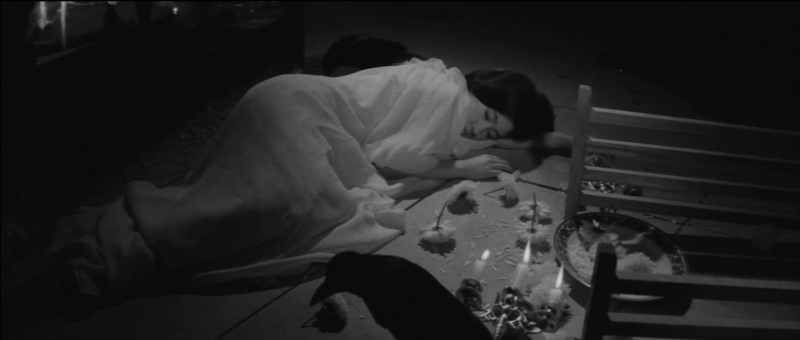
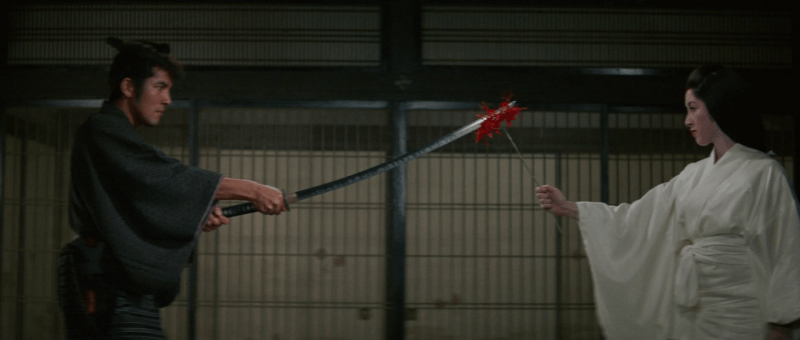
This particular ruse is suggested by Toma (Isao Natsuyagi), the disenfranchised former member of the Yagyu school turned ninja ronin they bring in to solve the problem. He quickly homes in on Kageroi (Hiroko Sakuramachi), a female ninja, as the villainess whose special power is poisoning men with love and desire by means of the spider lily plant. But as Toma points out to her, she is also a prisoner of her skill in that if she were to fall in love she would inevitably kill her lover. Of course, he survives her first attempt to kill him, leading her to fall in love with Toma and become conflicted in her mission while he plays on her emotions to escape but eventually realises they may be more genuine than he first realised. 

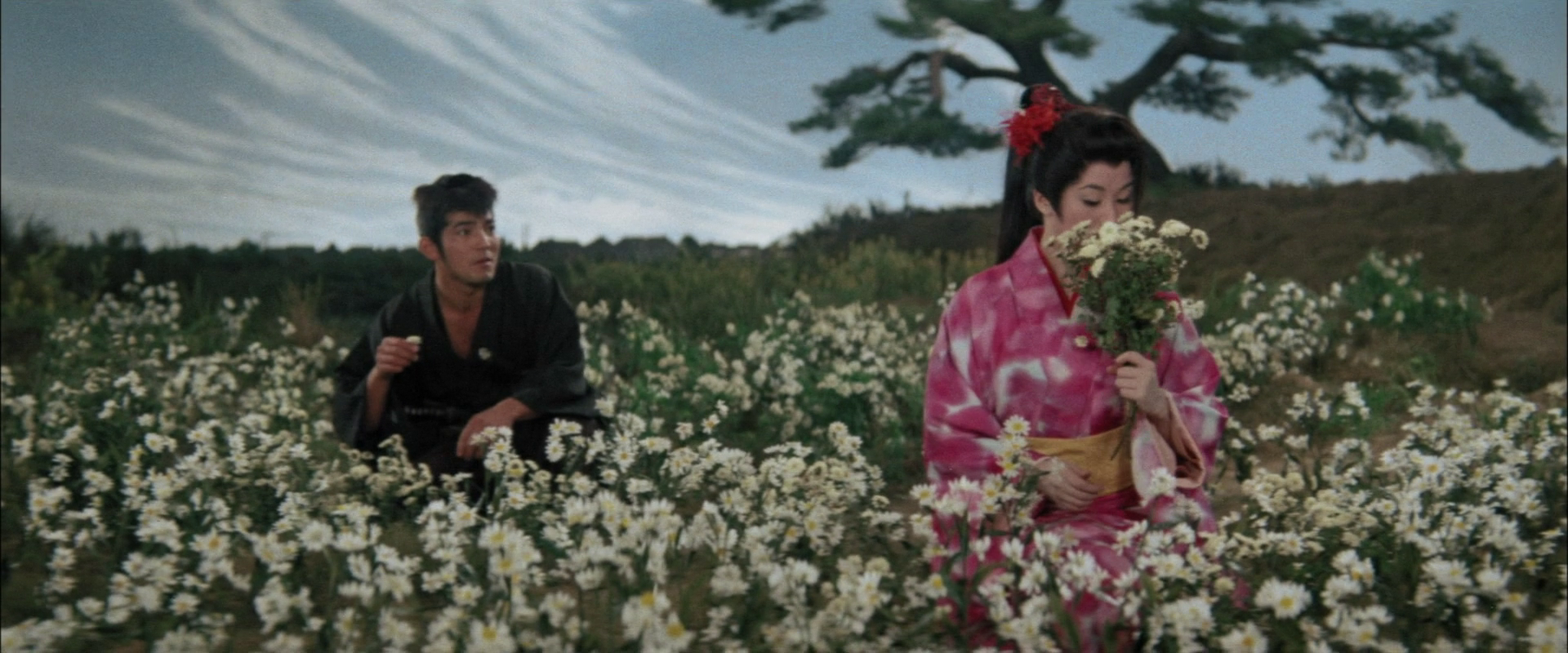
In this, Suzuki brings some of his trademark romanticism particularly in the colourful art nouveau aesthetics and frequent use of rose imagery. Though the film is clearly designed to lean into the erotic with frequent use of nudity and salacious scenes including a brief moment of lesbian seduction, it eventually heads towards romantic tragedy in which the debauched and nihilistic Toma and the wronged Kageroi discover a love made impossible by their ninja code and the times in which they live. Having been ordered to kill her, Toma declares that he will marry Kageroi in the next life and returns to her the Buddhist Manji that is the “ninja mark” of the title. 

Nevertheless, the dialogue is often suggestive as in Kageroi’s curse that Toma’s “sword” will rot, while it’s also Toma’s “sword” that alerts him to the danger she presents. Toma too claims to derive his ninja powers from his “sword” having apparently concentrated them by repressing his sexual desire and swearing off women. He says that he seals all his “distracting” thoughts into a virgin, closing off all her senses and placing her into a coma until he breaks the spell. Even so, he admits that without his “sword” he is just a man, and as a man claims to love Kageroi, but as long as he has his “sword”, and she her “lily”, their love is impossible. 

But this repressed love seems to pose less threat to the social order than the lack of it in Iemitsu who is bored with his courtesans and cannot conceive an heir. Constitutional crisis is averted only through a little ninja trickery and a convenient ruse to overcome Iemitsu’s infertility so that in time he produces five sons and a daughter, which honestly seems like it might just present another set of problems in about 30 years’ time. Like similarly themed ninja pictures, Suzuki makes good use of surrealist imagery and colour play alongside the kind of onscreen text later used in jitsuroku yakuza films to name each of the ninja’s key skills and which clan they belong to. What he always returns to, however, is the sense of romantic tragedy in a world seemingly poisoned by ambition in which love itself is rendered an impossibility. 


*Norifumi Suzuki’s name is actually “Noribumi” but he has become known as “Norifumi” to English-speaking audiences.

Yakuza Hooligans (893 愚連隊, Sadao Nakajima, 1966)

“The world has changed,” an old school street thug is repeatedly reminded after his release from prison into a new Japan amid the tides of rising prosperity. An early effort from Sadao Nakajima, Yakuza Hooligans (893 愚連隊, 893 Gurentai) situates itself in cultural and generational abyss among those who find themselves locked out of the new society and unable to escape the immediate post-war era in part perhaps because they may not really want to.

At least it seems that way for the central trio of “hooligans” who later explain to their sometime mentor that they aren’t doing petty crime because of a lack of other options but out of devilment and a childish rebellion against a world they feel doesn’t accept them. As the film opens, they’re running a petty scam luring queuing passengers into unlicensed cabs for which they are almost arrested, stiffing the cabbie that helps them escape and then conning a takoyaki vendor out of a free lunch. Several times they’re criticised for “bullying the weak,” most obviously in their sideline seducing women and forcing them into sex work or blackmailing men who sleep with them. 

They are, however, fairly weak themselves. They like to describe themselves as a “democratic” institution in which everyone is equal and everything is shared fairly but despite supposedly having no boss they’re bossed around by almost everyone and when challenged by actual yakuza quickly back down. A generation older, failed kamikaze Sugi is released from prison after spending 15 years behind bars for killing a Chinese man as part of a petty crime gang formed in the immediate chaos after the war. Unlike his former associate Kurokawa, Sugi too claims that he doesn’t see the point in having a boss but like the younger men flounders unable to see a place for himself in the new society.

Sugi doesn’t approve of the more immoral sides of their business, particularly the rape and trafficking of women but proves just how out of touch he is when he asks the guys why they can’t just swipe some rice or clothing. In the immediate post-war period, rice and kimono were the only things which held their value but in a newly consumerist Japan they’re in plentiful supply and in fact worth relatively little. While he was inside, his former girlfriend married someone else and had a child, burning the tattoo she once had of his name on her arm clean away. She tells him that she’s sorry, but she’s happy and she doesn’t want anything to disrupt the life she has now. Falling for a middle-aged woman unhappy in her marriage and subsequently forced into sex work by the gang, he dreams of a happy family life and ultimately risks all on a confrontation with his old yakuza pal Kurokawa.

The film seems to suggest that the writing’s on the wall for men like Kurokawa too. His old school world of regimented, authoritarian gangsterdom doesn’t fit in the new Japan anymore than Sugi’s corrupted post-war idealism. A subplot revolving around Ken, a mixed-race member of the gang who hates the way they treat women because his mother was raped by a US serviceman positions the Occupation as another source of corruption leaving nothing behind itself other than moral decline and lasting trauma. But as Nobuko later says as long as you’re alive you have to go on searching for something and if one place is the same as another then you might as well move. 

The hooligans, however, seem stuck in the past. They can’t stand up for themselves or mount any real resistance to their circumstances, continuing to “bully the weak” in an attempt to mask their own weakness until racing headlong towards a confrontation with the yakuza along a bridge which quite literally hasn’t been finished yet symbolising their mutual inability to progress into the new society. Shooting with a heavy dose of irony enhanced by the whimsical jazz score, Nakajima captures a sense of contemporary Kyoto as an alienating environment caught between the ancient and the modern in which men like Sugi and the hooligans are permanently displaced yet lack the desire to escape because the newly consumerist society has little to offer them. 


Original trailer (no subtitles)

Rub Out the Past (日本暗黒街, Masaharu Segawa, 1966)

A former yakuza’s attempts to shed his old identity and start again as an upscale restaurateur are disrupted by the unwelcome appearance of an old acquaintance in Masaharu Segawa’s noirish drama, Rub Out the Past (日本暗黒街, Nihon Ankokugai). Another “akokugai” or “underworld” film, Segawa’s surprisingly subversive Toei crime story involves not only the drugs trade but hints of Manchurian transgression as the hero tries to forget his past while unable to realise his love for the daughter of a man he killed on the order of his boss. 

Now calling himself Yashiro, Kageyama (Koji Tsuruta) runs a swanky bar in Kobe and is in love with his pianist Yoko (Eiko Muramatsu) who is also, though she doesn’t know it, the daughter of a former associate back in his yakuza days whom he apparently killed for otherwise unclear reasons leaving Yoko and her mother alone and defenceless in Manchuria during the evacuation at the end of the war. When a mysterious man arrives and explains he’s from “Hayami Industries”, Kageyama is reluctant to listen but eventually forced to accompany him to Tokyo where he is led into Hayami’s rather swanky new office complete with electronic displays and workers positioned in tiny booths. Since the end of the war, Hayami has become a “respectable” businessman running some of Asia’s most prestigious hotels in addition to a chain of casinos. Yet his real business is of course in drug smuggling, which is a problem because the guy he put in charge of the Hong Kong route has drawn the attention of the police. He makes Kageyama an offer he can’t refuse ,much as he tries, to take it over. He accepts on the condition it’ll just be a one time thing. 

In any case, Kageyama’s involvement with Hayami soon costs him his relationship with Yoko, who is aware of Kageyama’s criminal past but blames Hayami for her father’s death, and with it a potential for redemption. Details are few, but there are constant references to the gang’s illegal and immoral dealings in Manchuria, a time that Kageyama is keen to leave in the past having made a new more honest life for himself in the post-war society while Hayami has shifted into the increasingly corporatised realms of contemporary organised crime. Yet despite himself Kageyama is good at being a gangster, effortlessly subduing the bumbling head of “Sekiya Industries” and realising that part of the problem is that too many of his men are getting high on their own supply. To streamline the business he lays off drug users telling them to come back when they’re clean and temporarily pauses the business while he reorganises it at street level. This however leaves a small vacuum in the underworld economy which is soon filled by “alternative” suppliers. 

More akin to one of Toho’s spy spoofs, Hayami Industries seems to be incredibly keen on zany gadgets like cigarette lighters that double as secret radios and guns which shoot listening devices not to mention the panel wall which hides Hayami’s secret control room or the knuckle dusters and belt swords sported by the Sekiya guys. All of which is slightly at odds with the seriousness of the constant reminders of abuses in Manchuria and on the Mainland, and the frankness with which drugs are treated onscreen with frequent shots of syringes and powder. As usual in these films, the main villain is from Hong Kong, an unhinged maniac who kidnaps Yoko and gets her hooked on drugs partly at the instigation of Hayami who seems to be making something of a strategic blunder in his attempts to manipulate Kageyama. Yet Kageyama can only get his redemption through reassuming his wartime persona to face Hayami if indirectly in trying to engineer a gang war between middlemen with Hong Konger Tei caught in the middle. 

Segawa adds to the noir feel through the melancholy jazz score reinforcing the fatalism and futility that seems to define Kageyama’s life as he tries but fails to escape from his violent past. A product of wartime misuse he finds himself at odds with the contemporary society, inconveniently falling in love with the daughter of a man he killed and therefore unable to move on from the shadow of his life of crime only granted a second chance after losing everything and paying his debt to society by destroying the system he himself helped to create. 


The Ghost of the Hunchback (怪談せむし男, Hajime Sato, 1965)

The old, dark house fetches up in Japan in Hajime Sato’s slice of weird, gothic horror The Ghost of the Hunchback (怪談せむし男, Kaidan Semushi Otoko, AKA House of Terrors). Long in circulation only in an Italian dub, Sato’s B-movie romp owes an obvious debt to Mario Bava but also to similarly themed gothic chillers such as Robert Wise’s The Haunting somewhat repurposing the central nexus of the cursed mansion as a black hole of morality sucking into its orbit the sinners of the post-war society each it seems both victims and embodiments of their times. 

Opening in true gothic fashion with lightning and a full moon, Sato zooms in to a strangely creepy yet ordinary Western-style villa where the soon-to-be widowed Yoshie (Yuko Kusunoki) is woken from a dream in which she had a premonition that her husband, who we learn has been in a vegetative state for some time, had something he desperately wanted to tell her. Shinichi has indeed passed away while apparently imprisoned under the care of his father, Munekata (Kazuo Kitamura), a psychiatrist who seems less than moved by his son’s death describing it as the least he could do to repay the debt he owed to his parents. It seems that Shinichi had been in the hospital following an “incident” some time previously and though Munekata insists that his brain had been “destroyed”, younger doctor Yamashita (Shinjiro Ebara) echoes Yoshie’s dream in informing her that immediately before he died it seemed that Shinichi, who had long been mute, was desperately trying to tell him something. Meanwhile, Yoshie begins hearing strange noises emanating from the coffin and opens it to find a chrysanthemum clenched between her husband’s teeth. 

After the funeral, she’s visited by a lawyer claiming that Shinichi entrusted a key to him to be given to his wife in the event of his death along with the deed for a mountain villa where “the incident” took place. Later, everyone comes to the conclusion that what Shinichi wanted to tell them was not to go to the mansion, but of course what else was Yoshie supposed to do other than investigate. A classic gothic estate swathed in fog and hidden behind ornate iron gates, the remote country house also turns out to have a hunchback custodian (Ko Nishimura) as well as a weird, demonic statue standing inconveniently in the hallway. Soon after arriving Yoshie is attacked by a crow, told of “the incident” by the hunchback, and begins to hear strange noises including disembodied laughter before she is eventually joined by Munekata, Yamashita, and her niece Kazuko (Yoko Hayama).

Yamashita tries to rationalise that the noises are just the normal kinds of creaking born of “deformation” as a building naturally ages, literally becoming warped with time, while the stress of living in such an environment, he claims, can eventually drive one mad. He’s come along to investigate believing that Shinichi’s illness is connected to the mansion. Yet the old, dark house in this case is somewhat divorced from its gothic roots in being transported to Japan where it is in a sense “new” and “foreign” rather than an ancient relic weighing heavily on the shoulders of declining aristocracy. Even so we do indeed have something of that in the later revelations of previous owner Baron Tominaga and his particular grudges which, in this case, are if only partially rooted in wartime trauma, the mansion apparently also once home to an anti-aircraft depot the remains of which can be seen in the grounds. 

The war may not be the corrupting force in play but it’s certainly a factor, especially the surprising accusation thrown at Dr. Munekata that he participated in wartime atrocity in being party to vivisection, a claim he does not dispute but defends in insisting his actions were justified in the name of science. The house has not so much called them, but each of the “guests” is in their own way morally compromised, Munekata not only a war criminal but a venal, lecherous old man hoping to get his hands on the house to open a sanatorium by fulfilling his quasi-incestuous desire for Yoshie. Yamashita, meanwhile, is not exactly pure hearted either, using what he knows about Munekata to blackmail him into standing down so he can become the director in his place and marry his wealthy girlfriend, Akiko (Keiko Yumi), who has also turned up to join in the haunted house fun. As far as sin goes, Yoshie is largely without it but perhaps pays for daring to own her sexuality, rejecting Munekata’s advances but apparently having made a habit of getting into bed with her comatose husband despite knowing of his many affairs which may be the reason for his punishment by the house. Only Kazuko remains pure and innocent save her one-sided attraction to Yamashita, the only one of the gang to show any kind of compassion towards the admittedly strange hunchback. 

In keeping with the house, Tominaga and the hunchback are later revealed to be Christians, though in a gothic inversion they are also the source of the “evil” that infects the creepy old mansion once again positioning Christianity as a foreign corruption but also in this case punishing post-war moral failure. Sato conjures an atmosphere of pure gothic chill complete with oversize cobwebs, doors which open and close on their own, a crow infestation, and even a passing shinto priestess (Mitsue Suzuki) who just had to drop in because of the powerful emanations of evil echoing from the mansion but leaves his collection of extremely flawed humans very much at the mercy of their own demons as they desperately try to escape from the House of Terrors. 


Snake Woman’s Curse (怪談蛇女, Nobuo Nakagawa, 1968)

The landed gentry find themselves haunted by the feudal legacy in Nobuo Nakagawa’s Meiji-era ghost story, Snake Woman’s Curse (怪談蛇女, Kaidan Hebi-onna). Though the figure of the vengeful ghost is rightly feared, they are rarely directly dangerous pushing their targets to damn themselves as they rail against the manifestation of their deeply buried guilt, yet the guilt here is perhaps buried deeper still as those who once had power find themselves floundering in the death throws of feudalism. 

As the opening voice over explains, the screen oppressively letterboxed to an extreme degree, the tale takes place in Onuma, a small village yet to be Westernised where the ruling family brutally exploit the tenant farmers still regarded as part of their fief. Old Yasuke (Ko Nishimura) chases after the local lord Onuma (Seizaburo Kawazu) and begs him not to kick him off his land, vowing that even if he has to eat dirt he will repay his debts. Onuma pays him no attention and Yasuke is soon thrown by the wayside after trying to catch hold of his cart. Concussed, all he can do is repeat his pleas not to lose the farm, and though he seems to recover passes away some days later leaving his wife Sue (Chiaki Tsukioka) and daughter Asa (Yukiko Kuwahara) alone. Heartless, Onuma evicts the women and knocks the house down to plant mulberry trees in its place while offering them “jobs” in his household for which they will not be paid for at least 10 years while they work off Yasuke’s debts. 

In addition to terrorising the peasants on the land, we discover that the Onumas are also running a sweatshop, a sign on the wall of Asa’s new place of employment reading that she must rise at 4am and be at work by 5 where she must stay until 9pm. There is to be no talking between the women in the workplace. Sue meanwhile is enlisted as a maid, but Onuma’s wife Masae (Akemi Negishi) immediately takes against her while she is continually sexually harassed by Onuma. Like father like son, the young master Takeo (Shingo Yamashiro) has also taken a fancy to Asa, though he is soon to be married to the daughter of the local mayor (Yukie Kagawa), a match all seem to regard as auspicious. 

Immediately after his soul vacates his body, Yasuke fetches up to haunt Onuma who is perhaps more affected by his guilt than his feudal upbringing would allow him to admit. Questioned later, he likens the peasants on his land to worms in the earth claiming that the deaths of one or two are no real matter and in any case nothing at all to do with him. “You people can survive drinking water and eating anything” he cruelly snaps back seconds after exclaiming he will fire the entire weaving staff as if that would put an end to the curse, paying little consideration to the fact he’s likely just condemned them to starvation. An exploitative landlord, he cares nothing for his feudal responsibility and all for his privileges. He and his son reserve the right to do as they please, regarding peasant women as theirs to be taken and having no real right to refuse. They do not believe there are any consequences for their actions because they are in a sense above the law of the land. 

Yet modernity is coming. We see our first uniformed policemen descend on the village after Sutematsu (Kunio Murai), Asa’s intended before her virtual enslavement through debt bondage, creates a scene at Takeo’s wedding in protest of the family’s treatment of Asa. Onuma’s attempts to reject the authority of the police in refusing their summons, describing it as “rude”, roundly fail, as do his attempts to leverage his feudal privilege in threatening to have the police chief fired in order to avoid answering his questions. His grip on authority is weakening as power necessarily reverts to the mechanisms of the state rendering him in some senses equal with those who till the soil. 

Even so, it’s spiritual rather than Earthly justice which will eventually do for him. The ghosts, such as they are, are mere echoes of time repeating the essential messages of the moments in which they died. Yasuke pleads for his land, he does not harm Onuma directly but causes Onuma to harm himself as he thrashes around trying in vain to vanquish a ghost with his gentleman’s cane. The family is, essentially, crushed under the weight of their feudal injustices as their noble house collapses all around them with modernity knocking on the door. Shooting in unusually lush colour, Nakagawa makes the most of his famously effective ghostly apparitions, finally drenching the screen itself in blood, but closes with an image of serenity in which justice of a kind at least has been served leaving the wronged to walk peacefully towards salvation while their tormentors will perhaps be travelling in another direction condemned not only for their own heartless venality but for that of the system that allowed them so ruthlessly to exploit those they ought to have protected. 


Original trailer (no subtitles)