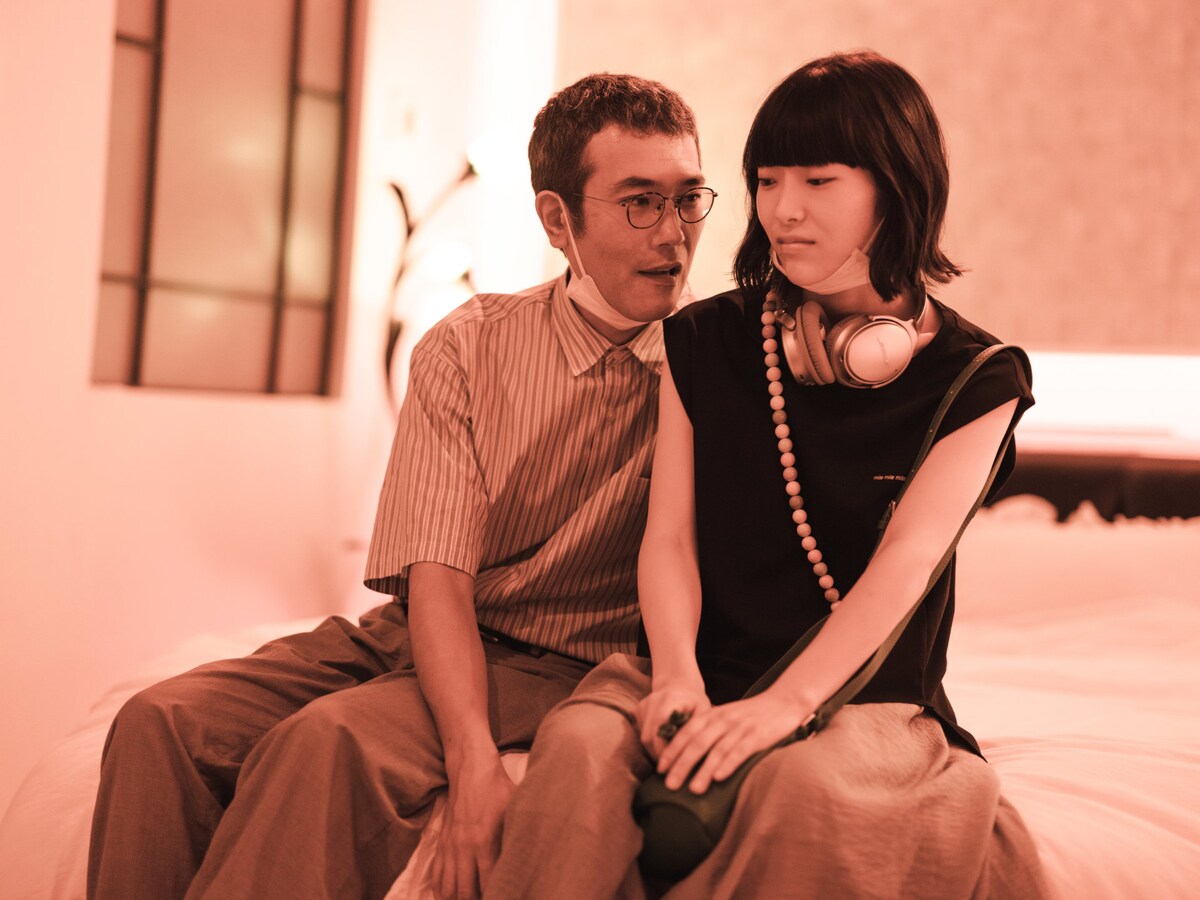
During the Rains (つゆのあとさき, Shinpei Yamazaki, 2024)

At several points during Shinpei Yamasaki’s indie drama During the Rains (つゆのあとさき, Tsuyu no Atosaki) we encounter someone whose life has been disrupted by the economic effects of the coronavirus pandemic. The danger is, of course, that the pandemic itself becomes the problem which is also a way of glossing over all the problems that existed before and will likely survive whatever kind of sickness they encounter. Chief among those problems and impacting the lives of the women at the film’s centre is problematic men and the generalised disregard for women.

It seems that Kotone was working in hostess bar that closed because of the pandemic while her no good boyfriend ran off with a necklace a customer had given her. Left with nowhere to go she’s noticed on the street by Kaede, a young woman who promises her a room in a love hotel but does so in order to recruit her for a threesome. Sometime later Kotone is working in a “cafe” where young women sit behind a glass window in numbered booths for male customers pick out and select though she also has a “daddy”, Kiyooka, who pays the lease on her flat and would be annoyed to discover she was still frequenting the cafe.

It’s the at the cafe that she meets Sakura, a naive young college student who was pushed into sex work when the place she was working before closed down because of the pandemic. Kotone at one point snaps back at her that she wouldn’t even be at the cafe if it weren’t for the pandemic as if suggesting she were in some way better than the other girls after she reacted with horror to Konone’s plan to find a “hardcore daddy” who’ll pay more for the right to break a few bones and cause other kinds of harm.

This might be ironic in a sense as Sakura is a Christian who carries around bible verses to calm herself down including the ones about turning the other cheek and blessing those who persecute you which don’t seem to be particularly good advice for the situations she finds herself in especially as the lesson she’s learned from them is that you should accept whatever abuse comes your way without complaining. Ironically that might be what Kotone has been doing in her almost total indifference to her circumstances. The Roomba in her apartment gets stuck in her hallway and shuffles in confusion between the walls after constantly butting its head unable to find a way out. Yet according to Kiyooka what separates Kotone and Sakura is that Sakura seems desperate in a way Kotone does not which is a quality he appreciates presumably because it gives him more control over her, something he knows he doesn’t have over Kotone who point black tells him she has no strong feelings about whether he dumps her or not after he discovers she’s still seeing other men and engaging in casual sex work.

The lollipops she’s always sucking on give Kotone a slightly childish edge as perhaps does her moodiness but she’s also cynical beyond her years and seemingly living the way she does almost as an act of self harm. She’s being relentlessly trolled by someone who accuses her of having a sexually transmitted disease while even the other girls at the cafe resent her, ironically calling her a slut and other misogyinistic insults. Later she’s even knocked down some stairs by a previous client who is resentful that she doesn’t really remember him while another of her regulars, Yata, paws at her insultingly as if feeling himself entitled to her body. Another customer whose wife and daughter left him after his business failed asks her why she does this, adding that he’s worried about his daughter which seems to be an incredibly ironic comment given the situation.

Even the girls at the cafe complain that they’re getting les work because of the influx of women showing up there after being pushed towards sex work out of desperation, but it’s almost as if the film would like to believe the pandemic was the problem rather than attitudes society has towards these women and indeed all women. Nevertheless, through her growing friendship with Sakura and an unexpected tragedy Kotone comes to realise that she can perhaps change her circumstances and does not necessarily have to continue turning the other cheek to a society that had largely turned its back on her.
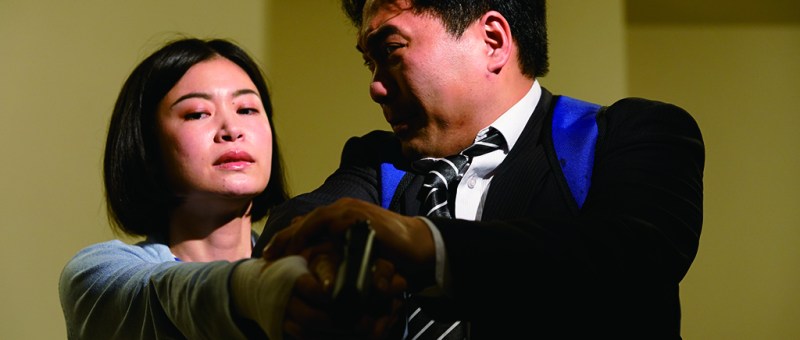

Howling (遠吠え, M Haris Sheikh, 2022)

“What do you want from the world?” the sad sack hero of M Harris Sheikh’s noirish drama Howling (遠吠え, Tooboe) is asked on three separate occasions giving first a non-answer, then the answer he’d like to give, then the real one which is far less heroic or edifying but at least honest. Like everyone else, he too is howling into a void putting a brave face on his inner insecurity while longing to play the hero in his own life only to discover that no matter how many chances he’s given he may not be up to the mark. 

A self-professed nice guy, we first meet Ryuji (Ichiro Hashimoto) trying to help a young woman at the karaoke bar where he works escape sexual harassment in the workplace promising that he can protect her while pledging to kick the other guy’s ass, only as it turns out the other guy is her boyfriend and it’s Ryuji who’s been harassing her. Quite clearly uncomfortable, the young woman informs Ryuji she’s already reported him to HR and he’ll probably be fired today which is exactly what happens but rather than take this as an opportunity to learn Ryuji goes around telling everyone it was all a misunderstanding and he’s fallen victim to a needlessly judgmental society. “The world is tough for middle-aged men” he adds, lamenting that even having a “friendly discussion” with a younger woman has somehow become inappropriate. 

It’s these twin facets of his personality that go on to precipitate his downfall in his intense desire to conform to the masculine ideal as a protector when coming into contact with two women who are each in need of his help. Apparently never having had a girlfriend, Ryuji is overexcited when a 20-year-old college student, Akane (Yukino Takahashi), contacts him, a 40-year-old man, on a dating app never really considering that there might be something untoward going on right until the moment she explains that she’s trying to hire a randomer to kill her abusive father who happens to be the chief of police which is why she can’t hire a professional. Meanwhile, a school reunion grants him the opportunity of reuniting with middle-school crush Chisato (Sonae Kotani) only to discover that she has since married the bully, Tsuchida, who made their lives miserable and is trapped in an abusive relationship. Ryuji had been unable to protect her when they were children but claims to be different now. Then again Tsuchida said the same the thing and clearly hasn’t changed at all. Hoping to solve all his problems by getting a sudden windfall and proving that he can be the hero, Ryuji agrees to Akane’s plan but of course eventually disappoints himself realising that his fantasy of being a saviour is just that. 

Meanwhile the two women, who happen to be neighbours in a swanky high rise apartment block, begin by believing that they cannot escape their situations alone but need a male saviour each placing their hopes in the overeager Ryuji but finally freeing themselves perhaps spurred on by Ryuji’s male failure but otherwise rendering him an irrelevance. By the final confrontation each of the trio has sustained a wound to the hand to which Akane and Chisato jokingly refer as an eye of truth just like the hero from a manga yet with its own degree of truthfulness in that the women begin to see that their freedom is theirs for the taking while Ryuji is finally forced to accept that his presence is unnecessary proving his mettle only with a gesture of nihilistic futility. 

On the other hand we can also see the hand of a highly pressurised society on his fragile masculinity as he accidentally bonds with a pair of weird street preachers crying out for revolution but with an ironic bent. The first is a former Todai graduate who lost a good job in advertising because of all his unhealthy coping mechanisms. He preaches about a creating a truly fair society free of inequality brought about through a deadly virus claiming that his guru, the Master, is the origin not only of the coronavirus pandemic but every other dangerous pathogen known to man. Somewhat contradictorily, the Master reveals that he once lived in a swanky high rise apartment and would like to do so again which sounds somewhat incompatible with the goals of his revolution assuming he’s not planning to build so many that everyone who wants one can have one. The contradiction is further borne out in Ryuji’s answers about what it is he wants from the world, firstly stating ordinary requests such as a decent job, home, wife, children etc before admitting he’d actually prefer a really big house, lots of women, and respect from other people the last emphasising his internalised sense of belittlement and failure. 

The world that Ryuji inhabits does indeed seem to be oppressive and ominous, the strange overgrown alleyway below an overpass where he first encounters the revolutionaries reflecting the dark path of his soul while in the film’s complex production design the sterile space of the upscale tower block becomes a kind of trauma room where truths are aired leading to the final confrontation whimsically scored with circus music in which the women literally take matters into their own hands, and even the diner where Ryuji meets Akane takes on a Lynchian sense of the uncanny. Darkly humorous with its deadpan gags of giant spaghetti and the completely random entrance of an unrelated older woman also with a glove on her right hand ranting about her daughter’s hairdresser boyfriend and his koala neck tattoo, Sheikh’s absurdist drama quietly builds to its theatrical conclusion bringing down the curtain on a bloody tableaux the world as prophesied turned upside-down.  


Howling screened as part of Osaka Asian Film Festival 2022

International trailer (English subtitles)