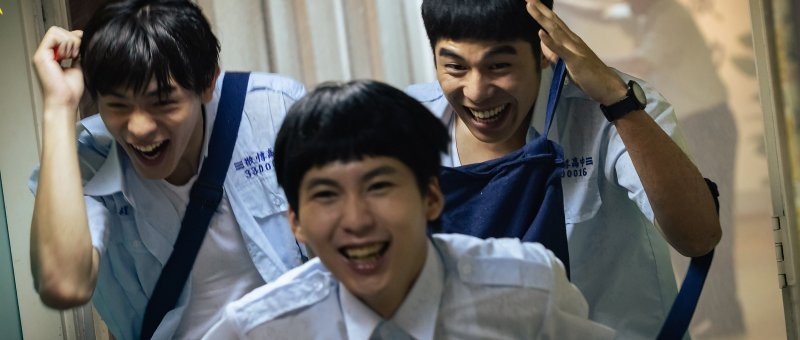
After School (成功補習班, Lan Cheng-lung, 2023)

In an odd kind of way, Lan Cheng-lung’s autobiographically inspired coming-age drama After School (成功補習班) charts how far Taiwan has come since the mid-90s while pivoting around the figure of Mickey Chen, a hugely influential LGBTQ+ filmmaker who passed away 2018. Chen was in fact Lan’s own cram school teacher and in terms of the film a voice for the future giving the children the permission to be themselves in the post-martial law society even as they struggle to break free of the authoritarian and fiercely patriarchal past. 

In a sense, cram school itself is the manifestation of that culture in that most of the kids have been forced to go there by their parents to pursue futures not of their choosing. The hero Cheng Heng (Zhan Huai-Yun), Lan’s stand in, wants to be a filmmaker but his dad wants him to be a maths teacher. That might be one reason he and his friend Cheng Hsiang (Chui Yi-tai), who lives with his family because problems with his own, spend most of their time messing around and playing childish pranks on the teachers and admin staff. Meanwhile, they’re far mare interested in potential romance than studying with Cheng Hsiang a bit of a ladies man and Cheng Heng nursing a crush on the school’s most popular girl Chen Si (Charlize Lamb). 

Nevertheless, the closeness between the boys gives rise to a few rumours that they may be gay. The idea is only further cemented by an ironic incident in which Cheng Heng sustains an embarrassing injury to his groin while watching a pornographic video he swiped from a cousin little realising that it was actually gay porn. His parents, or really more his father, do not take well to this and see it perhaps as just more evidence of his rebelliousness and lack of respect for his family in his desire to follow his own path rather than the one they’ve set down for him of getting a steady, respectable job as a teacher. 

That’s one reason that the arrival of Mickey (Hou Yan-xi), a recent graduate taking a temporary teaching job to save for studying abroad, is thought so disruptive because he encourages the kids to be who they are not who they’re taught to be. Mickey holds progressive sessions on sex and sexual identity, explaining concepts such sexual orientation and safe sex which is surprising not least because this is a cram school which exists solely to help kids do well on standardised tests rather than give them any broader kind of education. The headmaster, who is also the father of the boys’ friend Ho Shang (Wu Chien-Ho), is by contrast an authoritarian remnant of the martial law era who can’t permit any kind of liberalisation or individualisation and often inflicts corporate punishment on pupils deemed to have transgressed the rules of a polite society. 

But it’s Mickey who tries to help the boys accept and become comfortable with their sexuality and that of others, taking them to a gay bar where he interviews several of the regulars for his documentary. The barman once entered a marriage of convenience and had a child to please his parents but feels deep guilt and regret for the way he treated his wife and his since been disowned by his family. Now he hosts a New Year dinner for others like him who have nowhere else to go because their families have rejected them. The boys too are rejected by their fathers solely on the suspicion of homosexuality while the mothers remain broadly supportive of their children but trapped by those same patriarchal social codes caught between their authoritarian husbands and love for their sons.

Yet even with these more distressing themes, Lan’s film is at times a little too rosy, sticking to its lighthearted tone rather than fully address the implications of society’s attitude to the LGBTQ+ community in the mid-1990s as opposed to that of today in which Taiwan became the first Asian nation to legalise same sex marriage. Nevertheless, it presents a warm-hearted firsthand account of the effect Mickey had on those around him as the teens rebel against the authoritarian past to embrace their freedom and identities, no longer afraid to speak their feelings but determined to be themselves and accept the selves of others rather than live under the constraints of oppressive patriarchy and traditions.


After School screened as part of the 18th Season of Asian Pop-Up Cinema.

Trailer (Traditional Chinese / English subtitles)
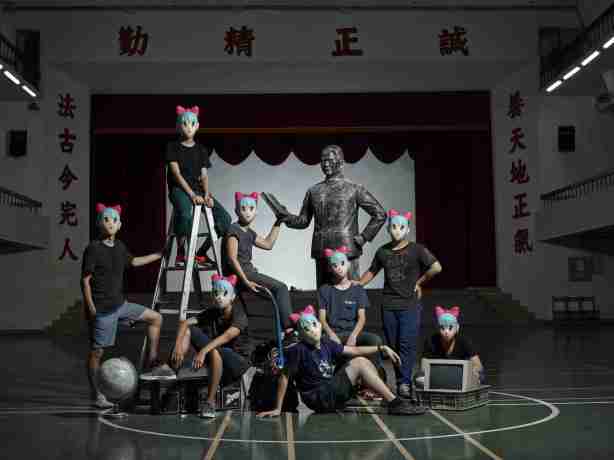
Salute! Sun Yat-Sen (UK Anime Network Review)

articlesubpic1597Reviewed the latest film from Blue Gate Crossing director Yee Chih-Yen Salute! Sun Yat-Sen for UK Anime Network. Also interviewed the director when he was here for the film’s screening as the closing night gala of the 2015 Chinese Visual Festival (under the old title of Meeting Dr Sun). This will also be getting a DVD/VOD release from Facet Film Distribution on 27th July if you didn’t manage to make it to the festival. Good movie, kind of cute but with bite too.


Salute! Sun Yat-Sen is the long awaited new film from Taiwanese director Yee Chih-Yen which arrives a massive 13 years after the award winning Blue Gate Crossing. Like Blue Gate Crossing, Salute! Sun Yat-Sen centres around the everyday life of teenagers with a subtle level of social commentary though this time it swaps sexuality for social inequality and complicated male friendships.

Lefty is a typical high school boy, at once giddy and lackadaisical. His major problem in life is that he’s behind on his school fees and despite his attempts to dodge the issue, it’s become an embarrassment for him around the school. Lefty lives with his grandmother who’s on a low income and he simply does not have the money to pay. That’s when he catches sight of an abandoned metal statue in a school storeroom and hatches on a plan to steal it and sell it for scrap. However, just when it looks like the plan is complete, Lefty and his friends discover another group of boys has hatched on the same idea! It’s then up to Lefty & co to figure out a way of getting to the statue before the other gang.

Salute! Sun Yat-Sen mixes comedy caper tropes with high school drama as the boys try to beat each other to this overly symbolic statue that they intend to sell for scrap. The plan is, of course, a little bit ridiculous – first of all the business of sneaking an extremely heavy and cumbersome metal statue out of the school with no one noticing and then simply taking it to a scrap metal merchant and selling it, all without anyone asking how exactly they came by this distinctive statue, is quite a childishly naive plan but one which makes for quite a lot of comedy. One of the best moments being the boys trying to buy masks to hide their faces from the security cameras and having to go for the cheapest one which happens to be a horrible anime style face which is so cheaply priced because it’s made from an awful plastic which gives you a rash and makes your face itch if you wear it too long.

Sun Yat-Sen is obviously a hugely important, inspirational and well known historical figure particularly in Taiwan but also across mainland China. However, it has to be said that he is not such a well known figure in the UK and, especially as his name is not even mentioned until a news report close to the end, UK viewers may find that the symbolism his name carries is largely lost on them as is the film’s subtle social commentary. Briefly put, Sun Yat-Sen was the “father of the Chinese Republic” who sought to steer China towards a democratic and more egalitarian society after the collapse of the Qing dynasty and the Chinese revolution in 1911. Sadly, his utopian vision for the new China was not to be but his idealism and humanitarian thinking are still widely praised in Chinese culture. He also still appears on Taiwanese bank notes and so may be primarily linked with money in the minds of these young boys, but there is a central irony that it’s a statue of the left leaning Sun Yat-Sen that these money strapped young men have chosen to steal and melt down to get the money they so desperately need to get by.

However, even without grasping all of the complex political allusions to Taiwanese cultural issues both historical and contemporary, Salute! Sun Yat-Sen still succeeds as a warm and amusing coming of age tale in which a group of teenage boys on the cusp of adulthood come to realise a few things about themselves and the culture they live in. Though the central two boys are in someways very different, in other ways they have a lot in common and it’s a fun ride seeing how their conflicting personalities rub up against each other until a tentative friendship eventually develops. The second boy (who repeatedly avoids telling Lefty his name throughout the film) is, in many ways, in a far worse position than Lefty which has made him bitter and devoid of hope for the future but thanks to Lefty’s optimism perhaps begins to think it’s not all as gloomy as he once thought.

Like Blue Gate Crossing, Salute! Sun Yat-Sen is a quiet sort of film where plot takes second place to character (although all the heist shenanigans are undeniably entertaining – especially one horror movie inspired episode). The film feels authentically youthful, manages to imbue its young cast with an unusual degree of realism and it’s very hard not to be charmed by Lefty’s giant smile and happy go lucky attitude. Simply put, Salute! Sun Yat-Sen is unlikely to spark a revolution but its quietly encouraging messages are certainly a good start.