Forever Young (栀子花开, He Jiong, 2015)

“As long as you don’t give up, it’s never too late to follow your dream” according to a sympathetic teacher perhaps incongruously advising a conflicted student who might in one sense be facing an ending but also has his whole life in front of him. Apparently inspired by a song from 2004, Gardenia in Blossom, Forever Young (栀子花开, Zhīzihuā Kāi) ironically concerns itself with the lives of a collection of youngsters facing their first roadblock as they approach the end of university while their dreams seem further away than ever. 

Popular girl Yanxi (Zhang Huiwen) has her heart set on joining the Paris Opera Ballet along with her three roommates with whom she dances the Dance of the Four Swans. Yanxi’s boyfriend Xunuo (Li Yifeng), meanwhile, dreams of making it as a rockstar with his three bandmates. The combined group of friends, cheerful and excited about celebrating Yanxi’s upcoming 21st birthday, are upbeat about the future and looking forward to their graduation concert “Dream Night” at which they hope to catch the eye of influential people. When tragedy strikes however and it seems the girls will not be able to perform, Xunuo makes a surprising decision, roping his bandmates in to take their place and dance the Dance of the Four Swans in their stead. 

Mirrors of each other, Yanxi and Xunuo can each be blinkered and self-centred. Yanxi takes it for granted that the group all want the same thing and are determined to go to Paris with her but apparently hasn’t noticed that her friends have their own problems and at least one may not be able to afford to go abroad because she’s already subsidising her brother’s education. Stubborn and unsympathetic, Yanxi later comes to regret having been so unforgiving as she faces the prospect of continuing alone only to encounter yet another setback. Xunuo meanwhile does something similar in convincing his bandmates to join him in the Four Swans project at the expense of their own dream in taking time away from their band practice while forcing them to don tutus and possibly make fools of themselves in front of all their friends. 

Asked why she chose ballet, Yanxi replies that standing on tiptoes allowed her to see further, but now she worries she’s been suffering with a particular kind of myopia in having seen nothing at all while still clinging on to a vain hope for her Paris dream. The idealised relationship between the pair is marred only by Xunuo’s petulant decision not to get on the bus with everyone else after their night out when Yanxi reminded him she was bound overseas, and her later despondency as they’re temporarily forced apart by Xunuo’s secret plan even while his strange rivalry with a former friend with whom he wrote a plaintive love song takes on an overtly homoerotic quality.  

Nevertheless, there’s something of an incongruity in such young people being constantly reminded that as long as you don’t give up there’s always time to achieve your dreams though it’s true enough that they’re each at a crisis point, about to lose the student safety net and faced with the choice of whether to keep trying to make it or go for the “safe” option of heading into the workforce. Xunuo declares that he just wants “all the sadness and troubles to go away”, only for his teacher to point out that if you’ve nothing to overcome then you’ll never grow. The presence of tragedy never seems to touch them as deeply as one would think, though at least through Xunuo’s vicarious dancing dream the guys are able to renew their friendships, acknowledging their own strengths and weaknesses as they work together in memory of absent friends and perhaps their own fading youth. 

A strangely cheerful campus drama despite its darkness and the foreboding of the title, Forever Young allows its heroes to be just that as they promise themselves that as long as they refuse to give up it’s never too late for their dreams to come true while also subtly hinting at a new ideal of masculinity in the infinitely sensitive Xunuo who is selfless and kind and just wants everyone to be happy. An overly idealised conclusion perhaps as the youngsters bid goodbye to their adolescent lives for the stormy seas of adulthood, but also a reassuring one as they emerge from their respective traumas and hardships with renewed hope for the future.


Forever Young streams in the US Feb. 12 to 18 as part of Asian Pop-Up Cinema’s “Happy Lunar New Year!”

Original trailer (English subtitles)
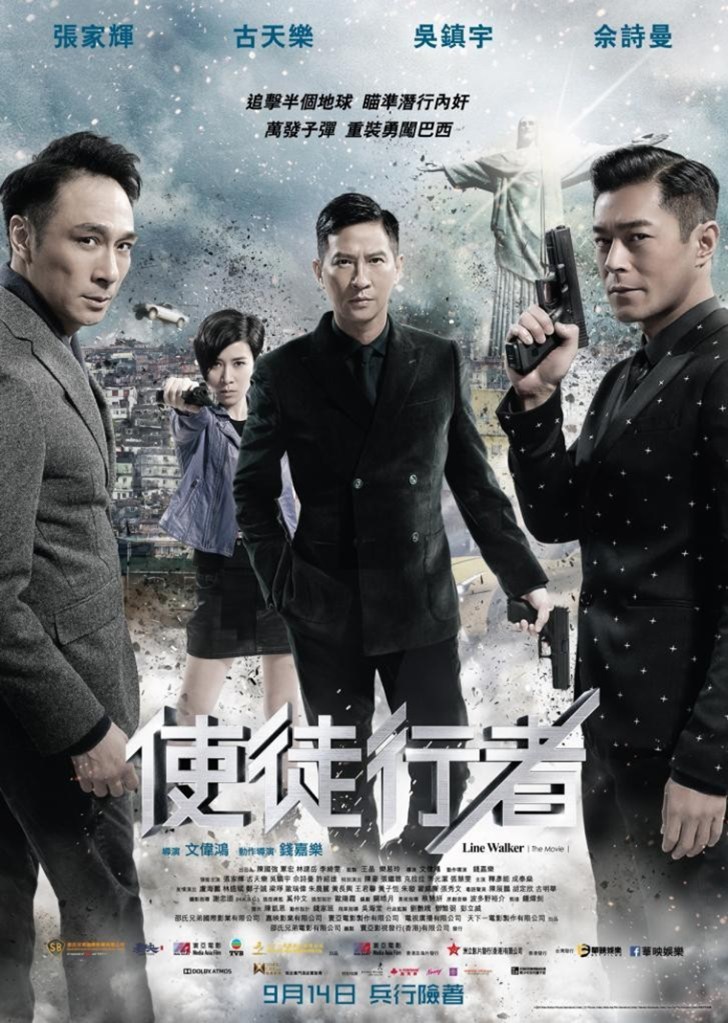
Line Walker (使徒行者, Jazz Boon, 2016)

When sitcoms make the transition to the big screen, they usually do so by going on holiday. Police procedurals are no different as Line Walker (使徒行者), a cinematic outing for a wildly popular Hong Kong TV series, proves by throwing its hat into the global ring with a Brazil bound drug based gang war. Taking more than a little inspiration from the classic undercover cop drama Infernal Affairs, Line Walker joins former undercover officer Ding and her handler Q as they receive a mysterious message from a missing operative identifying himself only as “Blackjack”.

Two years ago (as detailed in the TV series), a top Hong Kong detective, Hong, managed to find just enough time before being murdered to wipe all his data relating to officers currently working deep cover. Ditzy cop Ding (Charmaine Sheh) was one such asset, and together with her boyfriend who is also her boss, Q (Francis Ng), managed to round up and bring in all the other operatives save one whose file was corrupted beyond recovery. Therefore when they receive a message written in Hong’s unique code signed “Blackjack” they are cautiously optimistic.

The trail leads them to a corporatised Triad gang currently engaged in the usual Triad business of petty gang wars over drugs, territory, and power. Shiu (Louis Koo) and Lam (Nick Cheung) are best buds and underlings in the organisation with their eyes on bigger prizes. Making a trip to Brazil to broker a drugs deal the pair get themselves into various kinds of trouble which is only compounded by the “Blackjack” issue and suspicions of a possible mole in the gang.

Ding and Q are the only returning characters from the TV series which has received significant upgrades in the big screen jump with the addition of several Hong Kong superstars including Louis Koo and Nick Cheung. Though the central narrative stands alone, there is a degree of assumed familiarity with the ongoing backstory which is at times frustrating for the uninitiated but never much of a barrier. Line Walker does, however, suffer from the common pitfalls of the TV show making the jump into the cinematic world in that it can’t shake the artificial largeness of the small screen.

After beginning with a broadly comic sequence as Ding chases down Blackjack in a Macao casino whilst making time for slapstick pratfalls along the way, the tone progressively darkens until the final, gritty action based finale. Though the banter between the bickering couple Q and Ding is never less than amusing, Ding’s cutesy airhead routine feels out of place with the general tone of the rest of the film especially as she is also supposedly part of a team of elite undercover police officers.

In attempting to up the ante, Line Walker’s scriptwriters have thrown in twists and turns at every juncture as more and more diehard criminals suddenly confess that they are, in fact, undercover police officers. No one is telling the whole truth as double crosses and betrayals dominate the action with an overt Infernal Affairs homage set in the Olympic stadium. Frankly, it all borders on the ridiculous as plot twist plies on plot twist with predictable regularity though it does at least make things exciting.

Exciting is clearly the name of the game when it comes to the action set pieces which attempt to make the most of the cinematic budget. The most high profile of these are the Brazil set sequences filled with shootouts and car chases not to mention precision timed chain reactions of exploding vehicles used as bombs. The physical fights are impressively visceral but occasionally contrived. In one notable instance two men are attacked by a lone assassin armed only with a knife but almost allow themselves to be stabbed for no reason at all. When they do fight back, they do so one on one rather simply taking down the opponent by overwhelming him with their combined strength.

Caught between comedy crime caper and gritty heroic bloodshed, Line Walker can’t make either approach work leading to an abrupt and unsatisfying, if artistically pleasing, finale. Koo and Cheung do their best as the brothers in crime duo each realising that they can’t quite go through with betraying the other, moving from easy banter in the first half to angst ridden glares in the second, but they’re in a different picture from the sunny world of Ding and Q who are still stuck in the TV screen. Though the overworked plot and variable tone create serious problems, Line Walker does at least offer impressive action with a thin layer of comedy even if it fails to hit its emotional target.


Original trailer (English subtitles)