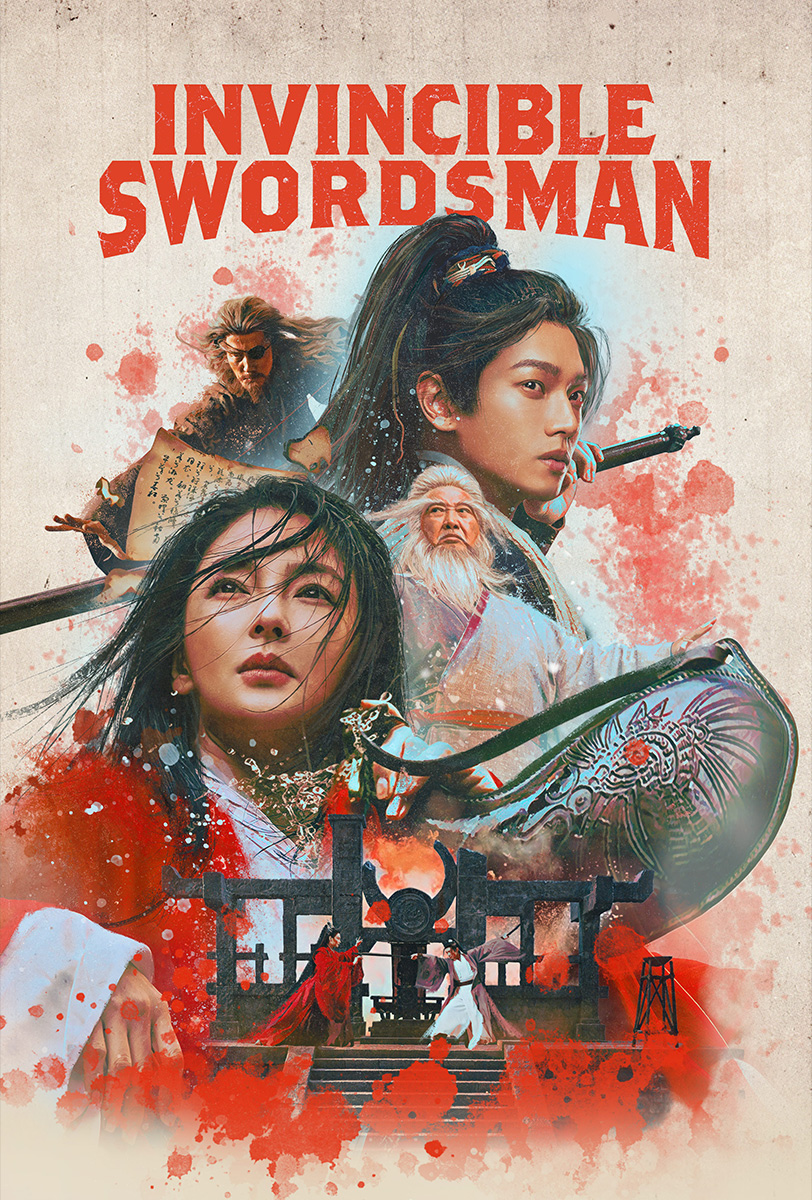
Invincible Swordsman (笑傲江湖, Luo Yiwei, 2025)

Adapted from Jin Yong’s wuxia classic The Smiling Proud Warrior, Invincible Swordsman (笑傲江湖,
xiào ào jiānghú) has a hard battle to fight in covering the same ground as 1992’s Swordsman II which featured an iconic performance from Brigitte Lin as the androgynous Invincible Asia. Produced by streaming network IQYI and Tencent, the film has a more epic feel than the studio’s similarly pitched wuxia and was also released in cinemas but is undoubtedly a much more conventional affair let down by an over-reliance on CGI.

To recap, Ren Woxing (Terence Yin Chi-Wai) led the demonic Sun and Moon Sect in despotic fashion slaughtering many of his own followers. Consequently, they flocked behind Invincible East (Zhang Yuqi ) to free them who eventually defeated Woxing and has imprisoned him in the basement of their lair. Meanwhile, drunken but earnest swordsman of the Mount Hua sect Linghu Chong (Tim Huang) has befriended Woxing’s daughter Ren Yinging (Xuan Lu) through their shared love of music and is kicked out of the clan for treason. Nevertheless, he’s taken on as a disciple by the charismatic Feng Qingyang (Sammo Hung Kam-Bo) who continues teaching him martial arts before he’s called back to the world of Jianghu by Yingying who warns him his friends are in danger after teaming up to defeat Invincible East who has now become even more despotic than Woxing in drinking the blood of their victims to stay young.

Even so, breaking Woxing out of containment so he can take out Invincible East seems like a bold plan given there’s no guarantee he’ll actually do that and even less he won’t just go back to his old ways afterwards. Linghu Chong only participates out of loyalty to his men and as a favour to Yingying and is therefore constantly insisting that none of this is anything to do with him because he’s leaving the martial arts world. It’s a fault with the source material, but it’s quite frustrating that all these women are hopelessly in love with the actually quite bland Linghu Chong who has a nasty habit of turning up every time a woman is about to fight someone and heroically standing in front of her. Ironically, that’s how he meets “Invincible East” without realising, or at least the nameless final substitute of Invincible East who has become the public face of the legendary warrior. 

Christened “Little Fish,” by a besotted Linghu Chong who believes her to be a damsel in distress, she is the only female substitute of Invincible East who has undergone self-castration in order to achieve a higher level of martial arts and in the film’s conception thereby feminised. Unlike the ’92 version, however, Little Fish is concretely female and bar a brief flirtation with some of her maids more preoccupied with her lack of individual identity in having no name of her own. Consequently, her love of Linghu Chong becomes an opposing identity though she feels herself forced to take on the persona of Invincible East. Linghu Chong too is fascinated by her mystery which causes him to act in a caddish way towards Yingying who is otherwise positioned as his rightful love interest even if their romance is frustrated by the relationships of their respective clans.

What they’re really fighting is Invinsible East’s corruption of Jianghu which it wants to rule in its entirety. The corruption has already worked its way into the Mount Hua sect as ambitious couturiers vie for power and throw their lot in with the Sun and Moon sect in the hope of advancement. Luo does his best to conjure a sense of the majestic in the elaborate action set pieces, but the over-reliance on wire work and CGI particularly for the swords leaves them feeling inconsequential while there’s barely any actual martial arts content as the fights revolve around the martial arts stances rather than combat. Frequent homages to the ’92 film including the use of its iconic song also serve to highlight the disparity in scope and vision though even if Zhang Yuqi appears to be channelling Brigitte Lin there is genuine poignancy in her tragic love for Linghu Chong which is also the longing for freedom and another identity that is forever denied her. With his belief in Jianghu well and truly destroyed, Linghu Chong finds himself a lonely wanderer and refugee from a martial arts world largely devoid of hope or honour and adrift with seemingly no destination in sight.


Invincible Swordsman is released on Digital 19th August courtesy of Well Go USA.

Trailer (English subtitles)

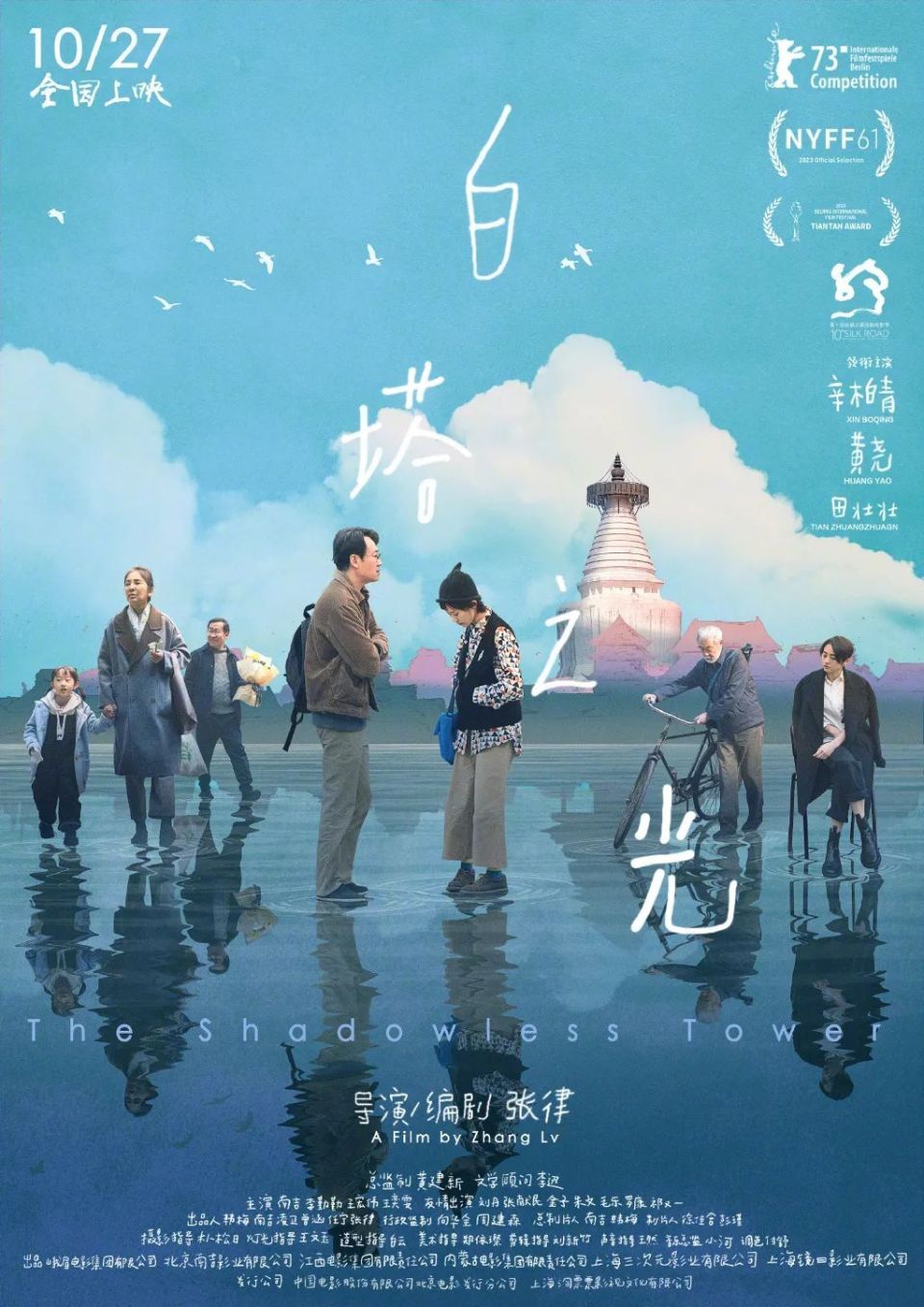
The Shadowless Tower (白塔之光, Zhang Lu, 2023)

A tale of middle-aged loneliness and regret, Zhang Lu’s Shadowless Tower (白塔之光, Bái Tǎ zhī Guāng) takes its name from a white pagoda in the centre of Beijing that is said to cast no shadow. Or at least, as the hero later suggests, its shadow may be far away in its old home town of Tibet. Most Zhang’s protagonists are somewhat displaced most particularly spiritually and existentially, cut adrift by corrupted paternity while uncertain how to progress towards the future. 

For Gu (Xin Baiqing), a former poet now a melancholy restaurant critic and divorcee with a small daughter, the problem is he’s beginning to feel more and more like the father he hasn’t seen since he was five when his mother kicked him out of the house after he was accused of groping a woman on a bus. In a meta-textual touch, Gu’s kite-flying father Yunlai is played by film director Tian Zhuangzhuang who once made a film called The Blue Kite that is also about failed fatherhood and was banned by the authorities on its release. In any case, Gu is only a part-time father to his little girl, Smiley (Wang Yiwen), who is living with his sister and her husband who has been secretly in touch with Yunlai and aware that he rides hundreds of miles by bicycle twice a year visit Beijing on the kids’ birthdays though he cannot meet them.

In many ways, it might seem to be the father, or at least the image of one, that is the shadowless tower that hangs over Gu’s life. He fantasies about interrogating him over the bus incident, wondering if what his mother did was right or if they unfairly rejected a good man because of a misunderstanding. His mother’s anger was apparently partly because Yunlai would not compromise and confess to the crime to get a lighter sentence, instead being sent to a labour camp which left her financially responsible for the children on her own. Gu’s sister Wenhai (Li Qinqin) reflects that if he had not been such a good father to begin with she could have forgiven him, but because he was his disgrace caused her to lose faith in the world. 

Gu seems not to have much faith in the world either, remarking that he separated from his wife owing to an excess of politeness, the same politeness that keeps him aloof from his surroundings and prevents him from making meaningful connections. Yet for all that, he embodies a kind of fatherhood, sitting down on the bed of his lodger and gently placing a hand on his back on hearing his crying through the wall. The young man later embraces him as a son to a father, while Gu finds himself dancing a melancholy waltz with Yunlai who is also an image of his future self. 

But even as a lifelong Beijinger, Gu remains rootless. Meeting up with old friends, all of whom might have been young in the late ‘80s, they drink and sing the song composed for the 2008 Olympics as if they were looking for a father in the city. Gu also reads from Bei Dao’s My Beijing which similarly rests on a sense of exile even while present. The only woman in the group laments that she never married and meditates on the ghost of lost love, while the only one of them who fled abroad eventually takes his own life in a foreign land.

Jolting him out of his inertia, Gu encounters free spirited photographer Wenhai (Huang Ya) who shares his sister’s name though she is also similarly displaced and struggling with a more literal orphanhood that leaves her caught between the North East and the Cantonese-speaking south where she was adopted. A gentle love story arises between them, Wenhai cutting through the wall of Gu’s politeness with refreshing frankness but also with troubles of her own and a worrying tendency to refer to him as her father which nevertheless has a kind of circularity to it. 

Crouching down by the pagoda, they can’t see their shadows either and wonder where they are. Then again, perhaps it’s not so much that tower casts no shadow, but the shadow it casts is so vast that covers everything below just as Gu’s searching for his father overshadows his life even as he is also searching for himself. Intensely moving, Zhang’s poetic drama waxes on middle-aged rootlessness but also the interconnectedness of all things, from kites to earthworms and the great dance of life in all its inescapable loneliness. 


The Shadowless Tower screened as part of this year’s London East Asia Film Festival.

Original trailer (Simplified Chinese / English subtitles)

Ode to the Goose (군산: 거위를 노래하다, Zhang Lü, 2018)

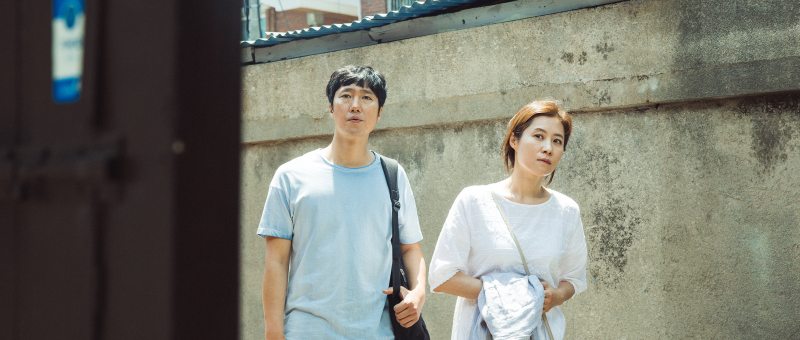
15eeddc21a2c46f3992b2b459ee3ceb3Past and present flow as one in Zhang Lü’s elliptical Ode to the Goose (군산: 거위를 노래하다, Gunsan: Geowileul Nolaehada). Making a perhaps controversial point, Zhang sets the majority of his tale in the harbour town of Gunsan which echoes ‘30s Korea when the nation was still brutally oppressed by the Japanese to which the many graphic photographs and monuments on display stand testament. Yet Zhang seems to ask, returning to his favourite theme, if they’re all Koreans no matter where they were born, why are some more oppressed than others?

The film opens with the hero, struggling poet Yoon-young (Park Hae-il), standing in front of a street map, lost in his mother’s home town. He is then joined by a slightly older woman, Song-hyun (Moon So-ri), whom he has apparently asked to accompany him to Gunsan on a whim without really explaining why. Still hung over from the night before, they stop off at an odd little noodle joint run by an elegant older woman (Moon Sook) who seems oddly fascinated by their strange chemistry. Yoon-young, innocently enough, makes conversation by asking about her home town only for her to shut him down. “What home town?” she fires back, “home is where you settle”.

Later we discover she speaks fluent Japanese, cheerfully conversing with the autistic daughter of the inn owner (Park So-dam) where the couple eventually stay after being judged “lucky” enough to be allowed in. The daughter of Japanese-Korean parents apparently “returned” from Fukuoka, the girl rarely speaks to strangers and only ever in Japanese, though she seems to take a liking to Yoon-young and is keen to try and connect with him, making sure he is always well taken care of while Song-hyun has turned her attentions to the girl’s father, melancholy widower Mr. Lee (Jung Jin-young) who likes to take photographs but only ever of landscapes and not of people.

The Lees are Korean too, even if one of them only speaks Japanese and they run a Japanese-style inn in the middle of a moribund museum to colonial horror (the local shrine even has a comfort woman statue standing in the back). Meanwhile, a passerby mistakes Song-hyun for a Chinese-Korean woman she once knew and insists on speaking to her in Yanbian dialect which Song-hyun, as we later learn, is unable to understand even if there is a Chinese-Korean connection in her family history. Song-hyun muses that had her grandfather, like his brother, chosen to stay in Manchuria after the war then she’d be Chinese-Korean too, as would famed poet of the colonial era Yun Dong-ju if he hadn’t died a political prisoner in a Japanese jail in Fukuoka which is, coincidentally, where the Lees were “from”. It is all “coincidental”.

So why does Yoon-young’s “right wing nut job” (as Song-hyun calls him) father hate Chinese-Koreans so much, blaming them for all the faults of the modern nation and decrying those who left for Shanghai with the Independence Movement as traitorous communist collaborators? A whimsical prequel (or a kind of re-imagining) of the Gunsan incident sees Yoon-young walking through his own “hometown” while a man who probably is not actually Chinese-Korean himself and may just be out to claim a buck or two, holds a rally for the rights of “foreign” Koreans in order to avoid exploitative employment practices and affirm that Koreans from other parts are the same as Koreans from Korea. Are “native” Koreans perhaps oppressing “non-native” ones in the same way that they were oppressed by the Japanese? In practical terms no, obviously not – there are no essential horrors here, but there is deeply ingrained prejudice and wilful exploitation. Interestingly enough, despite his conservatism, Yoon-young’s dad had him attend Chinese language classes, if ones that were run by the Taiwanese who are obviously not “communist” but were also formerly a Japanese colony.

Meanwhile, Yoon-young’s life takes him on a curious symmetry in which everything reminds him of something else. He repeatedly asks the women he meets if they’ve met before, experiences eerily similar moments in Gunsan and at home, and continues to look for connections between himself and a world of universal poetry stretching from the classical Chinese of the film’s title to the melancholy odes of Yun Dong-ju, writing in his “native” language in defiance of colonial authority. Dualities predominate – beauty/horror, attraction/indifference, silence/language, here/there, then/now, but through it all there is commonality. Yoon-young’s failure to communicate leaves him feeling defeated and depressed, trapped in a self-imposed exile while the gregarious Song-hyun gleefully moves forward little caring of the costs. Whimsical and “ambiguous”, Zhang’s playful poetry is difficult to parse but nevertheless carries an essential warmth in its reassuring familiarities and openhearted commitment to the universality of human connections.


Ode to the Goose was screened as the latest teaser for the upcoming London Korean Film Festival. Tickets are already on sale for the next and final teaser screening, Kokdu, which will take place at Regent Street Cinema on 16th September.

Original trailer (no subtitles)

https://www.youtube.com/watch?v=z8vZ0RIJ0GU

Grain in Ear (芒种 / 망종, Zhang Lu, 2005)

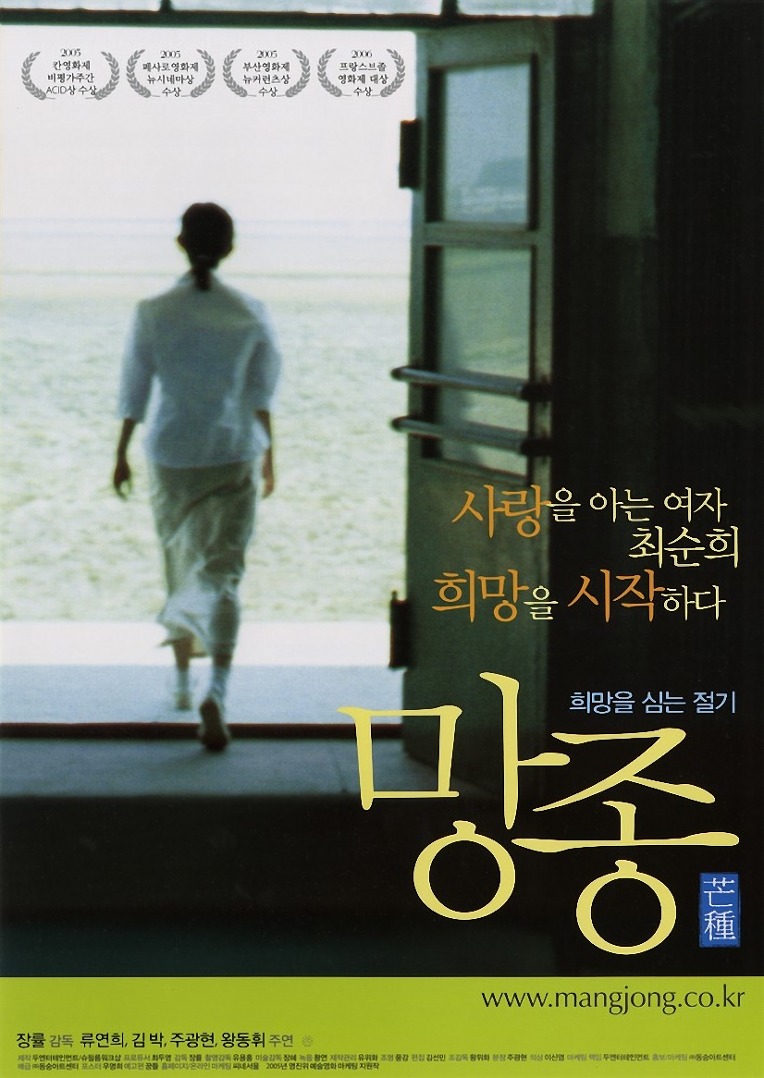
Grain in Ear posterChinese-Korean director Zhang Lu has made a career of exploring the lives of those living on the margins of modern China and most particularly those of the ethnic Korean minority. 2005’s Grain in Ear (芒种, Máng zhòng, 망종, Mang Jong) brings this theme to the fore through the struggles of its stoic heroine who bears all her troubles with quiet fortitude until the weight of her despair threatens an already fragile sense of civility, consistently eroded by multiple betrayals, misuses, and an unforgettable othering. Yet she is not entirely alone in her outsider status even if there is precious little value in solidarity among the powerless in a world of circular oppressions.

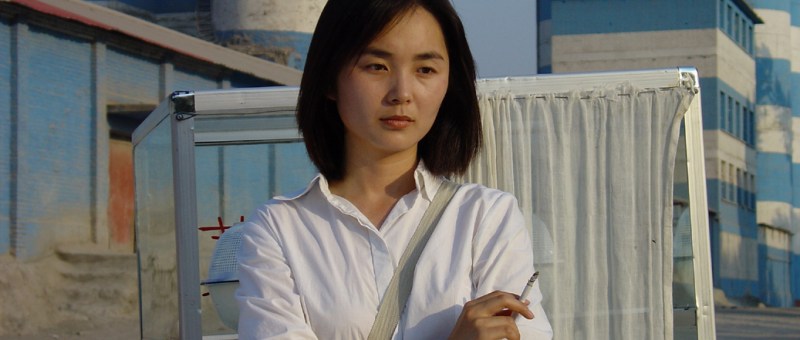
32-year-old Cui Shun-ji (Liu Lianji) has moved to a small town with her young son Chang-ho (Jin Bo) following her husband’s conviction of a violent crime. Unable to find work, she ekes out a living illegally selling kimchi from a cart without a permit while Chang-ho busies himself playing with the neighbourhood kids in the rundown industrial town. Isolated not only as a newcomer but as a member of the ethnic Korean minority, Shun-ji keeps herself to herself but can’t help attracting the attentions of the locals some of whom are merely curious about her spicy side dishes while others are intent on helping themselves to things which aren’t actually on sale.

There is something peculiarly perverse about Shun-Ji’s decision to make her living selling kimchi. It is both an act of frustrated patriotism and a kind of commodification of her ethnicity though she seems to have intense pride in her ability to produce her national dish even if there is not often as much calling for it as she would like. Meanwhile, at home, Shun-ji virtually tortures little Chang-ho into trying to learn the Korean alphabet as a way of fastening him closely to his heritage and community, but Chang-ho is a Chinese boy to all intents and purposes. He may understand Korean, but he doesn’t want or need to speak it and resents his mother’s attempts to reinforce his Koreanness.

Meanwhile, despite her aloofness, Shun-ji eventually forms a kind of relationship with a lonely Korean-Chinese man, Mr. Kim (Zhu Guangxuan), who visits her cart. Brought together by a shared sense of loneliness and a connection born only of a mutual ethnicity, the pair drift into an affair but Shun-ji’s dreams of romantic rescue will be short lived. Her lover is a weak willed man married to a feisty Chinese woman who will stop at nothing to recapture her henpecked husband. Cornered, Kim tells his wife it’s not “an affair” because money changed hands, branding Shun-ji a prostitute and getting her arrested by the police to prove his point.

To be fair, Shun-ji’s married lover is another oppressed minority afraid of the consequences of non-compliance, but he’s also just one of the terrible men that Shun-ji will encounter in her quest towards independence and self sufficiency. Her husband killed a man for money and left his family to fend for themselves when he went to prison for it. Her lover called her a whore and left her at the mercy of the police. A man who offered to help with a lucrative kimchi contract turned out to be after another kind of spice, and the kindly policeman who stopped by her cart with tales of his impending marriage turned out not to be so nice after all.

In this fiercely patriarchal world, women like Shun-ji have no one to rely upon but each other. Marginalised by poverty, ethnicity, and unfamiliarity, Shun-ji and Chang-ho live in a small shack behind the railway next to the local sex workers. Chang-ho, too small to understand why everyone calls the women next-door “chickens”, treats them all like big sisters while a kind of solidarity emerges between Shun-ji and the melancholy youngsters from far away towns who’ve travelled to this remote place to ply their trade out of desperation, too ashamed to stay any closer to home. One of the sex workers tries to warn Shun-ji about Kim – men who buy their services are not especially good romantic material, but it’s advice that falls on deaf ears. Shun-ji wants to believe better of her compatriot, but her faith is not repaid.

Zhang, in a familiar motif, foregrounds Li Bai’s famous ode to homesickness, giving it additional weight in the mouth of little Chang-ho whose longing is for another kind of home in contrast to his mother’s continued need to believe in the solidarity of her community. Yet even she eventually loses faith, tearing up Chang-ho’s Hangul cards and finally allowing him to give up on his Koreanness. Having endured so much, Shun-Li’s broken spirit eventually leads her towards an inevitable explosion and a grim, strangely poetic revenge against the society which has so badly wronged her. Only in this final moment of transgression does Shun-ji begin to harvest her own freedom, but escape is still a long way off and her final act of defiance may only further condemn her in world of constant oppressions.


Grain in Ear was screened as part of the 2018 London Korean Film Festival.

Original trailer (Mandarin and Korean with Korean subtitles only)

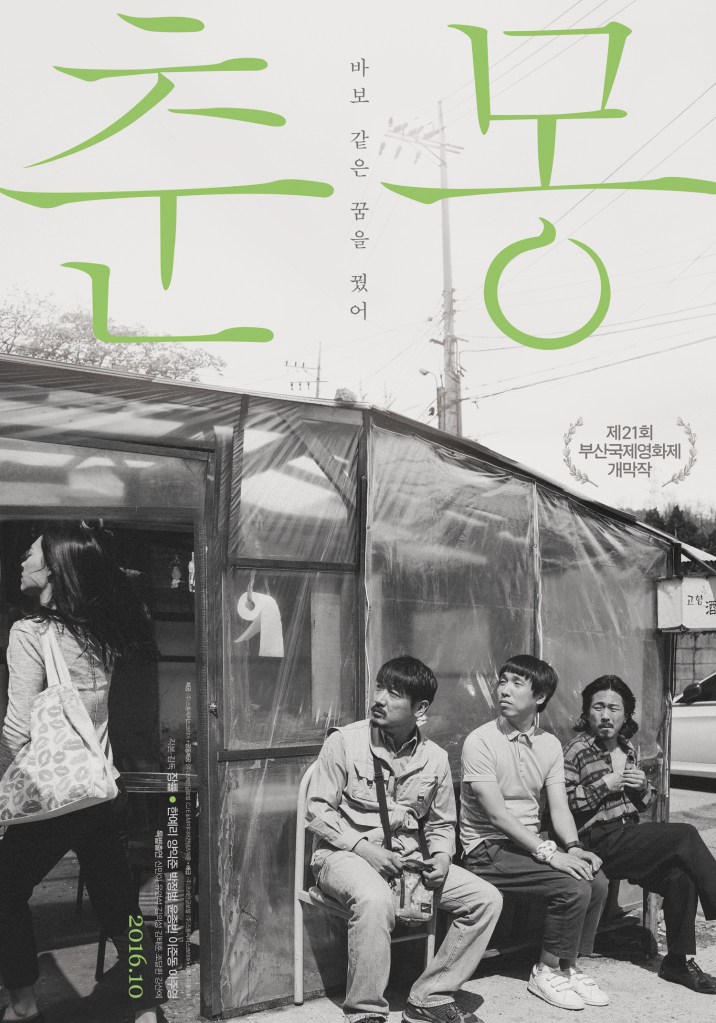
A Quiet Dream (춘몽, Zhang Lu, 2016)

Review of Zhang Lu’s A Quiet Dream (춘몽, Chun-mong) first published by UK Anime Network.


A North Korean defector, a lonely orphan, and a nerdy landlord walk into a bar but also, perhaps, into a dream or several dreams in Zhang Lu’s latest chronicle of lovelorn city dwellers and their eccentric days of tiresome banality. Dreams, reality, and wish fulfilment mingle freely in this run down land of cheerful hopelessness populated by the displaced and permanently fugitive. Zhang’s film is as elusive as it is melancholy but offers its painful meditations with good humour and kindness even if it sees little possibility of escape.

Everyone is in love with pretty barmaid, Yeri (Han Ye-ri). Yeri bears this with good grace as she divides her attentions equally between her three suitors, nervous landlord Jong-bin (Yoon Jong-bin), petty criminal Ik-june (Yang Ik-june), and sorrowful North Korean defector Jung-bum (Park Jung-bum). Having come to Korea as a teenager after her mother died, Yeri tracked down her estranged father only for him to suffer a serious illness requiring round the clock care soon after. When she’s not serving drinks or looking after dad, Yeri spends her time with the three guys, drinking, visiting the Korean Film Archive, or chatting with the romantic teenage poetess (Lee Joo-young) so obviously, painfully, in love with her that Yeri is able to do little other than ignore it in an attempt to let her down gently.

Dreamscape aside, the problems each of the protagonists is facing is real enough. Yeri’s life yields its own sorrows as her heartfelt rendition of Li Bai’s famous ode to homesickness makes plain as do her frequent references to her mother and the quest for a mysterious crater bound lake. Having lost a mother and found a father she loses again when he is taken ill and she is left to care for a man she barely knew in the most intimate of ways. Her burden is a heavy one and her dreams filled with the idea of abandoning it as her father’s wheelchair careers emptily down the hill on which they live. A visit to a fortune teller proves far from reassuring when he informs her that her father will live a long life, but abruptly changes the subject when it comes to a more personal projection.

The three guys could almost be aspects of her own personality turning up to haunt her but each of Yeri’s men (as she later describes them) is battling his own kind of despair. Jung-bum’s is the most pronounced as he battles bipolar disorder and possible PTSD from North Korean labour camps. A refugee with no one to protect him, Jung-bum falls victim to workplace exploitation only be fired because his eyes are “too sad” and it’s bringing his boss down. Ik-june, kinder than anyone gives him credit for, thinks he can help him through his gangland godfather “Mr. Jellyfish” but Ik-june can’t decide how far he really wants to be in the criminal underworld and is in disgrace after laughing at a funeral. Jong-bim lays claim to control over everything in sight as he’s “the landlord” only it’s his father who actually owns the land and Jong-bim is arrested in an almost adolescent sense of powerlessness.

Nevertheless, their days are ones of gentle dreaming as the guys push their luck but refuse to compete for the love of Yeri, preferring to share the unique light she seems to bring into their darkened world. Dreams and reality flow into one another without thought or warning leaving each indistinct as Yeri dances drunkenly on a rooftop only to turn around and find her trio of suitors disappeared, though the surreal characters which people the city including an old lady who collects cans, bottles and cardboard to place outside an old wardrobe on the side of the road which she uses “to pray” might make “reality” a difficult thing to believe in in any case.

Purgatorial as their existence is, the melancholy collective seem to find a comforting symbiosis in their personal miseries. Filming through mirrors and opaque curtains Zhang rejects any idea of certainty or concrete realities. The Chinese characters which accompany the film’s original title effectively mean “short lived illusion”, lending a poetic air to the otherwise surreal goings on, painting this greyed out land as a temporary container for eternal woes. At the film’s end we either wake up or fall asleep, or perhaps merely exchange one dream for another but despite all of the heartache and desperation this strange world is one defined by warmth and basic human goodness.


A Quiet Dream was screened as part of a teaser programme for the London Korean Film Festival. The next screening in the series will be E Oni’s Missing at Picturehouse Central on April 10, 2017. Tickets on sale now directly from Picturehouse.

Original trailer (English subtitles)