Snow Leopard (གསའ།, Pema Tseden, 2023)

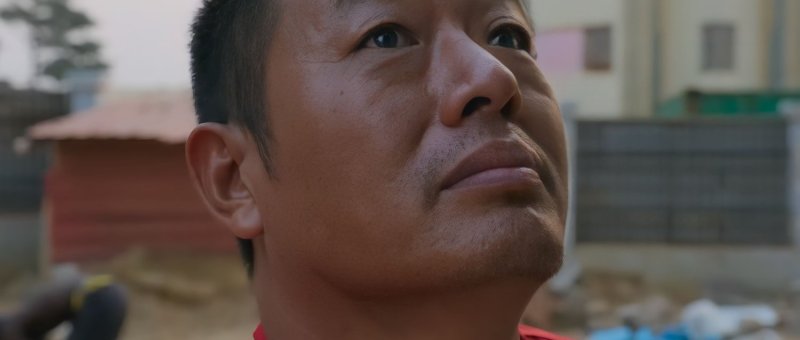
When a snow leopard breaks into a herder’s pen and kills nine of his castrated rams, the herder traps it and effectively holds the animal hostage in the hope of gaining compensation in Pema Tseden’s mystical drama Snow Leopard (གསའ།). He is reminded that the snow leopard is a “first class protected animal” but understandably asks who’s going to protect him, why is the snow leopard’s life so much more important than his own?

Prone to angry rants, Jinpa (Jinpa) is more often than not portrayed as a snow leopard himself grunting and struggling to get free when the forestry police attempt to restrain him. He says that the herders and local wildlife used to live in harmony. If a snow leopard eats one or two sheep, then they just accept it but as climate change and other environmental forces have pushed them further down the mountain Jinpa feels the snow leopards in particular have become greedy and must be stopped. He wants to kill the snow leopard in revenge and refuses to let it go until the government agrees to compensate him for his financial loss. His rage is such that it’s economically irresponsible, calling in a local man with a digger to rescue the remaining sheep and telling him that it’s fine if one or two die while agreeing to pay the same price as the sheep is worth to have him try to rescue them. 

Jinpa’s brother, a monk obsessed with photographing snow leopards, and father are each of the opinion that it’s spiritually irresponsible to keep the snow leopard bound up as it is the embodiment of the spirit of the mountains. It’s possible to read Jinpa’s animosity towards it as rage against the natural world and his fierce, almost mad diatribes against it as a kind of irrational hatred. Yet like him the snow leopard contains dualities. The one in the pen has a cub on the mountainside and seems to be capable of true tenderness though also violent carnality in its attack on the sheep. Jinpa more than anyone seems to be aware that the snow leopard is simply being what it is, but cannot forgive it for this very personal act of betrayal. 

The monk, meanwhile, has a unique relationship with the captive snow leopard segueing into a surreal black and white sequence in which he eventually sets it free and is rewarded for his act of kindness. This seems to hint at the ways in which human life and animal could coexist but also at the essential spiritual quality of the snow leopard as a symbol of something elemental along with the roots of traditional Tibetan culture which are now on the brink of eclipse. A TV news crew tipped off by the monk with whom the reporter went to school turn up to capture these bizarre events but appear uncertain as to what they’re actually filming. The cameraman is frequently so awestruck that he forgets to film anything while the reporter is constantly fending off calls from his girlfriend.

A farcical stand off occurs when representatives from the government turn up, seemingly looking down on Jinpa and irritated by his demands for compensation while insisting that the snow leopard must be released. He refuses to give in even as they remind him that if anything happens to it, it’s him that will be held legally responsible. The forces of authority are also intruders, making an incursion from the world of modernity much as the snow leopard descends from the mountain and the ancient past. Men like Jinpa occupy a liminal space, caught between the old and the new while their way of life is increasingly threatened by the forces of modernity. 

In a way, perhaps you could say the monk is trying to capture the snow leopard too even as he shares a special affiliation with it that connects him to the land and his culture along with something deeper and older that the modern world may lack. Yet what they need to do is set it free and restore an order that’s natural rather than manmade. Director Pema Tseden sadly passed away at the young age of 55 shortly after completing the film but offers a sense of the eternal in the snow-covered expanses of mountains and the cruel tenderness of those who live there.


Snow Leopard screened as part of this year’s London East Asia Film Festival.

International trailer (English subtitles)

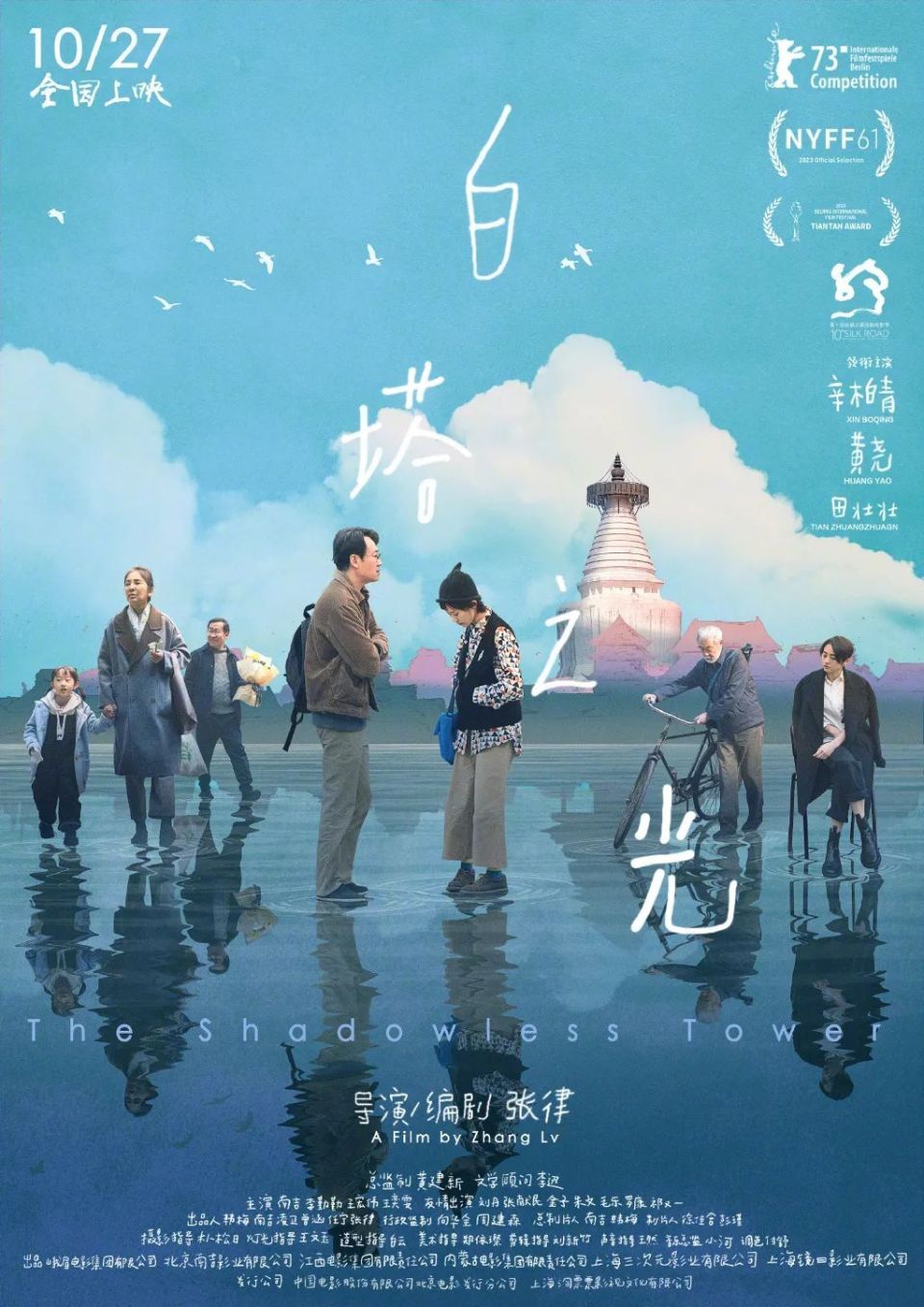
The Shadowless Tower (白塔之光, Zhang Lu, 2023)

A tale of middle-aged loneliness and regret, Zhang Lu’s Shadowless Tower (白塔之光, Bái Tǎ zhī Guāng) takes its name from a white pagoda in the centre of Beijing that is said to cast no shadow. Or at least, as the hero later suggests, its shadow may be far away in its old home town of Tibet. Most Zhang’s protagonists are somewhat displaced most particularly spiritually and existentially, cut adrift by corrupted paternity while uncertain how to progress towards the future. 

For Gu (Xin Baiqing), a former poet now a melancholy restaurant critic and divorcee with a small daughter, the problem is he’s beginning to feel more and more like the father he hasn’t seen since he was five when his mother kicked him out of the house after he was accused of groping a woman on a bus. In a meta-textual touch, Gu’s kite-flying father Yunlai is played by film director Tian Zhuangzhuang who once made a film called The Blue Kite that is also about failed fatherhood and was banned by the authorities on its release. In any case, Gu is only a part-time father to his little girl, Smiley (Wang Yiwen), who is living with his sister and her husband who has been secretly in touch with Yunlai and aware that he rides hundreds of miles by bicycle twice a year visit Beijing on the kids’ birthdays though he cannot meet them.

In many ways, it might seem to be the father, or at least the image of one, that is the shadowless tower that hangs over Gu’s life. He fantasies about interrogating him over the bus incident, wondering if what his mother did was right or if they unfairly rejected a good man because of a misunderstanding. His mother’s anger was apparently partly because Yunlai would not compromise and confess to the crime to get a lighter sentence, instead being sent to a labour camp which left her financially responsible for the children on her own. Gu’s sister Wenhai (Li Qinqin) reflects that if he had not been such a good father to begin with she could have forgiven him, but because he was his disgrace caused her to lose faith in the world. 

Gu seems not to have much faith in the world either, remarking that he separated from his wife owing to an excess of politeness, the same politeness that keeps him aloof from his surroundings and prevents him from making meaningful connections. Yet for all that, he embodies a kind of fatherhood, sitting down on the bed of his lodger and gently placing a hand on his back on hearing his crying through the wall. The young man later embraces him as a son to a father, while Gu finds himself dancing a melancholy waltz with Yunlai who is also an image of his future self. 

But even as a lifelong Beijinger, Gu remains rootless. Meeting up with old friends, all of whom might have been young in the late ‘80s, they drink and sing the song composed for the 2008 Olympics as if they were looking for a father in the city. Gu also reads from Bei Dao’s My Beijing which similarly rests on a sense of exile even while present. The only woman in the group laments that she never married and meditates on the ghost of lost love, while the only one of them who fled abroad eventually takes his own life in a foreign land.

Jolting him out of his inertia, Gu encounters free spirited photographer Wenhai (Huang Ya) who shares his sister’s name though she is also similarly displaced and struggling with a more literal orphanhood that leaves her caught between the North East and the Cantonese-speaking south where she was adopted. A gentle love story arises between them, Wenhai cutting through the wall of Gu’s politeness with refreshing frankness but also with troubles of her own and a worrying tendency to refer to him as her father which nevertheless has a kind of circularity to it. 

Crouching down by the pagoda, they can’t see their shadows either and wonder where they are. Then again, perhaps it’s not so much that tower casts no shadow, but the shadow it casts is so vast that covers everything below just as Gu’s searching for his father overshadows his life even as he is also searching for himself. Intensely moving, Zhang’s poetic drama waxes on middle-aged rootlessness but also the interconnectedness of all things, from kites to earthworms and the great dance of life in all its inescapable loneliness. 


The Shadowless Tower screened as part of this year’s London East Asia Film Festival.

Original trailer (Simplified Chinese / English subtitles)

Eat Bitter (Pascale Appora-Gnekindy & Sun Ningyi, 2023)

“Happiness is not about what you eat or what you wear but mutual understanding” according to Luan, a Chinese construction manager, in Pascale Appora-Gnekindy & Sun Ningyi’s documentary Eat Bitter. Mutual understanding is perhaps something he’s striving for in his working life in the Central African Republic which is as the opening titles state one of the poorest places on Earth. As China deepens its economic investment in Africa, Luan is one of many who’ve travelled overseas in search of higher salaries to provide better lives for their families.

His struggles are mirrored in those of Boa, a local man who works a sand diver gathering the raw materials that Luan needs for his construction work. Boa’s wife has recently left him with their two children whom he can barely support, though as it later turns out that may partly be because he had conceived a child with another woman whom he subsequently tries to marry only to see the relationship fail when she regards him as unkind and can no longer live with him. Luan’s status as a migrant worker has also placed a strain on his family life. Having left when his son was a teenager, he worries that he wasn’t there to effectively parent him at an important age which has contributed to the difficulties his wife is currently facing in her relationship with him. Luan and Yuzhen talk every day on the phone and she generally seems upbeat but later makes an attempt on her life in the depths of her loneliness being separated from her husband and estranged from her son. 

The film’s title comes from a phrase that Luan utters close to its conclusion that one must eat bitter before tasting sweet, meaning that in order to find happiness one must endure hardship. But then the hardships that he and Boa are facing are obviously very different. Luan is here to build to a bank, a slick and modern building that symbolises a new future for an otherwise impoverished country which might be one reason the president wants to come in person to inaugurate it with an election looming along with the rise of a new militia threatening civil war. While working on the project, Luan complains that the local workers are slow in comparison to the speed and efficiency common in China while it’s clear that health and safety concerns are almost non-existent. A large group of men standing on a skinny girder joke that they’ll die if they fall but no one is wearing helmets or other safety gear. At one point it’s suggested that they were provided but the workers opted not to use them. In any case, a local worker is eventually killed due to a fall on site causing Luan to reflect that he should have made helmets mandatory and has perhaps failed in his duty of care to the casual workers he employs. 

Boa says his job is dangerous too and that he’s caused himself injury due to being preoccupied with his complicated domestic situation. His dream is to buy a canoe and go into business for himself, something which his current boss supports and even offers to help him with even if the sand diving business appears to be semi-legal and precarious. The authorities soon close down the site where Boa and the other men were gathering sand and gravel stating that they want to redevelop it but when the boss returns sometime later he discovers that nothing has been done and wonders why they had to be moved on. 

Later Luan and his wife attend the opening of a new apartment building for a banquet hosted by his hitherto unseen boss Madame He but it seems unlikely that many of the local residents would be able to afford to live in a place like this even if like the bank it is intended as symbol of what the Central African Republic could become rather than what it is now. Asked for his opinion on the Chinese, Boa states that he feels they’ve got a raw deal. The Chinese are just like white people, he remarks, they say they’ve come to help but they earn a lot more money and the terms of the deal are disadvantageous to men like him. Perhaps this is an ironic inversion of the mutual understanding Luan was talking about though admittedly more in reference to his now much happier relationship with his wife who has finally agreed to relocate in order to be with him. In any case, it’s true that both men are intent on building a mutually beneficial future even if it’s one where the scales are very much tipped. 


Eat Bitter screened as part of this year’s DOC NYC.

Original trailer (English subtitles)

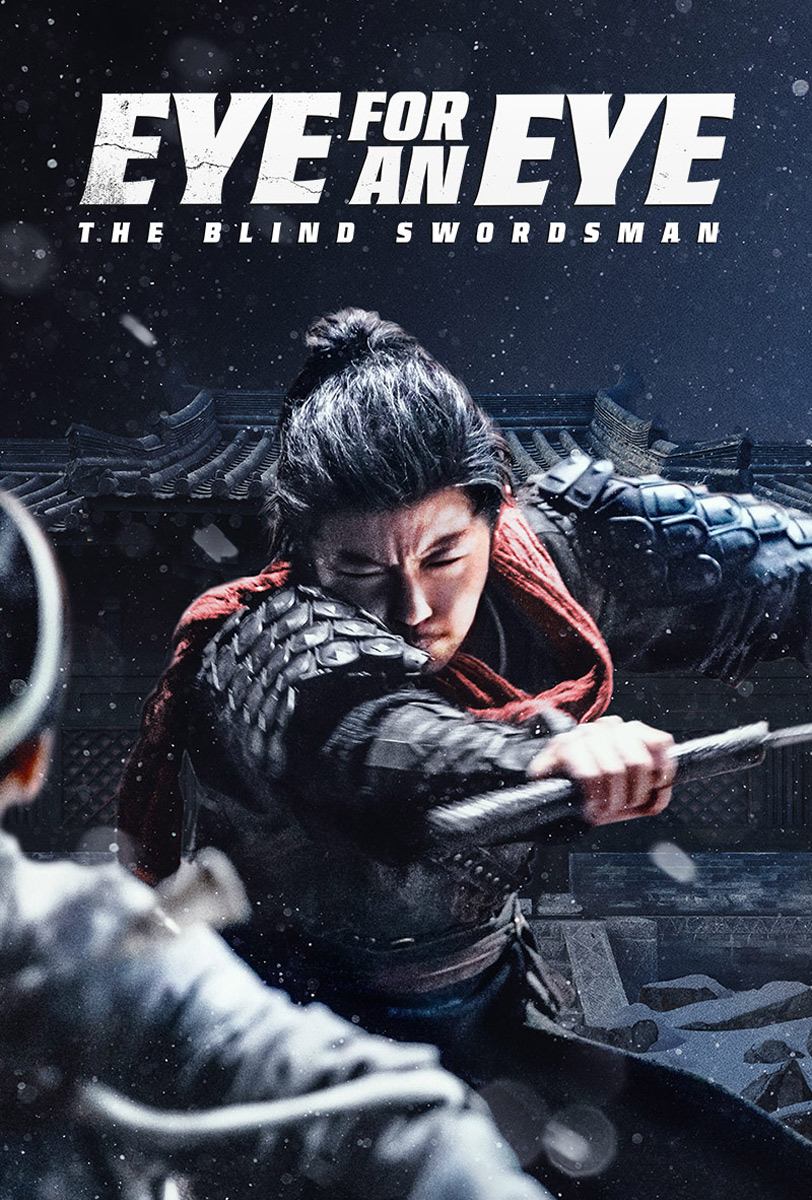
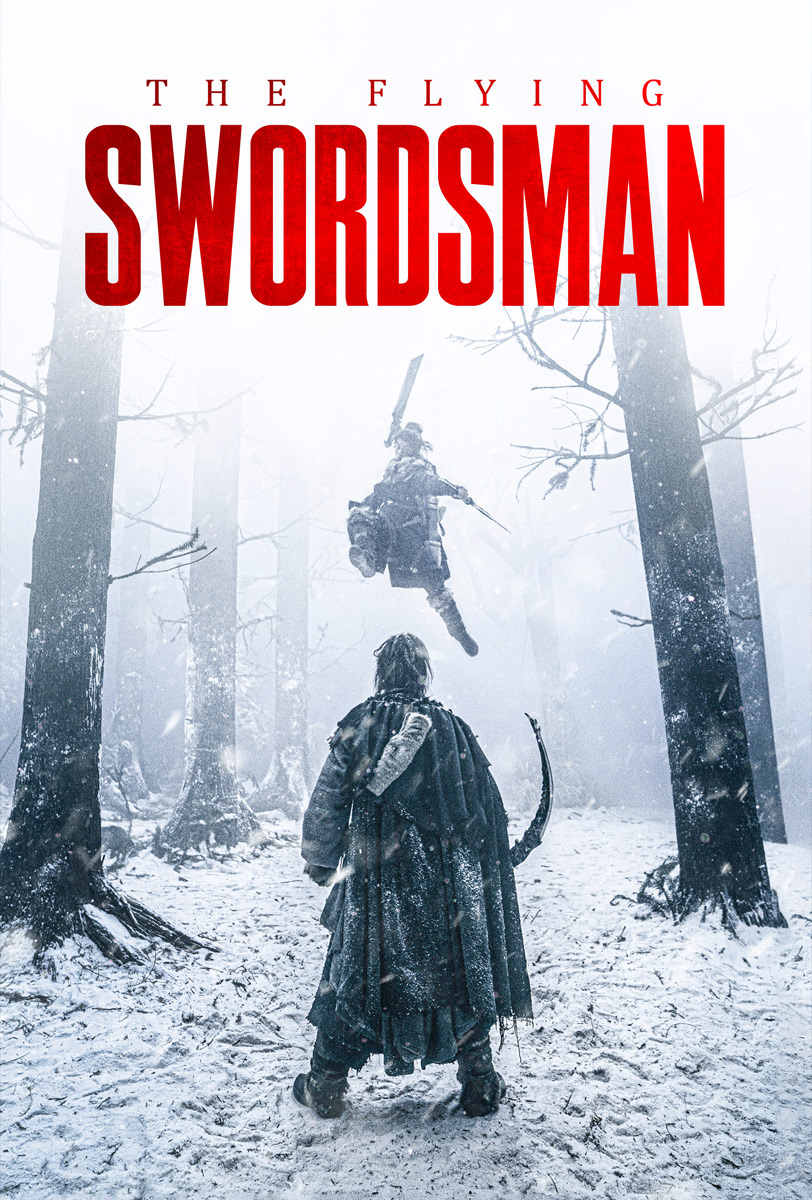
Eye for an Eye: The Blind Swordsman (目中无人, Yang Bingjia, 2022)

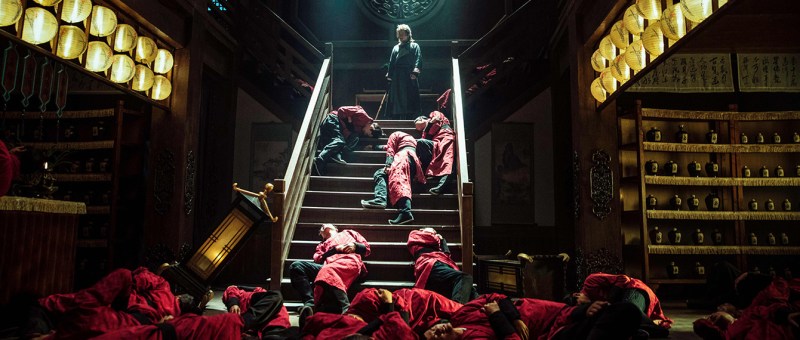
A blind swordsman takes revenge against the evils of feudal society in Yang Bingjia’s impressively helmed action drama, Eye For An Eye: The Blind Swordsman (目中无人, mùzhōngwúrén). Set in the “lawless” society of the Tang era following the Tianbao rebellion, the film has a western sensibility with its twanging guitar score and dusty roads not to mention jumped up gangsters trying to get a foothold in the legitimate order simply because they have become too powerful and no one is willing to resist them. 

Ni Yan (Gao Weiman), a young tavern woman who lost her brother and husband when her wedding was attacked by the Yuwen clan asks for nothing more than “justice” but that’s something no one can give her. Wandering swordsman Cheng Yi (Mo Tse) who’d taken a liking to her because she offered him some of her wine and even gave some to his horse reports the crime to the local magistrate after claiming the bounty on a fugitive, only he tells her directly that he will do nothing because the Yuwen clan have already moved beyond justice and not even he will touch them. 

In a way, Cheng is depicted as a failed revolutionary and his blindness a symbol his despair in a world he no longer cares to see. A bounty hunter by trade, his work is facilitated by old comrade Lady Qin (Zhang Qin) who, in contrast to him, seems to live a cheerful life repairing musical instruments while much loved in the town around her. Though they pretend to be saving money for an operation to restore Cheng’s sight, their line of work is perhaps cynical in taking advantage of the times while accidentally outsourcing a justice the authorities can no longer provide in the weakened Tang society. The Yuwen have infiltrated most institutions and cultivated relationships with important people that allow them to ride roughshod over ordinary citizens who are now completely at their mercy.

There might be something quietly subversive in these references to a corrupt and authoritarian institution which tries to brand Ni Yani the criminal in her pleas for justice, insisting that she admit to killing her brother herself in resentment of his criminal past while he is also hunted by the Yuwen because he knows to much about their dodgy dealings including raiding tombs to get precious gems to use as bargaining chips in a dynastic marriage negotiation. Cheng Yi did not originally want to get involved, himself too cynical and having given up hope of “justice” in this “lawless” society, but finds himself sympathetic towards Ni Yan because of the kindness she showed him and the obvious suffering her ordeal has inflicted on her. 

In a sense, his eyes are opened to the injustice of the society around him to which he had been wilfully blind if ironically accepting that he will never see again. He alone is willing to stand up to the Yuwen while even within their ranks petty resentments are growing as a princeling grows ambitious to escape his own oppression at the hands of an authoritarian brother who berates him for his weakness. 

Despite the budgetary issues which often plague straight to streaming cinema, Yang’s elegantly lensed drama brings a real sense of place to the dusty provincial towns where Cheng plies his trade along with the ornate elegance of the realm of Lady Qin whose flowing robes belie her military past. Drawing inspiration from the western as well as Japanese genre classics such as Yojimbo the film presents a world in decay in which the wandering swordsman becomes a moral authority, delivering justice if for a price. The irony is that it isn’t money which opens his eyes, but the reclaimed ability to see with his heart in deciding to help Ni Yan in her quest to avenge the deaths of those close to her. A series of excellently choreographed and well-shot action scenes along with Yang’s post-modern take on the material lend this tale of wandering swordsmen and feudal abuses a sense of the legendary that hints at further adventures for wandering sword for hire Cheng Yi bringing his own brand of justice to a lawless place. 


Eye for an Eye: The Blind Swordsman is out in the US on Digital, blu-ray, and DVD on 28th November courtesy of Well Go USA.

US trailer (English subtitles)
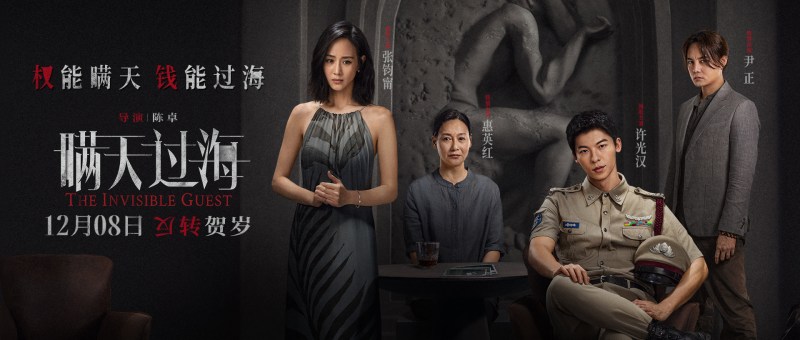
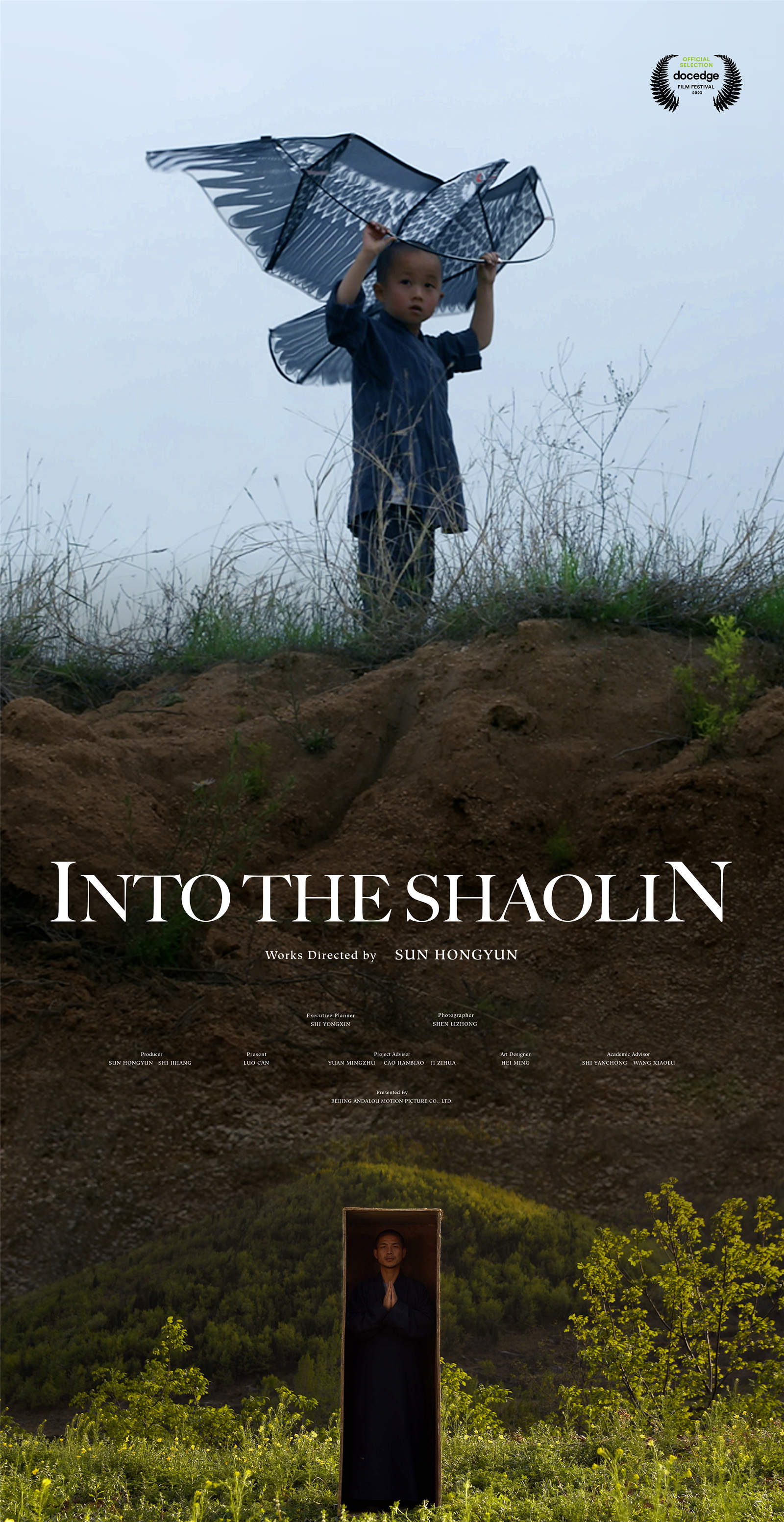
Into the Shaolin (在少林, Sun Hongyun, 2023)

Like many of the monks at the centre of Sun Hongyun’s documentary Into the Shaolin (在少林
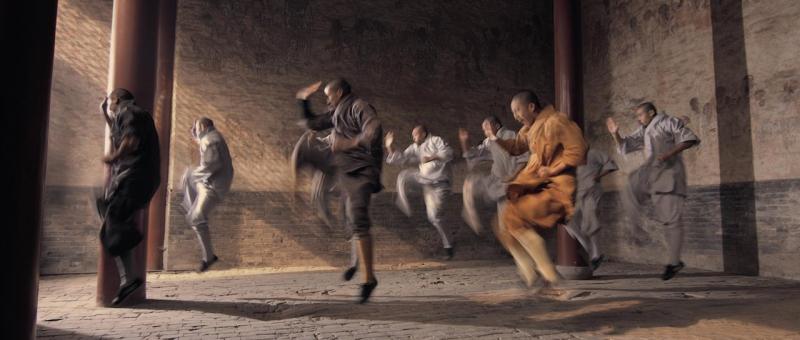
zài Shàolín), our associations with the name are almost exclusively tied up with martial arts movies. Yet as they discovered on entering the temple, it’s not all about kung fu which to some at least came as a disappointment when they were still novices tasked with performing ordinary chores. Then again, many of them do not necessarily anticipate being monks all their lives and so long spent in contemplation leaves them with few other ways to support themselves in the secular world other than through leveraging their martial arts training.

As we can see, many monks come to the temple in childhood often to escape poverty or because they were thought to be troublemakers at home. Sun follows the little monks with empathy, capturing both their mastery over the craft at such a young age and the pain and difficulty it often causes them raising series ethical issues over whether it is right and fair to expect so much from small children who often cry in pain or frustration. Others also remark that they miss their parents having essentially been sent away though one boy explains that his mother managed to get a job nearby so that she can still spend time with him and observe his training.

It’s these familial ties that present the strongest contradictions to the monks and bind them more fully to the secular world. One young man who came to the temple for lack of other options contemplates remaining there for the rest of his life and is a little resentful that even at 18 he still has to get the permission of the grandparents who raised him to go on a mountain retreat. The grandparents, who lost their son, his father, in a workplace accident they believe caused by overwork, want nothing more than for him to get married and start a business and so they flatly refuse to allow him to go on being a monk forever instructing him not to bother contacting them again if that’s what he plans to do. 

But then as others have said, being a shaolin monk doesn’t teach you how to live in the secular world and gives you few transferable skills that would allow you to support yourself. An older monk explains that most of the monks who came to the temple at the same time as him have left but almost all still work with martial arts in some capacity as there’s nothing else for them to do. Even so, the little monks talk of doing other things with their lives once they grow up one hoping to become a soldier defending China and another a movie star. Many came to the temple specifically because of their love of kung fu films starring Jet Li, Donnie Yen, or Wang Baoqiang who himself trained in Shaolin martial arts. 

Others meanwhile have found serenity in the rhythms of the temple and may no longer be suited to living outside of it. The show the boys are preparing utilises a series of boxes of the kind they usually sleep in which as one monk admits to the untrained eye closely resemble coffins but as he puts it no one really needs much more space than their body naturally occupies and it doesn’t really matter where they sleep. Of course, to those in the secular world those things mean a great deal and there’s probably a big difference between a box at the temple and one on the street. Another monk reflects on the shaolin name which means “few trees” though at the temple few is a lot and less is more. He thinks that it’s a fallacy to consider a “return” to the secular world because the true “return” is to your true self which you only discover by leaving home. 

That might be a sentiment shared by a Serbian doctoral student staying at the temple while researching her thesis and in particular the concept of “Chan”. Offering her own insights as a foreigner living at the temple she reflects on the differing attitudes to nature found in China while she seems to be the only woman currently in training. She remarks that it might be odd to call a temple home but that’s what it’s been to here even as she prepares to leave it. Sun’s documentary has an ambivalence to it, at once admiring of the monks in their asceticism, but also somewhat sad not only for their inability to escape their suffering, merely exchange one kind for another, but also for the predicament they my find themselves in should the time come to leave the temple whether by their own will or otherwise.


Into the Shaolin screened as part of this year’s DOC NYC and is available to stream in the US until Nov. 26.

Trailer (English subtitles)

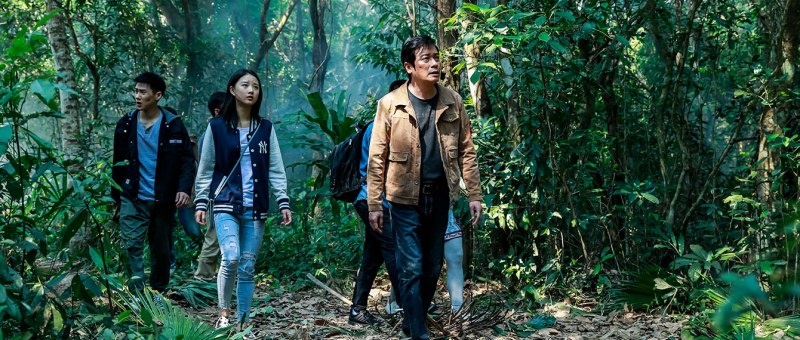
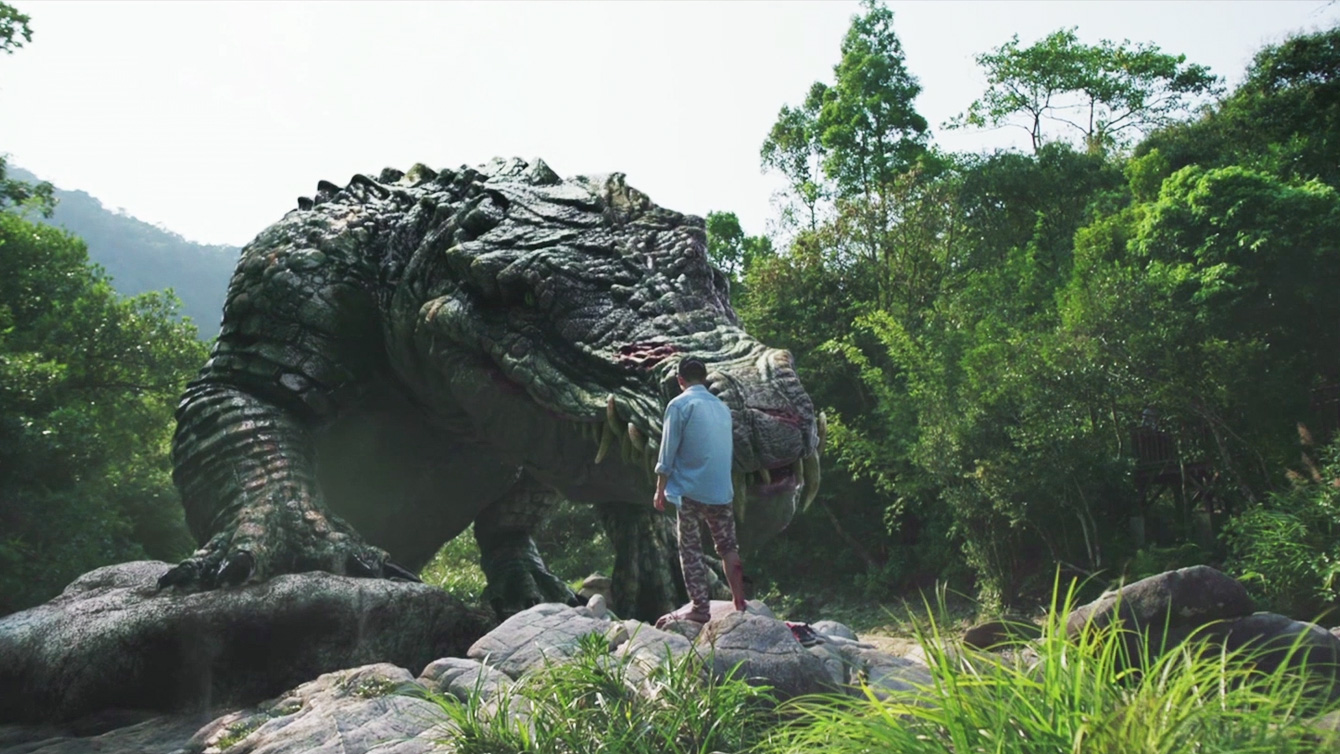
Crocodile Island (巨鳄岛, Simon Zhao & Xu Shixing, 2020)

Monster movie streamer Crocodile Island (巨鳄岛, jù è dǎo) became a surprise hit in the early days of the pandemic as people increasingly preferred to entertain themselves at home, though of course in a way it may be somehow comforting to see people battle more obvious threats that they can actually see and physically resist. In any case, the film never promises much more than its nature as fodder for online streaming would suggest while admittedly pinching plot elements from other similarly themed movies such Train to Busan and positioning the central conflict as effective paternity rather than the monster itself.

A brief prologue finds American pilots flying through the Dragon Triangle during the Second World War while ominously carrying cargo labeled as containing dangerous radiation though the reason they later crash on an uncharted island is that they are suddenly attacked by what appear to be pterodactyls. Nevertheless, the radiation is later given as an explanation as to why all the creatures on the island have evolved into huge and terrifying monsters including the titular crocodile.

Flash forward to the present day and grumpy middle-aged man Lin Hao (Gallen Lo Ka-leung) is escorting his estranged 19-year-old daughter Yiyi (Liao Yinyue) home to China following the sudden death of her mother in Australia where the pair had been living. Yiyi has secretly been accompanied by her university student boyfriend Cheng Jie (Wang Bingxiang) of whom Lin clearly does not approve, not yet able to shift his perspective on the daughter he hadn’t seen in five years to realise she is no longer a little girl. Family bonding will however have to wait as the plane they’re travelling on alongside a pregnant lady and her husband, an influencer, and an obnoxious man travelling home for a heart transplant, is pulled into Dragon’s Triangle by magnetic interference and crash lands on the island where several of the survivors are quickly swallowed by the crocodile. 

Those who remain are therefore faced with a series of dilemmas as to whether to help each other or prioritise their own survival with Cao Fang (He Qiwei), the heart transplant candidate, actively pushing several of his fellow passengers towards the crocodile so that he can get away. Lin meanwhile quickly takes charge and is more or less unchallenged as they try to explore the island in search of clues hoping that the radio equipment in the ‘40s plane they read about in a diary one of the pilots left behind will allow them to make contact through the outdated tech of radio waves. 

This is might be something of a plot hole seeing as it obviously didn’t work for the American pilot though perhaps there just weren’t any ships in range given the circumstances, and it seems he too might have come to a sticky end. But thanks to his sudden promotion to father of the group, Lin begins to reassess his role as a father to Yiyi in beginning to cede ground and actually listen to some of her ideas along with accepting support from Cheng Jie to help him protect her not lease because he realises he may not survive. There are also a few other giant and very hungry monsters on the island who in this case turn out to be more of a threat than other people who with the exception of Cao Fang are more community minded than individualistic. 

A mild social message is conveyed through Yiyi’s eventual discarding of the cigarettes she secretly smoked, symbolising the end of her rebellion and the re-acceptance of her father along with his patriarchal authority as if shifting back onto the right path thanks to the experience of fighting a giant crocodile together and realising that he really did stay to protect her instead of just going off on his own. Some undeniably ropey special effects and a general lack of coherence in the film’s internal logic frustrate its ability to maintain momentum though English-speakers aside, the performances are strong even if the plot developments at times feel unoriginal. Even so the film sells its message of family reunion and perhaps less palatably patriarchal social conventions as Lin Hao steps up to protect his daughter and community from the threats that surround them be they giant crocodiles or otherwise.


Crocodile Island is out now in the US on Digital & DVD courtesy of Well Go USA.

US release trailer (English trailer)

Heaven Rain Flows Sweetly (Li Shasha, 2023)

In her personal essay film Heaven Rain Flows Sweetly, Li Shasha finds herself meditating on her rootless life and traditional attitudes to the natural world when confronted firstly by ecological disaster and then by global pandemic. In the traditional culture of the Nakhi People among whom Li grew up in the remote landscape of the Himalayas, they say there was once a war between humanity and the spirits because humanity took too much from the Earth and gave nothing in return. As wildfires rip through Oregon where she handled settled and begun a garden, she wonders if we haven’t reneged on our bargain and are paying for our lack of regard for nature.

On a return to the US, it suddenly seems odd to her that grasshoppers and frogs appear only as motifs on shop window displays amid the grey concrete of the cities. As child, she had taken part in rituals honouring fire but now sees its terrifying potential as the world around her is reduced to ashes. In the wake of disaster, she pays a visit home to see the grandmother who raised her while her her own mother studied abroad but encounters a different kind of destruction as the village she once new has become a living museum. Now designated a UNESCO World Cultural Heritage Site, most of the original residents have moved away and rent their traditional-style homes out to the throngs of tourists which now descend on the region. Wandering around the town she sees a bustling night life scene in which the traditional dance of Nakhi People has been repurposed as entertainment for outsiders drinking in the many bars.

In order to rediscover Nakhi culture she must head further into the mountains, but also observes that this way of life has also been disrupted by encroaching modernity. She finds a little girl who, as she once was, is being cared for by grandparents while her brother and mother work in the city. Her cousin has returned from university for the summer and remarks how much more difficult it is to readjust to rural life than it is become used to urban living. It seems much hotter here than he remembered, he’d never have thought to bring a hat, and given the ongoing drought they now farm corn rather than rice. The young man asks if America is more ecologically friendly than China, which seems like an ironic question but prompts Li into a reconsideration of her own relationship with the natural world along with the uncomfortable reminder that as she walks through America she treads on the land of another displaced indigenous people. 

Li celebrates Lunar New Year with the villagers and only hears of an imminent lockdown and a mysterious new disease that seems again like a kind of rebuke for the way mankind has treated the Earth. Presented with a choice, she can’t decide whether to stay or go and reflects that far from uniting us the pandemic has presented only more division. But then even on her return to the US she finds new ways of being and echoes of a more traditional culture in a local community garden that reminds of the way the villagers live tending to the earth with togetherness and replacing what one takes in a gentle symbiosis with nature. 

Using mainly English when talking about her life in America and Mandarin for that in China, Li laments she knows no Nakhi and has lost touch with her culture which seems to be retreating even further in the face of encroaching modernity. Even so, she begins to reevaluate the balance of her life while asking if it’s already too late or if we, like her ancestors, can find new ways to repair our relationship with nature and learn to live in harmony with it once again. Li’s poetic voiceover lends a touch of melancholy to her exploration of all we’ve all lost in a bid for modernity but also perhaps a note of hope that scorched earth can still be replanted though it may take many hands to do so. 


Heaven Rain Flows Sweetly screened as part of this year’s DOC NYC and is available to stream in the US until Nov. 26.

Total Trust (Zhang Jialing, 2023)

“The government strives to provide a stable society, fair legal system, and quality services to ensure the fulfilment, happiness, and security of its people,” according to a news reader at the beginning of Zhang Jialing’s documentary exploring the contemporary surveillance state of the modern China, Total Trust. In recent mainstream narrative cinema, there has a been a clear message that the Chinese citizen is safe nowhere other than at home, but here other voices tell us that threat comes not only from abroad but from within and the co-operation of all citizens is necessary to ensure the nation’s security. 

Early scenes see what others may regard as busybodies enforcing public order by picking up rubbish or monitoring minor parking infractions, but it’s precisely this sense of oppressive community pressure that “social management” systems are designed to create. Utilising cutting edge technology, the authorities harvest big data to assess the “trustworthiness” of the ordinary citizen and accord them a rank which then affects all aspects of their lives from their ability to gain or maintain employment to the right to use public transport. Social responsibility is rewarded with points for the above mentioned activities but also for keeping an eye on your neighbours and ensuring they aren’t planning to do anything “subversive” while your neighbours also watch you. 

But this trustworthiness is not so much towards the society as it is towards the Party. Many of Zhang’s protagonists are lawyers and their families who were targeted during a recent crackdown and charged with subverting state power because they defended those who claimed they’d been falsely convicted of crimes which is problematic because the Party cannot be wrong and it doesn’t make mistakes. Chang Weiping was arrested in 2020 and sent back to his hometown for house arrest leaving him separated from his wife and son. He recounts frequent torture which caused him permanent physical damage while his wife has also found herself targeted by the surveillance state after protesting his imprisonment. 

Other families report similar harassment. Wenzu Li’s husband Quanzhang Wang was imprisoned because of his championing of human rights and though he’s since been released the couple have effectively been banned from social media with any photos featuring their faces automatically removed by AI technology and the accounts that posted them limited. They are constantly watched while the police have also motivated their neighbours to monitor and shun them. After being invited to speak at an international conference, their door is blocked by mysterious mask-wearing neighbours who physically prevent them from leaving (they later appear at the conference via Zoom). Their son has also had to change schools almost every term because of the persistent harassment and their own low social credit ranking.

As another persecuted journalist, Sophia, points out after generations of censorship, a degree of censure has become internalised and in general people tend to self-censor without necessarily regarding it as an infringement on their freedom. Many people welcome this kind of oppressive “security” because it makes them feel safe while others are too afraid of the potential consequences to resist. Weiping’s wife takes his father to task for giving up on the campaign against his imprisonment as he remains reluctant to challenge the Party of which he has been a lifelong member, while he agrees that he is simply old and frightened and doesn’t want to be subjected to state harassment himself. 

Weiping’s wife eventually decides to emigrate to the US believing there is no future for her son in China while Weiping himself remains imprisoned. The journalist makes plans to study abroad in the UK, which might in itself be ironic given the increasing authoritarianism of the British government. The UK is already one of the most surveilled places in the world and similar kinds of AI-based facial recognition technology are already being employed in law enforcement. In any case, she is arrested at the airport and prevented from the leaving the country before being detained and charged with the same “subverting government power” line as the lawyers. According to the closing titles, she remains in prison. Emergency powers introduced during the pandemic have only enabled a wider authoritarian power grab with authorities now able to manipulate “health ratings” to silent protest or otherwise make lives unliveable by simply switching the reading to red meaning that the target can be arrested simply for leaving their home. Citizens may need to reevaluate the “trustworthiness” of the government but are of course prevented from doing so in a society in which their every movement is already closely controlled.


Total Trust screened as part of this year’s DOC NYC.

Trailer (English subtitles)

How to Have an American Baby (Leslie Tai, 2023)

“Mama, why wasn’t I born in America?” a salesman promoting a programme bringing women from China to give birth in the US so that their child will have citizenship rather manipulatively states in an almost certainly made-up quote from a child jealous of another’s life of baseball playing freedom abroad. The never quite explained mystery at the centre of Leslie Tai’s documentary How to Have an American Baby is why exactly so many families find US citizenship so desirable given that they have no immediate intention of living there themselves.

A father later suggests that he was looking for “security”, perhaps implying a sense of anxiety regarding the future direction of China while others insist they want their kids educated in the US presumably to take advantage of more global opportunities (additional press materials also suggest a desire for a legal security not afforded to children born out of wedlock). But it’s also true that the US has shockingly high maternal mortality rates in comparison to the rest of the developed world and that, though it seems they may not have realised it, these women are risking their lives and the lives of their unborn children undergoing an incredibly stressful and difficult period of confinement and later medical procedure usually alone and unable to speak the language. Most of the women appear to be under the care of Mandarin-speaking doctors, yet their manner is often rough and unkind while at least one woman seems to suspect that the advice she’s being given may not be impartial. As non-residents who do not have medical insurance, the parents assume that the hospitals are taking advantage of the Chinese patients and charging whatever they like with rates far higher than locals would typically pay.

One could therefore say that this is a very circular business. The hospitals make their money and they’re happy, while a small industry seems to have arisen with Chinese migrants running maternity hospitals to facilititate this practice. However, largely unable to speak English themselves, they can offer little help in a crisis and as they are operating in a legal grey area are not keen to get involved in any disputes. One woman, Lele, who unfortunately loses her baby she suspects as a result of medical malpractice is kept isolated from the other mothers and given almost no support. In the lengthy birth scene in which one mother undergoes a difficult labour lasting more than a day, the director is called away to translate for Lele with alarming warnings about a baby “coding” and that there is something wrong with their heartbeat all of which only places further stress on the mother giving birth who worries that her own anxiety is the reason the delivery is taking so long.  

Meanwhile, alarm is being raised by residents of the local area in which many of these “maternity hotels” are situated. They complain about increased traffic and noise due to the fact that ordinary family homes are now being used for a commercial purpose though one woman’s suggestion that they report such an innocuous sound as a baby crying (incorrectly assuming the women are also giving birth at the hotel) could obviously have unintended consequences and speaks to a greater degree of ingrained prejudice. A local government representative suggests that beyond instituting checks to ensure building safety there isn’t much they can do as the hotels aren’t breaking any laws or occupancy rules and even if they were they’d just pay someone to lease another property under a different name and set up somewhere else. 

As the salesman had suggested, for some of the women US citizenship is a status symbol and something they’re made to feel they’re denying their children if they chose to give birth to them at home. This process is expensive, and many of the families lead lives far more materially comfortable in China than they likely would in the US yet they see US citizenship as something that will be extremely beneficial to their children and so naturally want to give them the best if also securing their own status in being able to give it to them. Perhaps as one man at the neighbourhood meeting suggests, it’s only “smart” to take advantage of this obvious business opportunity but it’s also true that it’s the families who are perhaps being exploited in being missold a safe and easy path to engineering future possibility for their as yet unborn children. 


How to Have an American Baby screens Nov. 14 as part of DOC NYC and will be available to stream in the US until Nov. 26 before making its broadcast premiere on Dec. 11th on POV.

Original trailer (English subtitles)
Youth (Spring) (青春, Wang Bing, 2023)

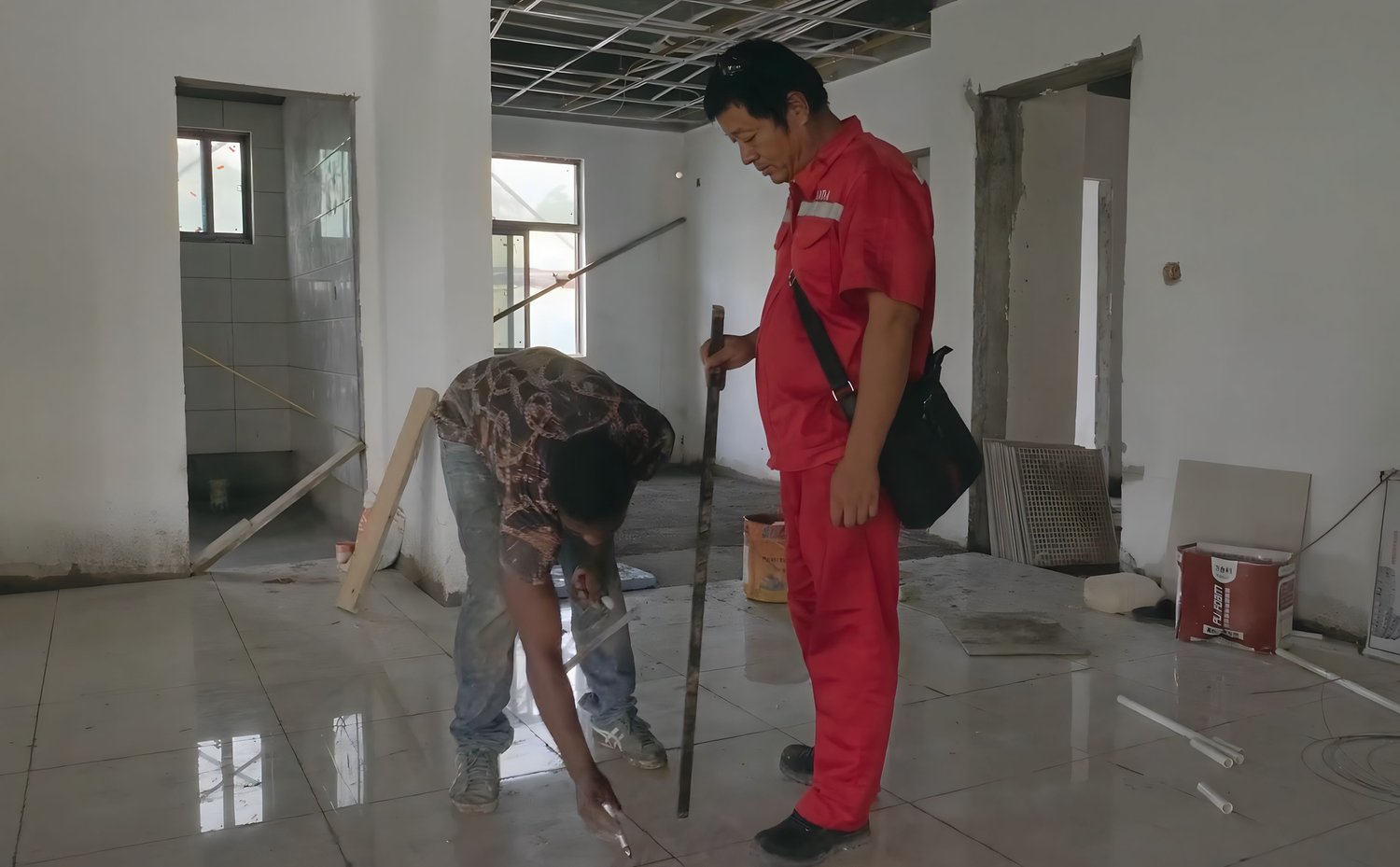
There’s an almost eerie quality to the absence of age in Wang Bing’s sprawling exploration of the Zhili textile industry Youth (Spring). Perhaps for reasons of tact, the ages of older workers, unlike those under 35, are not displayed while they are also predominantly female. One has to wonder where the young men who currently work on the shop floor will later end up if they generally do not stay in this line of work though alternatively it may be further evidence of generational shift in which the young men of 30 or 40 years ago simply did not take up jobs as seamstresses. In any case, the only older men we see here are factory owners and floor managers while the older women are often at the forefront of mostly futile attempts at collective bargaining. 

Many young migrant workers apparently prefer the factories in Zhili because they offer a greater degree of freedom than the large state-run complexes which often micromanage the lives of their employees in almost prison-like conditions. But then it’s also obvious that they struggle and largely cannot earn a living wage despite the long hours they are often forced to put in. One younger worker tries to complain about the lack of overtime pay on offer, explaining that he needs to make at least 4-500 yuan a day and cannot do that without the extra payment but the manager simply tells him that he pays better than other shops and in any case there are plenty of rural youngsters who will be happy to take his job. 

The later part of the film is largely concerned with attempts at collective bargaining led by veteran workers who find themselves frustrated by the system. This kind of work is often seasonal and ironically unavailable in the spring during which many workers return home to their villagers. They are paid on piece rate contracts but the rate is set by the kinds of garments they’re making and they often can’t know how much money they’ll be getting by the end of the season. Consequently they try to work up the rate on certain items while at times resentful of other workers who’ve been able to make more solely because they were assigned different tasks which pay better. The managers give them all the usual excuses, largely refusing to budge or offering only a modest per item increase which as one worker points out will barely make a difference if the quota is small anyway. 

Wang gives more of an overview rather than focussing on a series of individuals but discovers an ironic intersection of the legacy of the One Child Policy and the economic realities of today. At the first workshop, a couple who met on the shop floor experience an unexpected pregnancy. The young woman, Shengnan, seems to be given little choice in the matter which is largely being decided by the respective parents on each side. Because of the additional complications of the residence system (they are each from different districts) the parents both want the couple to move closer to them especially as the boy’s parents are economically dependent on him as they age. Shengnan’s mother puts her foot down and negotiates with the manager to get Shengnan time off for an abortion but he refuses until Shengnan has finished her current quota after which he says he’ll be very happy for her to take some rest at home to get over it though as another suggests, trying to offer comfort, an abortion is just like getting bitten by a dog and then biting back. He does however accept that it’s the girls who suffer while all the men are “little emperors”.

Evidence of sexism is rife. Another worker needles his girlfriend about her job in an overnight internet cafe, telling her that it’s not good for girls and that it might cause acne while seemingly not bothering to think about how his long shifts at the factory might be affecting him. “Women are useless” another man later exclaims despite being largely supported by them in the workplace, not least by his own mother who works in the same factory. The younger workers are often cheerful, messing around with silly banter and constant flirting. It’s not surprising that relationships often arise with people trapped together such long periods of time with little possibility of going out to meet someone else, but they’re also largely impossible given the futility of trying earn enough to support a family through seamstressing. Another man faces a similar dilemma when he discovers his girlfriend has also become pregnant but cannot decide if he wants to get married, worrying about shouldering the responsibility of a wife and child while financially insecure. 

All of which would seem to conflict with a wider anxiety about children not getting married as parents often reject a potential suitor based on low economic status or residency while young men find themselves frustrated unable to envisage a time when they might be financially stable enough to start a family. Meanwhile, the old-style factory dorms are strewn with rubbish and in general depressing in their grey concrete exteriors and poorly lit rooms. An outburst leading to a physical confrontation between workers seems only natural given the fraught conditions though Wang presents it as a howl of despair from a generation trapped between the old China and the new with very little to show for it.


Youth (Spring) screened as part of this year’s BFI London Film Festival.