
Kung Fu Soccer (功夫女足, Stephen Chow, 2026)

Seven years on from New King of Comedy, Stephen Chow returns with another reimagining of a past hit in Kung Fu Soccer (功夫女足, gōngfu nǚzú), a new take on the 2001 global sensation Shaolin Soccer. Throughout the ‘90s, Chow had been one of Hong Kong cinema’s most bankable talents with a series of mo lei tau or “nonsense” comedies. There’s no getting away from the fact that the Cantonese language is intrinsic to the genre which heavily relies on zany puns and wordplay in addition to slapstick humour, though the later phase of Chow’s career has largely been in Mainland-friendly Mandarin as is Kung Fu Soccer.

As such, the film struggles to achieve the kind of comedic rhythm that made Chow’s earlier work so popular while its nonsense gags such as a man burning his leg in order to get rid of unwanted hair after mistakenly thinking someone talking on the phone about cooking pork was talking to him play out less successfully. As in Shaolin Soccer, Chow turns subpar CGI into a kitsch feature, leaning in to the unreality of virtual stadia and the uncanniness of a CGI ball being knocked around the pitch to create a cartoon world where the normal rules of physics do not apply.

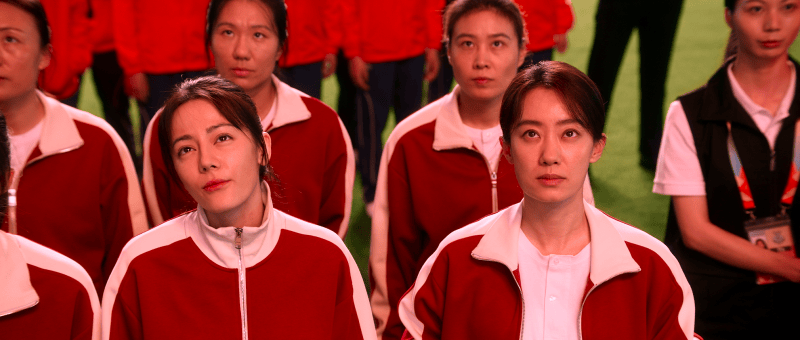
This time around, the action follows the Emei women’s football team who face ageism and sexism after making a belated bid to win an Asian championship. Headstrong captain Shuang (Zhang Xiaofei) and her childhood friend Jade (Dilraba Dilmurat) are struggling to overcome a falling-out over Jade’s decision to leave the sport and get married only to return following her divorce, while Shuang has dedicated her life to football and kung fu but now at almost 40 is beginning to realise that she may have missed out on other life experiences and has no plans for the future. Shuang is an orphan who found a place within the team and fears abandonment, whereas Jade is a wealthy heiress whose devil-may-care attitude is informed by her financial security.

As expected, part of the path for the team’s success is getting the pair to patch things up, which they eventually do after a little manipulation by “Grand Uncle” Xu Feng (Lay Zhang), another childhood friend with a longstanding crush on Shuang she in fact returns but is unable to act on due to being arrested emotionally having done nothing but sport and kung fu since she was a child. The conclusion that Shuang is gradually guided towards is that she’s too intense and has lost her love of playing the game. She has a lack of empathy for her teammates and an autocratic management style that alienates those around her, a criticism that has been levelled at Chow himself in the past. It’s this internalised pressure that makes it difficult for the players to perform. If they chilled out a bit and rediscovered the joy of it, they might be better placed to face their opponents who also have their own particular quirks.

The film has also come in for criticism for the ways that it depicts the other Asian nations in the competition, most particularly the South Koreans who are shown to be obsessed with beauty and play in underhanded ways while the Korean spoken in the film is delivered unconvincingly. The team from India similarly have some kind of super-stretchy ability and the Australians are defined by aggression and tactlessness. The Japanese team, coached by Takeru Satoh in a cameo appearance, are mainly just violent while the decision to make their goalie a figure of fun for not being considered conventionally attractive seems very outdated and undercuts the film’s other messages of female power and solidarity. The Emei team face questions of ageism and are forced to constantly prove themselves, but eventually come out on top after learning to trust each other, pool their respective strengths, and just have fun playing the game. Backed by Carina Lau’s mahjong-obsessed grandmaster, they have perhaps learned to integrate their martial arts abilities and love of sport to overcome not only the prejudice held against them, but their own internalised anxieties.


Kung Fu Soccer is in North American, UK, & Ireland cinemas from 23rd October.

Trailer (Simplified Chinese / English subtitles)
Eye for an Eye: The Blind Swordsman (目中无人, Yang Bingjia, 2022)

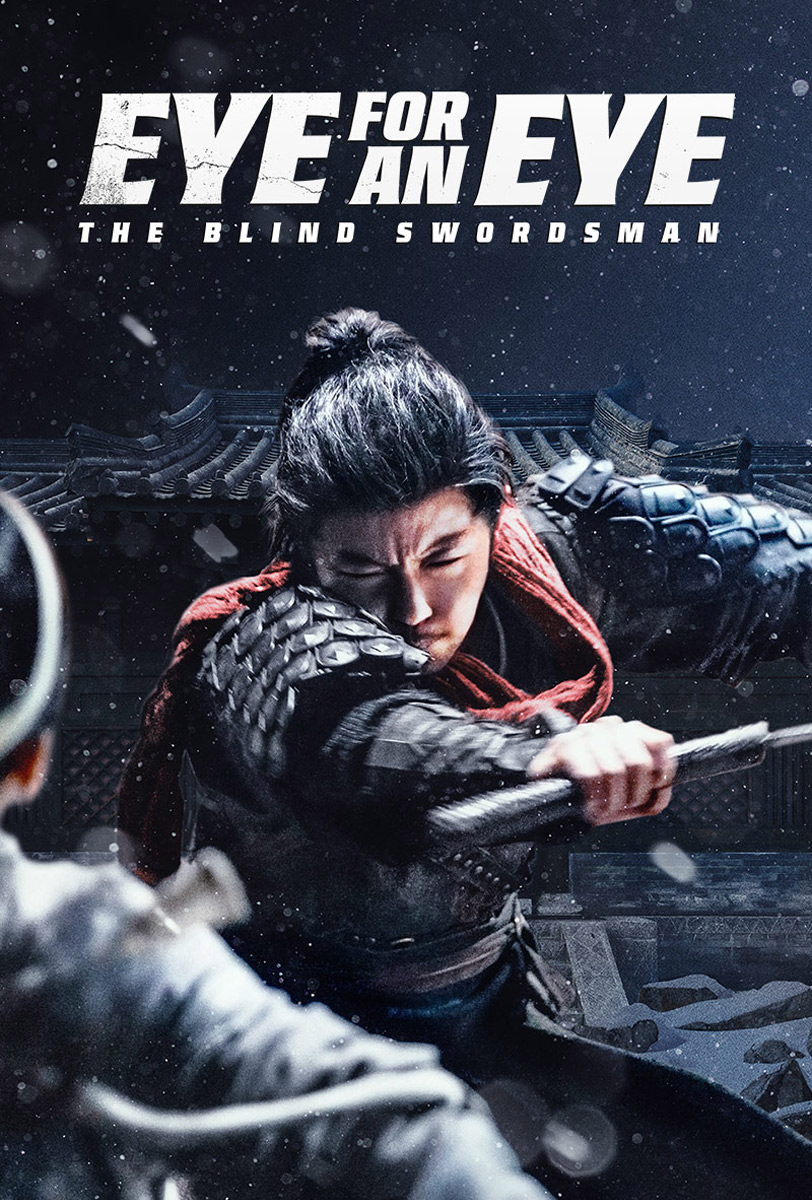
A blind swordsman takes revenge against the evils of feudal society in Yang Bingjia’s impressively helmed action drama, Eye For An Eye: The Blind Swordsman (目中无人, mùzhōngwúrén). Set in the “lawless” society of the Tang era following the Tianbao rebellion, the film has a western sensibility with its twanging guitar score and dusty roads not to mention jumped up gangsters trying to get a foothold in the legitimate order simply because they have become too powerful and no one is willing to resist them. 

Ni Yan (Gao Weiman), a young tavern woman who lost her brother and husband when her wedding was attacked by the Yuwen clan asks for nothing more than “justice” but that’s something no one can give her. Wandering swordsman Cheng Yi (Mo Tse) who’d taken a liking to her because she offered him some of her wine and even gave some to his horse reports the crime to the local magistrate after claiming the bounty on a fugitive, only he tells her directly that he will do nothing because the Yuwen clan have already moved beyond justice and not even he will touch them. 

In a way, Cheng is depicted as a failed revolutionary and his blindness a symbol his despair in a world he no longer cares to see. A bounty hunter by trade, his work is facilitated by old comrade Lady Qin (Zhang Qin) who, in contrast to him, seems to live a cheerful life repairing musical instruments while much loved in the town around her. Though they pretend to be saving money for an operation to restore Cheng’s sight, their line of work is perhaps cynical in taking advantage of the times while accidentally outsourcing a justice the authorities can no longer provide in the weakened Tang society. The Yuwen have infiltrated most institutions and cultivated relationships with important people that allow them to ride roughshod over ordinary citizens who are now completely at their mercy.

There might be something quietly subversive in these references to a corrupt and authoritarian institution which tries to brand Ni Yani the criminal in her pleas for justice, insisting that she admit to killing her brother herself in resentment of his criminal past while he is also hunted by the Yuwen because he knows to much about their dodgy dealings including raiding tombs to get precious gems to use as bargaining chips in a dynastic marriage negotiation. Cheng Yi did not originally want to get involved, himself too cynical and having given up hope of “justice” in this “lawless” society, but finds himself sympathetic towards Ni Yan because of the kindness she showed him and the obvious suffering her ordeal has inflicted on her. 

In a sense, his eyes are opened to the injustice of the society around him to which he had been wilfully blind if ironically accepting that he will never see again. He alone is willing to stand up to the Yuwen while even within their ranks petty resentments are growing as a princeling grows ambitious to escape his own oppression at the hands of an authoritarian brother who berates him for his weakness. 

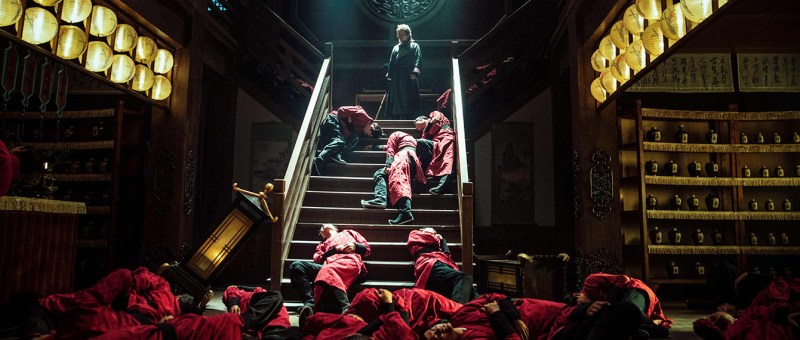
Despite the budgetary issues which often plague straight to streaming cinema, Yang’s elegantly lensed drama brings a real sense of place to the dusty provincial towns where Cheng plies his trade along with the ornate elegance of the realm of Lady Qin whose flowing robes belie her military past. Drawing inspiration from the western as well as Japanese genre classics such as Yojimbo the film presents a world in decay in which the wandering swordsman becomes a moral authority, delivering justice if for a price. The irony is that it isn’t money which opens his eyes, but the reclaimed ability to see with his heart in deciding to help Ni Yan in her quest to avenge the deaths of those close to her. A series of excellently choreographed and well-shot action scenes along with Yang’s post-modern take on the material lend this tale of wandering swordsmen and feudal abuses a sense of the legendary that hints at further adventures for wandering sword for hire Cheng Yi bringing his own brand of justice to a lawless place. 


Eye for an Eye: The Blind Swordsman is out in the US on Digital, blu-ray, and DVD on 28th November courtesy of Well Go USA.

US trailer (English subtitles)