
Fight Against Evil 3 (东北警察故事3, Yang Bingjia, 2026)

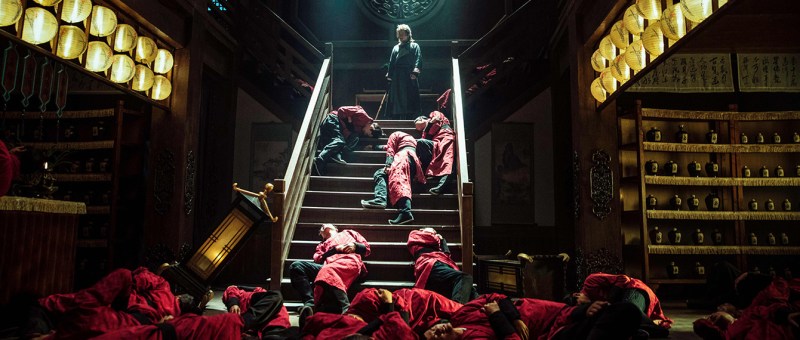
Top cop Li Hongqi (returns for another holiday gone wrong in the third instalment of the Fight Against Evil series, and there is indeed some serious evil to be thought. Directed this time by Yang Bingjia rather than Qin Pengfei, Fight Against Evil 3 (东北警察故事3, Dōngběi jǐngchá gùshi)received a theatrical release in Mainland China rather than premiering on IQYI’s streaming service and so benefits from slightly higher production values and features a mild tonal shift that sends the film into action comedy territory.

In fact the first “fight” takes place off-screen as Honqi casually takes down a man who’s taken his wife hostage so that he can finish a telephone call with the rather demanding mother-in-law (Diama Lin Xiaojie) he hasn’t actually me though he and his wife Touzi have already been married for two years. Having become estranged from her birthmother, Touzi tells him not to bother with her because she’s a handful, though Hongqi is keen to be a good son-in-law and hopes to broker a reconciliation by agreeing to his mother-in-law’s madcap plan to stage a second wedding in her hometown without actually telling Touzi until she gets there. 

In any case, Hongqi is immediately distracted when Xinxin (Ma Qianyi) , a cheerful teenage girl he met on the plane, is reported missing, suspected of having fallen victim to traffickers after failing to reach her grandfather’s house. Hongqi feels personally responsible because he said he’d take her, but had to leave after hearing that his mother-in-law had been arrested for causing trouble in a cafe. Nevertheless, the mother-in-law proves to be unusually well connected and helps him track down the local crime kingpin whom she apparently knew when he was a snivelling child getting beaten up for his lunch money. 

On his arrival in the town, Hong’s old friend Sun Biao (Cui Zhijia) tells him that times are different now and they have to do law enforcement in a more “civilised” way, which might suggest that things work differently here compared to the city, though as it turns out Hong’s skills are still in demand as he finds himself repeatedly getting into brawls with the local bad guys. Even Baio also gets into the swing of things wanting to prove that his fighting skills are still as good as Hongqi’s. This is, however, violence very much in the service as justice as everyone involved in the fights is already an active participant in the world of crime and the violence is being used to subdue rather than interrogate them.

Meanwhile, the trafficking gang seems to be an offshoot of some kind of cult that attracts people who’ve encountered financial ruin due to contemporary social issues from being scammed to failing in business or developing a gambling problem. Most of the lower-ranking members are doing this more out of desperation and have abandoned their humanity as a means of survival, not that it excuses what they’ve done. The leader, meanwhile, experienced a tragedy of her own which seems to have affected her mind and has made her especially attached to young Xinxin who otherwise proves plucky and resourceful with her repeated attempts to escape from the gang.

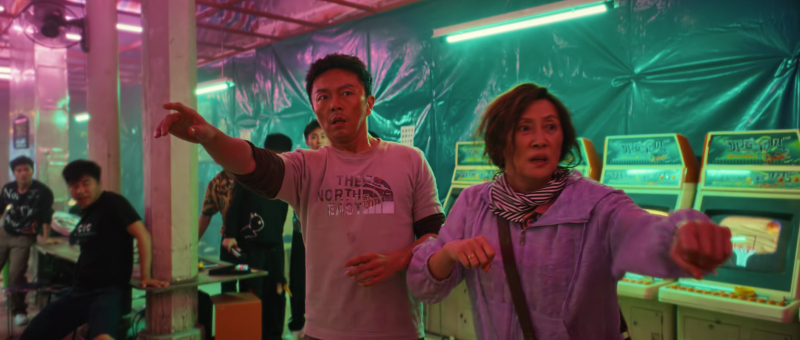
Despite the grimness of the subject matter, the film finds plenty of opportunities for comedy not least in the zany antics of Hongqi’s mother-in-law who also has a justice-loving heart and at one point takes off to catch the kidnappers herself on her moped. There’s a fundamental absurdity to Hong’s existence in which he’s been yet again drawn into a case while supposedly on holiday while attempting to keep his demanding mother-in-law happy and keeping the whole thing secret from wife in the hope he can either bamboozle her into taking part or she will arrive and talk her mother out of it. This sense of absurdity also carries over into some of the fight scenes in which Hongqi has to fight off an entire gang while his mother-in-law hides under a table in a pool hall or has to go undercover in a club, despite looking the most like a policeman it’s possible to look without actually wearing a uniform.

It is not, however, all slapstick and still features some seriously impressive action sequences. The film also makes some attempt to mine humour in the decidedly unfunny customary series of title cards explaining that the nation is taking measures to combat human trafficking and explaining that everyone was caught and punished in accordance of law before finishing on a note that explains China has over two million police officers, which is intended to be reassuring but perhaps is also the exact opposite. Nevertheless, the film is a great deal fun as Hongqi and his mother-in-law fight off bad guys while simultaneously planning a wedding.


Fight Against Evil 3 screens 23rd August as part of Big Bad Film Fest.

Trailer (Simplified Chinese subtitles only)
Eye for an Eye 2: Blind Vengeance (目中无人2, Yang Bingjia, 2024)

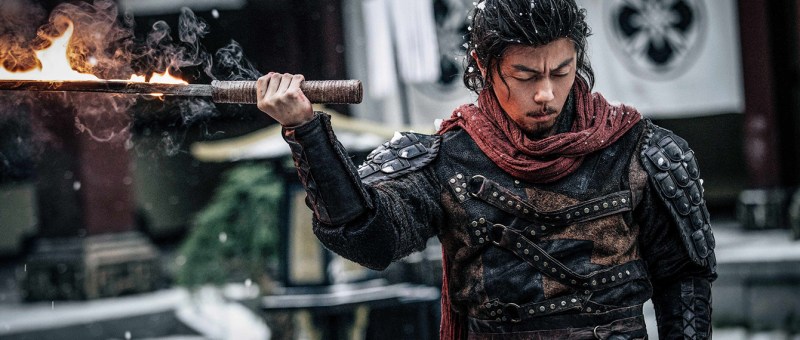
The wandering swordsman returns but this time to a world much more in disarray than when we last left it in the sequel to the surprise hit streaming movie An Eye for an Eye: The Blind Swordsman, An Eye for an Eye 2: Blind Vengeance (目中无人2, mùzhōngwúrén 2). Less origin story than endgame, the film finds bounty hunter Cheng Yi living in another dusty town and working for Youzhou Prefecture to bring in wanted criminals dead or alive but finally forced into the role of protector for a little girl dead set on vengeance against this world.

Richer in scope and ambition, this time around we’re given a little more backstory about the former lieutenant who is now using his martial skills to enact justice in an otherwise lawless society if only when he’s paid to do so. One of his targets turns out to be a man who served under him in the war and is disillusioned about its aftermath. “What did we gain in the end?” he asks, justifying himself that he may have killed a few people and taken some money but he was only claiming what he was owed. The argument doesn’t wash with Cheng Yi, but the war also took his sight from him and he too is a disillusioned exile from his home in Chang’an living a nihilistic life of drink of killing on the behalf of a distant and compromised authority. 

His wilful isolation may be why he is not originally motivated to help the orphan little girl Xiaoyu (Yang Enyou) who says her mother starved to death during their escape. Xiaoyu had tried to protect her little brother who seemed to be mute only to see him trampled beneath the hooves of a debauched nobleman who had just murdered an entire family because they had dared to tell on him to his father. The family had been planning to flee at dawn but Li Jiulang (Huang Tao) got there first. Xiaoyu witnessed his crime after sneaking in to steal the bread they were baking and was then freely given to her by a young woman Li later killed, further stirring her desire for revenge. Cheng Yi ends up saving her from Li on two separate occasions, though the second time it isn’t overly clear whether it was intentional or a drunken coincidence. Nevertheless, he continues to counsel her against pursuing her revenge, especially towards a man like Li who is wealthy and connected and has no compunctions about killing children. 

Li is also seen to abuse drugs and have a sadistic streak though no real explanation is given for his cruelty save that he is evil and has enough money and power to do as he pleases. No one except the little girl is going to put a bounty out on him, as she naively tries to do by selling her brother’s silver whistle to get a poster mocked up though Li simply offers a double bounty on her and it seems plenty are desperate enough to consider killing a defenceless girl to get their hands on it. Perhaps it’s this that eventually moves Cheng Yi’s heart as she continues to insist on an impossible justice even at the cost of her own life. Like him, she no longer has any family nor any place to call home and is displaced within the chaos of late Tang. Through bonding with her, he begins to rediscover his humanity and considers leaving the world of the bounty hunter behind to become an “ordinary person” in Chang’an to raise her away from this nihilistic way of life.

Building on the success of the first film, Yang Bingjia makes the most of an increased production budget to fully recreate the atmosphere of a bustling frontier town while continuing the Western influence as Cheng Yi hunts down wrongdoers in an otherwise lawless place. The connection between the cynical swordsman and his tiny charge has genuine poignancy as he continues to caution her against the path of revenge, reminding her that it is a continuous cycle and one act of vengeance merely sets another in motion, yet finally deciding that he must teach her what he knows anyway because like him she has no other way to live. Still, what he envisions for her is a peaceful life in Chang’an, far away from the chaos of the frontiers in a world that may not quite exist anymore but may yet come again if not, perhaps, for all.


Eye for an Eye 2: Blind Vengeance is released in the US on Digital, Blu-ray & DVD March 4 courtesy of Well Go USA.

Trailer (English subtitles)

Eye for an Eye: The Blind Swordsman (目中无人, Yang Bingjia, 2022)

A blind swordsman takes revenge against the evils of feudal society in Yang Bingjia’s impressively helmed action drama, Eye For An Eye: The Blind Swordsman (目中无人, mùzhōngwúrén). Set in the “lawless” society of the Tang era following the Tianbao rebellion, the film has a western sensibility with its twanging guitar score and dusty roads not to mention jumped up gangsters trying to get a foothold in the legitimate order simply because they have become too powerful and no one is willing to resist them. 

Ni Yan (Gao Weiman), a young tavern woman who lost her brother and husband when her wedding was attacked by the Yuwen clan asks for nothing more than “justice” but that’s something no one can give her. Wandering swordsman Cheng Yi (Mo Tse) who’d taken a liking to her because she offered him some of her wine and even gave some to his horse reports the crime to the local magistrate after claiming the bounty on a fugitive, only he tells her directly that he will do nothing because the Yuwen clan have already moved beyond justice and not even he will touch them. 

In a way, Cheng is depicted as a failed revolutionary and his blindness a symbol his despair in a world he no longer cares to see. A bounty hunter by trade, his work is facilitated by old comrade Lady Qin (Zhang Qin) who, in contrast to him, seems to live a cheerful life repairing musical instruments while much loved in the town around her. Though they pretend to be saving money for an operation to restore Cheng’s sight, their line of work is perhaps cynical in taking advantage of the times while accidentally outsourcing a justice the authorities can no longer provide in the weakened Tang society. The Yuwen have infiltrated most institutions and cultivated relationships with important people that allow them to ride roughshod over ordinary citizens who are now completely at their mercy.

There might be something quietly subversive in these references to a corrupt and authoritarian institution which tries to brand Ni Yani the criminal in her pleas for justice, insisting that she admit to killing her brother herself in resentment of his criminal past while he is also hunted by the Yuwen because he knows to much about their dodgy dealings including raiding tombs to get precious gems to use as bargaining chips in a dynastic marriage negotiation. Cheng Yi did not originally want to get involved, himself too cynical and having given up hope of “justice” in this “lawless” society, but finds himself sympathetic towards Ni Yan because of the kindness she showed him and the obvious suffering her ordeal has inflicted on her. 

In a sense, his eyes are opened to the injustice of the society around him to which he had been wilfully blind if ironically accepting that he will never see again. He alone is willing to stand up to the Yuwen while even within their ranks petty resentments are growing as a princeling grows ambitious to escape his own oppression at the hands of an authoritarian brother who berates him for his weakness. 

Despite the budgetary issues which often plague straight to streaming cinema, Yang’s elegantly lensed drama brings a real sense of place to the dusty provincial towns where Cheng plies his trade along with the ornate elegance of the realm of Lady Qin whose flowing robes belie her military past. Drawing inspiration from the western as well as Japanese genre classics such as Yojimbo the film presents a world in decay in which the wandering swordsman becomes a moral authority, delivering justice if for a price. The irony is that it isn’t money which opens his eyes, but the reclaimed ability to see with his heart in deciding to help Ni Yan in her quest to avenge the deaths of those close to her. A series of excellently choreographed and well-shot action scenes along with Yang’s post-modern take on the material lend this tale of wandering swordsmen and feudal abuses a sense of the legendary that hints at further adventures for wandering sword for hire Cheng Yi bringing his own brand of justice to a lawless place. 


Eye for an Eye: The Blind Swordsman is out in the US on Digital, blu-ray, and DVD on 28th November courtesy of Well Go USA.

US trailer (English subtitles)