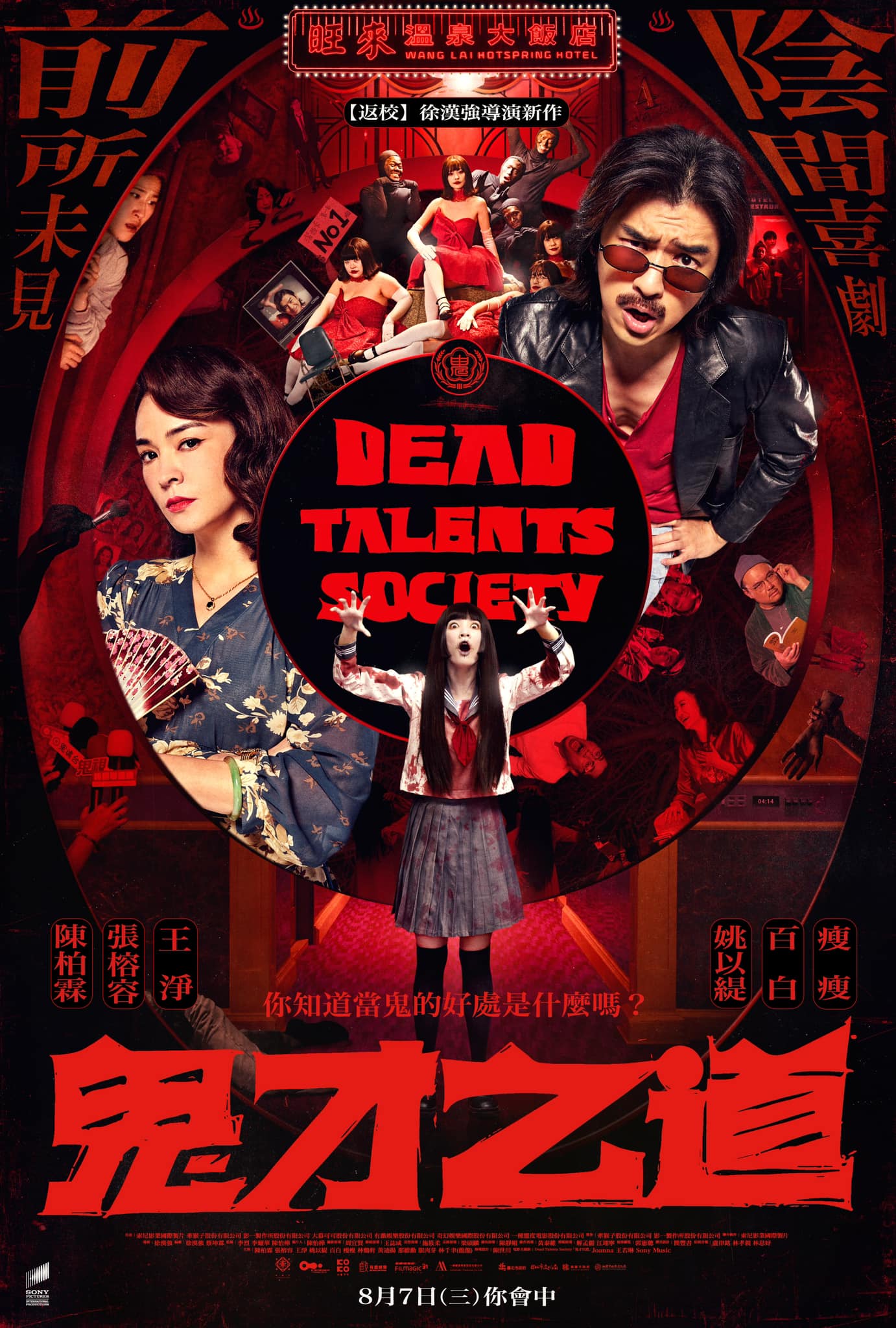
Dead Talents Society (鬼才之道, John Hsu, 2024)

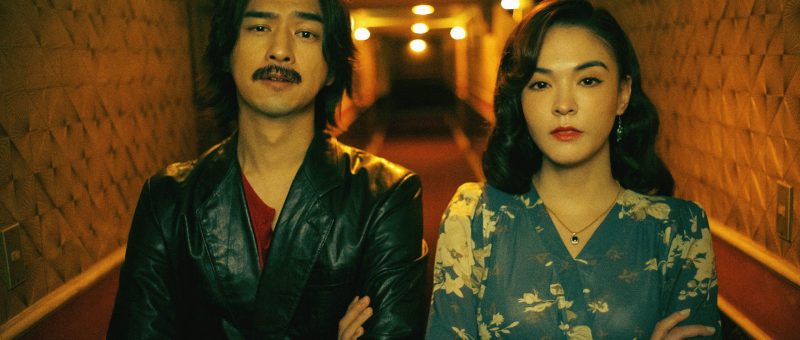
“Why is it more tiring to be dead than alive?” A fed up ghost asks themselves and with good reason. If you thought you’d be able to rest easy in the afterlife, you’ve got another thing coming because it’s just as much of a capitalist hellscape on the other side as it is here. The central conceit of John Hsu’s Dead Talents Society (鬼才之道, guǐcái zhī dào) is that a ghost must must earn their keep by haunting the living in order to provoke large-scale appeasement rituals and the burning of vast amounts of ghost money or risk disintegration and finally disappearing from this world.

In a certain way, this is the paradox of the ghost. They fear being forgotten and only want to be seen mostly by the living but also by the dead in order to feel the validation that they exist and are appreciated. For Rookie (Gingle Wang) , a teenage girl who it later turns out was almost literally crushed by the weight of parental expectation, this was something she was never able to feel in life partly because of her father’s well-meaning attempts to boost her confidence by telling her she was “special”.  He even went so far as to mock up a fake certificate for her while leaving her to feel inadequate that her sister’s trophy shelves were full while hers were empty. It’s this certificate that’s gone missing during her family’s literal attempt to move on from her death and start again leaving her behind. With no place to return to, Rookie will disintegrate in 30 days if she can’t win a haunting licence which is a problem given her mousey personality and the lack of talent that left her feeling so inadequate in life.

Yet many of the pro ghosts are in the same position. Cathy (Sandrine Pinna) used to be the reigning queen, but her thunder was stolen by a former prodigy, Jessica (Eleven Yao), a very modern ghost who’s figured out how to haunt the internet and go viral for scaring influencers to death. In some ways, the living too are ghosts online haunting an alternate plane of reality while it’s through these online personas that we make ourselves seen. After all, in the modern world, there’s no better way to be “remembered” than by achieving internet fame. By contrast, all Cathy has is her decades old trick of backflipping on guests staying in the hotel room where she died in a lover’s suicide over a man who cared little for her. In a hilarious twist, the gang set up the trick on a harried businessman but he’s so busy he doesn’t even really notice any of their ghost stuff and remains entirely focussed on his work. 

Taken in by the gang, the realisation that rookie begins to come to is that she never really needed to be “special” but only herself and for someone to see her as she really was. Her anxieties are those of contemporary youth burdened by the weight of parental expectation and fearing they can’t live up to it. Manager Makoto (Chen Bolin) experienced something similar in life, struck by anxiety while struggling to make it as a early ‘90s popstar while unable to make his mark in the ghost world by virtue of being unable to scare anyone because he’s too good looking. As he tells it, the best thing about being dead is that you no longer need to worry about what other people think and Rookie is therefore free to become herself or else disappear forever. 

Even so, the irony is that the finale sees the central gangs take on unified appearances as if becoming one with one side doing better than the other in their genuine sense of mutual solidarity as a ghost world family. They watch J-horror-esque movies for tips and muse of the contradictions of fame that perhaps we accord those talented that are merely the most visible while these ghosts struggle to be seen in an increasingly haunted world of hollow influencers and illusionary online avatars. Rookie still doesn’t know what being seen means but has perhaps learned to see and accept herself thanks to her experiences in the afterlife. Charming and somehow warm in its lived-in universe of celebrity ghosts and professional hauntings, Hsu’s zany horror comedy may suggest there’s no escape from the living hell of capitalism but that dead or alive you might as well enjoy the ride as best you can before it all suddenly blinks out.


Dead Talents Society screens Nov. 9/10 as part of this year’s San Diego Asian Film Festival.

Original trailer (English subtitles)
Falling in Love Like in Movies (Jatuh Cinta Seperti Di Film-Film, Yandy Laurens, 2023)

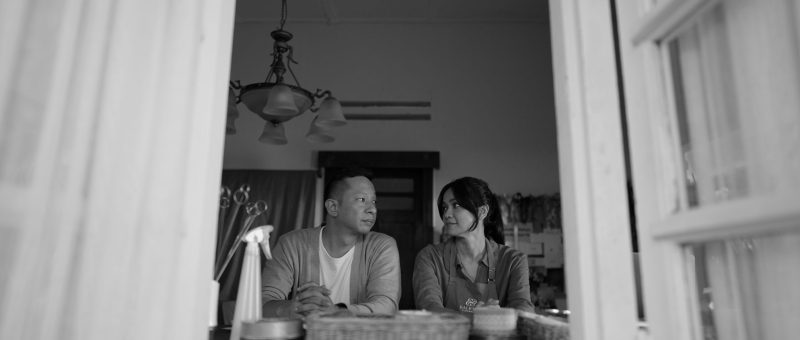
The screenwriter hero of meta rom-com Falling in Love Like in Movies (Jatuh Cinta Seperti Di Film-Film) seems intent to prove that romance can be just as fiery for the middle aged as it can for the average teenager even as his own love interest cautions him that grown-up love is much more considered. It’s mostly about long conversations and frank discussions about what you both do and don’t want rather the clumsiness and artificial barriers that disrupt the relationship between young lovers. She, and the film’s producer, wonder if an audience would find that very interesting, but there is of course something incredibly captivating about witty dialogue and a slow burn romance although that might not actually be quite how it turns out for the lovelorn screenwriter.

Or at least, Bagus (Ringgo Agus Rahman) wants to fall in love like the movies rather than like in real life. His chief idea is that he’s going to write a screenplay for a romance and then his old high school friend Hana (Nirina Zubir) will go to see it and understand it’s all about her so they’ll end up together the end. What it makes it all even more awkward, is that Hana is very recently widowed and Bagus’ clumsy pursuit of her is incredibly insensitive especially as he frames it as a kind of salvation, that he’s helping her to “move on” and escape the inertia of her grief.

Through his experiences, he may come to learn that he’s become stuck in his own head applying movie logic to real life and expecting people to behave the way they would in one of his screenplays in which he of course controls everything. Yet in another way the film is also a departure for him as it’s his first based on his own original idea as opposed to being an adaptation of a existing material. He later says that he’s writing it to try and understand something, yet it’s not until others read it that he begins to see himself reflected and dislike what he sees. His lead actor asks if he made himself this annoying on purpose, while the actress complains the movie Bagus is “cruel” and insensitive in his dismissal of Hana’s feelings little knowing that movie Bargus and writer Bargus are basically the same. 

What he’s left with is the gap between the fantasy of cinema and a more rational reality, the illusion of a romance like in the movies and the less glamorous process of getting to know someone gradually and putting love together piece by piece. On a baseline level, he’s emotionally immature and a little self-interested, unable to see that writing a screenplay as a roundabout confession of love is not romantic but cowardly and what’s really romantic is being present and honest about his feelings even if it’s all quite awkward and maybe a little bit inappropriate considering his love interest only lost her husband a few months previously and in any case has every right to reject future romance if that’s her choice.

Hana is in many way’s the film’s moral arbiter, though often framed within Bargus’ gaze as a tragic victim of her grief only to adopt the moral high ground in the final “reality” of the film. Laurens often wrongfoots us in his meta commentary, shifting from 2.35 black and white to letterboxed colour and structuring the film around title cards liked to screenwriting theory which ultimately pay off in Bargus’ ironic epiphany that actually he was the protagonist all along only he’d forgotten to give himself a character arc in his ongoing fixation on Hana’s supposed need to change. His screenplay is literally all about him, but he’s too close to it to see that his behaviour is not really acceptable off the page and if it’s romantic successes he’s after, he’ll have to recalibrate his idea of what romance is while pitching it to his producer boss and convincing him that it’s worth taking the risk on the smart sophistication of a witty rom-com about the gap between the magic of the movies and the difficult realities of love and loss in which going to the supermarket might be the most romantic thing you’ll ever do.


Falling in Love Like in Movies screens April 24th as part of this year’s San Diego Asian Film Festival Spring Showcase.

Original trailer (no subtitles)

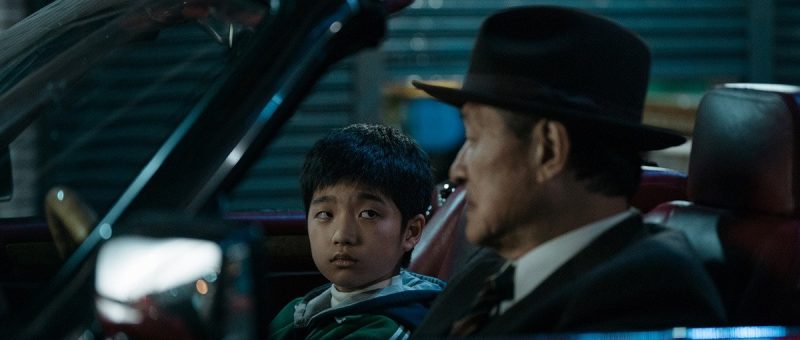
Old Fox (老狐狸 , Hsiao Ya-chuan, 2023)

It’s all about “inequality”, according to the titular Old Fox (老狐狸, lǎohúli). Or at least knowing how to leverage it. Inequality is something that’s coming to bother the young hero of Hsiao Ya-chuan’s coming-of-age drama in which a small boy finds himself torn between two father figures, one a wily old slumlandlord with a heart of stone and the other his melancholy and disappointed but kindhearted father who simply endures the many blows that life has dealt him. 

Set in Taipei in 1989 shortly before an apocalyptic stock market crash in the post-martial law economy crushes the hopes of millions of ordinary people convinced to invest their savings, the film wastes no time in showing us the various inequalities in play in small alleyway of traditional stores all owned by Boss Xie (Akio Chen) whom many seem to regard as a kind of saviour even if he cares not at all about them. Jie’s (Bai Run-yin) father Tai-lai (Liu Kuan-ting) works in a local restaurant and rents a room above a beef noodle cafe for which he pays in cash every week to Miss Lin (Eugenie Liu), a pretty young woman working for Boss Xie and enjoying an unusual amount of power for someone of her age and gender for a society still somewhat conservative. 

Tai-lai has been patiently saving money so that he can afford to buy a house and open a hair salon which was the dream of his late wife, but obvlious to the world around him he hasn’t noticed that prices are continuing to rise placing his dream of homeownership further out of his reach. Meanwhile, Jie is bullied at school and called a “snitch” without understanding why or even what the word means. This sense powerlessness and inferiority maybe be why he’s drawn to Boss Xie, a man who does after all exude power if also a sense of menace and melancholy. Xie in turn sees in Jie a potential protégé, both a mirror of his younger self and an echo of the son he lost who rebelled against everything he represents.

Nicknamed Old Fox, Xie stands for everything that’s wrong with the contemporary society which is about to implode in the financial crash. Wounded by his childhood poverty in which he, like Jie, also pleaded with a local landlord to sell his mother a property, Xie has adopted a ruthlessly selfish disregard for the lives of others teaching Jie his mantra of “none of my damn business” while the boy develops a worrying admiration for the aura a man like Xie projects and actively enjoys the sensation that others fear him. While hanging out with Xie he comes to look down on men like his father whom Xie calls “losers” who care only for others and disregard themselves. Xie teaches him to leverage the inequalities of power and turn his enemies’ weakness back against them to increase his own strength placing him further at odds with Tai-lai’s innate goodness and down-to-earth humanity. 

Yet we can also see that Tai-lai has had a life of disappointment. A woman who comes into the restaurant (Mugi Kadowaki) now married to a thuggish local big wig is a former childhood sweetheart from whom he was separated by time and circumstance while it also seems that Miss Lin has taken a liking to him though he appears not to have noticed. At home he plays the saxophone and takes in tailoring while resigned to saving a little longer before he’ll finally be able to buy a house and achieve his dreams. Tai-lai is one of the few who does not play the stock market and is therefore free of the danger it represents while Jie soon becomes sick of his his father’s frugality in their regular practice of turning the boiler off after having a bath and keeping their taps on a slow drip so they don’t trip the water metre and longs to become a man like Boss Xie unafraid to exploit any advantage in complete disregard for the lives of others. 

A brief coda set in the present in the day suggests that the older Jie may have found a happy medium, at least disguising a genuine concern for the safety and happiness of others as being solely about profit, while Xie’s sadness and doubts about the path his life has taken are never far from the surface as the society teeters on the brink of financial disaster. Capturing a palpable sense of late ’80s Taipei the film has a nostalgic atmosphere but also an equally prescient quality in the things that are only half-visible to the younger Jie in the melancholy disappointments of the adults who surround him still struggling to reroot themselves in a new society while overburdened by the failures of the old.


Old Fox screens April 22nd as part of this year’s San Diego Asian Film Festival Spring Showcase.

Original trailer (English subtitles)