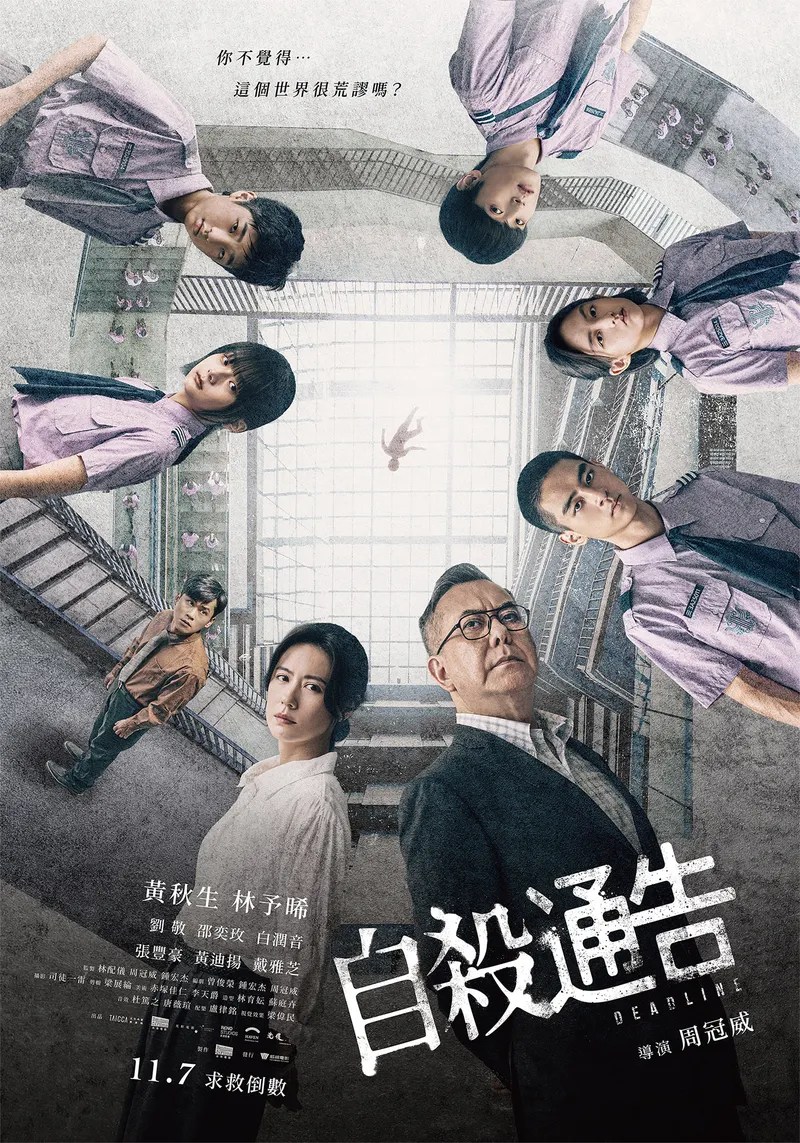
Deadline (自殺通告, Kiwi Chow Kwun-Wai, 2025)

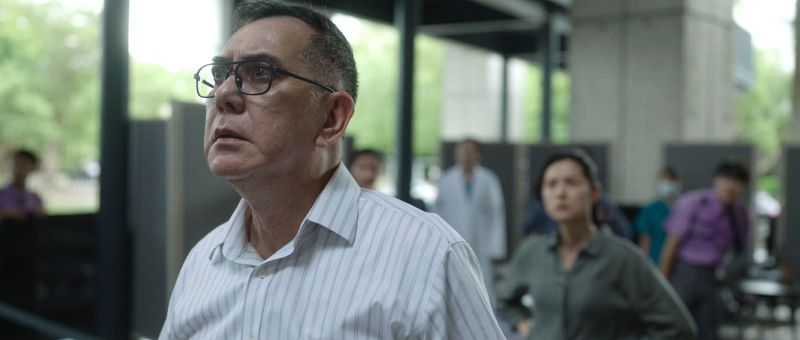
What does it mean to get “an education”? Is the school system only really there to brainwash the young into following accepted the path and prepare them to be receptive to authority, actively destroying both the ability and desire to think for oneself? The fact that Kiwi Chow’s Deadline (自殺通告, zìshā tōnggào) was not approved for release in Hong Kong on the grounds of “national security” may indicate the direction of its perspective on the interplay between the intensity of the education system and entrenched authoritarianism.

The mere fact that En Shan high school is described as “elite” already implies that it exists to perpetuate a kind of social inequality, though in other ways some might say that it also encourages social mobility in that the students come from all backgrounds and are selected for academic excellence rather than simply the ability to pay the fees. Education does seem to be life’s make or break. Students who don’t make it to university are perceived as being relegated to a kind of underclass from which there is no other escape. Yet at the same time, perhaps university isn’t right for everyone and not all of the pupils want to live a life dedicated to achieving conventional success that might otherwise leave them miserable.

Chun Chiu (Jimmy Liu) is one of the few brave ones who’s decided he doesn’t want to go to university and is happy enough pottering around with his plants. He doesn’t care if people look down on him because he knows he’s happy in himself, and they probably aren’t. Consequently, he’s also the only one to really see what’s going on at the school and to want to try to stop it. Despite its elegant name, there’s a kind of bloodthirstiness that underlines the survival of the fittest mentality at En Shan where they wear mildly fascistic uniforms and start the day with a haka-style dance in which they recite the school’s mantras about being the best of the best and that there’s no point coming second. These children are prevented from forming real friendships or developing social skills and empathy because they’ll always be rivals waiting for the ideal time to stab each other in the back.

The school reinforces this sense of judgment and hierarchy through adopting a social credit-style system in which pupils’ “privileges” are linked to their performance and obedience levels. Chun Chiu is at one point locked out of the garden because his scores have fallen so low he’s not allowed outside the prison-like school environment. Everyone at the school, including the teachers, is under constant surveillance with an AI programme responsible for assigning grades and points. Headmaster Kung wants to get rid of Mr Gao (Huang Di-yang) because the system says his performance is poor, while star teacher Mrs Tien tries to defend him. To begin with, Gao seems as if he might be resisting in another way by giving care and attention to struggling pupils like Heng (Bai Run-yin) who is taking medication for ADHD. But it turns out that Gao is so worried about losing his job as he has to pay maintenance for his ex-wife and child that he’s been giving the kids performance enhancing drugs in the hope of boosting his own approval ratings in the app.

Heng is also getting bullied by some of the other pupils, not just because he’s different but because they resent it that they think he’s being given special advantages by taking medicine that helps him concentrate and being given extra time to finish exams. This leads Heng to try and and cancel his accommodations in a bid to avoid being singled out and in a mistaken gesture of solidarity with the other kids to prove he’s not being given any extra privileges. Meanwhile, they’re all taking similar medication that’s designed to aid concentration and reduce the need for sleep for they can study for longer. But the drugs also prevent them from sleeping when they want to and suppress their appetites so they don’t eat. They cause low mood and suicidal ideation, which, coupled with the already high-stress environment, is a recipe for disaster.

To combat this culture, someone drops a series of ominous flyers threatening the school that there will be a suicide if they don’t “stop poisoning us” by ending the practice of holding exams under medication. While headmaster Kung appears oblivious to the monster he himself has created and has no real idea what’s going on in the school, to his credit he does seem keen to find out if there are any pupils in danger of harming themselves rather than solely trying to silence the whistleblower or save the school’s reputation. He has no idea about the drugs and is shocked on realising how prevalent they’ve become in the school. When they start doing drug tests and discover that over half the pupils are taking them, the director of the board of governors, who has the real power, tells him to stop the testing before they find any more.

But it turns out that this problem extends far beyond the school as in some cases it’s the parents who are making their kids take these drugs, and the head of the student council, Mo (Michael Chang), that’s been selling them. After a few deaths have occurred, Tien and Kung want to stop the exams, but are prevented from doing so, in part because the education system is a national machine. The kids can’t just take the exam on another day because they can’t come up with all new papers just for them at short notice. In a truly chilling moment, Mo gets up on his chair begins chanting the nonsensical mantra “exams are a human right” while insisting on being allowed to take them even if it means that more pupils end up dying. After all, that’s just less competition for him. They’re already locked into this system and refuse to be cast out of it, in part because they’ve learned how to manipulate it so perfectly.

Then again, obsessive study doesn’t leave you with much time to think about anything else even if you’re not also sleep deprived and malnourished as a result of long-term drug use. Chun Chiu’s friend Peiching (Tai Ya-chih), the current number one, becomes conflicted in part because she realises that she does not really know who she is and is incapable of determining what she wants out of life. She said she wanted to be a doctor because that’s what her parents were so she thought she was supposed to be too, but doesn’t know if that’s actually what she wants. Peiching seems genuinely worried about rival Ruoyan (Mimi Shao Yi-mei) who self-harms out of frustration and feelings of inadequacy, but equally only perhaps because thanks to the drugs she stands a real chance of knocking her off  the top spot. Mrs Tien may secretly be thinking of moving abroad precisely because her own daughter does not suit this rigid educational system, but remains largely unable to change it while the students have, it seems, already internalised its tenets unable to let go of a world in which everything is defined by numbers and ranking without the intrusion of independent thought or human empathy.


Deadline screened as part of Hong Kong Film Fest UK and opens in UK cinemas 16th October.

Trailer (English subtitles)
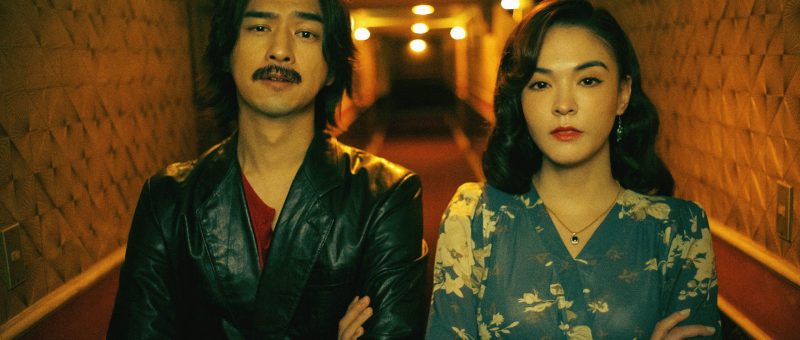
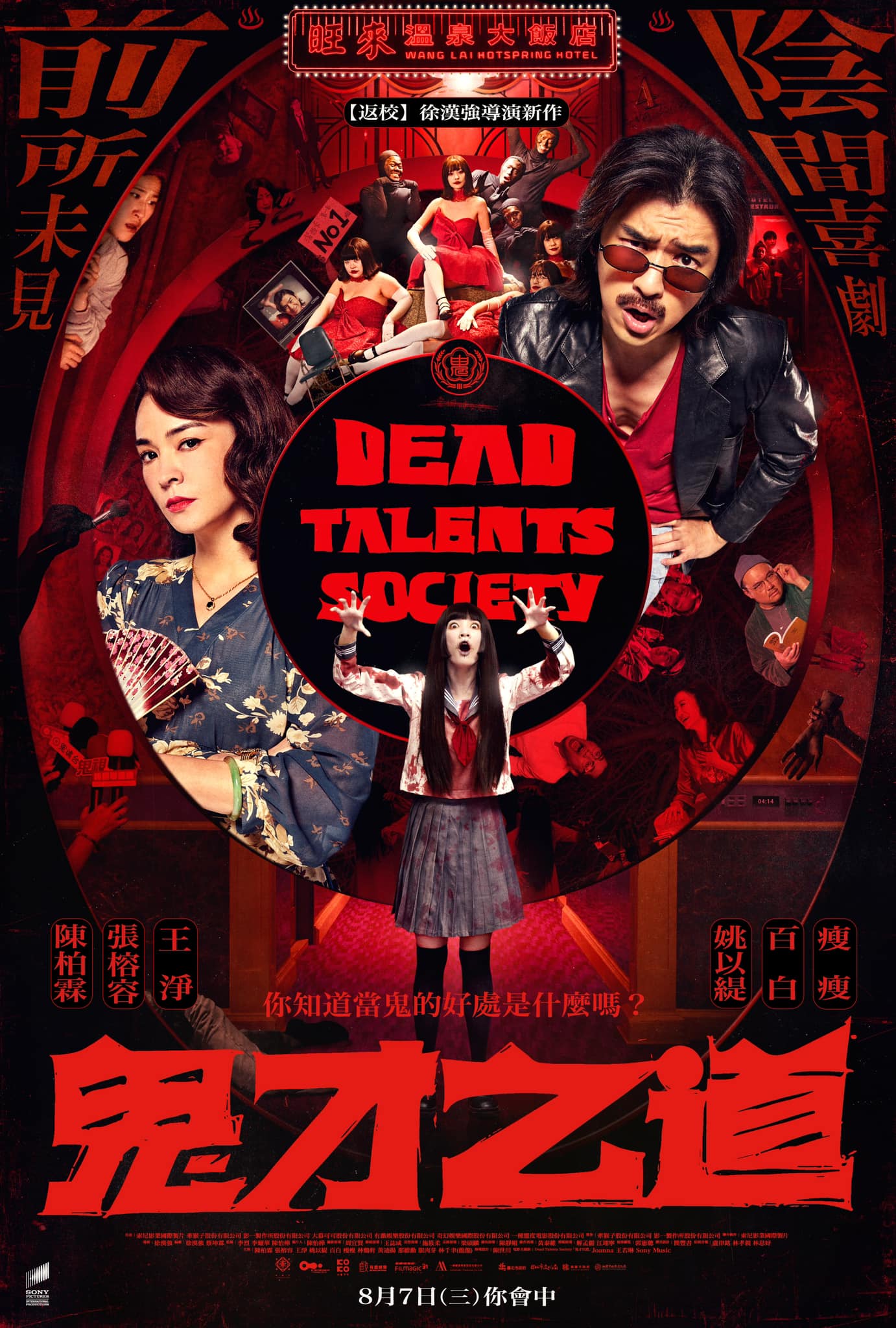
Dead Talents Society (鬼才之道, John Hsu, 2024)

“Why is it more tiring to be dead than alive?” A fed up ghost asks themselves and with good reason. If you thought you’d be able to rest easy in the afterlife, you’ve got another thing coming because it’s just as much of a capitalist hellscape on the other side as it is here. The central conceit of John Hsu’s Dead Talents Society (鬼才之道, guǐcái zhī dào) is that a ghost must must earn their keep by haunting the living in order to provoke large-scale appeasement rituals and the burning of vast amounts of ghost money or risk disintegration and finally disappearing from this world.

In a certain way, this is the paradox of the ghost. They fear being forgotten and only want to be seen mostly by the living but also by the dead in order to feel the validation that they exist and are appreciated. For Rookie (Gingle Wang) , a teenage girl who it later turns out was almost literally crushed by the weight of parental expectation, this was something she was never able to feel in life partly because of her father’s well-meaning attempts to boost her confidence by telling her she was “special”.  He even went so far as to mock up a fake certificate for her while leaving her to feel inadequate that her sister’s trophy shelves were full while hers were empty. It’s this certificate that’s gone missing during her family’s literal attempt to move on from her death and start again leaving her behind. With no place to return to, Rookie will disintegrate in 30 days if she can’t win a haunting licence which is a problem given her mousey personality and the lack of talent that left her feeling so inadequate in life.

Yet many of the pro ghosts are in the same position. Cathy (Sandrine Pinna) used to be the reigning queen, but her thunder was stolen by a former prodigy, Jessica (Eleven Yao), a very modern ghost who’s figured out how to haunt the internet and go viral for scaring influencers to death. In some ways, the living too are ghosts online haunting an alternate plane of reality while it’s through these online personas that we make ourselves seen. After all, in the modern world, there’s no better way to be “remembered” than by achieving internet fame. By contrast, all Cathy has is her decades old trick of backflipping on guests staying in the hotel room where she died in a lover’s suicide over a man who cared little for her. In a hilarious twist, the gang set up the trick on a harried businessman but he’s so busy he doesn’t even really notice any of their ghost stuff and remains entirely focussed on his work. 

Taken in by the gang, the realisation that rookie begins to come to is that she never really needed to be “special” but only herself and for someone to see her as she really was. Her anxieties are those of contemporary youth burdened by the weight of parental expectation and fearing they can’t live up to it. Manager Makoto (Chen Bolin) experienced something similar in life, struck by anxiety while struggling to make it as a early ‘90s popstar while unable to make his mark in the ghost world by virtue of being unable to scare anyone because he’s too good looking. As he tells it, the best thing about being dead is that you no longer need to worry about what other people think and Rookie is therefore free to become herself or else disappear forever. 

Even so, the irony is that the finale sees the central gangs take on unified appearances as if becoming one with one side doing better than the other in their genuine sense of mutual solidarity as a ghost world family. They watch J-horror-esque movies for tips and muse of the contradictions of fame that perhaps we accord those talented that are merely the most visible while these ghosts struggle to be seen in an increasingly haunted world of hollow influencers and illusionary online avatars. Rookie still doesn’t know what being seen means but has perhaps learned to see and accept herself thanks to her experiences in the afterlife. Charming and somehow warm in its lived-in universe of celebrity ghosts and professional hauntings, Hsu’s zany horror comedy may suggest there’s no escape from the living hell of capitalism but that dead or alive you might as well enjoy the ride as best you can before it all suddenly blinks out.


Dead Talents Society screens Nov. 9/10 as part of this year’s San Diego Asian Film Festival.

Original trailer (English subtitles)

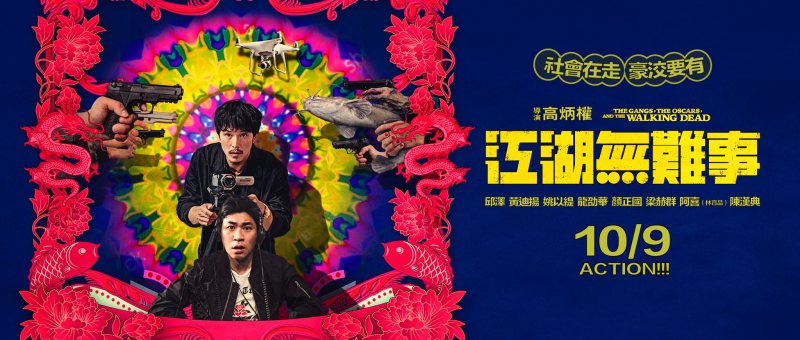
The Gangs, the Oscars, and the Walking Dead (江湖無難事, Kao Pin-chuan, 2019)

You remember that film back in the ‘80s where those guys go to their boss’ house for a party only he’s dead but they want to have a good time without being murder suspects so they pretend that he’s alive, only it turns out he was going to have them killed because they found out about his massive fraud and embezzlement? The Gangs, The Oscars, and The Walking Dead (江湖無難事, Jiānghú Wú Nán Shì) is kind of like that, if lacking the mild critique of rampant consumerism. 

Our heroes are BS (Roy Chiu), a film producer, and his director/childhood best friend Wenxi (Huang Di-yang). Wenxi is a lifelong film buff who decided he had to grow up and make a zombie movie after falling in love with hopping vampires from Hong Kong. BS has been trying to make his friend’s dream come true, but the production gets derailed when the lead actor is engulfed by a sex scandal and the guys end up taking on odd jobs to make ends meet one of which involves filming the funeral of a recently deceased mob boss who later joined the boy scouts to give back to the community. The job goes just about as wrong as it’s possible to go seeing as they manage to set fire to the corpse, but somehow they manage to impress Boss Long (Lung Shao-hua) who agrees to fund their movie on the condition that part of it is shot in Japan, and his girlfriend Shanny (Yao Yi-ti) gets to play the lead. 

The second part is more of a deal breaker than the first because Wenxi’s long gestating zombie script revolves around a pure and innocent high school girl who quickly gets zombiefied during the initial outbreak but somehow retains her humanity while a heroic PE teacher/gangster falls in love with her as they fail to survive the apocalypse. Shanny is many things, but passing for a high schooler will be a stretch and in Wenxi’s eyes at least she is neither beautiful nor “pure”. To be fair, Shanny does look as if she may have suffered a lot in her life, but Wenxi’s peculiar obsession is with a mole on her face which he seems to find unsightly. In any case, it’s not a problem for very long because Shanny ends up dying during a freak accident at the launch party leaving the guys with several problems of a different order. Afraid of Boss Long, they decide to hire a top SFX artist and manipulate Shanny’s body as if she were a puppet so no one knows she’s dead. 

Sadly the film has little sympathy for Shanny who is treated more or less as a human plot device, a ridiculous figure of fun who seems to have sealed her own fate by being an “immoral” woman involved with a man like Boss Long who is, we find out, using her in more ways than one as are his not so loyal henchmen. Latent misogyny later gives over to mild homophobia as the boys figure out that Shanny got her unusual looks after getting plastic surgery to look like her favourite drag queen, so they decide to try asking him to help out, playing into an extended joke about Boss Long being fooled into canoodling with a man.

The theme, however, is brotherhood and loyalty not only between BS and Wenxi, but also Boss Long, Shanny/drag queen Hsiao Ching, and the gang. You have to die to figure out who your real brothers are, according to Boss Long, and it’s a lesson which gets put to pretty good use by just about everyone. At the end of Wenxi’s screenplay, everyone is supposed to become a zombie – the ultimate end of the world pay off for anxiety suffers, at least you won’t have to worry about getting zombified anymore, but is intended to render everyone “equal” so the world is “fair”. There is something quite ironic therefore in their unwitting zombification of Shanny, exploiting her body even after death while playing at being tough guy gangsters so they can make a film with zombies in it they are certain will win an Oscar. Aside from all that, however, the Wenxi gets his “happy” ending which eventually honours Shanny’s memory while cementing a feeling of brotherhood and acceptance placing Hsiao Ching firmly at the boss’ side as they look forward to a bright new movie making future founded on the ashes of the violent past.


The Gangs, the Oscars, and the Walking Dead was screened as part of this year’s Osaka Asian Film Festival.

Original trailer (English / Traditional Chinese subtitles)

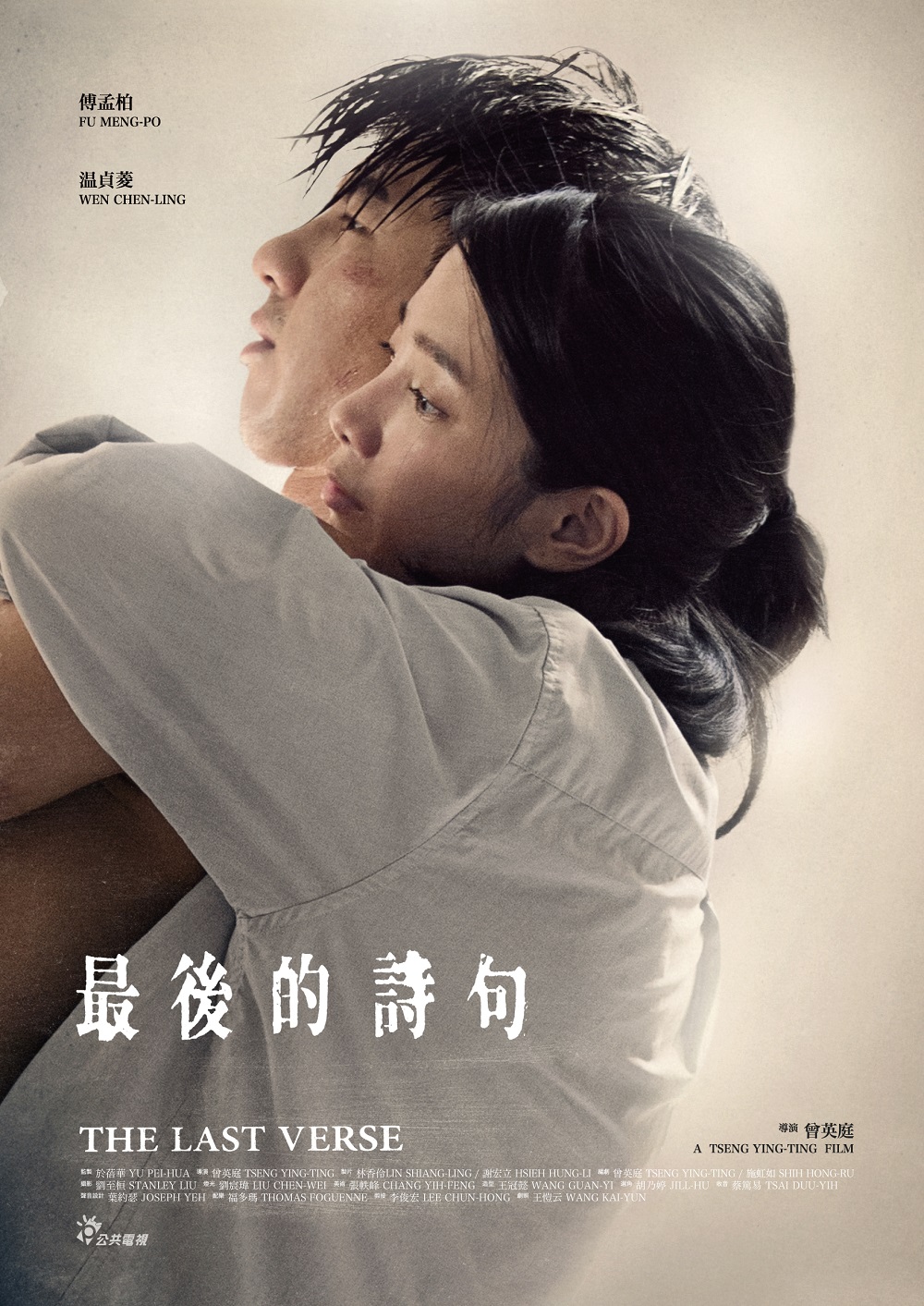
The Last Verse (最後的詩句, Tseng Ying-Ting, 2017)

The last verse posterThe dreams of youth seem destined to elude two idealistic Taiwanese romantics as they fall in love, out of love, into debt and then despair. Set against 16 years of turbulent Taiwanese history, The Last Verse (最後的詩句, Zuìhòu de Shījù) follows two ordinary teenage sweethearts whose humble dreams of conventional success are consistently undermined by familial legacy and economic instability. Society crushes the dreams of those who refuse to abandon their youthful idealism, but then again perhaps they destroy themselves through chronic insecurity and a refusal to address their own failings rather than conveniently assigning blame to all but themselves.

In the golden summer of 2000, Ren-jie (Fu Meng-Po), nicknamed “poet” meets Xiao-ping (Wen Chen-Ling), the love of his life. The pair start dating and are sure enough about their future to be discussing long term financial plans, but Ren-jie still needs to complete his military service and so their lives are currently in a mild hiatus. Everything starts to go wrong when Ren-jie receives visit a from his estranged father – a broken shadow of a man whose wife left him because of his drunken violence in the face of the humiliating failure of his business when his towel factory went bust. Ren-jie didn’t want anything to do with his dad and sent him packing, only to bitterly regret his decision when he commits suicide on the way home by gassing himself in his car.

This original failing is the fracture line from which all Ren-jie’s subsequent sufferings unfold. Despite signing away any right to his inheritance in order to avoid taking on his dad’s debt, Ren-jie can’t shake off the vicious loansharks his dad once borrowed money from. Having managed to get a well paid, if morally dubious, job as an investment broker Ren-jie’s life ought to be progressing towards middle-class success. He lives with but is not legally married to Xiao-ping who also has a good job at a magazine, but is putting off legalities until the advent of financial stability. Ren-jie is therefore stubborn. He won’t pay the gangsters off because he doesn’t want his father’s legacy and resents their intrusion into his otherwise “respectable” life. He will learn, however, that there are things that cannot just be overcome through bloodymindedness and his male need to avoid being seen to back down is primed to put those he loves in great danger.

Ren-jie’s life is indeed ruined by the precarious era in which he lives as well as the legacy of that which came before, but his destruction is also at his own hands as he falls into a well of toxic masculinity which eventually leads him to harm and then betray the innocent love of his youth. During Ren-jie’s military service, some of the other men suggest staying on in the armed forces – most laugh off the idea but it does at least offer a secure paycheque, a fixed term contract, and the possibility for advancement – all things useful if, like Ren-jie, what you want is to get married and start a family even while still relatively young. Ren-jie, however, did not take this path. We don’t find out why he lost his well paid banking job, if it was the gangsters or the economy, but a few years later sees him an embittered estate agent trying to sell rundown flats in the middle of a housing crash to clients who know they’re better off waiting. Embarrassed not to be able to “provide” for a “wife”, Ren-jie’s male pride cracks under the twin pressures of being forced to give in to the gangsters and fearing that he is not good enough for Xiao-ping, paranoid that she will eventually leave him for someone with more money.

Xiao-ping, however, remains fiercely, idealistically in love with the boy she met at the river all those years ago. Ren-jie, making a common enough though self obsessed mistake, fails to see that financial success is not something that Xiao-ping worries about in any other way than wanting to see the man she loves fulfilled. What Xiao-ping wants is a conventional family life, but Ren-jie’s constant money worries and personal insecurities consistently deny her before he eventually makes another cruel and selfish decision that will only cause her additional suffering.

Ren-jie’s internalised self-loathing eventually boils over into violence, recalling the unwelcome legacy of the father he did not want to become. Yet Ren-jie is also a failure, a drunk, a violent man having meaningless sex with married women in empty apartments in order to try and reassert some kind of control in his largely powerless life. Unfairly burdened by his father’s literal debts, a legacy of violence, and the crushing hopelessness of his existence, Ren-jie has lost the sense of “poetry” which so endeared Xiao-ping to him all those years ago at the river. The memory of those sunswept days, romanticised as it might be, becomes both a touchstone and a dangerous symbol of all that has been lost and can never be regained. Unable to reconcile themselves to the compromises of adult life, the ballad of Ren-jie and Xiao-ping is destined to end in tragedy, self-inflicted wounds the only escape from the crushing hopelessness of a relentlessly indifferent society.


The Last Verse was screened as part of the 2018 New York Asian Film Festival.

Original trailer (traditional Chinese subtitles only)

Interview with director Tseng Ying-Ting from the 2017 Busan International Film Festival.