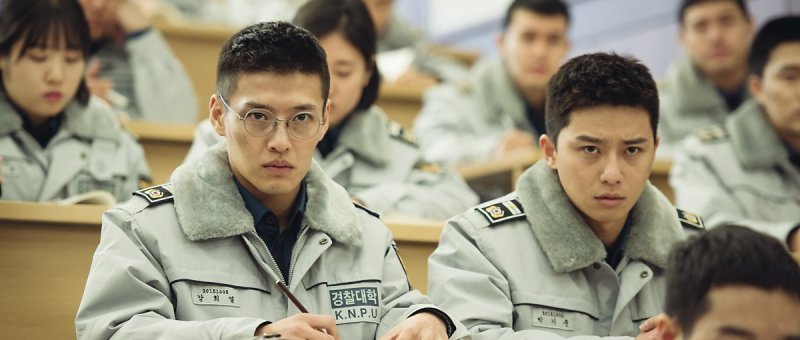
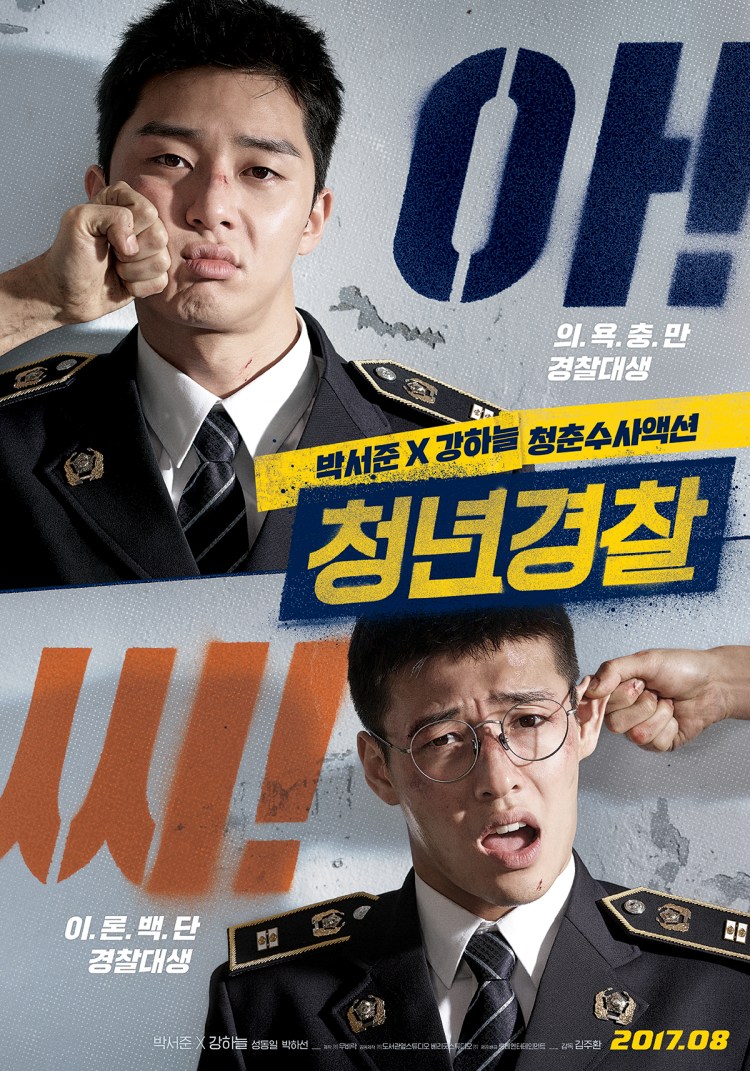
 There are many good reasons for applying to Police University, even if many people can’t see them. That aside, the heroes of Kim Joo-hwan’s Midnight Runners (청년경찰, Chungnyeongyungchal) have ended up there not through any particular love of honour and justice, but simply because it was cheap, on the one hand, and because it was different, on the other. An ‘80s-style buddy (not quite) cop comedy, Kim’s followup to the indie leaning Koala is the story of two young men finding their calling once their latent heroism is sparked by witnessing injustice first hand, but it’s also careful to temper its otherwise crowd pleasing narrative of two rookies taking on evil human trafficking gangsters with a dose of background realism.
Rookie recruits to Seoul’s Police University, Gi-jun (Park Seo-joon) and Hee-yeol (Kang Ha-neul) could not be more different. Gi-jun is exasperated by his worried mother’s words of parting, but hugs her goodbye anyway. Hee-yeol’s dad looks on in envy at this touching scene, but asking if he should hug his son too gets a resounding “no” before Hee-yeol begins to walk away, turning back to remind his father to button his coat because it’s cold outside. Gi-jun doesn’t want to get his hair cut because he’s fashion conscious, whereas Hee-yeol doesn’t want his cut because they don’t sterilise the clippers and he doesn’t want to catch a bacterial skin infection. Nevertheless, the pair eventually bond first during lunch as Hee-yeol surrenders his “carcinogenic” sausages to the always hungry Gi-jun, and then when Hee-yeol sprains his ankle during the final endurance test and Gi-jun (eventually) agrees to carry him to the finish line. Not for the first time, Gi-jun’s “selfless” actions to help a person in need earn the pair a few words of praise from their commander who berates the others for running past an injured comrade and thinking only of themselves when the very point of a police officer is to help those in need.
A year a later the pair are firm friends and decide to take a night on the town to find themselves some girlfriends to spend Christmas with. Sadly, they do not find any but they do find crime when they spot a pretty girl in the street and then spend ages arguing about asking for her number only to see her being clubbed over the head and bundled into a black van. Slightly drunk, the boys panic, chase the van, and ring the police but are told to stay put and wait for a patrol car. They figure they can get to the police station faster than a car can get to them but once they do they realise the entire station is being pulled away on another high profile case and no one’s coming. They do what it is they’ve been trained to do, investigate – but what they discover is much darker than anything they’d imagined.
Police in Korean cinema often have a bad rap. It’s nigh on impossible to think of any examples of heroic police officers who both start and finish as unblemished upholders of justice. Midnight Runners, however, attempts to paint a rosier picture of the police force, prompting some to describe it almost as a propagandistic recruiting tool. It helps that Gi-jun and Hee-yeol are still students which means that the idealistic line they’re being fed goes mostly unchallenged (at least until the climactic events prompt them to think again), but there are certainly no beatings, no shady dealings with the underworld, or compromised loyalties in the boys’ innocent quest to rescue a damsel in distress.
The spectre of corruption hovers in the background but on a national, rather than personal, level as the news constantly reports on the kidnapping of a wealthy CEO’s child while a young woman from a troubled background has also gone missing but no one, not even the police who have devoted all their resources to the CEO’s case, is interested. Meanwhile, Gi-jun and Hee-yeol, having just escaped from certain death, attempt to get help from a nearby police box but the shocked jobsworth of a duty officer won’t help them because they don’t have their IDs. The boys’ outrage on being informed that despite all their efforts, the specialist team who handle cases like these won’t even be able to look at it for weeks is instantly understandable, but so is their professor’s kindly rationale that all lives are equal and the squad can’t be expected to dump their current caseload and swap one set of victims for another. The police, so it goes, are heroes caged by increasing bureaucracy which has made them forget the reasons they became policemen in the first place.
Despite the grim turn the film takes after Gi-jun and Hee-yeol make a shocking discovery as a result of their investigation, Kim keeps things light thanks the boys’ easy, symbiotic relationship filled with private jokes and even a cute secret handshake. Jokey slapstick eventually gives way to hard-hitting action as the rookie officers finally get to try out some of their training and find it effective on entry level street punks, but less so on seasoned brawlers with mean looks in their eyes. Told to “leave things to the grown ups”, Gi-jun and Hee-yeol decide there are things which must be done even it is dangerous and irresponsible because no one else is going to do them (whether that be eating sausages or rescuing young women no one else seems to care about). A strange yet fitting place to make the case for a better, less selfish world, Midnight Runners is a buddy cop throwback which brings the best of the genre’s capacity for humour and action right back with it.
Currently on limited release in UK cinemas.
Original trailer (English subtitles – select from menu)
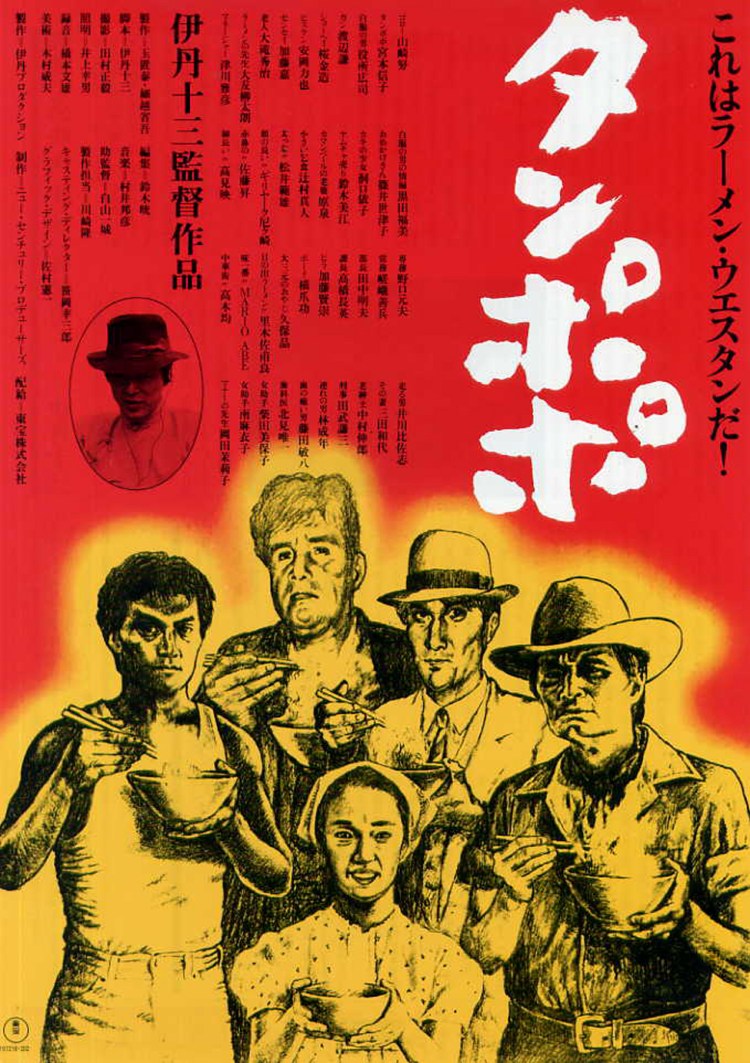 Some people love ramen so much that the idea of a “bad” bowl hardly occurs to them – all ramen is, at least, ramen. Then again, some love ramen so much that it’s almost a religious experience, bound up with ritual and the need to do things properly. A brief vignette at the beginning of Juzo Itami’s Tampopo (タンポポ) introduces us to one such ramen expert who runs through the proper way of enjoying a bowl of noodle soup which involves a lot of talking to your food whilst caressing it gently before finally consuming it with the utmost respect. Ramen is serious business, but for widowed mother Tampopo it’s a case of the watched pot never boiling. Thanks to a cowboy loner and a few other waifs and strays who eventually become friends and allies, Tampopo is about to get some schooling in the quest for the perfect noodle whilst the world goes on around her. Food becomes something used and misused but remains, ultimately, the source of all life and the thing which unites all living things.

 Windows on Worlds