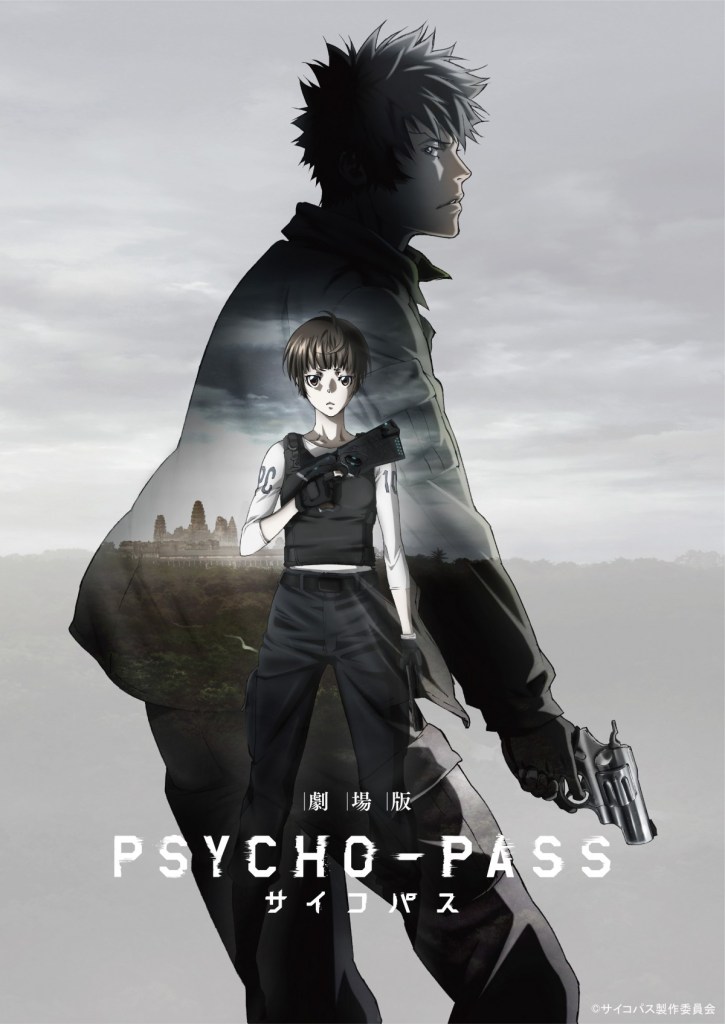
Psycho-Pass: The Movie (劇場版 PSYCHO-PASS サイコパス, Katsuyuki Motohiro & Naoyoshi Shiotani, 2015)

psycho-pass movieThe Japan of 2116 is a peaceful place. Crime is at an all time low thanks to the Sybil system which monitors the nation’s citizens issuing them a “Crime Coefficient” rating assessing how likely they are to commit a crime. When a potential criminal’s Psycho-Pass reaches an unacceptable level, the Public Safety Bureau are called in to hopefully put a stop to any criminal activity before it has the chance to occur.

However, the world outside of Japan is not quite so ordered and so its Sybil system has become an important political export. Things are about to get murky as the nearby SEAUn (South East Asia Union) is currently in a state of civil war and its de-facto leader has struck a deal with Japan for additional support in return for trialling the system in a new reclaimed land development. Not everyone is happy with sacrificing personal liberty for social safety and so an active resistance unit working against both the deployment of Sybil and the leader they see as a dictator is continuing to prove a destabilising force.

This all comes to a head when a group of so called “terrorists” manage to sneak in Japan hoping to  take the fight to Sybil itself. After a brief but intense shootout with the PSB, the gang is neutralised save for one which famed Inspector Akane Tsunemori manages to capture and take in for questioning. However, whilst Akane is waiting for the captive to come round from the sedative she gave him, her bosses have taken drastic action which amounts to lethal torture. Akane is horrified, but when the recovered information flags up the familiar face of her former colleague Kogami, she quickly finds herself at the centre of covert, international political machinations which cast her own nation in far from a positive light.

Psycho-Pass: The Movie (劇場版 PSYCHO-PASS サイコパス, Gekijo-ban Psycho-Pass) is the big screen outing for the hit TV anime which has so far spanned two series each with their own distinct narrative arcs. Series creator Gen Urobuchi handled the first season but sat out the second (handing the reign’s over to Murdock Scramble’s Tow Ubukata) in order to work on this film which takes place after season two but was actually developed at the same time so avoids direct reference to its events. For the most part, Psycho-Pass: The Movie works as a stand alone enterprise though it does make reference to plot elements from season one, or more exactly its villain, without further explanation which may leave newcomers feeling lost. Fans of the franchise already familiar with the characters and their relationships will undoubtedly get the most out of the set-up, but in depth knowledge of the series is never a prerequisite for understanding the action.

“Action” is an apt place to start when it comes to the themes of Psycho-Pass: The Movie as it acts more as an exciting side story to the main series than the grand conclusion that might be expected. Broadly speaking, the central concern is the increasing interference of powerful nations in the “domestic affairs” of smaller ones. Akane is as idealistic as they come despite everything she has already seen and is unprepared for the extent her own nation’s complicity in this very dirty, possibly proxy, war. In this country, those with flagged Crime Coefficients are forced to wear a standard issue collar which is designed to explode Battle Royale style and are treated as an underclass not permitted to board the same public transport or occupy the same “public” space as the general population. Once again this sits uncomfortably with Akane, but there isn’t a lot she can do about it.

Kogami, now a drifting mercenary since going on the run from the PSB, has become a rebel revolutionary trying to help the oppressed citizens fight for democracy in this war torn land. To some, he’s a terrorist (though the rebels are never shown targeting civilians or carrying out “terrorist action” so much as acting as a resistance group) but his sights are firmly set on hypocritical, oppressive regimes and especially those acting as puppet states for a third party. Akane and Kogami’s relationship status continues in the “it’s complicated” direction which has progressed throughout the series and they aren’t given very much time to build on that here though their mutual respect for each other adds to the tension as each comes to terms with being on opposing sides yet somehow still “together” in spite of external obligations.

Even if Psycho-Pass: the Movie proves disappointing in terms of its character development (betraying its side story origins), it excels in the action stakes with several impressive, high octane battle scenes not to mention the strange ballooning effect of the explosive Dominator weapons. Though it sets up a complicated, geo-political conspiracy of superpowers exploiting civil unrest to steal puppet states and install dictatorial stooges who oppress the local population into a sublime obedience with the promise of long desired peace, it wisely avoids expository dialogue preferring to keep things moving in a more urgent fashion. A minor entry into the Psycho-Pass world, Psycho-Pass: The Movie is nevertheless an exciting return to its increasingly dystopian universe and even if it adds little in terms of themes or characters, does at least point towards a promising continuation of the series.


Reviewed as part of the “biennial” Anime Weekend at BFI Southbank. Psycho-Pass: The Movie has also been licensed for UK distribution by All the Anime (and Funimation in the US).

English Subtitled trailer:

Ghost in the Shell: The New Movie (攻殻機動隊 新劇場版, Kazuya Nomura, 2015)

Ghost in the Sell new movieMasamune Shirow’s cyberpunk manga Ghost in the Shell burst onto the scene in 1989 and instantly became a genre classic. Mamoru Oshii then adapted the manga into a much lauded anime movie in 1995 which almost came to define cyberpunk animation even if it emerged towards the end of the genre’s heyday. A sequel, Ghost in the Shell: Innocence followed in 2004 as well as a TV anime spin-off Ghost in the Shell: Stand Alone Complex. Now with the 20th anniversary of the original animated movie, the series has yet again been adapted into a series of entirely new anime OVAs under the name of Ghost in the Shell: Arise. Ghost in the Shell: The New Movie (攻殻機動隊 新劇場版, Kokaku Kidotai – Shin Gekijoban) is the big screen outing of this latest incarnation scripted by Tow Ubukata who also produced the very GITS influenced Mardock Scramble.
Following on from the Arise OVAs, we find Major Motoko Kusanagi at the head of her gang of cybernetically enhanced former soldiers operating as security consultants with a special focus on cyber crime. Still outside the government aegis, Kusanagi has managed to wangle herself some extra funding and official patronage when she’s brought in to handle a sensitive hostage situation as seven disgruntled soldiers take a number of hostages inside a financial institution.

Though Kusanagi & co have the situation well in hand, they are about to have the rug pulled from under them firstly by the reappearance of the Firestarter virus which corrupts the memories stored on an infected cyberbrain wreaking havoc with their new captives, and then secondly as the hostage situation itself turns out to be a high level diversionary tactic designed to provide cover for the assassination of the prime minister. Kusanagi and her team quickly discover there’s far more going on here than they could ever have imagined and soon enough Kusanagi herself becomes the centre of a hi-tec conspiracy.

Like the Arise OVAs which preceded it, The New Movie maintains a much heavier focus on action set pieces than the philosophical contemplations that made Ghost in the Shell such an important entry in the cyberpunk catalogue. Though the ideas are not entirely absent, they are presented as background much more than an essential component of the series.

That said, the film does touch on some quite prescient issues firstly with the role of the soldiers which highlights the pressures ordinary rank and file officers are under when they see their service has not been valued and they’re about to be sold out by the country they risked their lives to protect. They are also, apparently, not well cared for by military authorities who kit them out with second grade equipment which they then also fail to maintain leaving many of their number literarily falling apart as their components become “obsolete”.

Ironically enough, Kusanagi also thinks of her team as component “parts” in a well functioning machine. She congratulates herself by praising them as a prime selection which she has been lucky to find – they need to look after themselves because a replacement component would be a hard thing to come by. However, if they begin to malfunction in some way, she will “purge” them rather than allow them to corrupt the rest of her system. This way of thinking seems cold to some members of the team, particularly to Togusa who’s the least “enhanced” among them. Raised by the military, Kusanagi is a born leader but not one to whom warm words come easily so this, actually rather apt, metaphor is as close as she will allow herself to get in letting the guys know that they each have their specific place within her grand plan. Though she needs them to perform as expected, they are important to her on both a personal and professional level.

This is where we’ve been heading with Arise – the origin story of Section 9 as it comes to be in the original movie, and of Kusanagi herself. Unsurprisingly the conspiracy turns out to have a lot to do with the Major’s own past and a few buried “ghosts” which must be exorcised in order to move forward. This extended metaphor is played out in the somewhat contrived final fight which sees Kusanagi facing off against a villain using an identical cyberbody which means she is fighting “herself” in a way, but nevertheless, it is a victory of the reclaimed self (even if that same “self” is about to undergo yet more existential battles in adventures to come).

The new character design and animation style have begun to seem more familiar by this point, though despite the stellar work of Production I.G the New Movie never quite reaches the aesthetic heights of the iconic original. This is only further brought out by the frequent homages to 1995’s Ghost in the Shell including the final scene which is almost a carbon copy of the original film’s opening (thematically fitting as it is). The action scenes, however, are extremely impressive and display innovative animation techniques which make fantastic use of the latest animation technology. Another exciting, action packed outing for Major Kusanagi and her guys, the New Movie doesn’t quite live up to the legacy of its namesake but nevertheless proves a thrilling cyberpunk infused adventure and a fitting bridge between the Arise series and the landmark 1995 movie.


Reviewed as part of the “biennial” Anime Weekend at BFI Southbank. Ghost in the Shell: The New Movie is also available in the UK from Manga Entertainment (and Funimation in the US).

Unsubtitled trailer (why is it so hard to find a trailer for the Japanese language track with English subtitles for these?)

https://www.youtube.com/watch?v=crDe_ZBAx4s

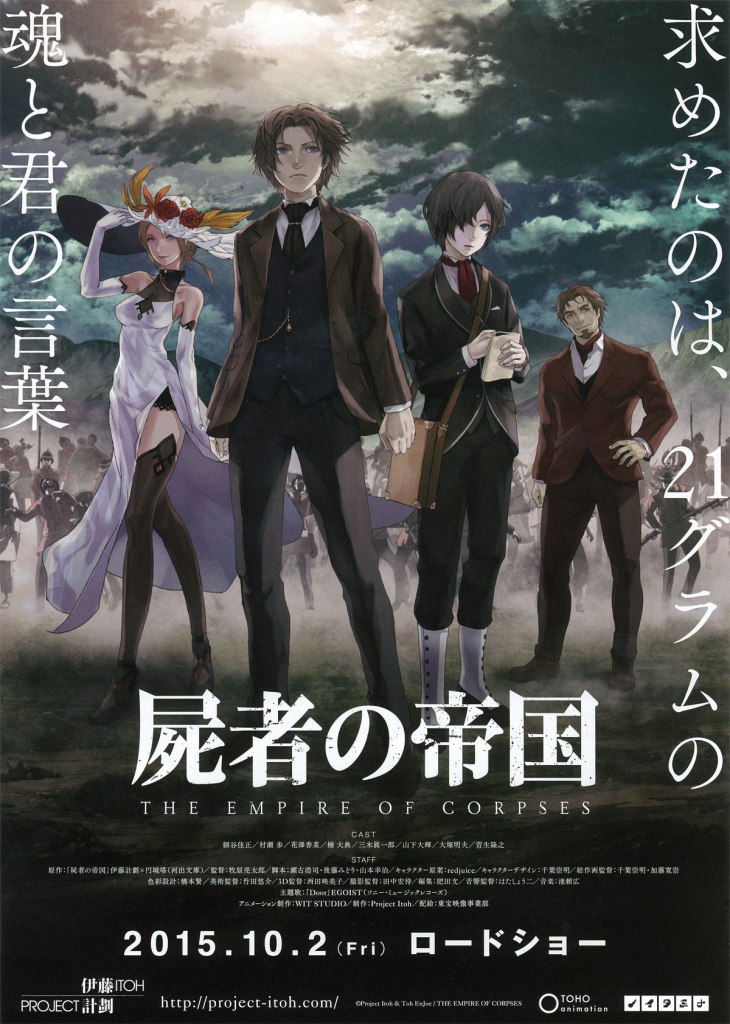
Empire of Corpses (屍者の帝国, Ryoutarou Makihara, 2015)

empire of corpses posterEmpire of Corpses (屍者の帝国, Shisha no Teikoku) is what would happen if someone’s vast library of Victorian literature was destroyed in a fire and then someone tried to put all the not too singed pages back together based on their knowledge of international pop culture. Inspired by Project Itoh’s novel of the same name and the first of three planned adaptations of his works, Empire of Corpses is a very specific kind of absurd, boys own action adventure based around the idea of empire supported by a zombified proletariat.

Beginning in London in 1878, this is steampunk paradise only steam power is quickly becoming old hat as the greatest discovery of the age turns out to be the city’s largest untapped resource – its dead. Reanimated corpses can be trained to fight wars, wait tables, or work as servants but they’re tools now – not people, they may be able to follow an order but they have no mind to act with. Corpse Engineer John Watson has unwisely reanimated his friend Friday, but is distressed not to be able to restore his friend’s soul along with his body.

Watson ends up being dispatched on a secret mission by Her Majesty’s government to reclaim the notes made by the famous Dr. Frankenstein who has succeeded in creating a sentient creature known as The One. The notes are apparently in the possession of Russian scientist Karamazov. Watson travels to India with Burnaby, a mercenary bodyguard, and Friday where he also teams up with a mysterious flame thrower wielding busty blonde, Hadaly.

Empire of Corpses touches on some interesting philosophical questions such as the nature of the soul, the border lines between death and life, and the repurposing of a body as a fleshy tool. Though it stops short of delving into what the British Empire was really based on, the idea is very much that using reanimated corpses to fight your wars remotely is an absurd solution to an unnecessary problem.

That said, these “zombies” are a well trained and docile bunch. Until of course, they aren’t. Certain forces have planned to harness the zombie hordes for their own ends to create mass panic and wholesale destruction across the world. This might be the first mission the later famous John Watson will tackle, but he’s about to realise that there’s a lot more going on here than a set of secret documents no one wants to fall into the “wrong” hands.

Empire of Corpses remained unfinished when Project Itoh unfortunately died at a relatively young age. The concept is filled with extremely interesting ideas which are only ever dealt with in a superficial sense, though one wonders if the novel he might eventually have completed would have progressed so far down the ridiculous fantasy historical epic route. Very clearly channelling ‘30s style, post-penny dreadful tales of derring do starring familiar names, Empire of Corpses steals a host of famous literary characters from across the international canon as well as a number of historical personages, though only really borrows their names or perhaps a few other minor details. After raising such interesting ideas, the film quickly reverts to riduclous B-movie genre tropes as the gang get caught up in a zombie apocalypse with flashing mystical lights and the transmigration of souls thrown in for good measure.

No, it doesn’t make any sense though it isn’t really supposed to. Patient viewers will be rewarded with a post credits sequence shining a little more light but just as much bafflement onto the characters and their possible futures, though the intention is clearly just to raise a knowing wink from the well read members of the audience. By the time it all turns into The Wizard of Oz, some will undoubtedly have followed the yellow brick road out of the cinema but it is worth sticking around to see the final coda.

What Empire of Corpses has going for it is the extremely impressive visuals. Backgrounds in particular are gorgeously drawn making for an always interesting spectacle even if other aspects of direction can seem a little uninspired. Clumsily plotted and often incoherent, Empire of Corpses has its fair share of problems even aside from the inherent absurdity of its original premise, yet it isn’t completely unsalvageable and those who come expecting a B-movie style slice of incomprehensible hokum might well find much to enjoy.


Reviewed as part of the “biennial” Anime Weekend at BFI Southbank. Empire of Corpses has also been licensed for UK distribution by All the Anime (and Funimation in the US).

Unsubtitled trailer:

Harmony (ハーモニー, Michael Arias & Takashi Nakamura, 2015)

Harmony PosterHarmony – the word itself sounds peaceful. A coalescence of sympathetic sounds, the feeling of wholeness and happiness. However, if given the choice, would you like to live in a world of peace and plenty in which your body is almost government property and your personal freedom is limited in favour of ensuring the survival of the species, or would you rather take your chances with the world as it is complete with its violence, sadness and pain if it meant you could be free to live in which ever way you see fit? Michael Arias’ adaptation of the Project Itoh novel addresses just this question in all its complexity as utopia turns out to have a heavy entrance fee.
Fifty years after a devastating nuclear war humanity has recovered itself and the elite now live in spotlessly clean, futuristic cities. A healthcare monitoring system administered through nanotechnology ensures proper adherence to health guidelines including sending alerts about unhealthy food and heart rate fluctuations making it almost impossible to cheat the system even if you wanted to. Everyone also has “augmentations” including a heads up display in the eyes which flags all the aforementioned info as well as a break down on your fellow humans which also includes their “social aptitude quotient” based on how well they treat others and how good they are at following the rules.

For some, all of this nannying is nothing other than an infringement on their personal freedom. After all, shouldn’t you have the right to eat what you want, drink, smoke, take risks, if that is your personal choice? Camus said that the only way to deal with an unfree world is to become so absolutely free that your very existence becomes an act of rebellion. Our heroine, Tuan, has opted for a similar solution as she finds herself working for enemy as a Helix Inspector allowed to life on the margins of society where the the rules are more easily breached. She flaunts the regulations and cares little for anything or anyone. Once, long ago, she cared deeply for a girl in high school who was so opposed to the constant invasions of the modern world that she chose the only way out that was available to her – suicide. The pair intended to die together but Tuan alone survived.

Tuan is then recalled to Tokyo following an incident of mass suicides only for another high school friend to kill herself in a violent and bloody way right in front of her. Tuan is about to discover that she herself is at the centre a complicated conspiracy which intends either to save or to destroy humanity depending on your point of view.

Harmony is an extremely complex dissection of the human need for self protection from threats real or imagined. Following a large scale humanitarian disaster, fear rules the day and humans must be protected from their bad decisions by gentle reinforcement but isn’t the right to slowly destroy yourself, should you choose to do so, exactly what wars are fought for? Is it worth surrendering such basic rights to live in a world without disease or hunger (for the wealthy nations, at least) or does this level of being looked after rob humanity of the thing that defines it? The “Harmony” of the title is a medical treatment designed to spread peace and love throughout the land, yet it eventually robs the patient of a self-aware soul leaving them without the individual desires and emotions which cause human conflict. What should the future look like – cold, sterile but long and peaceful or shorter but filled with all the richness of human passions?

Arias had been working on a live action adaptation of Harmony which apparently fell though and though asked to helm Genocidal Organ managed to get them to allow him to switch back to the anime version instead. Here he’s billed as a co-director along side Takashi Nakamura and it seems there was more than a little conflict involved in the process. In any case, the finished product is vastly different in approach from Arias’ original concept though sticks fairly close to Itoh’s novel.

Made on a very tight budget and in an extremely short time, Harmony makes the best of its difficult production circumstances with a complex mix of CG and hand drawn animation styles. The production design is prescient and interesting as it presents its utopic city as a serene place of muted colours and stress free round buildings. Even the monolith presented in the framing sequence looks exactly like what a traditional Japanese tombstone would look like if it was designed by Apple. However, the natural pops right out of the screen with its vibrant colours such as in an early scene where a field of sunflowers looks almost like stop motion in its highly textured 3D CGI. Though occasionally falling back on static conversations, the composition and directing style is also interesting with unsettling circular shots, frequent dissolves and montages, and even a light jazzy soundtrack which definitely lends to the Lynchian atmosphere.

Harmony is certainly a complex film and arguably succeeds much more because of its nuanced source material than the production itself, yet like the best sci-fi it does offer an in-depth philosophical discussion along side exciting acting scenes and moving character drama. Unfortunately, the film does fall into the trap of ponderous monologuing at times and is sometimes guilty of stilted, expository dialogue but largely manages to maintain goodwill even as it does so. In many ways imperfect, Harmony is an undoubtedly ambitious project and one of the better science fiction themed anime movies to emerge in recent years.


Reviewed as part of the “biennial” Anime Weekend at BFI Southbank. Harmony has also been licensed for UK distribution by All the Anime (and Funimation in the US). Project Itoh’s original Harmony novel is also available in English translation (by Alexander O. Smith) published by Haikasoru.

Unsubbed trailer:

Miss Hokusai (百日紅, Keiichi Hara, 2015)

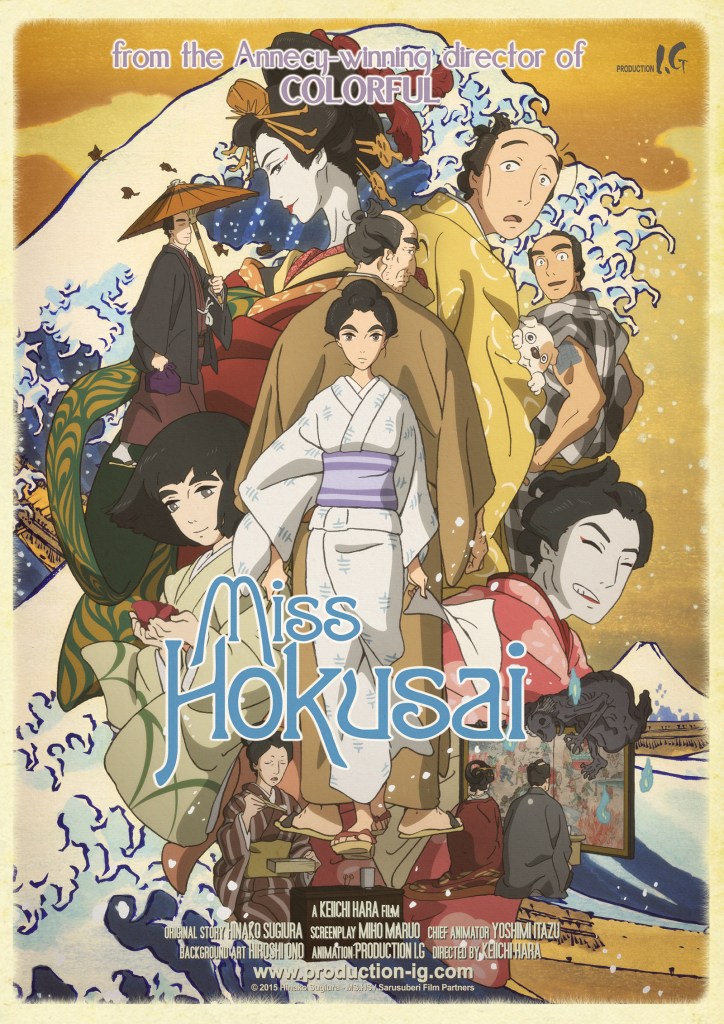
MISS_HOKUSAI_teaser_A4_oldpaper_1600When it comes to the great Japanese artworks that everybody knows, the figure of Hokusai looms large. From the ubiquitous The Great Wave off Kanagawa to the infamous Dream of the Fisherman’s Wife, the work of Hokusai has come to represent the art of Edo woodblocks almost single handedly in the popular imagination yet there has long been scholarly debate about the true artist behind some of the pieces which are attributed to his name. Hokusai had a daughter – uniquely gifted, perhaps even surpassing the skills of her father, O-Ei was a talented artist in her own right as well as her father’s assistant and caregiver in his old age.

Miss Hokusai, based on the popular 1980s manga Sarusuberi by Hinako Sugiura, takes up O-Ei’s story towards the beginning of her career before her marriage and subsequent divorce, after which she returned to her father’s side to nurse him as his health declined. Like the manga, the film is a collection of scenes from Edo life loosely tied together by its overarching theme, but broadly follows O-Ei as she lives her life as a young woman with a level of forthrightness and determination which sets her apart from the women of the time. Determined to become an artist, she lives with her father in their studio where neither of them cooks or cleans but each devotes themselves solely to art. Also living with them at the time is an ex-samurai and aspiring artist, Zenjiro, who specialises in erotica which has its own particular qualities even if his skills aren’t on a par with Hokusai or O-Ei.

When not in her father’s studio, O-Ei likes to visit her younger sister who, ironically, was born blind and is being cared for by the local nuns. O-Nao’s blindness is a sore spot for her father who hardly ever visits her, feeling as if her lack of sight is some sort of cosmic slight against him – the master painter with the daughter unable to appreciate his art and therefore his entire life philosophy. O-Ei is not so rigid and delights taking the girl out on trips where she can experience the world through her richly developed other senses. O-Nao particularly likes visiting the bridge with its complicated soundscape from the river below to the vendors above and all the passersby. There’s also a lovely set piece in which a young boy who quickly figures out that O-Nao can’t see tries to entertain her by knocking snow off a tree. Miss Hokusai, though a story of visual art, has an especially intricate sound design which proves that you can paint with materials other than ink and makes a point of calling out the stubbornness inherent in the world view of someone like Hokusai whose singleminded vision has become his entire universe.

O-Ei has her fair share of troubles as a young woman, though living with her father as his assistant she is a relatively free and unsheltered one. Her father doesn’t hide any aspect of his work from her – she even assists him with his erotic pieces and is said to be a particularly fine painter of women though her male figures lack conviction. “Sensation” itself becomes a theme, art is something which must be felt and therefore must have feeling imbued within it. As an unmarried woman O-Ei is ill equipt to complete these kinds of assignments and some say perhaps she should not be given them though her determination would never permit her to turn them down leading to rather a strange interlude in which she tries to gain some “experience” in a presumably “safe” way which won’t have much effect on her later life.

Less successfully, the film also attempts to enter the realm of the supernatural as we learn a painting can have other effects on the viewer particularly if it isn’t completed in the proper fashion. From a possessed geisha to a woman driven mad by O-Ei’s suitably creepy painting which features terrifying scenes from hell, Miss Hokusai most definitely occupies a world where ghosts, spirits and demons are real things which co-exist with real people. Luckily, Hokusai is able to fix the problem with the disturbing painting by closing its symbolic imagery with a suitable addition whilst berating O-Ei for having cut corners and not properly complete her vision so as to leave the onlooker “haunted” in an unintended way. Again, the painter is parent to the painting which attains the kind of immortality impossible for its creator in this transient world.

Clearly bound-up with the notion of transience, Miss Hokusai makes a valiant attempt to bring ordinary Edo living with its geisha houses, dusty rooms and drinking songs to life in vivid detail. However, its message becomes slightly confused with the superimposition of the modern Tokyo in the final frame of the film. At this point, the rather bizarre choice of a modern, electric guitar based soundtrack, begins to make a degree of sense at least on a thematic level but nowhere near enough to mitigate its jarring presence throughout the film.

Animated by animation powerhouse Production I.G who have been responsible for some of the most beautifully made animated movies of recent times, Miss Hokusai is a giant step up from Hara’s previous film, Colorful, in terms of its execution and boasts a number of scenes which are remarkable in their technical proficiency. The sky in particular as well as the background in general takes on a dreamy, woodblock style which is perfectly fitting for the film’s themes. An interesting look at the young O-Ei, an inexperienced female artist still looking for her voice in a world where the only thing that counts is the signature, Miss Hokusai doesn’t quite succeed in breathing life into its disparate collection of tales but makes a valiant attempt all the same.


Miss Hokusai is currently touring the UK with the Japan Foundation Touring Film Programme 2016 and will be released by All the Anime later in the year.


When Marnie Was There 思い出のマーニー (Hiromasa Yonebayashi 2014)

When-Marnie-Was-There-GhibliPerhaps the final effort from Studio Ghibli, When Marnie was There is directed by Hiromasa Yonebayashi whom some had seen as a potential successor to the company though it seems he too has now left Ghibli’s employ! Like Yonebayashi’s previous film The Secret World of Arriety, Marnie is also based on a vintage British children’s book – this time by Joan G. Robinson, though When Marnie Was There hasn’t enjoyed the same level on ongoing popularity as The Borrowers (maybe because it hasn’t received the same kind of televisual treatment as Mary Norton’s novels). Nevertheless, Marnie has been successfully shifted to modern day Japan whilst still managing to feel quite like ’60s England.

Anna is a solitary 12 year old orphaned girl living with her adoptive parents in Sapporo. A constant worry to her fretting mother, Anna suffers from severe asthma and has received complaints at school regarding her aloofness and seeming inability to make friends. Part blaming herself and her often absent husband, Anna’s mother decides to send her to the country for a while over the summer, hoping both that the clean air will be good for her lungs and a change of scene might help bring her out of herself. After arriving at a small seaside town to stay with some relatives of her mother’s, Anna hears tell of a mysterious grain silo which the local children think is haunted and also becomes strangely drawn to an apparently empty Western style mansion. Anna starts to dream about the house and eventually ends up meeting a mysterious and cheerful blonde girl there dressed in a distinctly old fashioned style. Though opposites in many ways the two have more than you might expect in common and quickly become firm friends. However, why can’t Marnie go very far from the mansion and why doesn’t anyone else seem to know about her? Only through solving the mystery of Marnie can Anna unlock the secrets that have been causing her pain in her own life.

Perhaps oddly, there are a lot of similarly themed children’s books from this period – enough to form a small genre all of their own though there are certainly much more well known examples than When Marnie was There. They are in fact so well known that to name any one of them might accidentally spoil the story but any British adult over 30 who grew up reading this kind of material or watching the numerous television adaptations has probably already figured out where this is going. Having said that, the film at least deviates from the norm in that the country relatives are actually nice if content to let Anna figure herself out while she’s there rather than the stern guardians you often see which necessitate the children getting out of the house to go on their adventures. Likewise, generally the stories focus on the accidental friendships developed by (oftentimes originally mismatched) children as they investigate whatever mystery has arisen – though Marnie has this, it leaves it as a nice, subtle detail that actually pays off in the end. Thankfully, though the resulting story is sad, there’s nothing really malevolent lurking and the resolution is such that it allows the central characters to close the loop on a traumatic event with their memories returned to them so they can move on with their lives.

By and large, the animation is just as impressive as any other Ghibli movie (though perhaps unremarkable by their very high standards). The pacing is, at times, strange – particularly the last segment in which the revelation is played as one long narrated tale, but Yonebayashi has been able to imbue this little seaside village with plenty of character full of tiny details and a fully realised life of its own. Though it’s a little more obviously sentimental than many of Ghibli’s other works and eschews some their more usual concerns, When Marnie was There stays true to the emphasis on the importance of friendship, loyalty and decency that has long been a mainstay in Ghibli movies. Unlike The Wind Rises or Princess Kaguya, this one is firmly aimed at girls of around the protagonist’s age and may have a little less to offer to those outside of it but its tale of adolescent connection still rings true.

Some might claim it’s second tier Ghibli, and they might be right, but even second tier Ghibli is still a ways ahead of most other animation. An old fashioned children’s mystery melodrama with friendship at its heart, When Marnie was There doesn’t exactly break any new ground but it does offer an intriguing tale told with characteristic warmth and intelligence by the promising young director Yonebayashi.

The Tale of the Princess Kaguya (かぐや姫の物語, Isao Takahata, 2013)

no3_kaguya_nikonikoboard_outSo, Studio Ghibli is no more. For the moment anyway – both of the old masters have hung up their paint brushes for good, intent on indulging other pursuits, or so they say. Neither has yet found a suitable apprentice to succeed them and so all Ghibli’s revels are now ended, the staff is broken, the book is burned and it’s time we all went home. We’ve not quite set them free yet though, 2014 saw both the founders release their “final masterpiece” in a pattern that was intended to mimic their early success – the double header of the gently melancholic yet uplifting My Neighbour Totoro and the utterly devastating Grave of the Fireflies. Miyazaki’s The Wind Rises read like a deeply moving final poem – a artist’s apology for his failings as man. Takahata’s, in a pattern reminiscent of his career overall, feels in some ways harsher. He pushes deeper both artistically but also emotionally, less cynical but also perhaps less forgiving. Based on the classic Japanese folktale by the same title, often translated into English as The Tale of the Bamboo Cutter, The Tale of the Princess Kaguya is another late career masterwork from Takahata that cuts right to the quick of what it means to be human.

Bamboo cutter Okina makes his everyday journey up the mountain to cut bamboo, but this time finds a single stalk shining strangely. When he cuts into it, a tiny yet elegant lady is sleeping inside. Quickly realising she must be a princess sent from heaven, he carries her home to his wife in whose hands she suddenly morphs into a screaming human child. The couple embrace their miraculous gift heartily and raise the girl as if she were their own. “L’il Bamboo” as the other village kids call her, grows at an alarming rate, but enjoys an idyllic country childhood full of long hot summers, juicy, ripe melons pinched from a neighbour’s garden and fantastic adventures. However, another shining bamboo stalk has yet more presents for Okina in the form of gold and expensive kimonos. Believing his little princess is intended for the life of a noble woman, not that of the lowly daughter of a bamboo cutter, he buys a big house in the city filled with teachers and servants. However, one person’s idea of “best” can be quite different from another’s, and no matter how much you love someone, there are lines that cannot be crossed.

Li’l Bamboo is an elemental creature, meant for frolicking with frogs and dancing under cherry blossoms but Princess Kaguya, the name given to her by a nobleman as she comes of age, is forced into the constrained life of a court lady. Imprisoned inside her castle, separated from her childhood friends and confined to a life of sedately studying “the feminine arts” Kaguya’s once wild love of life seems to dissipate under the weight of adulthood. Even on a rare (and secret) journey outside to once again view the transient cherry blossoms, she decides to return almost immediately after encountering a mother and her children who rapidly kneel, apologise for their presence and leave. Feeling the ever present barrier between herself and “ordinary” people because of her fine clothes and appearance, Kaguya retreats despondently. However, as relative “new money” to the noble set, she doesn’t fit in there either.

The life that Okina envisages for his “princess” maybe one that society regards as better, but that isn’t to say it’s the best for everyone. Okina’s tragedy is that he never stops to consider his adopted daughter’s own feelings. The responsibility he takes is too great and he never sees that he’s stifling the gift nature has given him. Kaguya goes along with most of this because he’s her father and she doesn’t want to displease him, but she’s constantly setting free caged animals because she herself feels so imprisoned. Okina’s desire to ensure his daughter’s future happiness has only made her miserable and in the end will cost them both dearly. As common now as it’s ever been, this classic miscommunication between parent and child is made all the more tragic because it has love at its core.

Unfolding like an illustrated scroll, Princess Kaguya is full of beautiful and imaginative artistry. With its beguiling watercolour-like aesthetic, the film often breaks into breathtaking, impressionistic spectacle that can allow a girl to dissolve into the landscape or summon dragons from the clouds and waves. It’s a style that’s perfectly suited to the classic nature of the story which is only aided by the traditional, folk-tale narration and whimsical score from Joe Hisaishi (working with Takahata here for the first time despite his long association with Studio Ghibli as a whole).

A fitting end to a long and sometimes difficult career, Princess Kaguya is, in the end, a tale of sad yet inevitable partings. Still, though Kaguya was often unhappy on Earth, ultimately she doesn’t want to leave nor to forget her experiences be they of joy or sorrow. Perhaps better appreciated from a perspective of age, Princess Kaguya is a sorrowful tale in many ways, full of misunderstandings and missed opportunities yet there is great beauty in it too. All things must pass, and we must bid goodbye to Studio Ghibli (for now, at least) though painful as it may be, we ought to be grateful for having had something to grieve.

009 Re:Cyborg

branding

Cyborg 009 by Shotaro Ishinomori is one of the most widely read and well regarded manga series in Japan. It has been adapted as an anime movie and TV series several times, most recently in 2001 where it ran for fifty-one episodes. Although the manga dealt with some complex themes, most of these adaptations had leant decidedly to the family friendly with the team of nine cyborgs squaring off against various deadly enemies and saving the world week after week. For this new adaptation, however, director Kenji Kamiyama – the creator of Ghost in the Shell: Stand Alone Complex, Eden of the East and Moribito, famed for his willingness to engage mature, topical subject matter has decided to take the film back to the manga’s darker heart.

This is a world of mass destruction, sky scrapers fall, buildings explode, people run and scream yet it is normalised – this is the way of the world. Joe Shimamura is a bored high school student who feels as if he’s living his life in repetition. Recently he’s begun to hear a voice – His Voice that’s offering him a new purpose and a new path if he will only follow it. Follow it he must though what His Voice is asking him to do is something truly abhorrent. Thankfully, before he can accomplish the task he’s been charged with, a large Native American turns up and begins to beat the stuffing out of him seemingly with the guidance of a French woman giving instructions from an aircraft hovering above. Luckily for all concerned, Shimamura’s survival instincts kick back in and he remembers his true identity just in time to catch said French woman after she’s rather riskily jumped out of her plane. Shimamura isn’t a high school student at all, he’s the head of a nine cyborg crime fighting team and there’s something very wrong in the world. His Voice is reaching more and more people and convincing them to do awful things in His name – who is He, what does He want and how are they going to stop him?

It’s a truly international cast with each of the cyborgs representing a different nation – 001 Ivan (Russia), 002 Jet (America), 003 François (France), 004  Heinrich (Germany), 005 Geronimo (Native American), 006 Changku (China) 007 Great Britain (British), 008 Pyunma (Africa), 009 Joe Shimamura (Japan). Tellingly, Jet and Shimamura have had some kind of bust up prior to the action of the film and tension still lingers – is America behind these attacks? Why are the NSA so suspiciously present and why does it seem they’re so keen to scapegoat the cyborgs as a terrorist group? Can Jet still be trusted or has he become involved with this dark plot? If the team are going to succeed in figuring out just what is going on its going to need an awful lot of international cooperation.

A familiarity with the source material doesn’t feel a necessity whilst watching the film, however though those cognisant of Kamiyama’s typically complex themes may feel a lack of depth in some of the imagery used. Christian religious allusions abound with fossilised angels and biblical sounding pronouncements from our unknown assailant but the overarching mythology is never really addressed or explained in any significantly explicit manner. Despite this the dialogue sometimes leans towards clunkyness overloaded with the weight of complicated exposition. The lack of clarity in the cosmology at play may leave some scratching their heads as the film ends in its rather ambiguous fashion, few would deny though that it’s been fun getting there.

Alongside its cerebral offerings 009 Re: Cyborg also serves up its fair share of pedal to the floor action sequences. Making the most of its 3D production and accompanied by Kenji Kawai’s energetic score the film succeeds in providing some genuinely thrilling set pieces. The use of 3D here is truly inspired and provides a welcome level of depth and inclusivity which showcases the best use of the medium. Though it wears its 3D badge proudly, the animation has been rendered with a 2D, cel shaded look much favoured by Production I.G. in the past.  It may look hand drawn but it has of course been created with computer technology – this has its benefits but more than a few costs. Though the look of the piece is striking, the computerisation is at times overly obvious and detracts from the otherwise traditional aesthetic. Characters sometimes move oddly or lack expression – which might be accounted for when concerning the cyborgs themselves but is less easy to explain away when it occurs with characters intended to appear 100% human. Still, these are minor problems and if one is able to adjust to the stylisation of the film they shouldn’t overly effect the enjoyment of it.

009 Re: Cyborg is not without its faults but it is still a very enjoyable experience. Its use of 3D, unusual visual style and innovative technology mark it out as essential viewing for anyone interested in the future of anime film making. Fans of Kamiyama’s previous work may feel short changed that the confined format of a feature film hasn’t allowed him free reign to fully explore his complex ideas yet what 009 has provided is the opportunity to showcase his talents as a director whilst crafting an entertaining and intelligent action extravaganza.