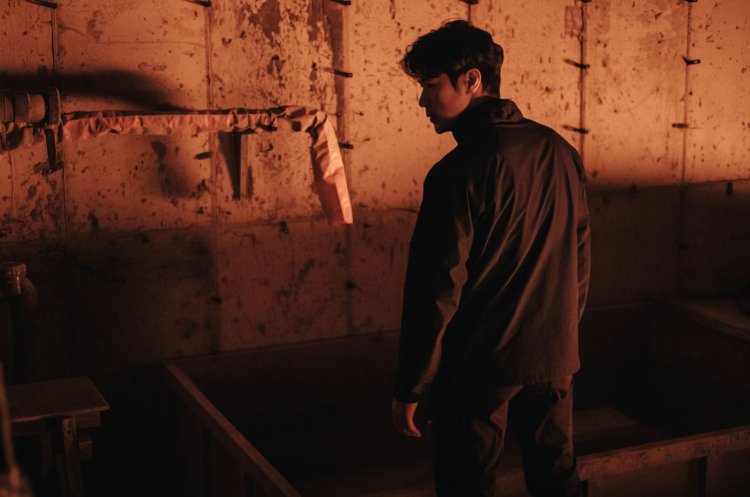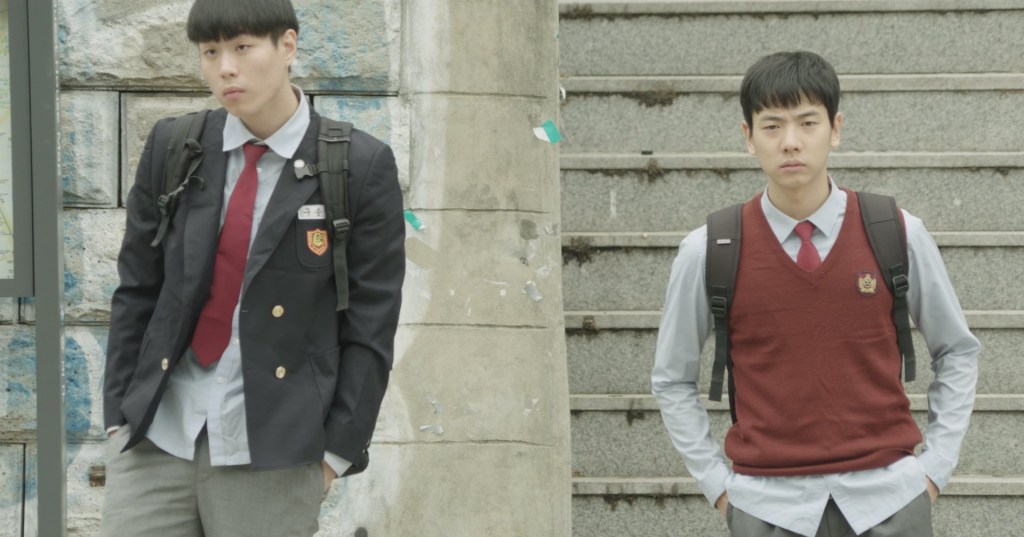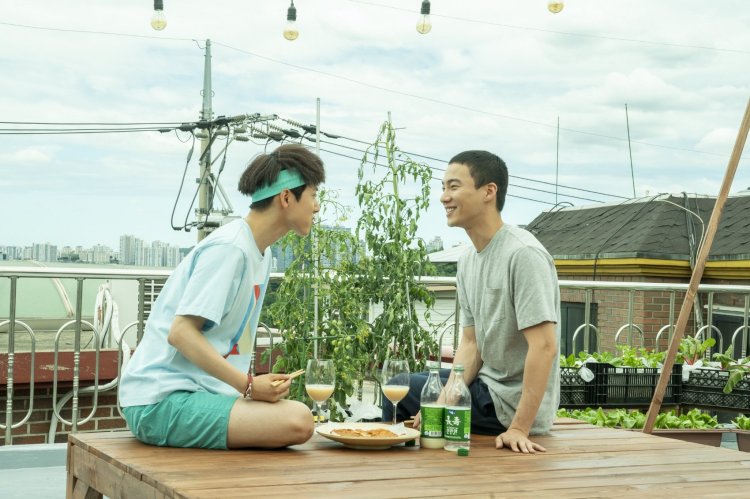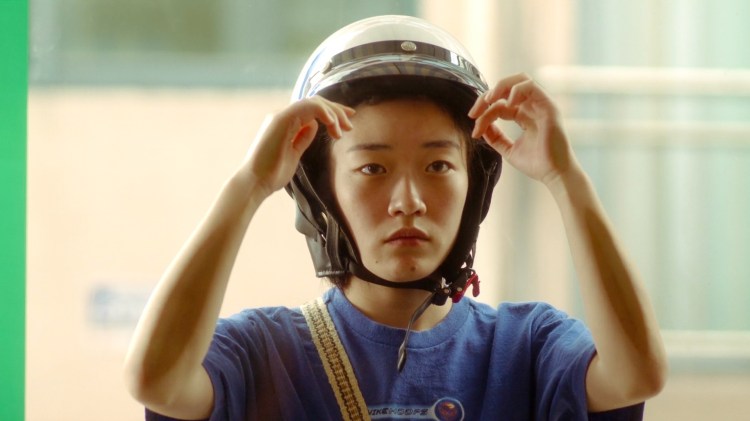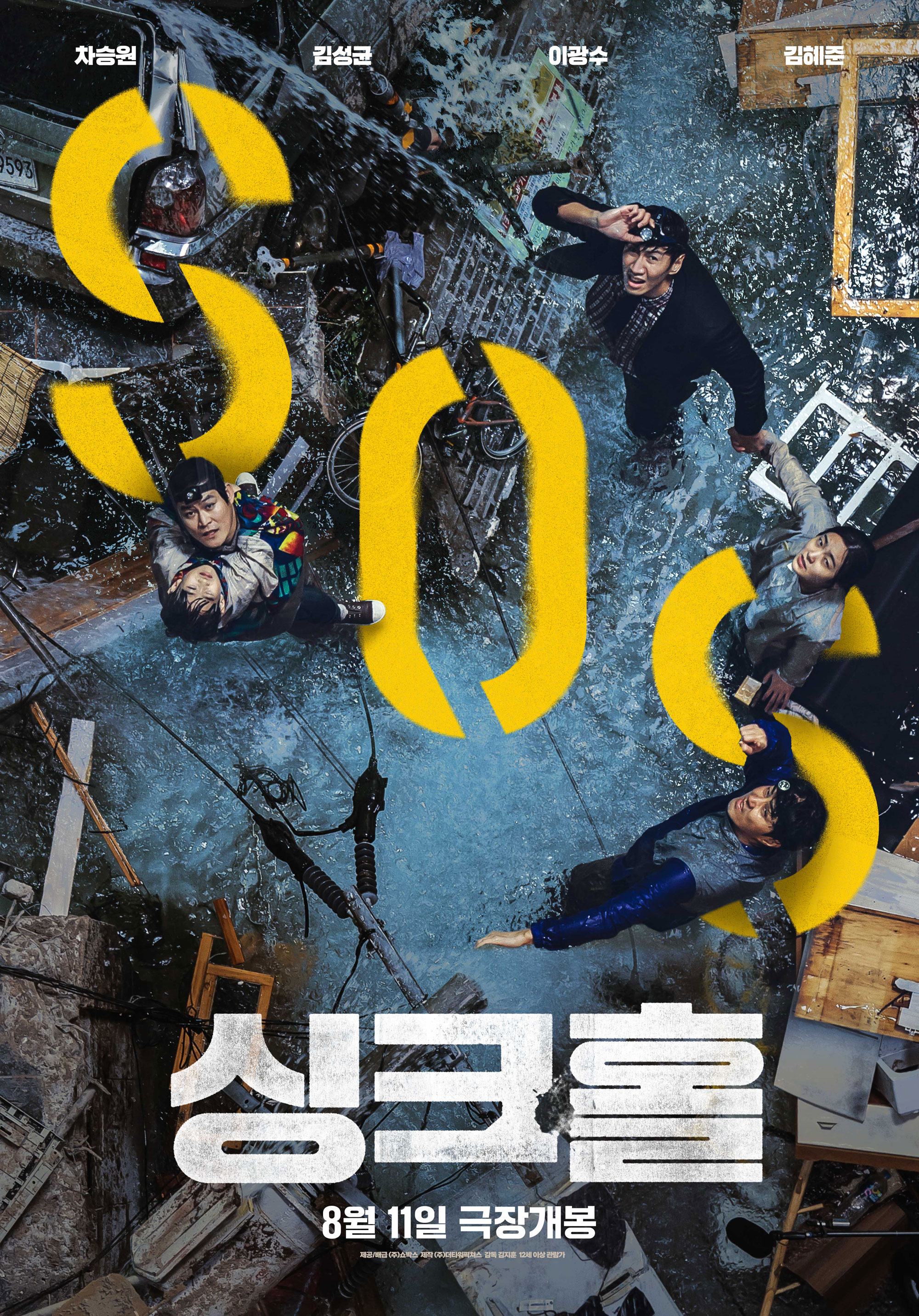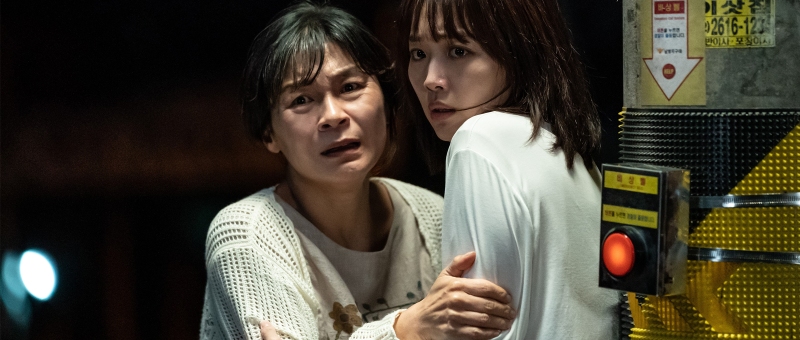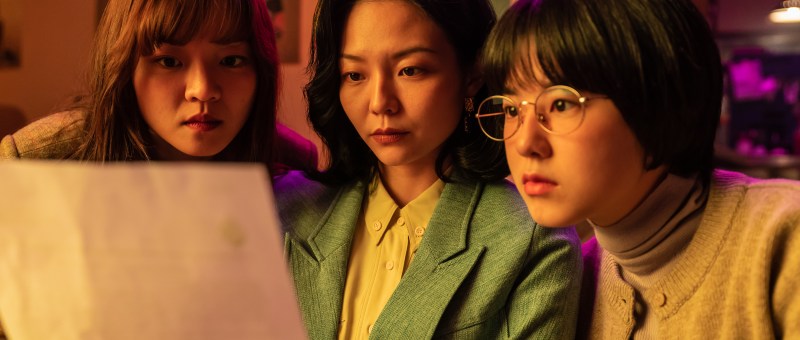
Snowball (최선의 삶, Lee Woo-jung, 2020)

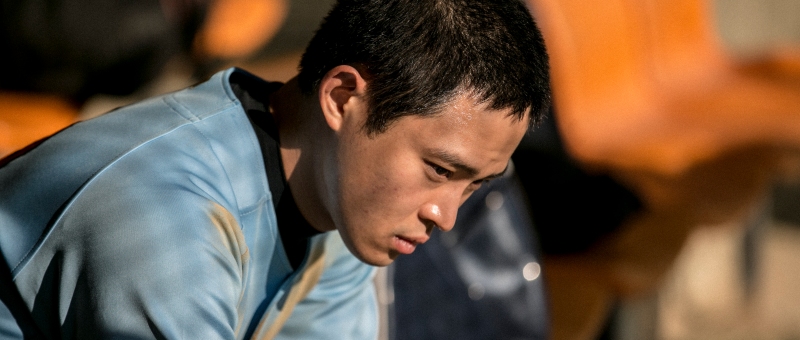
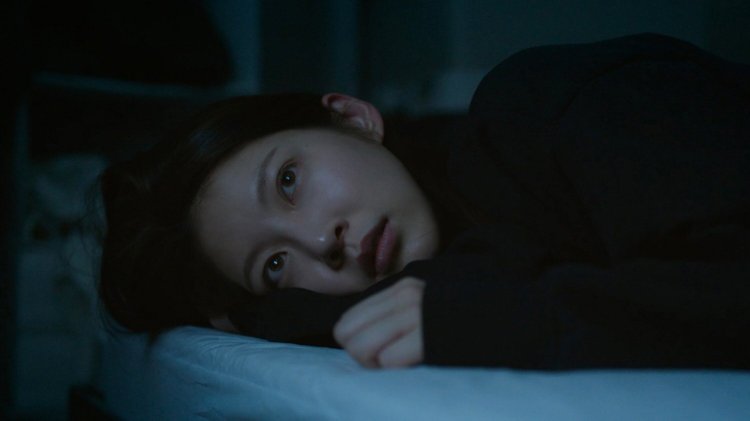
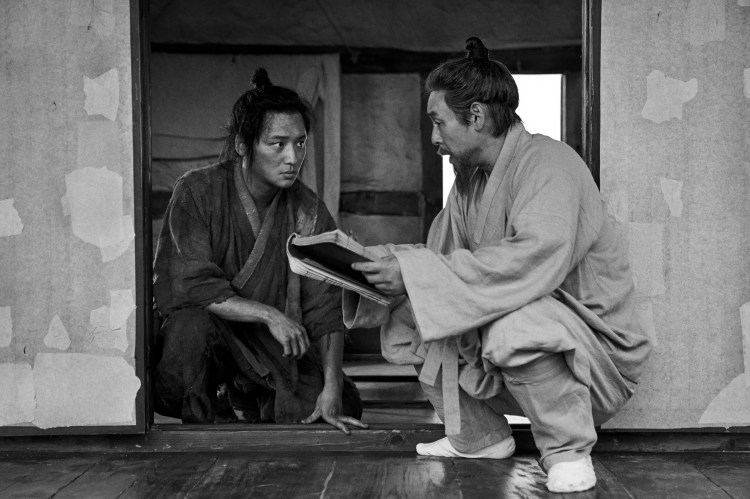
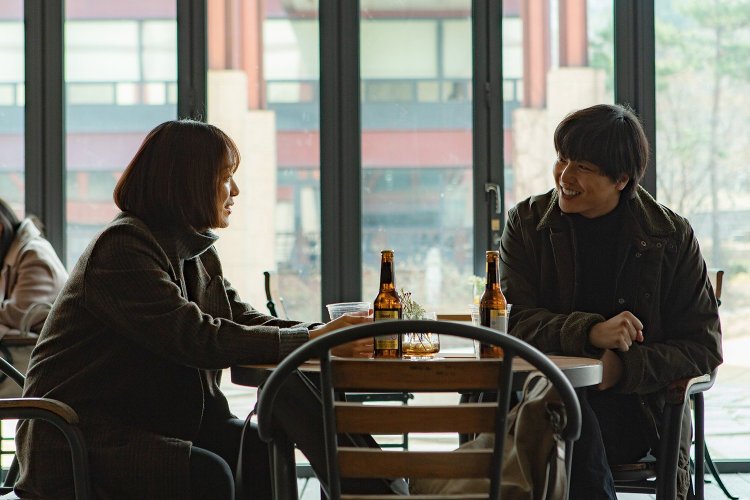
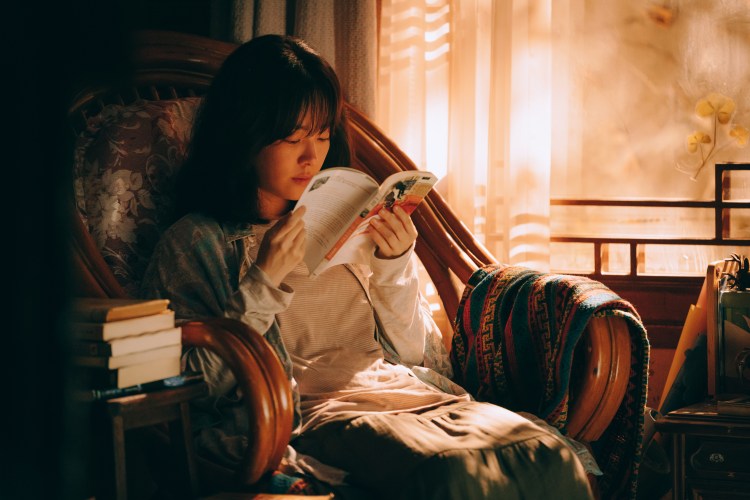
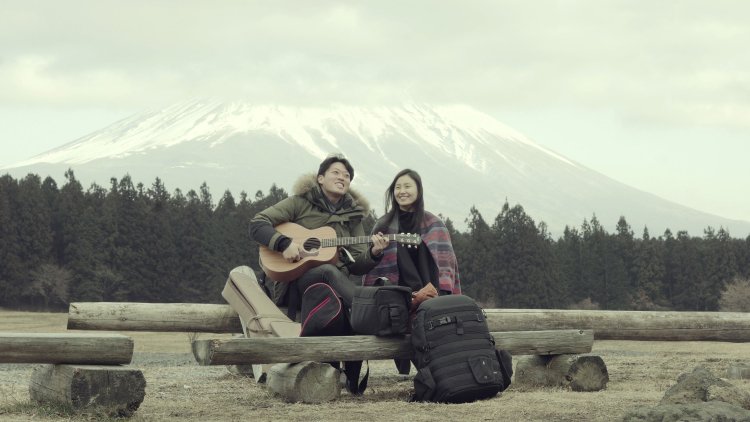
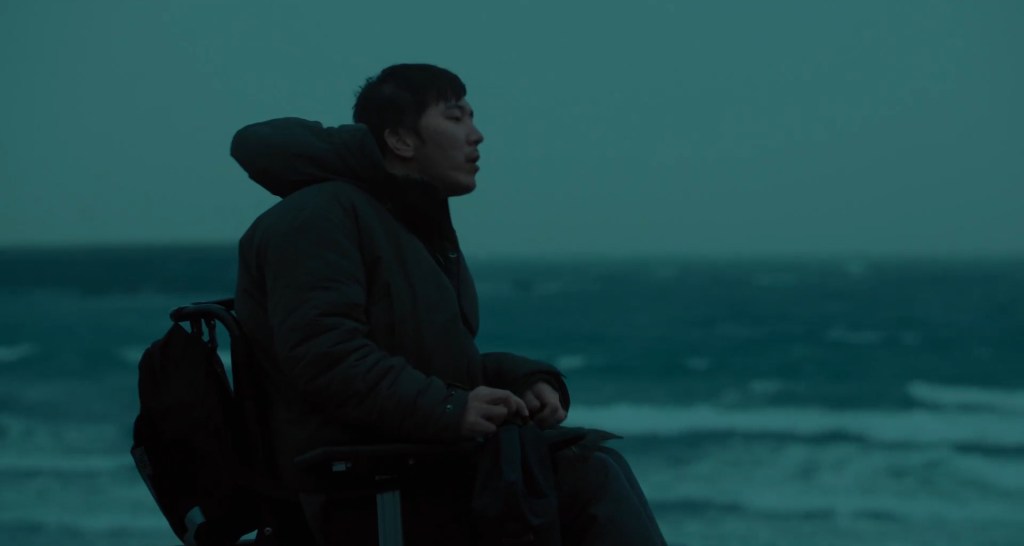
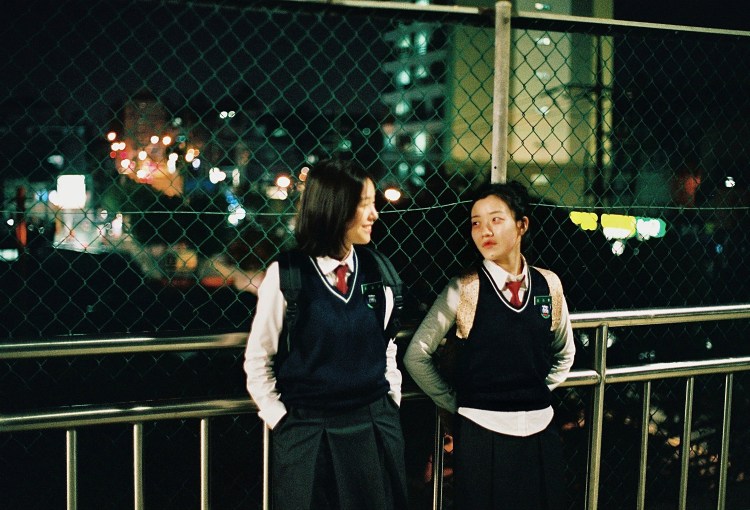
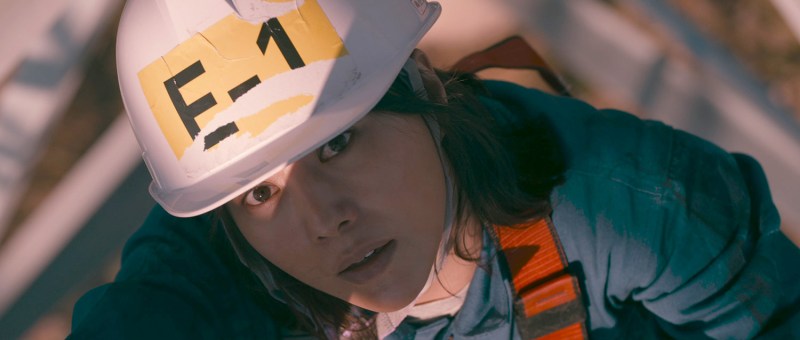
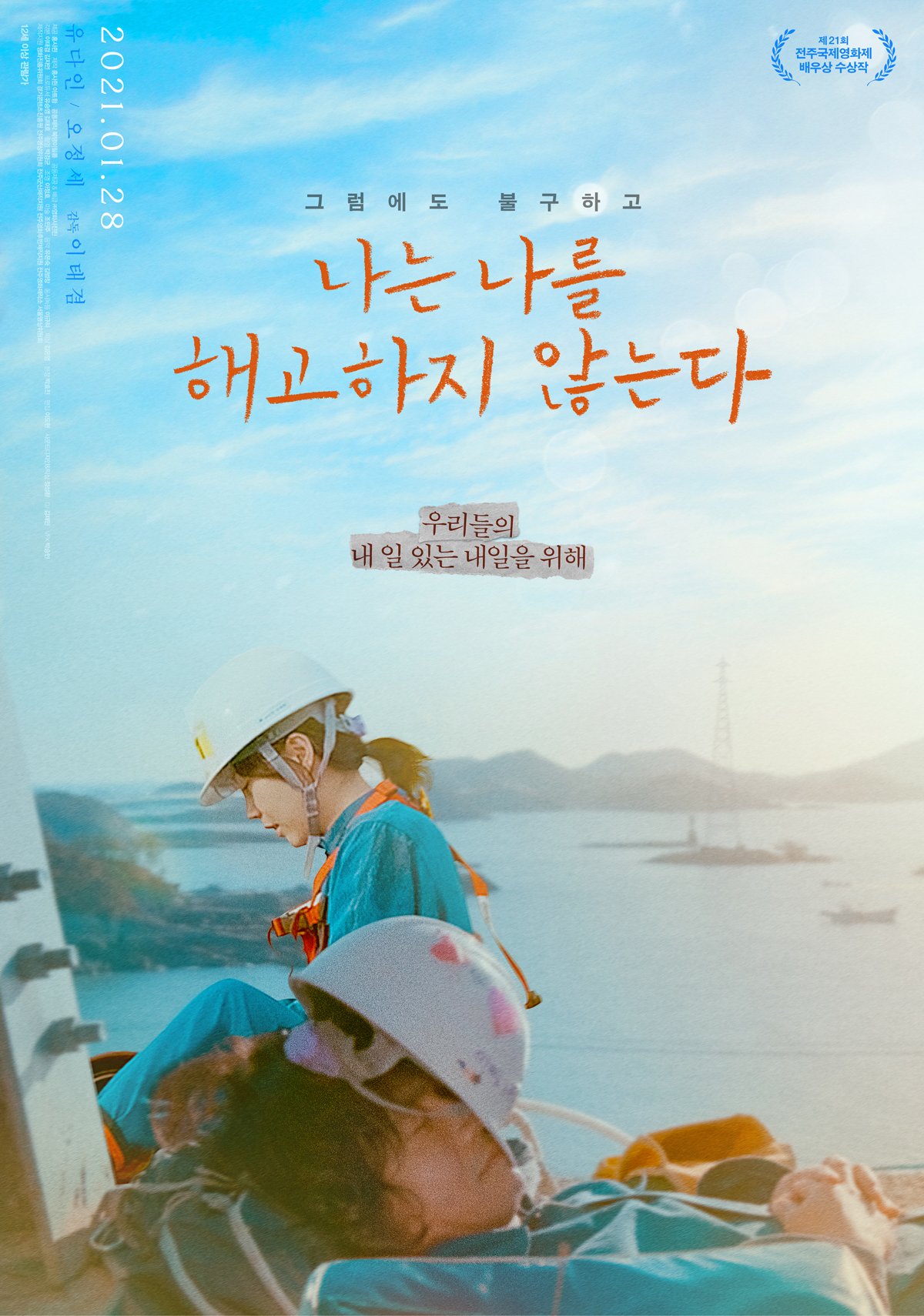
Three teenage girls seeking escape from an unsatisfying adolescence find only betrayal and disappointment in Lee Woo-jung’s sensitive adaptation of the novel by Lim Solah, Snowball (최선의 삶, Choisunui Sarm). Each oppressed by a resolutely patriarchal society, the three women nevertheless differ in the their respective traumas and resentments finding solidarity in the strength of their friendship only to witness it crumble when its barriers must necessarily be confronted. “Why did you do this to me?” Kang-yi (Bang Min-ah) eventually asks, only to receive no answer and realise that in the end they did to and for themselves. 

Though perhaps feeling a sense of familial rejection in the otherwise peaceful home she shares with her overly religious Buddhist mother, emotionally reserved father, and a little dog also yearning for love, Kang-yi is ostensibly the least burdened of her friends if facing a similar sense of detachment. Aloof golden child So-young (Han Sung-min) is clever and pretty, everything seems to go right for her as Kang-yi enviously explains, except for her dream to become a model and actress which her family apparently don’t support. Ah-ram (Shim Dal-gi), by contrast, is quirky and rebellious with a tendency to collect stray animals and other items from the street little caring who they may or may not belong to but is also trapped in abusive home with an authoritarian father. When So-young one day suggests running away together the other girls agree, but after the novelty wears off and they begin to run out of money the realities of a forced adulthood are suddenly brought home to them. 

The depths of their naivety are perhaps signalled in an early and misguided attempt to misuse a potentially predatory middle-aged man who offers them money for food, allows them to stay in his apartment, and suggests an improbably low stress job they might be able to do for him. As she’s want to do, Ah-ram runs off with his wallet only to begin feeling sorry him seeing as there’s so little in it and he is so clearly lonely even if So-young proclaims him a creep. Picking up a mattress in the street the girls end up sleeping in a stairwell, only for Kang-yi and So-young to return and find Ah-ram apparently beaten and raped by a man she later willingly returns to, talking as if such brutal treatment is a normal part of any relationship. “Children, when you’re in love you sometimes get into fights” she depressingly explains, later implying that her violent boyfriend has become her pimp as she slides into sex work in an effort to provide economic support to all three of them. 

So brutalised is she, that Ah-ram thinks nothing of the abuse she continues to suffer while So-young solipsistically wallows in a sense of defeat and despair. It’s at this point she whips out a credit card she’s apparently been carrying all along, her choice not to use it seemingly less about the possibility of its being traced than a stubborn desire to insist she is as underprivileged as her two friends. As we later discover, Kang-yi lied about her address to get into the school and in fact lives in a run-down semi-rural area some distance away, secretly regarded as even more of a hick provincial by the upwardly mobile So-young. Nevertheless, it’s not class differences which eventually shatter their friendship but repressed sexuality. One extremely hot evening, So-young and Kang-yi share a moment of physical intimacy but while it only seems to bind Kang-yi more closely to her friend, So-young is unable to cope with the taboo realisation of her desires and becomes increasingly irritable, distancing herself from both of the other girls before abruptly deciding to call the experiment in independence short and return to her parental home. 

All Kang-yi wants is a return to their former friendship, but So-young’s repression eventually turns violent. Rejecting Kang-yi and Ah-ram she becomes a part of the popular set and embarks on a campaign of bullying that leaves Kang-yi both physically bruised and emotionally wounded. Yet she is also in her own way repressed, unable to accept her parents’ love for her and often ignoring the plaintive cries of the family dog longing to be picked up and held. Neither she nor Ah-ram are able to conceive of a future for themselves, Kang-yi’s sense of rejection eventually pushing her towards a self-destructive act of violence that will further rob her of possibility and the potential for happiness. Captured with a restless, roving energy imbued with with the colours of twilight, Lee’s melancholy indie drama suggests that not even friendship can provide a refuge from the pressures of the modern society and its relentlessly oppressive social codes in which internalised shame can quickly snowball into an avalanche of violence.


Snowball screened as part of this year’s New York Asian Film Festival.

Festival trailer (no subtitles)

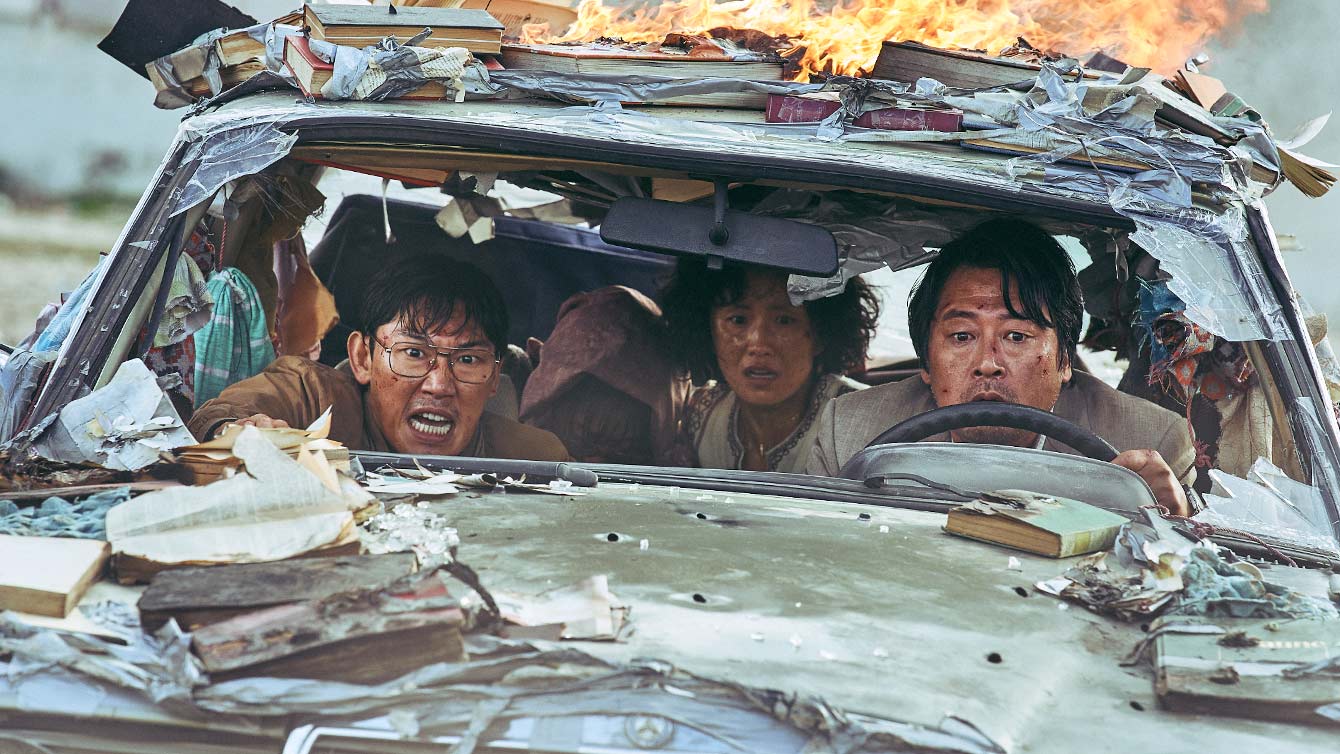
Seobok (서복, Lee Yong-ju, 2021) [Fantasia 2021]

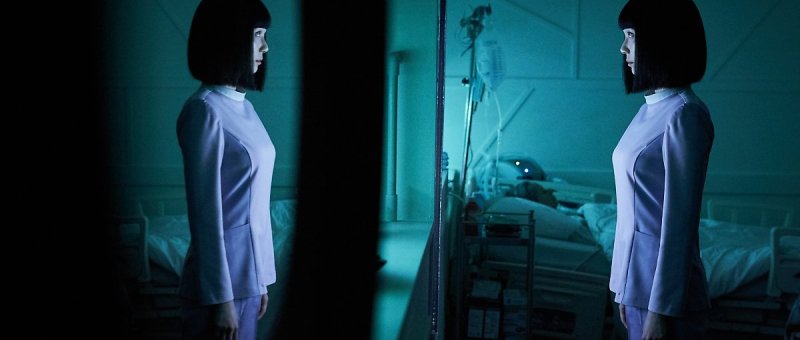
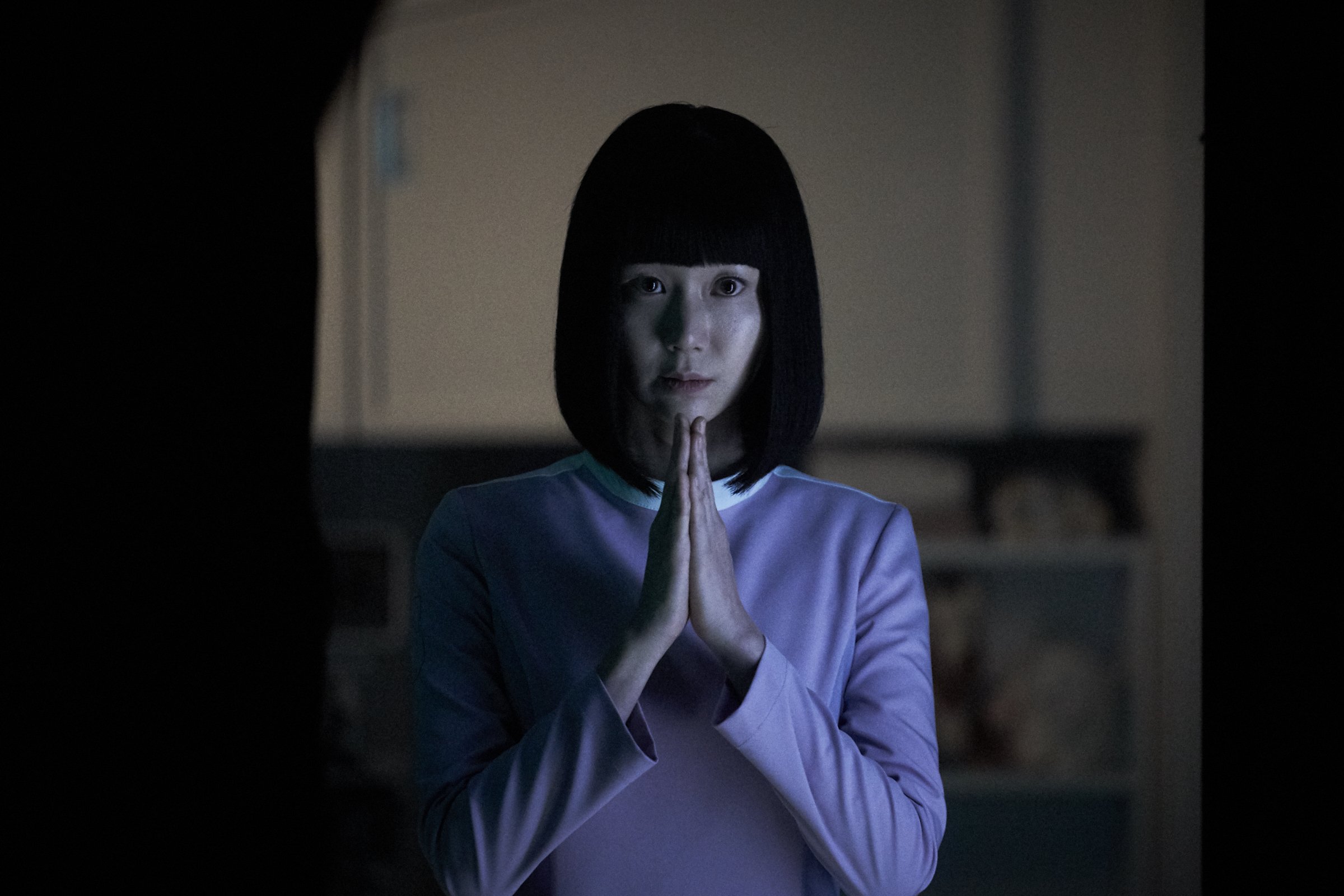
Without death, would life still have meaning? Lee Yong-ju’s high concept sci-fi thriller Seobok (서복) situates itself in a near future Korea in which the possibility of immortality is tantalisingly close only there are some who would prefer it not to be, fearing that without the driving force of mortal dread humanity will lose its ambition and thereafter slide into internecine greed. Then again, humanity hasn’t needed much of an excuse before. 

When a foreign scientist is murdered by drone the incident is attributed to “terrorists” presumably objecting to his research into stem cell technology and the possibilities of eternal healing. Fearing exposure, NIS agent Ahn (Jo Woo-jin) advises the project move to a secret location and recruits a former associate, Min Ki-hun (Gong Yoo), to act both as a test subject and a bodyguard. Since leaving the service, Ki-hun has been suffering with a terminal brain tumour that leaves him plagued by debilitating headaches and distressing hallucinations. 

Ki-hun is roped in by the promise of a potential cure for his condition brokered by Seobok (Park Bo-gum), a genetically modified clone who cannot die. Speaking to the dubious ethics of the research project, no one quite thinks of Seobok as “human” though he was born in the same way as any other child. “It’s like collecting insulin from a pig” a doctor later scoffs at Ki-hun’s squeamishness witnessing Seobok hooked up to a chair and milked for his lifesaving properties, realising that this may be his life “forever”. Having lived all his life within the lab, Seobok is filled with wonder for the outside world begging Ki-hun to walk a little slower through a market when the pair are forced on the run together so he can take it all in a little better. He has no clothes of his own, cannot use chopsticks, and is left with nothing to do with his time other than think. The scientists refer to him only as a “specimen” refusing to acknowledge his humanity viewing him solely as a test subject. 

Seobok can’t decide if life in the presence of death is worse than the curse of immortality. Already condemned, Ki-hun no longer knows if he wants to live or is merely afraid of dying. The fear of death is itself a kind of weapon, at least according to those against the project, a force which propels mankind forward in imposing an unavoidable deadline as it struggles against its mortality. Ki-hun, meanwhile, regards his tumour as a punishment, a mark of his moral cowardice in failing to stand up to his boss’ duplicitous practices and blaming himself for the death a friend who was silenced for daring to speak to out. In bonding with Seobok he realises he cannot allow the same thing to happen again in choosing to prioritise his own survival over someone else’s life. Seobok, meanwhile, comes to the opposite conclusion in realising that his existence is potentially apocalyptic and that there is no escape for him because he has nowhere else to go other than back to his “home” at the lab despite coming to an understanding that much of his treatment there constitutes abuse. 

Nevertheless, Seobok is fiercely contested by mysterious foreign forces intent either on capturing or destroying him apparently terrified of the implications of a world in which sickness can be instantly cured and death has become a thing of the past. Such a world would, of course, be very bad news for Big Pharma and the medical industry, yet it’s the philosophical arguments which they claim motivate them in a fear of a permanent and destructive anarchy which is more than a little ironic considering what eventually unfolds in their quest to capture Seobok who, as it turns out, has also developed awesome powers of telekinesis. Rather than eternal life, however, it’s death that the two must learn to accept, Ki-hun reckoning with his trauma while coming to terms with his terminal diagnosis, and Seobok by contrast seizing his humanity by rejecting his immortality. 

Essentially a lowkey existential drama, Lee Yong-ju’s high concept sci-fi thriller boasts excellent production design and large scale action set pieces, yet situates itself in a cold world of paranoia and anxiety in which even mortal dread has been effectively weaponised by duplicitous forces intent on playing god in the permanent power vacuum of the modern society.


Seobok streams in Canada until Aug. 25 as part of this year’s Fantasia International Film Festival.

International trailer (English subtitles)

Fighter (파이터, Jéro Yun, 2020)

“My name is Ree Jina. I am a “North Korean Refugee”. This is how South Koreans call us. My fight is not over yet. I will keep fighting until the end. Even if I fail I will rise again.” a young woman insists, finding a new sense of purpose in the boxing ring while attempting to adjust to her new life in the South. As the title implies, Jéro Yun’s indie drama Fighter (파이터) follows one woman’s attempt to fight her way through personal trauma and societal anxiety but is less boxing movie than gentle character study as the heroine gains the courage to begin moving on through reconnecting with the estranged mother who abandoned her to come to the South alone. 

After a spell in a readjustment centre, Jina (Lim Sung-mi) is guided to a well-appointed flat by a social worker whose off the cuff remark that apartments like these are out of reach for most South Koreans speaks of a latent resentment. Most of Jina’s rent is subsidised, but she still needs to cover a part of it plus maintenance fees and so she contacts a North Korean fixer who helps her get a job in a restaurant. Needing more money to bring her father, who has escaped the North but remains trapped in hiding in China, to the South she decides to take a second job working as a cleaner at a boxing gym. She’s only there to clean, but despite herself Jina is captivated by the unexpected sight of female boxers. Encouraged to step into the ring herself, she remains reluctant, exclaiming that she doesn’t have time to waste on “fighting”, but eventually decides to give it a go on being told there may be money it if you’re good enough to turn pro. 

One of the reasons Jina gives sympathetic sub coach Tae-su (Baek Seo-bin) for her reluctance to box is due to the discrimination she faces from South Koreans who have a stereotypical vision of Northerners as a heavily militarised people as if they were all enemy combatants. She reminds him that ordinary people live there too, like presumably her father whom she’s desperate to save before he gets picked up by the Chinese authorities and sent back. The social worker’s barbed comments meanwhile echo the impression of some that North Koreans have an unfair advantage in the South with better access to a higher standing of living thanks to being taken care of by the government, but this obviously ignores the societal difficulties they face from isolation and discrimination to trouble gaining employment, potential exploitation, and the persistent culture shock of living in a modern capitalist economy. Even the kind and supportive Tae-su can’t help making a minor joke at her expense as she struggles to understand his contemporary Konglish slang. After making a few friendly overtures, the social worker later turns up drunk at Jina’s flat and attempts to proposition her as if he thinks he’s entitled to her attention, both misogynistic and xenophobic, while having the gaul to blackmail her into paying his medical fees when she attempts to defend herself and get away from him. 

Life in the South is certainly not easy. But Jina is also battling a sense of abandonment and displacement born of her mother’s defection when she was only 12. Planning to ask for money to help her father, Jina finds herself conflicted on meeting her, feeling a further sense of betrayal on realising her mother married again to a moderately wealthy man and had another daughter living a comfortable life in Seoul while she and her father continued to suffer. Yet as the opening quotation implied, Jina’s salvation lies in finding forgiveness and rebuilding old relationships while allowing herself to build new ones. Anchored by a supportive mentor in her coach, Jina finds a new family at the boxing club who actively care for and support her. Tae-su claims boxing restored his sense of purpose in life and gave him the courage to go on living it, but it’s less the sport with its rigid discipline and clearly defined structure that gives her a sense of safety than the unconditional kindness of her new friends which stands in such stark contrast to the rejection she senses from so many others in the South. 

Playing with boxing movie tropes, Yun includes a series of training montages and introduces a fleeting rivalry with a mean girl at the gym, but gradually shifts away from genre norms towards the realms of the family drama as Jina begins to overcome her trauma though reconnecting with her mother. “In life there are times we need to cry”, Jina’s unexpectedly sympathetic coach tells her, giving her the space to be vulnerable even in this most defiantly defensive place as she attempts to process all that life is currently throwing at her, gaining a new determination to keep on fighting no matter who or what tries to knock her down. 


Fighter streams in the US Aug. 7 to 12 as part of this year’s New York Asian Film Festival.

Original trailer (English subtitles)
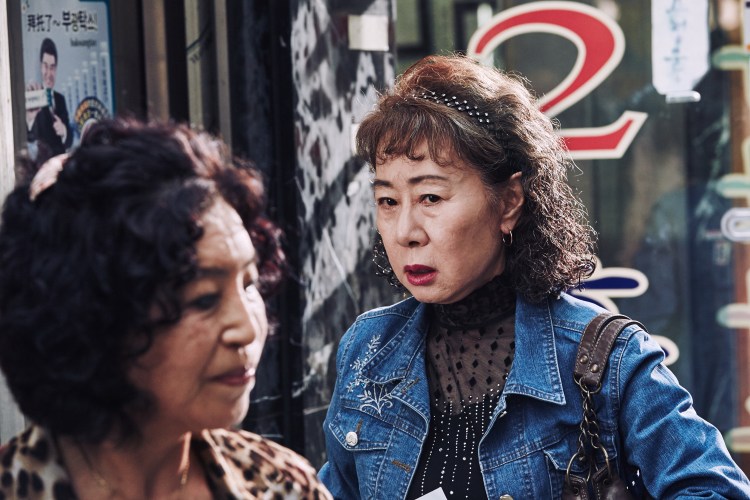
Escape from Mogadishu (모가디슈, Ryoo Seung-wan, 2021)

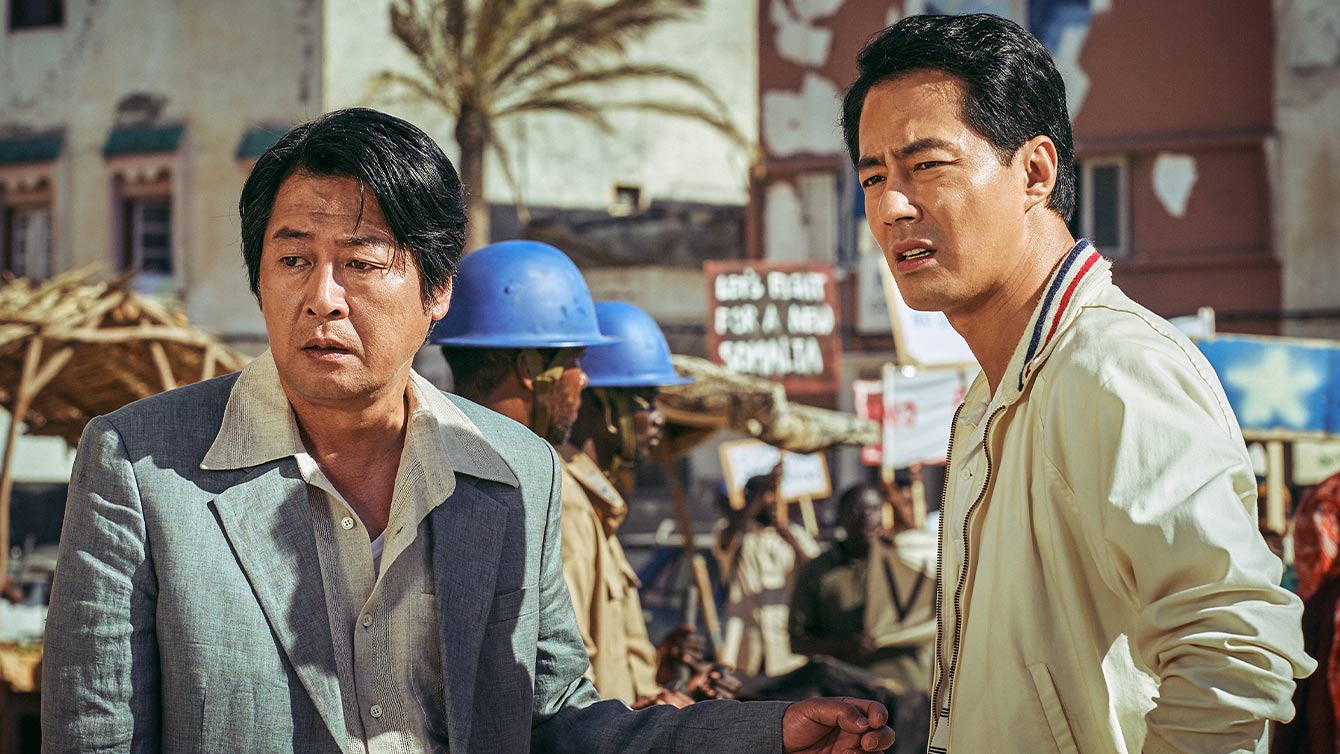
“You think we can accomplish more together?” the North Korean ambassador incredulously asks of the South, realising that if they’re to escape their desperate situation they will temporarily have to put ideology aside. Ryoo Seung-wan’s latest big budget action drama Escape from Mogadishu (모가디슈, Mogadishu) finds the diplomatic staff of a newly democratic South Korea ironically caught up in another nation’s much less peaceful revolution while perhaps confronted by the duplicities of their globalising ambitions even as they realise the North may already have the upper hand when it comes to cultivating relationships with authoritarian regimes. 

As the opening title cards explain, having successfully transitioned into democracy and fresh from its Olympic success the South Korea of 1991 was keen to claim its place on the global stage by joining the UN. Knowing that African votes are important in the process, the ambassador to Somalia, Han (Kim Yoon-seok), is determined to ensure he has that of President Barre in the bag before he finishes out his term. Unfortunately, his attempts are frustrated firstly by a lack of cultural knowledge in his home nation as witnessed by the inappropriate gifts they’ve prepared for the president which include expensive alcohol despite the fact Somalia is a muslim nation, and secondly by the North Koreans who seem to have cultivated a closer relationship with the ruling regime and are keen to ensure South Korea does not get its seat at the UN. 

Meanwhile, it becomes increasingly clear that there is unrest in the country with rebel forces intent on deposing the despotic regime of a military dictator and installing full democracy. The circumstances are in a sense ironic, the rebels and the ordinary citizens who later stage an uprising are only doing the same thing South Korea itself has recently done only they are of course doing it in a much less defensible way with widespread violence culminating in an entrenched civil war. The staff at the embassy therefore find themselves in a difficult position. “At home they turn innocent students into communist spies, think they can’t do that here?” a conflicted staff member advises uncertain as to what to do on realising they may unwittingly be harbouring a rebel soldier while diplomatically unable to declare a clear side. All they can think to do is play a tape from their welcome event describing themselves as friends of the Somalian people in the hope of deflecting rebels’ the anger. 

Nevertheless, the rebels have declared all foreign presences as their enemies for their tacit support of Barre’s regime. Han is certainly guilty of that in cosying up to the government in the hope of winning their vote, while the North Koreans fare little better despite being accused of secretly trafficking weapons to the rebel army while the rebels complain that foreign aid has only been used to facilitate Barre’s ongoing oppression. When the North Korean Embassy is destroyed and the Chinese have already left, the North Koreans are left with no choice other than the unthinkable, asking the South for help. The South, however, is conflicted. If they let them in they’re in danger of breaking the National Security Law and in any case they aren’t sure they can trust the North. “I hear they’re trained to kill with their bare hands” one of the ladies exclaims even doubting the children. But if they refuse to open the gate it means certain death for those who are, if not their fellow countrymen, then in a sense fellow Koreans. 

Based in historical fact, Ryoo’s high tension drama is in essence a division film which makes a strong case for the united Korean family even as the two sides remain somewhat distanced despite making the practical decision to trust each other in order to survive and escape. To do so they each have to make unpalatable political decisions, the South Koreans allowing others to believe the Northerners intend to defect in the hope of additional help from their own side and the wider diplomatic community. Given the opportunity to leave alone, Han nevertheless insists on making space for the North Koreans too unwilling to simply leave them behind. The North Koreans, meanwhile, reveal the reasons they could not defect even if they wanted to in that many of them have been forced to leave children behind in Pyongyang as hostages to ensure their continued obedience to the regime. Han may have gained a degree of enlightenment in realising there are sometimes “two truths” but there’s also an undeniable poignancy on realising that however much they’ve shared, the two men will never again be able to acknowledge each other in public, escaping Mogadishu but forever divided. Shooting in Morocco, Ryoo fully recreates the terror and desperation of being trapped in an unpredictable, rapidly devolving situation while allowing his divided Koreans to find a sense of commonality as they band together in order to escape someone else’s civil war.


Escape from Mogadishu opens this year’s New York Asian Film Festival on Aug. 6 and will thereafter screen at cinemas across the US courtesy of Well Go USA

International trailer (English subtitles)
A Hometown in Heart (마음의 고향, Yoon Yong-Kyu, 1949)

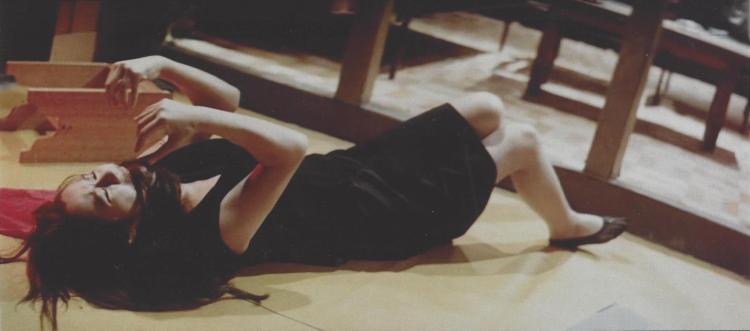
Should the “sins” of the mother be visited on the son? The ageing monk at the centre of A Hometown in Heart (마음의 고향, Maeum-ui Gohyang) seems to think so, punishing a young boy for his mother’s transgressions by treating him as a little man and insisting he reform himself by careful study of the sutras. A bereaved mother feels differently, certain that all he needs is maternal love, while the boy pines for the woman who abandoned him when he was so young that he is unable to remember her. 

As the film opens, 12-year-old Do-seong (Yu Min) is an apprentice monk at a mountain temple where he is forced to do the chores typically assigned to novices such as ringing the bell and carrying water from the valley below despite his youth. Do-seong has no interest in Buddhism and does not want to become a monk though he has little choice. He looks on enviously as the other children laugh and sing while playing in the forest, but if they bump into each other he is mocked and bullied. The ringleader, hunter’s son Jin-su (Cha Geun-su), is fond of killing birds around the temple with his slingshot, which is not very Buddhist and often gets him in trouble with the head monk which is another reason why he dislikes Do-seong. Meanwhile, all Do-seong hopes for is that his mother, who left him at the temple when the was three, will one day return. Apparently, she was very beautiful and is now living in Seoul, the urban paradise on the other side of the mountains. 

As we later learn, Do-seong’s mother was herself a relative of the head monk who took her in when she was orphaned and raised her as a nun, only she ran off with a hunter and gave birth to Do-seong perhaps not quite legitimately. All of that makes Do-seong almost like the head monk’s grandson, but he continues to hold his mother’s “betrayal” against him, insisting that he needs to be more virtuous than the other children in order to make up for his mother’s “sins” in running off with the hunter and abandoning her child. The monk claims that he could forgive her for the hunter, but not for leaving her son. Later we hear that the choice could not have been easy for her, she had two children and could not raise them both and so she left Do-seong somewhere he’d be safe. Do-seong has been pining for her all this time, little knowing she tried to visit him five years previously but the monk turned her away. 

Meanwhile, the temple is all abuzz because they’re due to hold a 49th day ceremony for the wealthy Ahn family from the city. Sadly, the young son of the widowed daughter-in-law (Choi Eun-hee) has passed away from measles at only six years old. On hearing that the ceremony is for a boy from a wealthy family, Do-seong is confused, certain that a family of that kind would have taken great care him, in the way he perhaps longed to be taken care of by a loving mother. Diseases like measles, however, do not discriminate. The loss of the child is a double blow for the widow because he was her only son and as her husband died just before the baby was born, perhaps in the war, she will have no more children. That may be why she takes so strongly to little Do-seong even though he’s much older than her son was, immediately realising how lonely he must be and how much he must miss his mother even though he never knew her.  

Growing close to the boy, the widow begins to wonder if she shouldn’t adopt him and take him away from this cold and austere temple life which he seems to so dislike. Her mother is against it, telling her to put the past behind her and attempt to marry again, but the widow is certain that she wants to raise Do-seong with maternal love in opposition to the head monk’s emotionless rigidity. The monk, however, is resistant, punishing Do-seong because of the grudge he bears his mother. Only when the boy’s mother turns up unexpectedly does he relent, preferring that Do-seong leave with the widow rather than with the woman who abandoned him. Do-seong’s mother wrestles with herself, longing to see her son but unsure she has the right, eventually meeting with the widow to ask her to reconsider which she of course does because she’s not someone who’d want to separate a mother and a child. But Do-seong is so excited about going to Seoul, getting a suit, and maybe going to college that his mother reconsiders and decides that perhaps it’s too late after all and Do-seong should go with the widow who can give him a much more comfortable life. 

As if to prove the head monk right, however, karma catches up with Do-seong when it’s discovered that he too killed one of the birds hoping to make a fancy feather fan like the widow’s for his mother in case she ever came back. The widow’s mother is scandalised, not wanting to bring a killer into her home, while the head monk revokes his permission in certainty that Do-seong is “bad”, filled with the sins of his mother, and in need of further correction. The widow disagrees and points out that he must miss his mother very much to have done something like that for her and what he needs is a mother’s love, not the cold cruelty of the monk’s emotionless asceticism. As the servants point out however, “we can’t do anything about our fate, we all have to live and die according to our lot”. There’s not much the widow can do other than promise to try again later. 

One of the other monks had tried to comfort the widow and her mother by reassuring them that it’s all because of karma, which seems like an inappropriate thing to say to a woman who’s lost a child no matter how sincerely it’s meant. The head monk also tells Do-seong that he’s bad because he’s got bad karma, but perhaps that’s not something he really needs to believe. Overhearing that his mother had returned and tried to see him but was prevented, he takes his fate into his own hands, striking out alone towards the city and an end to his loneliness in claiming his birthright as a beloved son in a world unburdened by moral austerity.


A Hometown in Heart is available on DVD from the Korean Film Archive in a set which also includes a bilingual booklet featuring essays by film critic Kim Jong-won and KOFA Film Conservation Center manager Jang Gwang-heon.

OK! Madam (오케이 마담, Lee Cheol-ha, 2020)

“If I have to die I’ll die in business class” a passenger insists, refusing her hijacker’s instructions to move to the more egalitarian section of the plane. Partly a social comedy in which a cast of disparate individuals respond in their idiosyncratic ways to an airborne hostage crisis, Lee Cheol-ha’s Ok! Madam (오케이 마담) is also an unconventional family drama in which an impoverished family go to great lengths to save their very first family holiday. 

Mum Mi-young (Uhm Jung-hwa) runs a successful twisted doughnut stand at the market, while her husband Seok-hwan (Park Sung-woong) is an in-demand IT expert. Yet financially the family is strained with Mi-young apparently exasperated that Seok-hwan keeps wasting money buying vitamin drinks in the hope of winning giveaway prizes. When they finally get lucky and win a dream trip to Hawaii, the couple are originally over the moon only for the penny pinching Mi-young to reconsider. Perhaps it’s irresponsible to take time off from their businesses and selling the prize online would be the more sensible option. When their daughter, Nari, complains that the other kids make fun of her because of her parents’ professions and the fact she’s never been abroad, however, Mi-young reconsiders. She may later regret that, as their dream family getaway is quite literally hijacked by North Korean spies who believe a fugitive former agent may be aboard their plane. 

Lee keeps up a sense of suspense as to the identity of the former North Korean agent even if the twist is a fairly obvious one. The other passengers on the plane are a minor microcosm of the contemporary society, one of the most vocal a feisty mother-in-law who’s forced her son’s wife on a long haul flight in the final trimester of her pregnancy so she can give birth on American soil and guarantee her child US citizenship. Other passengers meanwhile gossip about a famous actress while an arrogant politician constantly throws his weight about and an old man travelling to meet family bitterly regrets starting a conversation with Seok-hwan. 

Much of the comedy rests, ironically, on class disparity as the penny pinching Mi-young resolves to make the most of her unexpected upgrade to business class on learning everything’s free while the snooty mother-in-law quips about trying to engineer her grandchild’s access to American citizenship only to wonder if they might end up being born North Korean. Seok-hwan even jokingly brands his wife a “communist” for her financial austerity as she contemplates passing up personal pleasure for financial gain, while North Korean agents targeting the plane are eventually torn apart by infighting with some determining to sell off the rogue agent rather than simply capture them alive as instructed. 

Nevertheless, the main draw is the awesome fighting skills of Mi-young who finds herself donning a stewardess outfit and taking out the bad guys aboard the unexpectedly cavernous aircraft. Simultaneously enforcing and undercutting conventional gender norms, Mi-young had forced her daughter to learn ballet against her will even though Nari would rather learn taekwondo and is always watching action movies on TV. In a meta touch, an actress confesses that it’s just her face someone else does the actual fighting while Mi-young effortlessly takes out rows of bad guys who, it is has to be said, are not much of an advert for North Korean special forces. 

The hostage crisis in its own way brings the family closer together as they fight not only to save the plane, and everybody’s lives, but their dream Hawaiian holiday. Discovering mutual secrets and past lives, even encountering an old flame, the couple enter a deeper level of intimacy while remaining true to themselves and solidifying their family bond, little Nari’s taekwondo dreams apparently coming true after witnessing her mum showing off her action star credentials. At heart a slapstick comedy with a touch of ironic farce, OK! Madam rejoices in sending up national stereotypes from the clueless penny pinching housewife to the feckless competition-obsessed husband, celebrity obsessives, and self-absorbed politicians but also insists the most ordinary of people have hidden talents they’ll have no hesitation exposing when their loved ones are in danger. 


OK! Madam screens on July 5/7/9 as part of this year’s Neuchâtel International Fantastic Film Festival (NIFFF)

International trailer (English subtitles)
Deliver Us From Evil (다만 악에서 구하소서, Hong Won-chan, 2020)

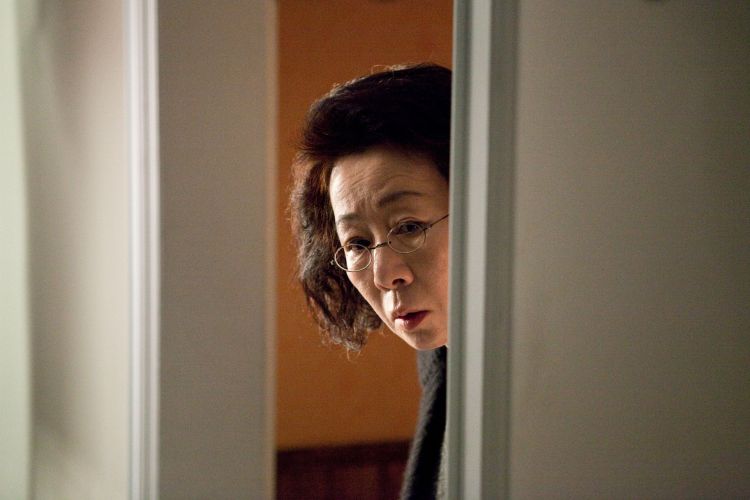
A melancholy hitman bids for paternal redemption but finds himself literally stalked by the mistakes of his violent past in Hong Won-chan’s pulpy action drama, Deliver Us From Evil (다만 악에서 구하소서, Daman Akeseo Goohasoseo). Aptly named, Hong’s noirish thriller takes us from the back streets of Osaka to underground Bangkok while the hero longs for the tranquil horizons of Panama but finally discovers that he cannot outrun himself even if he can perhaps repay his karmic debt by freeing others from the riptide of his moral transgressions. 

A former government agent apparently unceremoniously burned, In-nam (Hwang Jung-min) has been earning his keep as a killer for hire hiding out in Japan. His “one last job” is knocking off a Zainichi Korean mob boss, Koreda (Kosuke Toyohara), after which he’ll be free to go wherever he wants, arbitrarily setting his sights on Panama solely because of the tranquil scene featured in a picture opposite his favourite seat in his local izakaya. The past is however not done with him yet. His old handler gets in touch to let him know old flame Young-ju (Choi Hee-seo) has been trying to contact him, but so consumed with shame and defeat is he that he declines to respond only to hear a short time later that Young-ju has been found dead in Bangkok and as she’d listed him as next of kin he’s responsible for the repatriation of her body. Remorseful, he’s shocked to discover that Young-ju had a daughter, Yoo-min (Park So-yi), whose kidnap by her Korean-Chinese nanny may be connected to her murder. Switching up his plans, In-nam determines to save the daughter he believes to be his own but is pursued by flamboyant Korean-Japanese gangster Ray (Lee Jung-jae) hellbent on getting revenge for his estranged blood brother Koreda. 

In-nam finds himself in a sense caught between a series of codes of masculinity, apparently a former government spy who seems to have been involved in state sanctioned acts of torture and murder that may privately be against his sense of morality only to fall still further as a killer for hire even if we’re told in no uncertain terms that Koreda was a bad guy, a killer of women whose death is perhaps morally justifiable within the codes of chivalry. In-nam’s partner warns him about Ray, reminding him that they should have killed him at some point in the past but apparently let him live, a decision that has led, as Ray later states, to their present confrontation. Quizzed by a local Thai mobster, Ray claims he can’t even remember why he’s so set on killing In-nam but is mindlessly bound to follow his own code of manliness in avenging the death of a blood brother he had apparently fallen out with some years previously.

Meanwhile, in retrieving his daughter In-nam attempts to reclaim the right to a peaceful life making up in a sense for the mistakes of the past in having first abandoned Young-ju because of his manly code and then failed her in refusing her request for help. He attempts to reassert himself as a father by saving his little girl, but in doing so opts only for the personal, unmoved on discovering a child trafficking network enabled by the peculiar medical regulations of Japan and Korea which prohibit child organ transplants looking to save only Yoo-min while making no real effort to help the others. On reporting her daughter missing to the police, Young-ju had been horrified to discover Yoo-min’s photo pasted onto a wall entirely covered in similar notices for other children the police, as we later discover somewhat complicit, have so far failed to find. Yet saving the children is more happy accident than design, an indirect consequence of In-nam’s violent intervention. 

Indeed, In-nam more or less leaves the kids to his local sidekick a Korean transgender woman whose confirmation surgery he’s promised to fund in return for her assistance as guide and translator while he remains bound to a nihilistic path of manliness knowing there’s no way out for him that does not end in violent confrontation with past sins. Caught between the outlandish pulp of the flamboyant Ray and the noirish fatalism of In-nam’s journey into the darkness of the Bangkok underworld, Deliver Us From Evil defiantly refuses to marry its conflicting sensibilities as the two men pursue their respective codes each looking for their own particular deliverance but finding that salvation lies only in confrontation. 


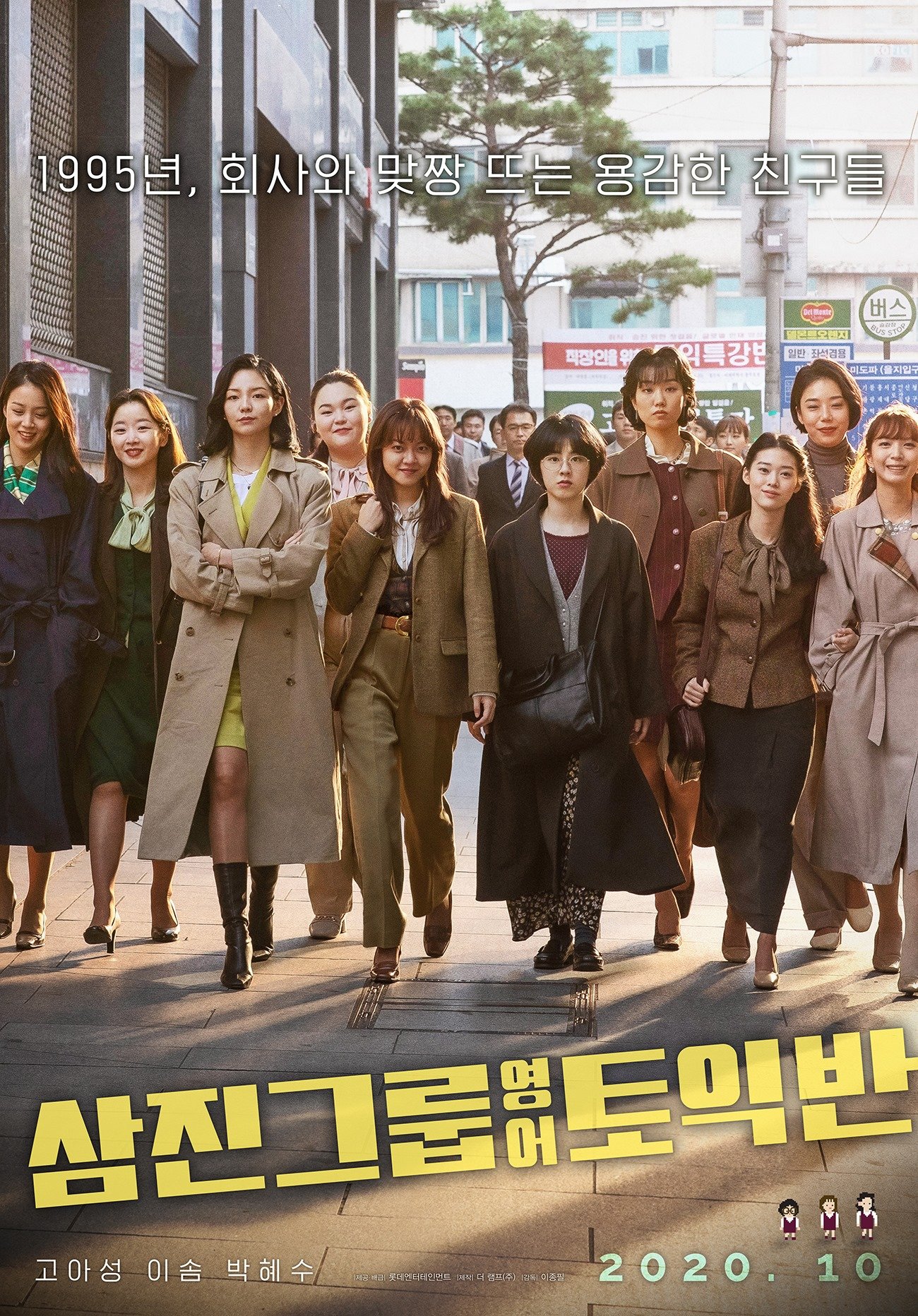
Deliver Us From Evil screens at Edinburgh Filmhouse on 22nd June and Genesis Cinema London 24th June as the first Teaser Screening for this year’s London Korean Film Festival. The next screening in the series, Voice of Silence, will screen at Edinburgh Filmhouse on 1st July and Curzon Soho 3rd July, while Samjin Company English Class will then screen at London’s Screen on the Green on 8th July.

International trailer (English subtitles)
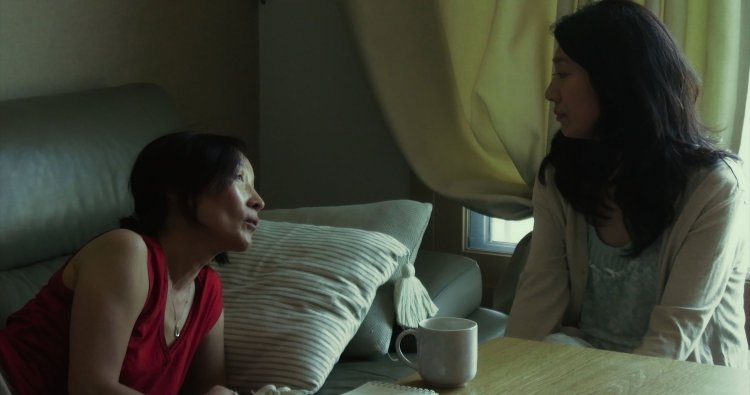
An Old Lady (69세, Lim Sun-ae, 2019)

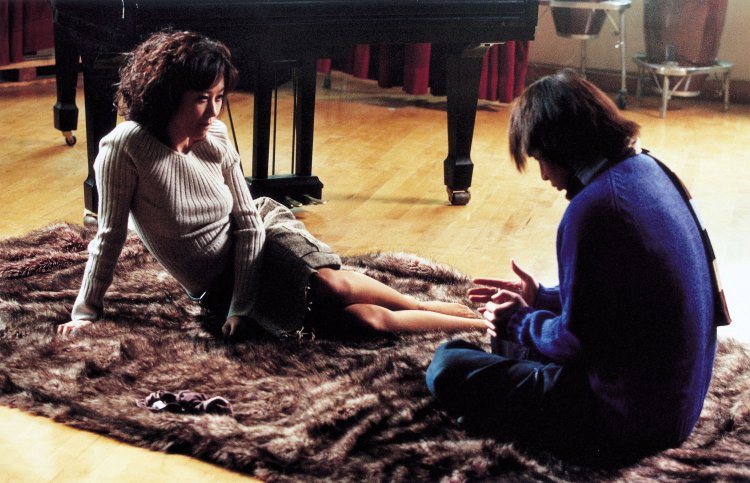
“Would you say I’m safe in these clothes?” the 69-year-old heroine of Lim Sun-ae’s An Old Lady (69세, 69-Se) asks of a now sympathetic police officer who has just, perhaps slightly inappropriately, complemented her on her always elegant dress sense little knowing it’s little more than ineffectual armour designed to help her feel not just less vulnerable but less culpable in the eyes of those who tell her that she is to blame for her sexual assault at the hands of a healthcare professional. 

Lim opens with a lengthy period of darkness in which we only hear the dialogue between Hyo-jeong (Ye Soo-Jung), an elderly woman receiving her final physiotherapy treatment following a knee operation, and 29-year-old nurse Joong-ho (Kim Joon-Kyung). We can hear Hyo-jeong’s discomfort in her muted replies to Joong-ho’s increasingly inappropriate comments on the beauty of her legs and youthful appearance and though we don’t see what happened next, we’ve heard enough to believe that what she says is true and that she has been assaulted by someone who was supposed to be a position of utmost trust. Though she doesn’t quite explain why, Hyo-jeong asks her live-in partner, Dong-in (Ki Joo-bong) to accompany her to the police station certain that she should report the crime but fearful and needlessly ashamed. The police, however, are not originally sympathetic, giggling slightly when they realise Joong-ho is a handsome 29-year-old man, stunned into disbelief that anyone would rape a 69-year-old let alone someone 40 years their junior. “We won’t make a scene, it’s not a murder” the lead investigator insensitively adds as a means of assuring them he’ll be discreet in his investigations. 

As a counsellor later points out, rape victims are forced to prove the accusation even when there is clear video evidence. The problems Hyo-jeong faces are the same as any other woman, but they are compounded by her age and most particularly by the spectre of dementia which is both wielded as a weapon by Joong-ho who admits to the sex but claims it was consensual, and by the police who must proceed as if her testimony may not be reliable. Hyo-jeong didn’t known Joong-ho’s name to report it and claims not to have known him previously, but he tells investigators he met her at a Christmas market and in fact recommended his hospital to her. In many senses, this is irrelevant. Meeting someone once and taking them up on a recommendation does not amount to consenting to a sexual relationship and there’s no evidence of their meeting on any subsequent occasion, but the inability to remember it clouds Hyo-jeong’s mind leaving her wondering if she really could have known him and begun some kind of romance and then simply forgotten about it. 

Dementia is a key tool in the gaslighting of the elderly who, when they ask legitimate questions about their healthcare or financial circumstances are simply told that their memory is faulty and everyone believes it because they’re old. Ageism is something both Hyo-jeong and Dong-in are repeatedly forced to face, berated by the young for being slow or in the way and watching as others seem to step in and assume authority over them as if they were children who can’t look after themselves. Hyo-jeong bears her troubles with quiet grace, but Joong-ho’s abuse of his position is all the more egregious because it leaves her afraid to seek medical treatment despite being in great pain. The police struggle to believe a young man would rape an old woman, but fail to spot that a predator has most likely installed himself in a line of work in which he is likely to meet vulnerable people who cannot fight back because of the physical impairments they are receiving treatment for, knowing that should they complain he can easily dismiss their claims as a figment of an elderly imagination. Hyo-jeong is only able to force him to admit inappropriate sexual contact because she preserved material evidence in not wanting to deal with her soiled hospital gown. 

“It drowns you little by little, life is really stubborn” she later tells an unrepentant Joong-ho complaining about having his life “ruined” by her desire for justice, and we can see that she has also had tragedy in her life that perhaps prevents her from asserting herself. Though living with Dong-in and working in his shop, she stubbornly continues to call him “Mr. Nam”, and the situation is indeed complicated by the irony that the pair met when she was his care nurse while he was recuperating in a hospital. The police didn’t quite like it that these two elderly people live together but aren’t married, and there are obviously problems with Dong-in’s resentful lawyer son (Kim Tae-hoon) who declares that it’s fine for his widowed father to live with a woman but he doesn’t see why he should take an interest in her private life. Nevertheless he later comes up with a legal tip that they should be prosecuting Joong-ho on a charge of assaulting someone with an age-related disability which might make it easier to get through the courts. Hyo-jeong doubts herself and backs off, Dong-in uncomfortably shifting into a mild chauvinism as he tries his best to protect her while outraged that someone like Joong-ho can just carry on living his life after what it is he’s done, continuing to provide medical care to other vulnerable women. 

Yet through her ordeal Hyo-jeong perhaps finds the strength to step into her self. “Telling my story isn’t easy. But this is me taking a step into the sun”, she says now more grounded and less minded to run away, ready to face the past as well as the future in having accepted herself for all that she is. A fierce condemnation of an ageist, patriarchal society, An Old Lady eventually allows its oppressed heroine to free herself not through revenge but through the simple act of refusing to be silent in the face of injustice. 


International trailer (English subtitles)
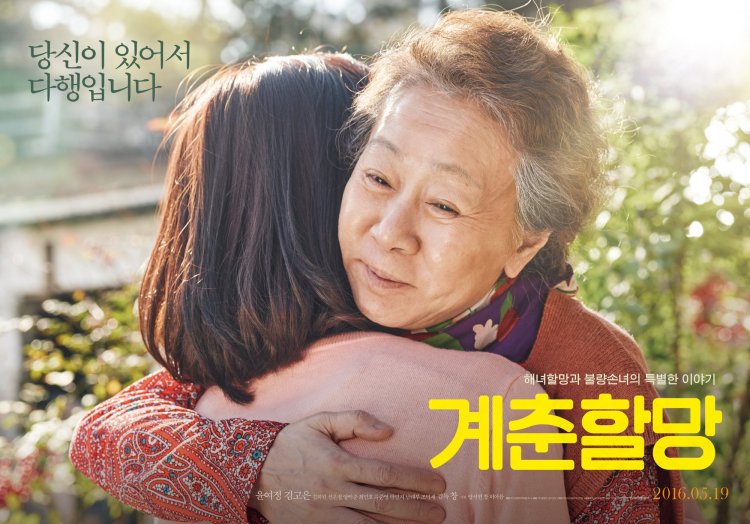
Daughter-in-Law (민며느리, Choi Eun-hee, 1965)
Domestic power struggle meets oppressive patriarchal social codes and entrenched class prejudice in Choi Eun-hee’s lighthearted marital drama, Daughter-in-Law (민며느리, Minmyeoneuli, AKA The Girl Raised as a Future Daughter-In-Law). One of the biggest stars of Korean cinema’s golden age, Choi was only the third woman to direct a feature film and the first to direct herself as the leading lady, adapting a popular radio serial in which a pure hearted young girl finds herself suffering while patiently fulfilling the role of a dutiful daughter-in-law to a tyrannical middle-aged woman. Though the film may eventually reinforce traditional gender roles and the patriarchal norms of the conventional marriage it also subtly undercuts them in its final bid for female solidarity as well as in the surprisingly frank depiction of the sexually active relationship between the middle-aged in-laws. 

Perhaps surprisingly, the film opens with a montage sequence of a young woman doing laborious household tasks while the title song muses on the difficulties of married life. For young Jeomsun (Choi Eun-hee), the problems are compounded as we discover she was in effect sold into marriage because of her once wealthy family’s poverty and as her intended husband is still only a child is treated as an unpaid housekeeper by her harridan of a mother-in-law, Mrs Kim (Hwang Jung-seun). “Serve your parents and respect your husband, that’s this country’s way” Mrs Kim reminds her, continually dissatisfied with everything but mostly that she isn’t getting enough respect or attention as the head of the household (in the domestic sense at least). 

As thoughtlessly cruel as she often appears to be, Mrs Kim’s behaviour can perhaps be seen as merely an attempt to leverage the only power she will ever have as the matriarch in her own house, a power made all the greater by the fact her son is still a child and her future daughter-in-law only afforded a liminal space within the family hierarchy. She continually reminds her husband (Kim Hie-gab) and Jeomsun that she too had a mother-in-law who treated her badly, often making her work through the night, and so her treatment of Jeomsun is a way of paying down the system, a facet of the “custom passed down through the generations”. Having been badly treated herself, she relishes her new sense of power and treats her daughter-in-law badly as misdirected payback for her own youthful suffering. 

Jeomsun herself has internalised a sense of the system’s righteousness, fully believing that she must do her “duty” as a good daughter-in-law even when her own mother points out that her in-laws are hardly doing their duty when they wilfully mistreat her. Added to notions of patriarchal subjugation is a further class dimension that leaves Jeomsun at their mercy because she has become impoverished, her mother having consented to her marriage only reluctantly in an attempt to avoid having to sell the family house. Jeomsun had been in love with a local man, Sugil (Park No-sik), but felt their union was impossible while her father was alive because he was of a lower social class and continues to believe it improper even after his death with only her mother lamenting that she wishes she had found a way that her daughter could have had a happier life marrying a man she loved. For his part, Sugil attempts to buck the system by continuing to pursue her, hoping to “buy” her back off the Kims after raising money while the marriage remains unconsummated and therefore unofficial. 

Choi’s age, then in her late 30s though presumably playing the part of a young woman in her late teens or early 20s, further adds to the incongruous inappropriateness of her position in the household as the future wife of a boy who is still quite clearly a child. Yet the young master, Bokman, appears to dote on her, often taking her side against his mother but in the end unable to defend her, too afraid of Mrs Kim to tell the truth and risk having to take responsibility for his actions preferring to let Jeomsun pay for them instead. In an interesting role reversal, it’s Mr Kim who is the perpetual peacemaker, a kind and patient man who quite clearly loves his firecracker wife despite her harsh demeanour. The slightly comedic depiction of their cheerfully active sex life as a middle-aged couple is perhaps at odds with the often prudish times, but also softens Mrs Kim’s otherwise difficult character until such time as she’s tricked into a moment of self-realisation in the recognition that her resentment of Jeomsun is really a reflection of her maternal jealousy and therefore entirely unfair. 

It’s this momentary epiphany that brokers an opportunity for a new female solidarity not only between Jeomsun and her mother-in-law but also with her own mother who must then find the magnanimity to forgive Mrs Kim for treating her daughter so badly in the first place. What began as a tale of patriarchal cruelties, a young woman sold as a wife to a spoilt child at the expense of her own romantic fulfilment, ends with a wilful reversal of the “custom passed down through the generations” as Mrs Kim agrees to cede some of her power in treating her daughter-in-law as more of an equal while making space to welcome her mother, another mother-in-law, into her home. “We all have to live according to our duties” Jeomsun had sadly explained to her former love, yet what she discovers is that duty is a two way street and lies perhaps more in mutual compassion than in slavish devotion to outdated tradition. 


Daughter-in-Law is currently available to stream in the UK as part of the Korean Cultural Centre UK’s Korean Film Nights: Filming Against the Odds where it will be followed by Choi Eun-hee’s second film as a director A Princess’ One Sided Love on 27th May. Other films streaming in the season include Park Nam-ok’s The Widow (streaming throughout), Li Mi-rye’s My Daughter Rescued From The Swamp and Lee Seo-gun’s Rub Love (both 10th June).

Fanfare (팡파레, Lee Don-ku, 2019)

“I’m the only one who gets out alive!” insists an accidental antagonist in Lee Don-ku’s tense theatrical chamber piece, Fanfare (팡파레). The ironic title perhaps hints at the surreal pettiness of four criminals as they find themselves engaged in a pointless battle to the death trapped in a record shop / cafe bar one very bloody Halloween, but Lee’s drama is less concerned with their darkly comic fecklessness than with the rapidly changing power dynamics of an uncertain situation largely determined as they are by initial impressions and societal prejudices. 

That’s one reason no one pays too much attention to the mysterious J (Lim Hwa-young), a young woman we first meet putting on her makeup before getting a call from a man using a voice disguiser who is supposed to send her information on her upcoming “appointment”. We can’t really be sure what it is J’s job entails, but the three men who later take her hostage seem to have drawn the conclusion that she’s some kind of sex worker and largely regard her life as unimportant while believing that she poses no kind of threat to them. She, meanwhile, strangely calm bides her time watching largely passively while sometimes playing into their stereotypical view of her as a weak and defenceless woman, crying and pleading for her life. 

J later explains to her boss that she missed her appointment because she “ran into some fun guys” which may be a strange way of describing the evening’s events but perhaps makes sense given what we can gather of her. In fact she only snuck into the cafe a little before closing because she was early and needed somewhere to hang out, ordering a tequila from the sleazy barman, dressed as Dracula, while he continues to make somewhat inappropriate and flirtatious comments that she ignores. While he goes to tidy up after the Halloween party on the upper floor, a man comes to the door pleading to be let in explaining that his brother has been taken ill. J waves them through but of course it’s a ruse, they intended to rob the place but can’t figure out the till. Younger brother Hee-tae (Park Jong-hwan) goes looking for the barman but accidentally kills him, leaving the guys with a series of problems. To solve them, older brother Kang-tae (Nam Yeon-woo) calls an underworld friend, Sen (Lee Seung-won), promising him a share of his non-existent (?) drug stash in return for help. Sen calls “cleaner” Mr. Baek (Park Se-Jun), but after a series of arguments and altercations the situation continues to deteriorate. 

The problem is, perhaps, that everyone thinks of themselves as the good guy. Hee-tae is apparently in this out of desperation trying to pay off his student loans while painting his older half-brother Kang-tae as a deadbeat drop out whose involvement with drugs brings shame on their family, both boys keen to go home and see their mum anxious that they don’t cause her any more worry. Kang-tae meanwhile evidently thinks he’s some kind of gangster mastermind, entirely unaware he’s in way over his head but reacting to the news that his brother’s just killed someone with bemusement more than horror. Hee-tae didn’t think it was a good idea to involve anyone else in their situation but is persuaded by Kang-tae’s supposed underworld experience while later resenting him, wondering if he really has a valuable drug stash he never mentioned while forcing him to help in his criminal schemes knowing he needed the money. Meanwhile, the more experienced Sen thinks he’s in control but quickly finds himself outmanoeuvred in part because of the boys’ panicky naivety. Baek is there as a contractor but finds himself without protection, a continual outsider with only the necessity of his skills to leverage for his survival along with a possible professional alliance with Sen.  

Set almost entirely within the bar, Fanfare is testament to snowballing chaos of cumulative bad decisions along with the dangers of misreading others based on impressions formed through the prism of societal prejudice. Ironic music cues lend a sense of surreal irony, though Lee’s humour is pitch black as the gang of bumbling criminals eventually consumes itself while those assumed to have the least power simply wait for events to run their course.  


Fanfare screens at Chicago’s Lincoln Yards Drive-in on April 30 as part of the 12th season of Asian Pop-Up Cinema.

Original trailer (no subtitles)