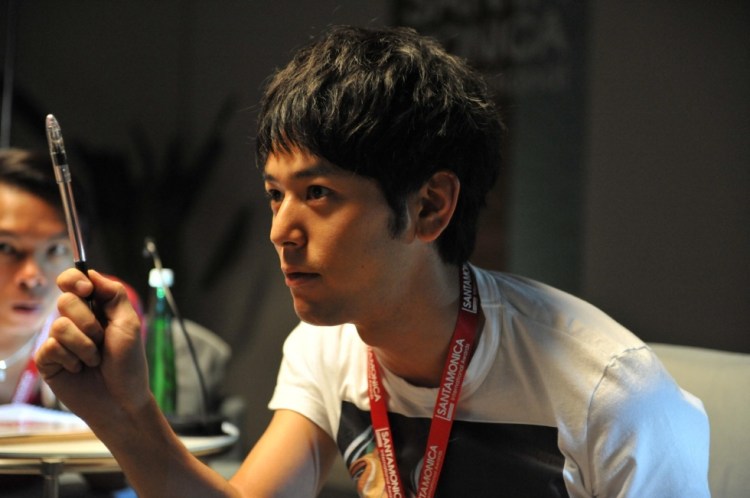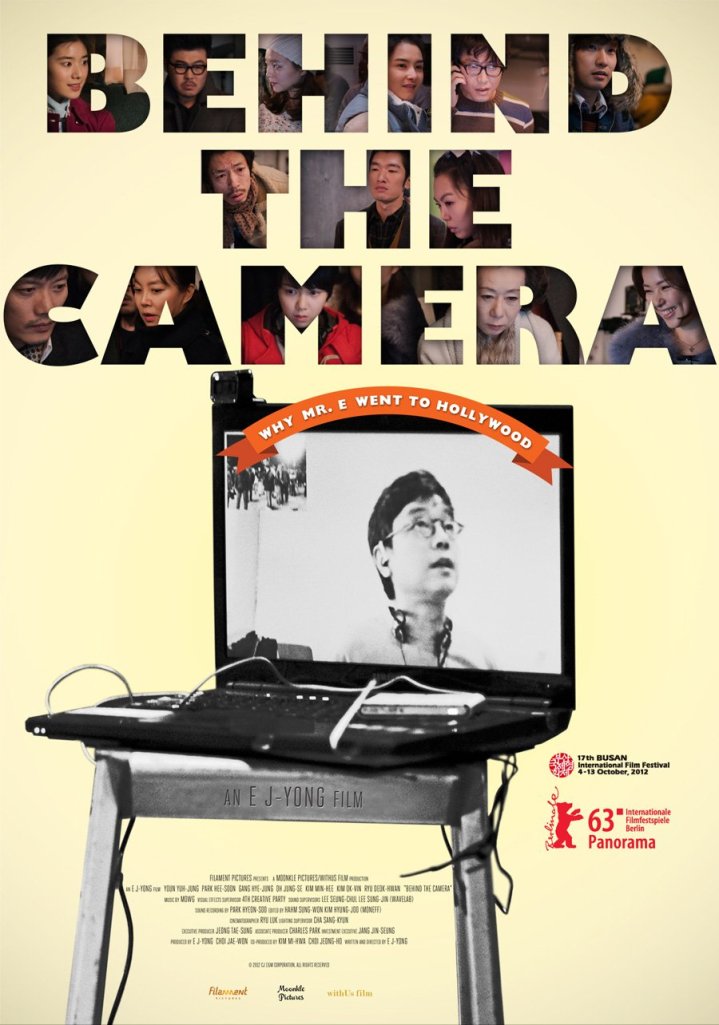
Behind the Camera (뒷담화: 감독이 미쳤어요, E J-yong, 2013)


fullsizephoto273825Review of Korean meta documentary style comedy up at UK-anime.net


When Korean director E J-yong was commissioned to make a short film as an advertisement for Samsung, he thought to himself what a wonderful idea it would be if he could test modern technology to its limits and direct the film remotely from a hotel room in LA. In particularly meta touch, the script he’s designed for the film also features a Korean director remotely directing a film the only difference being that the fake director is doing it because his overseas girlfriend is in town and he’s trying to avoid having to choose between love and money. Like E’s previous film, Actresses, which got some of Korea’s most talented actresses together for a fashion shoot where they proceeded to trash talk the industry and each other, Behind the Camera is fiercely funny behind the scenes style mockumentary where the lines between reality and fiction are anything but clear.

As the film begins, some of Korea’s best known talent has been assembled for a preliminary meeting regarding the short film they’re going to be making over the next two days – only there’s one very important person who doesn’t seem to have arrived yet. Coming as a surprise to some, the producer then stands up and makes an announcement that this film is going to be a little different, in fact the first of its kind, as the director will not be present on set at any point during the shoot but will be supervising from LA via Skype! Some members of cast take this better than others, especially as they lose wireless contact almost as soon E starts trying to explain the nature of the concept. Predictably, some don’t even believe he’s really in LA at all just engaging in a elaborate practical joke but others regard the whole thing as a farce and vaguely insulting to their status in the industry. As time moves on, the crew gradually start just ignoring E and doing their own thing and it’s clear one or two of them have their eyes on the director’s chair. Can you really direct a film from half way across the world and still realise your vision in the same way you would if you were really standing on the set? What’s more, is the idea of a director in itself anything more than vain conceit if all you do is say ‘yes’, ‘no’, and ‘cut’?

In the wrong hands, films with this sort of conceit can go horribly wrong. Often too clever by half, anything with a meta construct has a serious risk of ending up on the wrong side of pretentious but it’s clear that E J-yong’s intentions are a world away from any such self aggrandisement. Essentially a bolted on companion piece to his Samsung commercial (what a fantastic use of time!) what E has crafted is a warm and witty backstage look at the movie making business. Completely unafraid to poke fun at himself as the director with a high concept who may or may not be in Hollywood trying to make in America like his friends Park Chan-wook, Kim Ji-woon and Bong Joon-ho (now he’s made a film in Hollywood even if it wasn’t a Hollywood film), Behind the Camera takes what could be a fairly thin joke and unpacks it in such a witty fashion that it easily sustains itself over the course of a full length film.

Like Actresses, Behind the Camera assembles a whole host of Korean cinema talent with actors, actresses and industry personnel mostly playing themselves. Some of the funniest moments in the film occur when the cast and crew are just hanging out together and chatting generally about various things. Yun Yoe-jong had taken a brief break from filming Im Sang-soo’s A Taste of Money in order to take part in this mini-project as a favour to E who hasn’t even bothered to turn up! In fact she originally told him she was too busy but after he sent her a depressing photo of himself begging her to star in his film she gave in. If anyone has earned the right to a few salty and spiky retorts after such a long and illustrious career it’s certainly Yun Yeo-jong and witnessing her intense displeasure with the entire endeavour is one of the highlights of the film. There are also plenty of meta references to the Korean film industry and cinema history for those who are well versed enough to pick up on them.

At first glance, Behind the Camera might sound like one of those precious industry “mockmentaries”  that are never quite as funny as they think they are, but Behind the Camera is different precisely because it isn’t afraid to turn the camera around and expose what really goes on backstage. You genuinely can’t tell what is ‘real’ and what is ‘constructed’ but what is certainly true is that Behind the Camera’s warm and humorous outlook make it one of the funniest Korean comedies of recent times.
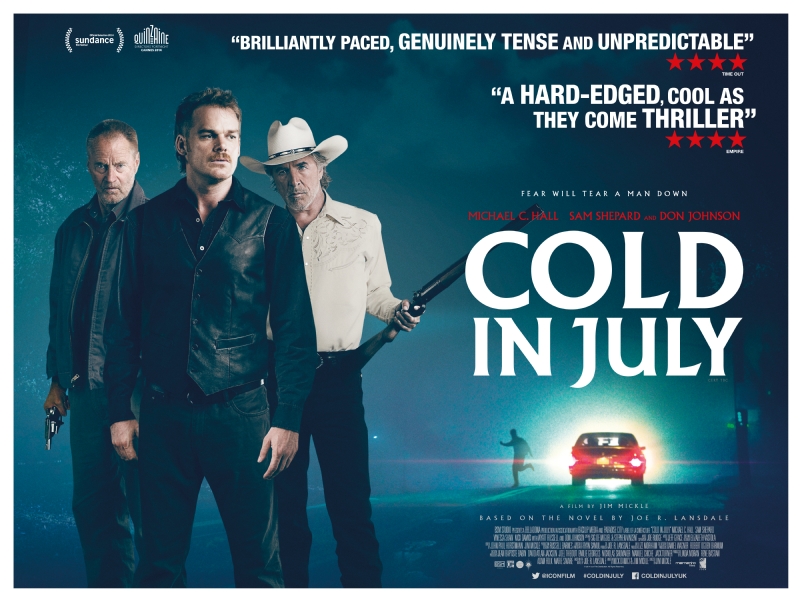
 

Cold in July

cold-in-july-quad-posterBased on Joe R Lansdale’s novel of the same name, Cold in July is an homage to classic ’80s neon tinged noir with a noticeable digression into Southern Gothic, revenge thrillers and B-movie heroics. Small town Texas picture framer Richard Dane (Michael C. Hall) is woken by his wife one night after she begins hearing strange noises from downstairs. Fearfully arming himself with his father’s old pistol hidden in a shoebox in his wardrobe, Richard tiptoes downstairs only to find a masked and hooded figure standing in his living room. In a halted moment Richard confronts the intruder with the gun and, hands shaking, uncertain what to do next locks eyes with the would-be burglar now held motionless as if in a tractor beam. As Richard holds his course, the mantlepiece clock begins to strike and whether accidentally or in panicked terror the gun goes off sending its explosive charge into the scenic landscape hanging on the wall by way of the burglar’s right-eye. The police arrive to find a traumatised Richard near catatonic in disbelief but oddly seem fairly congratulatory – “it must have been difficult, for a man like you” his Sheriff friend tells him, with heavy implications. Assured that it’s legally self defence and nothing further is likely to come of the matter Richard tries to return to his previous small town, family man life but the incident has left him jittery and with a noticeable ambivalence toward firearms. However, despite what the police may say it’s not quite over yet – the burglar had a father, and a psychotic one at that. An eye for an eye as they say, or a son for a for son – only, that’s not quite it either and before he knows it, Richard finds himself involved in a complex circle of crime and conspiracy.

Cold in July lines itself up with those late ’80s slightly sleazy, hyper violent crime thrillers in which one ordinary man must face off against some kind of larger danger which threatens the very foundations of his world. The period detail is exact with the book’s 1989 setting recreated faithfully down to every last detail from the bizarre red neck haircuts, giant portable telephones and floral furniture craze to VCRs and vintage 80s Apple Macs. The look has an appreciably 80s vibe with heavy grain despite having been filmed on digital RED cameras and the Carpenter-esque synth score give it the air of something that could have been made thirty years ago. Like all the best 80s small town crime stories there’s the melancholy and oppressive feeling of something not quite right, that there are no safe places and even in these cosy little towns there’s a great festering wound that’s rapidly turning rotten.

Like its ’80s settings, these are some old fashioned ‘heroes’ who display an unabashed adherence to ‘traditional’ ideas of masculinity. Richard is a mild mannered picture framer – work that requires skill and artistry rather than physical strength. After Richard shoots the man who threatened his home, the town’s reaction is less fear or sadness but almost joyful respect. “We didn’t think you had it in you” seems to be the general consensus from everyone from the local postman to the glowing write-up in the local paper. Before he was an emasculated husband and father, but now – having killed, he’s a man. Real men shoot first and don’t bother with questions at all. Despite Richard’s discomfort with his actions, with the reaction to his actions and even his own lingering feeling of inferiority he can’t escape the fact that something that he sees as weakness is being held up as heroism.

These old fashioned macho ideas are clearly something that continues to be passed from father to son – something that Richard begins to worry about when his own son playfully points a toy gun at him. The two older men – Don Johnson’s Jim-Bob the private-eye-cum-pig farmer and would be vengeful father Russell (Sam Shepard) are veterans of the Korean War and come from a generation steeped in conflict in which men are judged by their physical strength and survival techniques. Richard appears to have had some kind of strained relationship with his own (presumably deceased) father as though he keeps his gun in a shoebox at home, he seems pained every time the subject comes up. Russell hasn’t seen his own boy since he was a child and feels he’s failed as a father and perhaps as a man (in so far as a man is duty bound bring his son up right). What Richard learns from them is a lesson in old school masculinity – you carry the gun, you put things right. There’s an archetypal idea of chivalry there, that you stand up and protect your own and that the sins of the son are also visited on the father who must atone for failing to prevent such transgressive behaviour. There is something noble in it, but it is also dangerous – can a man who’s taken care of business, even in the name of his community, really return and live amongst other men?

Genre-busting as it is, the Cold in July mostly keeps itself together even as the action threatens to descend into the ridiculous. A thin stream of black humour helps to paint over its excesses as does its sheer joy in the larger than life elements such as the improbable Jim-Bob’s gaudy red cadillac, stetson hat and penchant for cool one-liners. There are undoubtedly a host of plot holes to the extent that it might be better to just avoid thinking about the sequence of events as a whole – the most obvious being a glaringly obvious loose end that everyone seems to have forgotten about. To be fair, no one leaves The Big Sleep shouting “yes, but who killed the chauffeur?”, a few potholes here and there don’t necessarily ruin the road and Cold in July is not a film about its plot. As an exercise in style, Cold in July excels but it also manages to pack in enough social commentary and primal melancholy to give its old fashioned morality tale some weight. Its politics maybe unpalatable and its outlook distinctly 1950s but Cold in July is among the best of recent retro exploitation B-movie throwbacks and walks its own path with considerable assuredness.

Wings of the Kirin 麒麟の翼

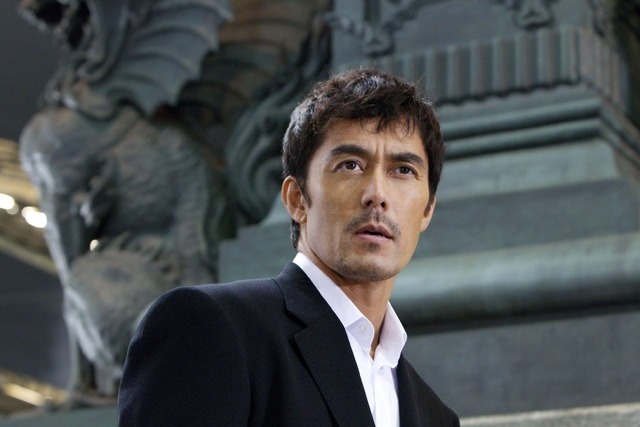
Wings_of_the_Kirin-002Based on the novel by Keigo Higashino (The Devotion of Suspect X), Wings of the Kirin is the latest big screen outing for Higashino’s famous detective Kaga. Previously played on TV by Hiroshi Abe who reprises his role as the much loved sleuth here, this latest instalment sees Kaga’s particular expertise put to use in the case of a salary man who appears to have staggered some distance from the subway tunnel where he was stabbed only to die right under the famous Kirin statue on Nihonbashi Bridge. Around the same time, a younger man calls his girlfriend to tell her he’s in ‘big trouble’ before being chased out into the road by police, whereupon he’s suddenly mown down by an oncoming truck. As this man had the salaryman’s briefcase the case seems open and shut – a mugging gone tragically wrong leading to the death of both perpetrator and victim. Kaga though feels differently and as always, the case is not quite as straightforward as the authorities would like to believe.

As with many of Higashino’s stories, the mystery itself is almost a macguffin as Higashino is more interested in investigating human behaviour and psychology with half an eye on traditional morality. Wings of the Kirin is no different in this respect as it has a heavy interest in the relationship between fathers and sons and the importance of taking personal responsibility for your own transgressions. However, that isn’t to downplay the mystery element as Higashino once again proves himself a master at wrong footing the audience. Many viewers may feel they have a pretty solid idea of who did it and why fairly early on the film only for it takes off in an entirely different direction in the final third. That said, although it is heavily pushing your intuition in one direction, there are perhaps an over abundance of subplots including illegal work practices and unfeeling employers, the difficulties faced by young people coming out of the foster system, complicated teenage friendships and misunderstandings brought about by people’s own sense of guilt. Consequently the film does run quite long as it manages to pack in just about as many wrong turns and red herrings as possible, however it largely earns its right to run as each of the characters and sub-plots manages to be compelling in its own right.

Though Wings of the Kirin is technically the big screen spin off of the Detective Kaga TV drama, no previous knowledge of Kaga and co is strictly necessary though familiarity with some of the peripheral characters may help. Hiroshi Abe excels once again as the slightly distant if all seeing detective who alone is capable to putting all the pieces together in the right order. Perhaps due to its TV roots, the film has a rather strange and quirky soundtrack which is frequently at odds with the serious nature of the drama yet it never quite tips over into being distracting enough to derail the film. Occasionally it does feel like more like a big budget TV special than a major feature but again perhaps that’s in keeping with the previous instalments in the series. Like all good mysteries, the solution involves a great deal of improbable coincidences yet watching Kaga shuffling them all into place to reveal the overall solution is quite masterful.

However, Higashino’s moralising does take over at times and there was at least one instance where it seemed Kaga had gone too far, or at least the actions of one character did seem reasonable. After all, if you can ‘save’ one person when there’s nothing to be done for another, is it really so wrong to try and help the people who are left behind? The actions in that case did seem altruistic, not born of any desire to ‘cover-up’ wrong doing but only to try and prevent more lives being ruined. Yes, Kaga’s assertion that you’ve effectively taught someone that it’s OK not to admit you’ve done wrong or that it’s OK to let others take the blame for your own mistakes is obviously true, but the consequences here are perhaps too extreme and dramatically neat to bear it out. Occasionally the film does feel preachy and its message is anything but subtle, however, thankfully it never manages to disrupt the pleasure of its finely constructed mystery. A little bit long and necessarily meandering, The Wings of the Kirin is another impressive crime thriller from the pen of Higashino that manages to entertain with a finely crafted central narrative but is also unexpectedly moving in its curiously small scale climax.

Library Wars (図書館戦争, Shinsuke Sato, 2013)

library-wars-2013-dojo-and-kasahara


Based on a series of light novels by Hiro Arikawa, Library Wars is another adaptation of a popular multimedia franchise from the director of the live action Gantz movies. Like Gantz, it’s another bug budget, tentpole style block buster with a subtle (though not insubstantial) desire to inject a bit of social commentary into what can be an entirely trivial genre. The manipulative forces at play here, however, are far less mysterious and unfortunately much more plausible than the mysterious black orbs of Gantz as they come in the form of crypto fascist censorship enthusiasts known as The Media Betterment Force. Having achieved the kind of success Mary Whitehouse could only dream of, The Media Betterment Force managed to pass the Media Betterment Act in the alternate Japan of 1989 which required all books containing ‘objectionable’ material to be destroyed. All is not lost though as the last bastion of intellectual freedom, the library, takes up arms and defends its right to disseminate whatsoever information anyone might desire with a government mandated assurance that library property can be safeguarded – with military force if necessary. Thirty years later in the near future of 2019, a young girl joins the LDF (Library Defence Force) full of idealistic zeal for protecting literature and a not so altruistic mission of finding the LDF officer who once saved her favourite book for her during in a MBF raid on a bookshop. Politics, romance, action! It’s all here for your edification and enjoyment.

If this all sounds a bit silly, well it is – but only in the best possible way. This is not a film about the evils of censorship, or how intellectual discourse and freedom of information are essential parts of any fully functioning society, though those themes are there if only in passing, so much as a big glossy blockbuster with just about every genre you can think of vying for the spotlight. The creeping totalitarianism is more backdrop than anything else but perhaps the absurdity of anyone picking up arms to defend access to information speaks to our unwillingness to prevent a gradual slide into a world of book burning and (not really) well meaning nannyism. First and foremost, Library Wars is science fiction action film modelled on the familiar boot camp genre following an underdog rookie recruit’s path to frontline glory. Yes we have training montages galore complete with the strained friendships and ‘you’re off the team!’ moments that appear in every film of this kind but the absurd premise and the film’s successful adoption of a warm comic tone help smooth over over any genre clichés and thankfully the film also manages to impress with several large scale battle scenes.

The romantic comedy element is arguably the least successful as it lacks the traditional climax many fans of the genre maybe hoping for (though one suspects a sequel may well put that right). That said the central relationship definitely falls into the ‘cute’ category and cleverly avoids the melodramatic nature of most blockbuster romances. Yes, the audience knows right away who the much sought after prince is but that only makes it more fun even if the post-idealistic bitterness of the man in question is another genre cliché. Supporting characters are also nicely fleshed out and each enjoys a decent amount of time in the spotlight creating a nice ensemble feel which is often rare in a blockbuster. As in Gantz the acting style remains fairly grounded rather the bigger, TV inflected performances which have been creeping into mainstream cinema and the strong performances from a fairly high profile cast help to lift Library Wars above some of its cinematic brethren.

Viewers expecting another Fahrenheit 451 or 1984 will obviously be disappointed in Library Wars’ fairly superficial examination of its themes but those hoping for a rip roaring, if slightly ridiculous, adventure are in line for a treat. Though the subject matter is itself absurd, such care has gone into the world building that it all makes a curious kind of sense assuming you’re willing to let yourself go with it. Most importantly, it’s remarkably self assured in terms of its tone – it knows exactly what it is and isn’t afraid to embrace its own nature. With much more heart than your average blockbuster, Library Wars is a warm and funny action comedy that also manages to be genuinely romantic. Now if they can only hurry up with Library Wars 2 so we can all enjoy the romantic resolution we’ve been waiting for!

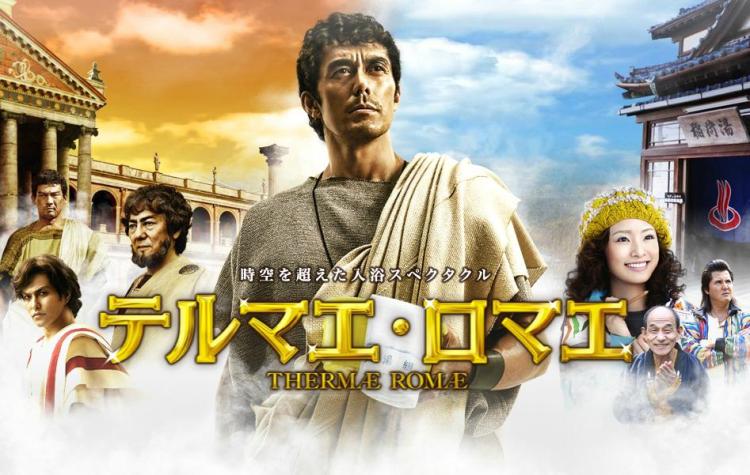
Thermae Romae

THERMAE ROMAE-T

Lucius ambulat in Tokyo? Review of improbable time travel comedy Thermae Romae up at UK-anime.net.


Pop quiz – what do modern day Japan and Ancient Rome have in common? Fish sauce? Emperor worship? Sandals? More than you thought, wasn’t it? Well, the correct answer is public bath houses and sure enough the people of modern day Tokyo still love going to the public bath even though they enjoy the luxury of being able to bathe at home! Of course, bath house culture with all its social and political uses and divisions was one of the things the Roman Empire took with it wherever it went. However, there must have been a time when some Romans began to feel their baths were getting a bit stale and in need of a new ‘modern’ twist, but what to do? What if they could leap forward in time and learn from the 21st century bath culture of modern Japan! Enter down on his luck architect Lucius who suddenly finds himself in a strange land full of strange looking people who seem to have taken bath technology to its very zenith.

Lucius Modestus (Hiroshi Abe) is a once successful bath architect with a case of serious designer’s block. Replaced on a prime project because he’s been unable to come up with any ideas he decides to go for a soak at the local bath house but whilst clearing his head underwater he finds himself sucked through a passage way only to reappear in a very strange looking place – it’s a bath house alright, but not as we know it! As they’re speaking a strange language he doesn’t understand, Lucius assumes the elderly men bathing here must be slaves and he’s been sucked into the “slaves only” part of the baths. Some of this stuff is kind of cool though – what are these funny spigot like things for, and these handy little buckets? Wait – they have baskets for their clothes?! We could do with some these in our bit! And so Lucius experiences the wonder of public bathing in Japan to the extent that it makes him cry with joy at which point he returns to Ancient Rome and begins to put some of these techniques to use in his designs. Travelling back and fore, Lucius always seems to run into the same Japanese girl who wants to make him the star of a manga and group of kindly old men. Can Lucius finally build the bath house of his dreams and stop a conspiracy against his beloved Emperor Hadrian at the same time?

Based on Mari Yamazaki’s manga of the same name (which also received an anime treatment from DLE), Thermae Romae sticks fairly closely to a fish out of water format for the the first half of the film as Lucius becomes by turns confused and then entranced by the various pieces of modern bathing technology he encounters on his travels. As a Roman encountering other people who are obviously not Roman, he of course adopts a superior attitude and assumes these people are either slaves or ought to be and so is extremely bewildered that their advancements seem to have eclipsed those of his own beloved Rome. These situations obviously provide a lot of room for humour as Lucius encounters various things that seem perfectly normal to us but strange and alien to him – his pure joy at discovering the wonder of the multifunctional Japanese toilet being particularly notable. It does though become fairly repetitive as Lucius finds himself in different situations which are essentially the same joke in different colours but then when the plot element begins to kick in later in the film it too fails to take off and feels a little too serious when taken with the wacky time travelling antics we began with.

Aided in his quest Lucius meets several amusing supporting characters including the group of elderly men from the baths who didn’t really need the help of an improbable ancient Roman to get themselves in trouble and Mami who functions as a kind of love interest who’s cast Lucius as the hero in her next manga. Mami begins learning about the Roman Empire and takes a course in Latin which helps a lot when she too finds herself in Ancient Rome and facilitates a kind of cross cultural exchange as she steals ideas from Rome for her manga as Lucius stole for the baths. However, the romantic comedy element never really comes together and even as Mami continues to pine over her noble Roman, Lucius remains aloof in the universal belief that all non-Romans are inferior. Though he does come to grudgingly acknowledge that the ‘flat faced people’ as he calls them have particular strengths such as their willingness to work as a team and put collective success ahead of personal gain, he never quite sheds his Roman arrogance.

It’s all very silly but undeniably quite funny if often absurd. We hear everyone in Rome speaking in Japanese and Lucius continues to think in Japanese wherever he actually is but obviously once he gets to Japan he can’t understand what anyone’s saying and attempts to communicate with them in Latin (whilst still giving his interior monologue in Japanese). Likewise, when Mami learns Latin she uses it to communicate with Lucius in Japan but once they get to Rome, all their ‘Latin’ is Japanese too which causes problems when the old men arrive because they’re speaking the same language as everyone else yet can’t understand anyone or be understood – which might be why they don’t get to say very much other than to Mami. It’s all quite strange and disorientating but kind of works as does the largely Puccini based score which screams 19th century Italy much more than Ancient Rome but helps to give the film the air of classical pomposity it’s aiming for. Big, ridiculous, silly fun – no one could accuse Thermae Romae of having any kind of serious message but it does provide genuinely entertaining silliness for the majority of its running time.


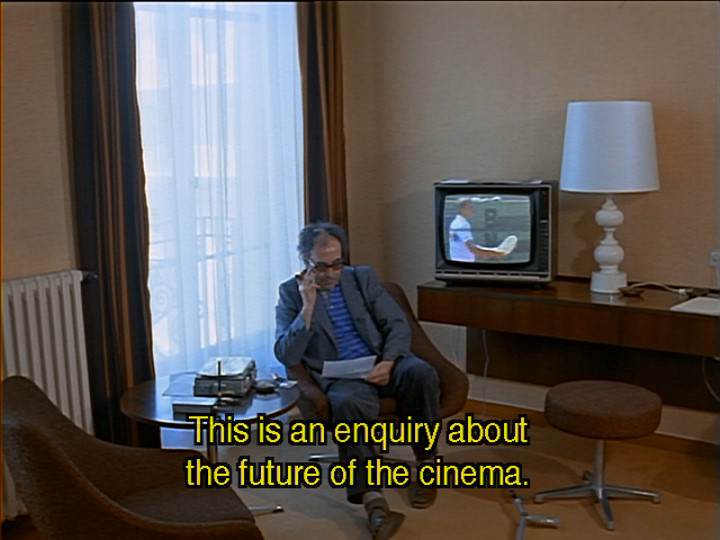
Room 666

a wim wenders collection v2 Room 666-4preston sturges

If you’re Wim Wenders and you’re bored at the 1982 Cannes Film Festival, you could amuse yourself by getting a bunch of your director friends to answer a series of pre-set questions about the future of cinema whilst sitting alone (aside from the ever present TV) in front of a static rolling camera in a fairly anonymous hotel room. Luckily, you have a lot of director friends making all sorts of films from all over the world who apparently won’t get that weirded out by sitting alone in an empty room pontificating about the death of cinema as an art form.

This is 1982, the year I was born (though I was born in the winter and Cannes is in the spring so I’m probably on my way somewhere but haven’t quite arrived yet), and this ‘future of cinema’ they’re envisioning is the present in which we now live. It’s depressing how many of the arguments the class of 1982 come up with are the exact same arguments we’re having now – that cinema as an art form has migrated to television and the cinematic output has been reduced to a vague amalgam of the the things Hollywood (in particular) wants it to be. More than one American director, when questioned about his own cinematic habits, admits he rarely watches films himself – he prefers television. In a telling and prophetic fashion, he videotapes films off the TV but then never bothers to watch them. Another recounts the story of friend who’s terrified of this ‘brave new world’ where you’ll be able to buy things through a video camera or, heaven forbid, order a meal from a computer screen! Some are more positive like Werner Herzog who believes the cinema has its own aesthetic which will save it or Antonioni who looks forward to a new age of HD video which is only now coming to pass.

However, aside from the futuristic visions of thirty years ago, it’s almost even more interesting to note how each director chooses to behave inside this strange “diary room”, left all alone except for the silently glaring camera. Jean-Luc Godard is first up – sitting directly facing the camera, smoking in a relaxed fashion and lamenting that his position isn’t the best for seeing the tennis on the TV just beside him. He gets the longest unbroken lecture in which he talks at length about various quite unrelated things until he gets bored and leaves in true Godard fashion – we wouldn’t have him any other way but it’s difficult to tell how seriously he’s taking this. Some directors sit nervously on the edge of the seat, thinking hard about their answers where as others bluster through as though they were at a Hollywood pool party a la Spielberg who laments the weak dollar and the rising cost of filmmaking which he fears will lead to a decline in artistry (which seems kind of ironic). Werner Herzog wins all the prizes for his entrance in which he makes a point of removing his shoes as ‘these aren’t the sort of questions that should be answered with your shoes on’ and being the only director to realise he can turn off the TV behind him! Antonioni gets up and roams around the room as if giving a lecture whereas Rainer Werner Fassbinder (in a late career appearance – he would sadly pass away of a drugs overdose only a few weeks later) gives his answer concisely and leaves almost straight away.

So there we have it, cinema apparently died sometime prior to 1982 and has been subsisting in some kind of bloated zombie state ever since. Art forms are always dying, books died a century ago and yet new ones keep being born which we take to our hearts and minds, nurturing them even though we keep being told there is no hope. The theatre is dead, pop music is dead, classical music and opera? fossilised, perhaps? The presence of the TV set in background is the most ironic use of a TV screen in any movie, just as the directors talk about the threat of television the viewer is constantly distracted by whatever happens to be playing (which includes some kind of Battle of the Planets type thing and Planet of the Apes!) and good old Werner is the only one who thinks to turn it off so we can focus all of our attention on what he has to say. Perhaps the most pressing segment is the one where the director isn’t even present as he’s the subject of an extradition order by the Turkish government but has been able to tape record his contribution prompting Director Wim Wenders to step in front of the camera to explain. This segment highlights how the cinematic art form is still held as a threat and that the true artistic spirit it can exhibit is often suppressed or oppressed by bodies governmental or otherwise. Sadly, this is a problem that has not gone away, nor is it likely to (and unfortunately applies to all art forms equally not just cinema which necessitates higher visibility). Where is the cinema in 2014 then, still trapped like Shrodinger’s cat inside an opaque box where we can’t be certain if it lives or dies? Maybe, it’s making noises every now and then though perhaps it doesn’t sound quite like it used to. The real question though is who wants to save it, and why? Are there people willing to stand up and fight for their art and what exactly is the ‘cinema’ that they want to save?

Watched on Mubi 12th June 2014 (its expiry date). Also available from Anchor Bay in the UK or legal streaming from The Paris Review (among other places).


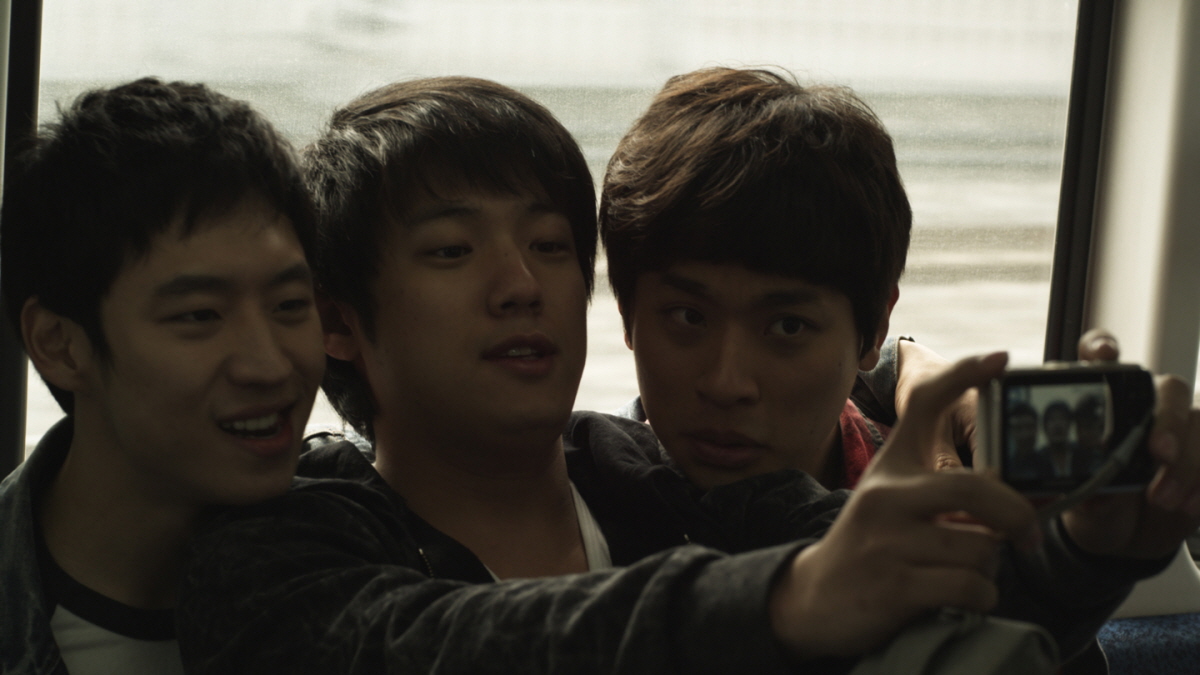
Pluto (명왕성, Shin Su-won, 2013)

GSEOiWzAs we’ve seen lately, there are certainly no shortage of films looking at the complicated and often harsh world of high school in Korea. Pluto (명왕성, Myungwangsung) takes a sideways look at the darker side of academic excellence when the praise and prestige of being one of the top students becomes almost like a drug and makes otherwise bright young people do things even a heroin addict in serious need of a fix might at least feel bad about afterwards with an all encompassing sense of entitlement that gives them a lifetime free pass for even the worst transgression.

June (David Lee) is a bright young boy from a regular high school who’s just transferred into an elite boarding school educating the country’s next great hopes. He may have been a top student at his old school, but here he’s merely average as the school hotshots are pretty quick to point out. Here, the top ten students are treated like princelings – a special computerised teaching room, no curfew, better rooms, better resources and they can more or less do what they like so long as they keep their grades up. Occasionally someone manages to bump one of the top ten from the list but they quickly get kicked out again. The top ten operate like some kind of swatters mafia – they all stick rigidly together, swapping hot tips for the upcoming exams that they refuse to share with the others and engaging in a series of increasingly cruel “pranks” they term rabbit hunts.

The film opens with the police finding the body of the previously number one student Yu-jin (Sung Joon) in a wood with June’s phone lying next him having been used to film the entire grisly affair. June is arrested for the murder but is released after his alibi checks out. Sick of all the struggle and unfairness, June puts his particular talents to use to try and teach the world a lesson about the sort of people this system is producing.

The picture Pluto paints of the Korean schools system is a frankly frightening one in which academic success is virtually bought and paid for or guaranteed by class credentials. Yes, the top students obviously must have ability – some of their activities may come close to cheating but interestingly nobody seems to want to try actual deception to get ahead. However, that natural ability has clearly been bolstered by their parents’ wealth. Attending an elite school and spending more than some people earn on private tutors geared towards knowing how to get into the best universities undoubtedly gives them advantages which are out of reach for others no matter how smart they may be. Perhaps that’s fair enough in a capitalist society, they didn’t ask to be born to rich parents and who would turn that sort of help down if offered it? However, though they may possess the virtues of discipline, hard work and a desire to succeed what they lack is any sort of empathy or even common human decency. Engaging in a series of manipulative hazing exercises, the elite group will stop at nothing to protect their status specialising in thuggery, blackmail, rape and even murder. The sort of people this system is advancing are not the sort of people you want running your schools and hospitals, they are morally bankrupt and only care about their own standing in the eyes of others.

Perhaps it’s fitting that this elite boarding school is housed inside a former compound of the Korean secret police, including a subterranean layer of prison-like tunnels once used as a torture chamber. Aside from the obvious school as torture analogies, much of them film seems to be about what people choose to ‘unsee’. The headmaster of the high school is aware of the ‘untoward’ behaviour of some of his pupils but refuses to do anything in case it upsets their well connected parents, damages the reputation of his school or has an adverse effect on those all important test results. The ‘Pluto’ of the title is referenced in June’s university application essay on the demotion of Pluto from the accepted list of planets. He argues that this is unfair and a fallacy as it’s illogical to measure anything by its proximity to the sun which is, after all, just another star which will eventually die like all the others. Just because it’s a little different looking, you shouldn’t necessarily categorise it as being in some way ‘inferior’ based on a set of fairly flimsy criteria. June, like Pluto, hovers in uncertain orbit on the periphery – always wanting in but perpetually locked out. Naturally gifted but from an ‘ordinary’ background where his single mother sells insurance for OK money, June can’t hope to compete with these elite kids even if his capabilities may be greater. A lot of decisions have already been made as to what people choose to see, have chosen to regard as an ideal, even if the reality is painfully obvious.

Though oddly funny in places for such a hard hitting film, Pluto is a difficult watch at times and paints a depressing picture of the high pressured nature of the Korean educational system and of human nature in general. The elite group are universally awful people who run the gamut from arrogant, entitled prigs to snivelling cowards which makes it difficult to feel any sort of sympathy and you start to long for bad things to happen to them which somewhat undermines the film’s premise. Perhaps the problem is just that they were awful people who were enabled by a system rather than people who started out good and were corrupted by it. Stylishly shot and supported by well grounded performances from its young cast, Pluto is a welcome addition to this perhaps overcrowded genre which brings more than a few new thought provoking ideas to the table.


Review of first Pluto published by UK Anime Network.