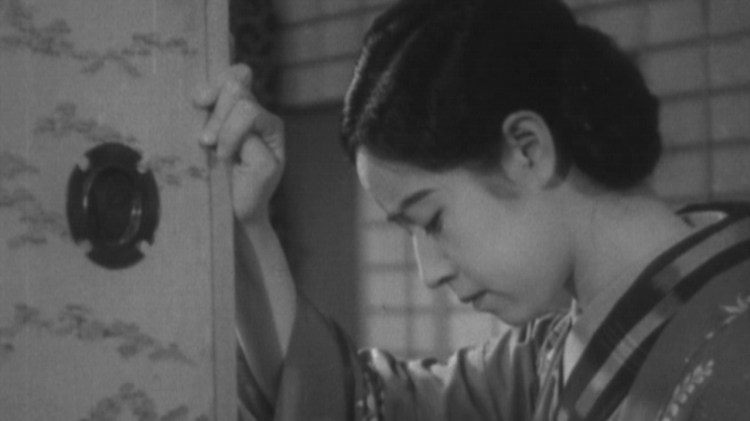
No Blood Relation (生さぬ仲, Mikio Naruse, 1932)

No blood relationNaruse apparently directed six other films in-between Flunky, Work Hard and No Blood Relation (生さぬ仲, Nasanunaka) but we’ll likely never see any of them again. Adapting a “Shinpa” play (a new kind of Western style melodrama focusing on the real lives of everyday people), Naruse addresses a theme which later becomes central to his cinematic output – the trials and tribulations of women in contemporary society. This time we have two fully grown women tussling over the affections of a little girl who herself seems to have little input into the situation.

After a brief introductory sequence in which we witness the accidentally humorous escapades of a pair of petty crooks, we meet the sister of one of them who happens to be returning ex-pat and successful Hollywood actress, Tamae. It turns out that Tamae has come back to Japan after making her fortune in the movies hoping to reunite with the daughter she left behind six years ago.

However, her ex-husband, Atsumi, has remarried and the daughter, Shigeko, believes the second wife, Masako, is her real mother. Although the family are very happy together there is tension in the air as Atsumi’s company is running into trouble in this period of economic instability and he’s about to reveal he’s gone bankrupt. Atsumi’s mother does not take this well as she’s used to the upper middle class lifestyle and throws something of a hissy fit at being shamed in this way. Masako, by contrast, remains stoic and says she can bear the worst of what comes only she doesn’t want Atsumi to do anything illegal to try and solve their money problems and she doesn’t want to see Shigeko suffer. Her maternal feelings are further borne out when she is injured diving in front of an oncoming car which threatens to hit her daughter as she stops to pick up her doll in the middle of the road.

The problems continue pile up and Tamae uses her money as a lever to try and prise Shigeko away from her step-mother via the greedy grandma but the little girl was an infant when her birth mother left so she simply doesn’t remember Tamae and repeatedly asks to be allowed to go home to her “mother”. It’s understandable how much this would hurt Tamae who claims she’s only returned to Japan because she’s been unable to forget her daughter, yet her daughter never even knew her. If she was expecting some kind of cosmic connection it does not occur and if she truly wanted to rebuild a relationship with her child, what amounts to a virtual kidnapping was probably not the best way to go about it.

At heart it’s a tug of love between two women – the one who gave birth to a child and then abandoned it (perhaps harsh words, but no concrete reason other than a man and America are ever revealed), and the one who later raised it and came to love it as her own though shares no blood connection. Masako is the faithful Japanese wife, devoted to her family and just a very good, decent person which contrasts nicely with the ferocity of her rival – a modern woman, adulteress and movie star who thinks her money can enable her to take back what she previously gave up. For all that, it’s difficult to not to feel sorry for Tamae as her daughter continues to reject her. Even if the way she’s going about things is not sensible, her maternal emotions and the passion, desperation and even in part grief and regret are all too real.

Of course, what gets forgotten here is the plight of little Shigeko who never had any reason to believe Masako, who obviously loves her dearly, was not her real mother. Extremely confused and probably frightened, she just doesn’t understand why she’s being separated from her mum and being forced to hang out with this strange woman. Masako can’t get to see Shigeko after grandma has removed her from the house, but no one else stops to think about what sort of effect this is all having on a confused little girl who just wants to go home.

The depression is more of a backdrop here and even if Atsumi ultimately ends up feeling the brunt of it, money troubles are only a small part of the question at hand. Naruse doesn’t experiment as much as in Flunky, Work Hard but throws in a few impressive tracking sequences across open rooms and adds some rapid zooms as the two women have silent arguments over their relationships to Shigeko. Without giving too much away, the ending undercuts the degree of nuance Naruse had been trying add in ensuring that both women were drawn in a suitably complex manner, provoking sympathy and understanding for everyone caught up in this complicated situation (well, except perhaps for the bumbling crooks who are a little surplus to requirements).

The finale itself almost feels tacked on from an entirely different film with its sudden cheerfulness and abrupt closure as the original family is repaired thanks to a sudden monetary atonement and subsequent self-exile from the originally corrupting influence of the first wife. In many ways a standard melodrama of the time, No Blood Relation perhaps doesn’t have much more to recommend it than as an early example of Naruse’s development but does offer strong performances from its leading ladies and an interesting take on an age old question.


No Blood Relation is the second of five films included in Criterion’s Eclipse Series 26: Silent Naruse box set.
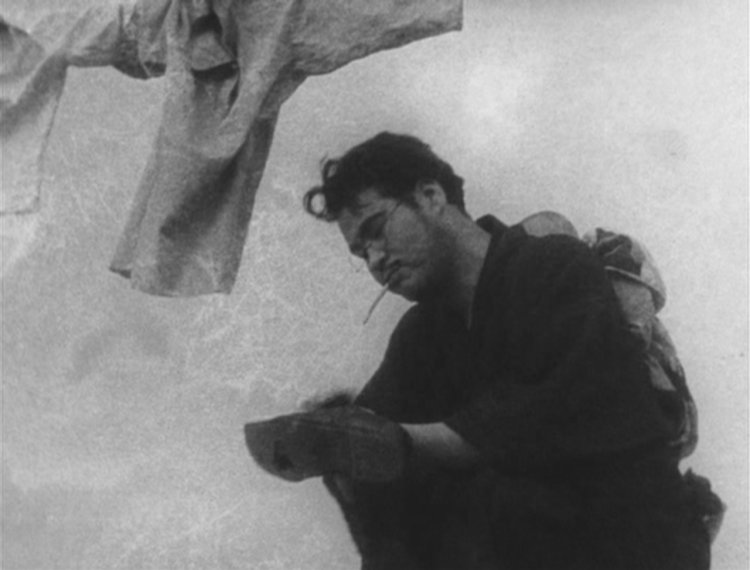
Flunky, Work Hard (腰弁頑張れ, Mikio Naruse, 1931)

flunky work hardMikio Naruse is often remembered for his female focussed stories of ordinary women trying to do they best they can in often difficult circumstances, but the earliest extant example of his work (actually his ninth film), Flunky, Work Hard (腰弁頑張れ, Koshiben Ganbare), is the sometimes comic but ultimately poignant tale of a lowly insurance salesman struggling to get ahead in depression era Japan.
Okabe is the lowly insurance agent of the title. He works hard for his money, but there are slim pickings round here to begin with and a lot of competition from rival agents so Okabe struggles to provide for his wife and his little boy, Susumu, in the way that he would like. Okabe subjects himself any sort of humiliating behaviour on offer to try and get a contract including engaging in leap frog with a well to do lady’s children to try and seem more “friendly” than his rival broker.

Susumu, by contrast is a rebellious little boy and is aways getting into scraps with the neighbourhood kids who tease him because of his parents’ money problems. This wouldn’t usually be too much of a problem and Okabe even tells him it’s OK to defend himself when the other kids start in on him. Only this time Susumu has been fighting with the well to do lady’s sons which is going to make Okabe look bad and make it more difficult to convince her to take out a policy with his firm over another.

Okabe loses his temper and scolds the boy who runs off in anger and confusion only to get into a serious accident. His father, not knowing it’s his son that’s been injured, uses the news of a little boy getting hurt to try and convince the other mothers to take out insurance policies on their children. Later he feels bad about shouting at Susumu and decides to buy him a present, only he might already be too late…

Flunky, Work Hard starts out like the nonsense comedies Shochiku were known for at the time with a little of their common man approach thrown in, but quickly heads into melodrama territory as Susumu meets with his unfortunate destiny. This sequence is the most notable in the film as it’s far more experimental in nature than anything found in Naruse’s later work. Dipping into a montage of kaleidoscopic images, diagonal splits and the awful momentum of a train hurtling along a predetermined track only to meet with a horrifying, unexpected obstacle, this extremely complex sequence is the perfect cinematic expression of the blood draining from a father’s face as he contemplates the fact that he might have just lost his son through having lost his temper over something as trivial as a few shiny coins. Okabe is not a bad man, or even a bad father, but just another ordinary guy trying to make it through the depression. Even so, he may be about to pay a terrible price for failing to side with his son in favour of businesses prospects.

Like many silent films from this era, almost all of Naruse’s early work appears to be lost. Flunky, Work Hard is somewhat atypical when considered alongside his later career which had a strong female focus and leant more towards social commentary than the slapstick humour seen here. However, its tale of a father desperately trying to find a way to support his son in difficult economic circumstances only to find that his efforts may cost him the very thing that he was trying to protect all along is one which is instantly recognisable in any era.


Flunky, Work Hard is the first and earliest of the five films included in Criterion’s Eclipse Series 26: Silent Naruse box set.

The Masseurs and a Woman (按摩と女, Hiroshi Shimizu, 1938)

vlcsnap-2016-05-19-23h22m51s149Hiroshi Shimizu takes another relaxing sojourn in 1938’s The Masseurs and a Woman (按摩と女, Anma to Onna), this time in a small mountain resort populated by runaways and bullish student hikers. Once again Shimizu follows an atypical narrative structure which begins with the two blind masseurs of the title and the elegant lady from Tokyo but quickly broadens out to investigate the transient hotel environment with even a little crime based intrigue added to the mix.

We arrive at the resort town at the same time as the masseurs themselves who’ve walked all the way passing the time playing games with each other over who can guess how many children are in a group travelling the same way or counting how many people they manage to overtake on the road. Comically, their efforts to pass a group of students actually frighten them a little bit so they take off at speed meaning Fuku and Toku miss their daily target.

As well as the group of male students and another group of female ones, the town is also host to a mysterious and beautiful woman from Tokyo who seems both a little sad and a little scared with a tendency to overreact to small sounds and unusual situations. The other main group is a little boy and his uncle with whom he seems to have something of a troubled relationship.

Toku becomes fascinated with Michiho, the mysterious woman from Tokyo, whom he recognises because of her distinctive perfume. Though he is blind, he “watches” her – sensing where she goes and reading her emotional state. He seems to realise there’s very little possibility that she will return his interest, though he allows her to play on the obvious feelings he has for her, and the pair strike up a melancholic friendship. However, Michiho is only interested in making a play for the good looking uncle of the little boy who she has also befriended but the boy eventually goes cold on her, feeling a little rejected because she spends so long talking to his uncle. The two neglected guys, Toku and the boy, form their own kind of friendship as the blind masseur is the only person who is willing to have some fun with him in this slightly less than child friendly resort in which he’s unspeakably bored.

This being a holiday town, it’s a place that only exists for a small amount of time before sinking back into the mists like Brigadoon when the season ends. All things are transient here and everyone is just passing through. The friends you make are just for now and this brief respite from everyday life will fade from the memory like a pleasant dream. Toku ought to know this as he spends his life in such places, providing additional relief for the weary traveller, yet he still has a yearning to connect which is only exacerbated by the feeling that his blindness cuts him off from everyday society.

When a spate of bath house thefts occur and it turns out Michiho has been seen at each of the crime scenes, Toku comes to the obvious conclusion even though his feelings make him reluctant to suspect her. He tries to help Michiho evade punishment for what he believes are her crimes only to find out a very different sort of truth that sees her eventually decide to continue her journey onward to an uncertain future (though at least one that is 100% of her own devising).

Again, Shimizu opts for a lot of location shooting emphasising the beauty of the scenery and the tranquility of the atmosphere. Mostly he sticks to static camera shots, aside from one lengthly tracking sequence and the hand held finale walking after a departing cart, but when he tries to show us the vision of a blind man it’s a striking moment – a whirling chaos where we too can almost smell the elusive perfume of a woman we know is “beautiful”  though we cannot see her, and also know is deliberately toying with us. A melancholy look at the transience of human relationships and the impossibility of true connection, The Masseurs and a Woman is a genre melding tragicomedy filled with innovative directorial flourishes that are once again far in advance of their time.


The Masseurs and a Woman is the third of four films in Criterion’s Eclipse Series 15: Travels with Hiroshi Shimizu box set.

This is the only video clip I can find but it’s not subtitled and it has quite a long speech about Hiroshi Shimizu’s career at the beginning so skip to 2:17 for the film itself:

Mr. Thank You (有りがとうさん, Hiroshi Shimizu, 1936)

Mr. Thank YouBus trips might be much less painful if only the drivers were all as kind as Mr. Thank You and the passengers as generous of spirit as the put upon rural folk travelling to the big city in Hiroshi Shimizu’s 1936 road trip (有りがとうさん, Arigatou-san). Set in depression era Japan and inspired by a story by Yasunari Kawabata, Mr. Thank You has its share of sorrows but like its cast of down to earth country folk, smiles broadly even through the bleakest of circumstances.

Mr. Thank You is everyone’s favourite bus driver. In fact, some of his passengers have even deliberately decided to “miss” the previous bus because they heard he was driving the next one. It’s not hard to see why, he’s a good a driver and a very polite, nice young man who’s been given the affectionate “Mr. Thank You” nickname because of his habit of shouting a loud thank you to everyone who moves out of the way for his bus to pass in the narrow mountain roads (the aforementioned pedestrians are also to be seen waving wildly and shouting his nickname back at him as he grins at them in the rear view mirror). He’s also prepared to stop and pick up passengers along the way as well as carrying messages between villages and filling requests for the latest records to hit Tokyo stores.

Mr. Thank You was apparently shot without a firm shooting script other than the inspiration of Kawabata’s story so the dialogue has a very immediate, contemporary feeling. There isn’t so much of a story as a journey taken with this disparate group of people all travelling from one place to another for various different reasons with the small interjections of other passersby on the roadside. The main drama occurs between a woman and her daughter who have such ashen faces they might as well be ascending the gallows, a very modern whiskey swilling travelling woman, and a grumpy guy with a handlebar moustache who seems very anxious about the bus being delayed by all these pleasantries. Along the way, Mr. Thank You offers commentary on some of the people he knows from his regular trips which amounts to a collection of sad stories decrying the state of the nation in which fathers are selling their daughters and mad men wander the streets searching for lost love.

“Young women used to laugh, but you never hear that now.” Says one passenger glancing at the sad face of a girl on a bus to the city. The mother and daughter seem reluctant to talk about their journey but it’s obvious to all that the girl is to be sold to a geisha house, never to see her home again. Mr. Thank You is sympathetic to her plight whilst silently listening to the lamentations of his customers like a sober barman. At one point he wonders out loud if he might be better off driving a hearse – acknowledging his own complicity in taking money for escorting this poor girl off to a life of rack and ruin. The flirtatious modern woman sitting behind him (most likely a prostitute herself) reminds him that women who pass these mountains rarely make a return journey, perhaps there is another way he could help her even if he can’t do the same for everyone.

Shimizu also stops a minute to consider the human costs of all this rapid progress. Taking a brief break from driving, Mr. Thank You chats to an acquaintance who has been working on the road building programme. A Korean migrant, she is among the most put upon of workers. She hoped she might have enough money to ride on Mr. Thank You’s bus just the once, but no sooner has one road been completed than she’s despatched off to build another one on another mountain so she’ll have to bid him goodbye. Mr. Thank You (seemingly quite taken with her and sorry to hear they may not meet again) offers to let her ride for free but she looks back at the masses of other people who are walking the mountain passes because they can’t afford the bus either and says it’s OK, she will stay with them, walking onward with everyone else caught in the same predicament as herself.

Filmed in 1936 Mr. Thank You has an extremely modern sensibility with a lot of naturalistic location shooting outside of the cramped environment of the bus which forms the main setting for the drama. The bus drives onward without stopping as obstacles fade from view only to reappear in the rear view mirror like ghosts, phantom images reflected on the landscape here one minute and gone the next. Time and history are marching on though one gets the impression Shimizu at least does not approve of the way his country is heading. The passengers on Mr. Thank You’s bus all have their troubles, but they’re trying to do the best they can by putting a brave face on it. They laugh, they drink, they sing but eventually they will all have to get off the bus, away from the careful protection of Mr. Thank You, and return to land of badgers and foxes where it’s every man for himself and those who cannot pay the fare will have to walk the rest of the way on their own two feet alone.


Mr. Thank You is the second of four films in Criterion’s Eclipse Series 15: Travels with Hiroshi Shimizu box set.

Scene featuring the Korean migrant worker (with English subtitles)

Japanese Girls at the Harbor (港の日本娘, Hiroshi Shimizu, 1933)

japanese girls at the harbourHiroshi Shimizu made over 160 films during his relatively short career but though many of them are hugely influential critically acclaimed movies, his name has never quite reached the levels of international renown acheived by his contemporaries Ozu, Naruse, or Mizoguchi. Early silent effort Japanese Girls at the Harbor (港の日本娘, Minato no Nihon Musume) displays his trademark interest in the lives of everyday people but also demonstrates a directing style and international interest that were each way ahead of their time.

A classic melodrama at heart, Japanese Girls at the Harbor begins with two school girls living their humdrum lives of commuting back and for to school in early 1930s Yokohama. Dora and Sunako attend a Catholic school in the “foreign quarter” of the city and are devoted best friends who swear they’ll stick together for ever. However, motorcycle riding bad boy Henry rips right through their friendship in the way that only a bad boy can. Sunako abandons Dora at the harbour to ride off with Henry (later apologising to her understanding friend) but it turns out that Henry likes hanging round with gangsters and also has something going with an older lady called Yoko.

Dora tells Sunako if she really loves Henry she’ll just have to accept him for what he is before going off to find the cheating louse herself and give him a piece of her mind. However, when Sunako catches Henry and Yoko together she loses the plot entirely and ends up running off out of the city. Time passes and Sunako returns but in shame as she’s become a prostitute living with a painter whom she doesn’t seem to care for very much at all. Can she repair the damage with the now married Dora and Henry and get herself out of the hell her existence has become, or is she forever doomed to the life of a fallen woman?

Made in 1933 just as Japan was heading into its militarist era, Japanese Girls at the Harbour has an oddly international mindset with its Western houses, names and a Christianising atmosphere. An international port, there’s plenty of the outside world to be found in Yokohama where things seem to leave much more often then they arrive. Sunako says watching the boats leave makes her feel sad, but it’s she who will go off on one of Shimizu’s trademark travels, running from a crime of passion and the ache of a breaking heart.

A true friend, Dora has not abandoned Sunako and is willing to welcome her back into her home. Henry, the first to meet Sunako (at her place of employ) is torn between the old attraction, feelings of guilt over what’s happened to her, and his responsibility to Dora as her husband. Shimizu introduces an interesting metaphorical device as Henry and Dora wind a ball of wool whilst sitting together in their Western style house but as soon as Sunako arrives it falls onto the floor and begins to unravel, eventually becoming tangled up around the feet of Henry and Sunako who dance in the living room while Dora prepares a meal. Suddenly seeing her married life unravel just like this shaggy ball of wool, Dora, though still devoted to her friend, begins to feel a little afraid that Sunako may be about to jump back on the bike with Henry, just as she did all those years ago.

Shimizu’s interest is much more with the two young women than it is with Henry who remains very much a prize not worth winning. This is Sunako’s fallen woman story – eventually she comes to feel that she’s bringing too much disruption into the lives of her old friends who were getting on so well before. Henry and Dora were her last lifeline to her old self, the only old friends she could still count on, but if she wants to save them (and herself) she will have to stay away and lose them forever. Her redemption lies in self sacrifice, in giving up something that made her profoundly happy for its own good despite the immense amount of suffering she will incur in doing so.

Shimizu was one of the earliest proponents of location shooting and he does make good use of the atmospheric Yokohama streets before heading indoors for the seedy, smoky clubs and cheap tenement housing. He also introduces a series of strange jump zooms at two moments of unusually high emotion which add a degree of panic to the scene as well as heightening the nuanced reactions of the characters in question. This, coupled with his use of dissolves which often sees characters simply evaporate from the frame like unwelcome ghosts of memory, lends to the almost noir-ish, melancholic tone with its dream-like blurring of the real and the merely recalled.

An interesting example of international cross pollination in the early 1930s before hard line militarism became entrenched, Japanese Girls at the Harbor is a pregnantly titled story of a wronged woman abandoned on the shore and left with the choice to board a boat to fairer climes or remain behind and risk destroying what she most loved. The past becomes something to be absorbed and then put to rest. Ghosts cannot travel by water, and so you must leave them behind, like girls at the harbour staring sadly at departing ships.


Japanese Girls at the Harbor is the first of four films in Criterion’s Eclipse Series 15: Travels with Hiroshi Shimizu box set.

Video clip of a climactic scene which showcases Shimuzu’s jump zoom technique (presented without musical score but does have subtitles for the really quite amazing intertitles which are a definite highlight of the film).

(Video clip courtesy of Mubi)