 Isn’t it sad that it’s always the kids that end up hurt when parents fight? Throughout Shimizu’s long career of child centric cinema, the one recurring motif is in the sheer pain of a child who suddenly finds the other kids won’t play with him anymore even though he doesn’t think he’s done anything wrong. Four Seasons of Children (子どもの四季, Kodomo no Shiki) is actually a kind of companion piece to Children in the Wind which also makes use of this motif, as they’re both based on works by the same author, Joji Tsubota, and feature the same cast playing characters with the same names. Four Seasons differs slightly in its form as it originally played as two films released at the same time with the piece split into four sections following the two central brothers across the course of a particularly traumatic year.
Beginning in spring, younger brother Sampei (Bakudan Kozo now known as Jun Yokoyama) is excitedly waiting for the arrival of an old man (Takeshi Sakamoto) who brings masks for the children and rides a fine horse. Unfortunately, Sampei takes a tumble and arrives last when only a noh style mask of a lady’s face remains which really doesn’t appeal to him (later he asks his older brother Zenta (Masao Hayama) to draw a moustache on it to make it look ”stronger”), so the old man offers to give him a ride on his horse to make up for it. Sampei and Zenta don’t think they have any grandparents, but Sampei thinks it would be nice if the old man were his grandpa for real.
After he does a typical Sampei thing and falls off a cow, Sampei’s mother (Mitsuko Yoshikawa) arrives and realises that, yes, mask man really is her estranged father who disowned her after she got married without his consent. Happy that perhaps her parents have finally forgiven her, Sampei’s mother is also a little bit worried as they’ve never explained to the children why they weren’t in contact with her parents and she’s afraid it might upset them. There’s also another problem. The boys’ father (Reikichi Kawamura) is currently very ill, and their dairy farm isn’t doing well either. The family have large debts secretly taken out with the father-in-law’s company behind his back, so all of this could quite easily backfire. More drama erupts when an ambitious underling, Rokai (Seiji Nishimura), realises there’s a possibility the old man will take his daughter’s family as his direct heirs rather than promote from within the company and starts on a series of fiendishly machiavellian plans to oust his rival.
The boys, however, know very little of this. They love their cows and life on the ranch, and the thing they’re most sad about is when they end up having to move in with grandpa for a while to avoid some of Rokai’s scheming. Having been very popular in their old town, the boys are slower to make friends and quickly run into a problem with the son of the man who’s causing their family so much bother. A typically melancholy episode sees little Sampei wandering off on his own to make friends with the carp in the local lake because there’s no one else for him to talk to. However, the boys later bond with their would be arch nemesis, Kintaro (Teruo Furuya), in defiance of the ongoing feud between their families, even going so far as to carry him on their back all the way home after he breaks his leg falling out of a tree when his father stupidly “repossesses” the backyard where the kids have been playing together safely.
Gradually, as time wears on, the allegiance of Kintaro and his mother starts shift away from Rokai and towards the boys and their family who have never been anything other than kind to them. In a nice piece of symmetry, it seems the two women were also close childhood friends who have been kept apart thanks to the ongoing pettiness instigated by the menfolk. The grandfather, having fully patched things up with his daughter, is doing his best to remain on the side of decency despite Rokai’s underhanded tactics but finds himself increasingly cornered by his finagling. The boys’ commitment to their friend and refusal to give in to Rokai’s attempts to use the children to perpetuate his feuding only serve to remind everyone how petty and self serving Rokai’s actions really are.
Rokai is several times described as “a real villain” by the disbelieving grandpa, constantly exasperated by the dishonourable conduct of someone he’d employed on his staff for several years. Yet aside from Rokai himself, it’s greed and pettiness that are the true villains of of the piece. The boys’ father gives them some very important advice for their future lives when he tells them not to strive to have more things than other people but to be generous in its place. Rokai, afraid and resentful, eventually gets his comeuppance, ending a long year of torment for the Ono family and restoring justice to an unjust world.
The boys themselves know little of the details of the feuds between their families, worrying about normal things like whether they’ll be able to go on to middle school and wondering how the cows are doing back at their old ranch. It’s these details at which Shimizu excels as usual, perfectly capturing the reality of childhood even whilst giving more space to adult concerns than he often did in many of his other, more purely child centred films. Once again making great use of location shooting, Shimizu captures the fast disappearing rural paradise the boys inhabit which is entirely divorced from the political tension of the day. Another warm and humorous tale of kids and the way they often become the accidental victims of a grown up dispute, Four Seasons of Children perfectly unifies all of Shimizu’s ongoing themes right up to its necessarily just, compassionate, ending.
 It would be a mistake to say that Hiroshi Shimizu made “children’s films” in that his work is not particularly intended for younger audiences though it often takes their point of view. This is certainly true of one of his most well known pieces, Children in the Wind (風の中の子供, Kaze no Naka no Kodomo), which is told entirely from the perspective of the two young boys who suddenly find themselves thrown into an entirely different world when their father is framed for embezzlement and arrested. Encompassing Shimizu’s constant themes of injustice, compassion and resilience, Children in the Wind is one of his kindest films, if perhaps one of his lightest.
 It’s tough being young. The Boss’ Son At College (大学の若旦那, Daigaku no Wakadanna) is the first, and only surviving, film in a series which followed the adventures of the well to do son of a soy sauce manufacturer set in the contemporary era. Somewhat autobiographical, Shimizu’s film centres around the titular boss’ son as he struggles with conflicting influences – those of his father and the traditional past and those of his forward looking, hedonistic youth.
 Japan in 1937 – film is propaganda, yet Hiroshi Shimizu once again does what he needs to do in managing to pay mere lip service to his studio’s aims. Star Athlete (花形選手, Hanagata senshu) is, ostensibly, a college comedy in which a group of university students debate the merits of physical vs cerebral strength and the place of the individual within the group yet it resolutely refuses to give in to the prevailing narrative of the day that those who cannot or will not conform must be left behind.
 Perhaps best known for his work with children, Hiroshi Shimizu changes tack for his 1937 adaptation of the oft filmed Ozaki Koyo short story The Golden Demon (金色夜叉, Konjiki Yasha) which is notable for featuring none at all – of the literal kind at least. A story of love and money, The Golden Demon has many questions to ask not least among them who is the most selfish when it comes to a frustrated romance.
 Sad stories of single mothers forced to work in the world of low entertainment are not exactly rare in pre-war Japanese cinema yet Hiroshi Shimizu’s 1937 entry, Forget Love For Now (Koi mo Wasurete) , puts his on own characteristic spin on things by looking at the situation through the eyes of the young son, Haru (Jun Yokoyama). Frustrated by both social and economic woes, little Haru’s life is blighted by loneliness and resentment culminating in tragedy for all.
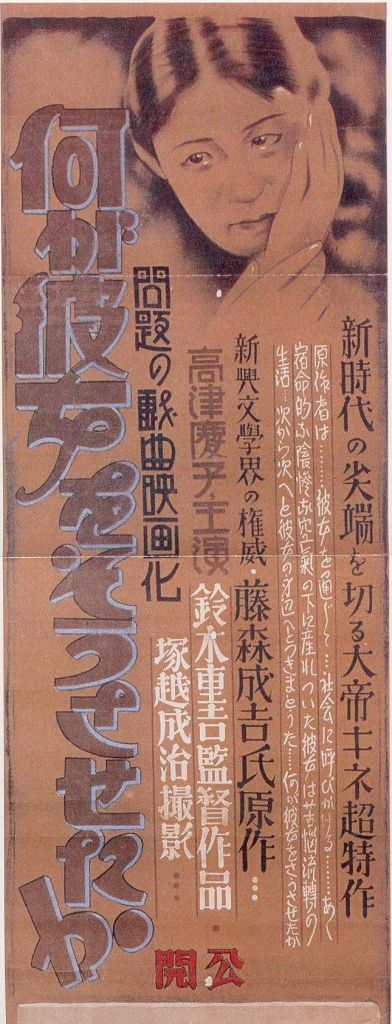 Like many other areas of the world in the first half of the 20th century, Japan also found itself at a dividing line of political thought with militarism on the rise from the late 1920s. Despite the onward march of right-wing ideology, the left was not necessarily silent. Ironically, the then voiceless cinema was able to speak for those who were its greatest consumers as an accidental genre was born detailing the everyday hardships faced by those at the bottom end of the ladder. These “proletarian films” or “tendency films” (keiko eiga) were increasingly suppressed as time went on yet, in contrast to the more politically overt cinema of the independent Proletarian Film League of Japan, continued to be produced by mainstream studios. Long thought lost, Shigeyoshi Suzuki’s What Made Her Do It? (何が彼女をそうさせたか, Nani ga Kanojo wo Sousaseta ka) was a major hit on its original release with some press reports even claiming the film provoked riots when audiences were passionately moved by the heroine’s tragic descent into madness and arson after suffering countless cruelties in an unfeeling world.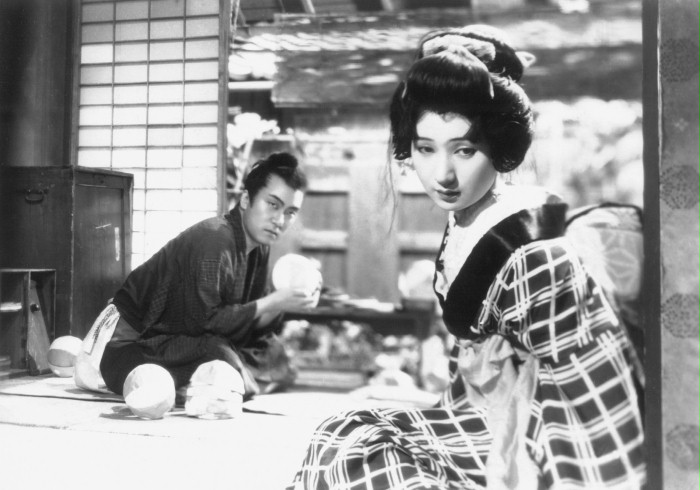
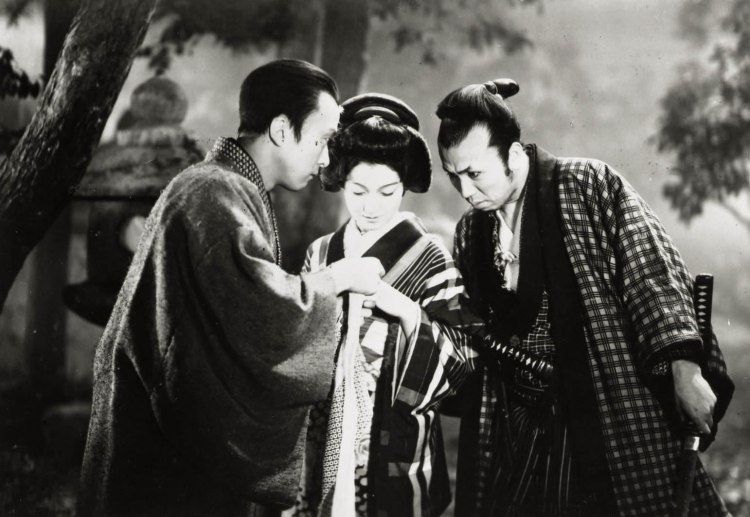 The second of the only three extant films directed by Sadao Yamanaka in his intense yet brief career, Kochiyama Soshun (河内山宗俊, oddly retitled “Preist of Darkness” in its English language release) is not as obviously comic or as desperately bleak as the other two but falls somewhere in between with its meandering tale of a stolen (ceremonial) knife which precedes to carve a deep wound into the lives of everyone connected with it. Once again taking place within the realm of the jidaigeki, Kochiyama Soshun focuses more tightly on the lives of the dispossessed, downtrodden, and criminal who invoke their own downfall by attempting to repurpose and misuse the samurai’s symbol of his power, only to find it hollow and void of protection.
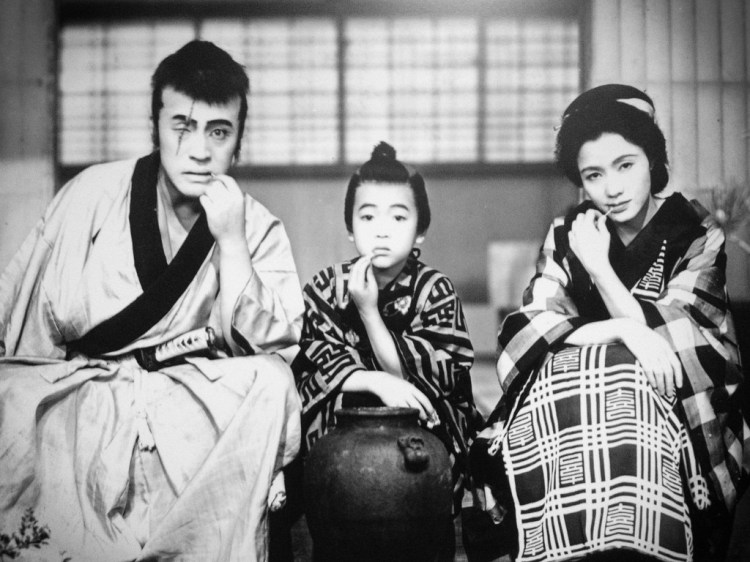 Sadao Yamanaka had a meteoric rise in the film industry completing 26 films between 1932 and 1938 after joining the Makino company at only 20 years old. Alongside such masters to be as Ozu, Naruse, and Mizoguchi, Yamanaka became one of the shining lights of the early Japanese cinematic world. Unfortunately, this light went out when Yamanaka was drafted into the army and sent on the Manchurian campaign where he unfortunately died in a field hospital at only 28 years old. Despite the vast respect of his peers, only three of Yamanaka’s 26 films have survived. Tange Sazen: The Million Ryo Pot (丹下左膳余話 百萬両の壺, Tange Sazen Yowa: Hyakuman Ryo no Tsubo) is the earliest of these and though a light hearted effort displays his trademark down to earth humanity.
