
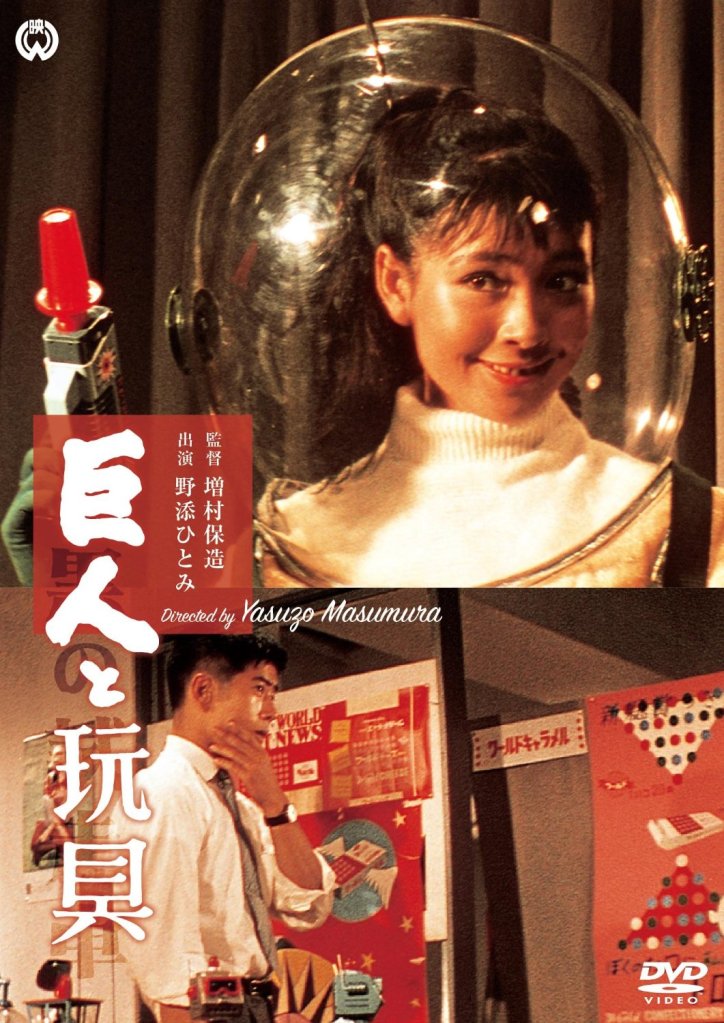
Giants & Toys (巨人と玩具, Yasuzo Masumura, 1958)

91C6JzGDYTL._SL1500_

Less acerbic than Masumura’s later Black Test Car, Giants & Toys (巨人と玩具, Kyojin to gangu) is an altogether more humorous, if no less piercing look at post-war consumerism. This time the battle ground is confectionary as the Japanese sweets industry laments the all powerful American candies taking over the Japanese landscape. Three sweet companies are duking it out for the hearts of Japanese consumers and the hard working salarymen in the PR & marketing departments are becoming ever more desperate to find the key to becoming Japan’s top selling sweet maker.

The three companies are Giant, Apollo and World, each of which is currently trying to come up with an advertising campaign which has a competition element that will really hook in the populace. Our main focus is with World whose top PR man, Goda, is currently stumped when he spots quirky hillbilly Kyoko in a bar and hatches on an idea to make her the central poster girl of his ad campaign. Kyoko is 18 with gap teeth and a childlike innocence that makes her a great fit for selling their confectionary products to the adult market. At the same time, Goda’s assistant Nishi meets an older female executive from Apollo who’s trying to shift a set of spacesuits. This fits in neatly with another of Goda’s space themed ideas and a suitably bizarre campaign is launched with the gangly Kyoko dressed up in a kitsch spacesuit and pointing a ray gun which is somehow supposed to encourage people to buy sweets. Kyoko is a hit! However, the more popular Kyoko becomes the more her innocent charms begin to dissipate. What will become of her, and of the campaign, as the competition mounts?

For an area that’s supposed to be so totally frivolous and cheerful, confectionary sales are serious business. Goda is working himself into an early grave just to sell sweets to grownups and old people. It’s advertising and marketing but like everything else in life it’s just so much spin. What they’re really trying to sell is frivolous fun and a return to childhood’s freedom all packed into a momentary suck on a salted caramel. In the Japan where “everyone works all the time” this may be quite an attractive idea, especially to the put upon members of the confectionary marketing board.

However, trivial as sweets are, they represent the fleeting unimportance of pop culture memes. During one of Kyoko’s recording sessions we meet one of the solitary female producers (labelled a “machine” by two of the other women waiting to be seen) who laments that a has been star keeps hassling her for work though her time has passed and no one’s interested. This is most likely how things will wind up for Kyoko, five minutes of being everywhere followed by a lifetime of being nowhere at all. After signing with World for their TV and radio advertising she becomes a break out personality attending events as a celebrity in her own right and later even becoming a pop star complete with a totally strange, South Pacific themed musical number referencing some kind of cannibalistic genocide where they’ll sell back the remains of the men they’ve killed to the native wives. Pointed satire in more ways than one.

Goda wants to build a kind of mass media dictatorship, cleverly controlling the public mood through all pervasive advertising (a prescient thought, if ever there was one). Having taken things too far, he’s taken to task by his underling, Nishi, who’s had a bit of a rethink following a series of heartbreaks involving friends and lovers. “I won’t sacrifice my dignity” he says, only to be shown doing just that a couple of minutes later as he himself dons the ridiculously camp space suit, takes the ray gun in hand and wanders out into the streets to be met by a series of bemused stares from the passersby. Eventually, the woman from Apollo with whom he’d been having an affair spots him and with an equally amused expression instructs him to “smile warmly”, at which point he grimaces before managing to turn it into a robotic grin.

Still oddly current, Giants & Toys is an absurdist’s guide to corporate politics where personal integrity is sacrificed on the altar of commerce. Everyone runs round in circles working hard to sell things no one really wants or needs to other hardworking people just to keep the wheel spinning. “Kanban Musume” come and go, one ridiculous meme follows another and we all just fall over ourselves to chase whichever unattainable ideal they pitch us. It would be nice to think the world has moved on since 1958, however…


Giants & Toys is available on R1 DVD with English subtitles courtesy of Fantoma.

Trailer
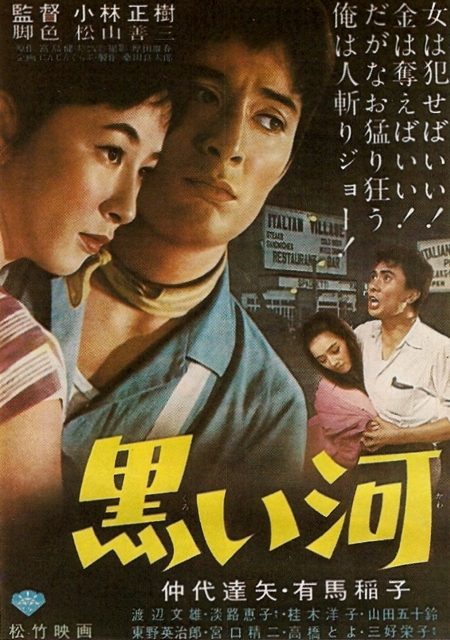
Black River (黒い河, Masaki Kobayashi, 1957)

20140731_762128Masaki Kobayashi is still not enamoured with the new Japan by the time he comes to make Black River (黒い河, Kuroi Kawa) in 1957 which proves his most raw and cynical take on contemporary society to date. Set in a small, rundown backwater filled with the desperate and hopeless, Black River is a tale of ruined innocence, opportunistic fury and a nation losing its way.

The tale begins as a poor student, Nishida, moves into a rundown tenement owned by a tyrannous landlady who collects rent payments as if drinking in souls. Nishida looks around his new abode with a depressed air as the landlady advises him that he can always clean the place up. The vast majority of his possessions are books and the studious Nishida quickly sets himself apart from the ordinary working class denizens of this forsaken place to whom he clearly feels himself superior. However, he does take a liking to a local waitress. This too is destined to go wrong as when Shizuko visits him late after work one night hoping to borrow a book, she is grabbed by a gang of guys who attempt to assault her. Another man turns up and disrupts them but it quickly transpires that the whole thing is a ruse set up by the local gangster, Killer Joe, who then rapes her himself.

The modern, jazz inspired score and classic love triangle plot are almost a seishun eiga cliché but Kobayashi is only partly interested in the central trio with the ruined girl at its core. Casting the net wider, he’s interested in each of the wretched people that live in this place which is on the fringes of an American military base. From the obvious and blatant pan pan girls to the secret prostitutes and black marketeers, the American military has become a disruptive force in the area offering the weak minded easy, if dishonest, ways of living. That is to say, the problem is not “the Americans” or “the occupation” so much as it is the society which is allowing itself to become corrupted by Western values.

In this place, it’s everyman for himself. One of the community is ill, probably with tuberculosis. At one point he’s in desperate need of a blood transfusion so the wife hysterically asks everyone else if they have a matching blood type which they all deny (some of them obviously lying). Nishida admits he has a match, but outright refuses his blood despite the fact that this man will likely die without it. This doesn’t matter however because someone remembers the wife herself is a match but even she did not want to volunteer her own blood to save the life of her husband. Later when he is rushed to hospital she will delay his departure trying to take all their worldly goods with them in case the husband dies and his relatives turn up to claim everything.

The landlady has hatched a plot with Killer Joe (played by a young Tatsuya Nakadai in his first film role) to evict the tenants, knock the place down and build a love hotel catering to the American troops. They have a small problem as a committed communist lives in the building and refuses to move – he also tries to organise some community action where he tries to get them to club together to reduce energy costs as the local American base doesn’t pay their bills and the community has to foot the bill for the entire area. Nobody really cares though and no one wants to pay.

Killer Joe plays the tough guy in swanky clothes and sunglasses but his authority is hollow and really he’s just a scared little boy. He rapes Shizuko because he’s too lazy and frightened to bother about doing things in the more conventional way. She, for herself, is too pure to consider herself anything other than ruined by her traumatic experience and immediately petitions Joe to marry her (he, predictably, laughs and offers to let her move in with him). She’s disgusted with herself but is completely in thrall to Joe, both attracted and repelled by him. Gone are her demure outfits and white parasol, in with the dark, figure hugging dresses with exposed shoulders, loose hair and pretty pearl earrings. Her love for Nishida is the one aspect of her former self that she clings to as a way of keeping her innocence alive. Eventually she decides the only way to reclaim her honour and be free of Joe is to kill him and kill the new self born in her by his violence.

Innocence, once lost, is not something which can ever be truly regained. Nishida makes the typically male decision and is saved from his folly by a typically female one, but the ending here can never be anything other than tragic for all involved. It’s the usual B-movie conclusion, leaving only a lonely white parasol lying abandoned on the road to ruin. The message is clear, the world is cruel because we allow it to be and that is a fact that is unlikely to change.


Black River is the third of four early films from Masaki Kobayashi available in Criterion’s Eclipse Series 38: Masaki Kobayashi Against the System DVD boxset.

Here’s a scene from about half way through the movie:


The Thick-Walled Room (壁あつき部屋, Masaki Kobayashi, 1956)

4473285465_b5cf3a248fThere’s a persistent myth that Japanese cinema avoids talking about the war directly and only addresses the war part of post-war malaise obliquely but if you look at the cinema of the early ‘50s immediately after the end of the occupation this is not the case at all. Though the strict censorship measures in place during the occupation often made referring to the war itself, the rise of militarism in the ‘30s or the American presence after the war’s end impossible, once these measures were relaxed a number of film directors who had direct experience with the conflict began to address what they felt about modern Japan. One of these directors was Masaki Kobayashi whose trilogy, The Human Condition, would come to be the best example of these films. This early effort, The Thick-Walled Room (壁あつき部屋, Kabe Atsuki Heya), scripted by Kobo Abe is one of the first attempts to tell the story of the men who’d returned from overseas bringing a troubled legacy with them.

The Thick-Walled Room is set inside an American detention centre for soldiers who have been declared B or C class war criminals. In essence, these are the rank and file men who were “just following orders” or committed random acts of desperation because they believed it was necessary to survive. The men are kept fairly well in the prison, they aren’t treated cruelly though they are sent for forced labour in a stone quarry. The main protagonist of the story, Yamashita, insists on maintaining a beard as a form of mini rebellion (quipping that he’s trying to grow a rope to hang himself). He feels betrayed by a superior officer,  who ordered him to commit an atrocity and then cut some kind of deal to deny it afterwards and get off scot free – he returned to Yamashita’s home town, has married and is lording it over Yamashita’s own family as some kind of devious landlord.

The others in the cell include a young romantic dreaming of a girl he met in the war who, it turns out, has long forgotten him and is now living in the pleasure quarters. The film also doesn’t shy away from the other implications of the war with a Korean soldier also among the detained who laments what’s happening both to the country of his birth which is now once again at war and his adopted country tearing itself apart in guilt and defeat. When asked whether he’s from North or South Korea the soldier hesitates, perhaps offended by the question, and simply replies “I am Korean” before walking off. Others dream of home and wives and families and this whole thing being over. However, they’re all at the mercy of two governments – the Americans and the Japanese and though they believe they may finally be released when the treaty is signed, it’s never that simple.

Masaki Kobayashi begins the themes he would return to over and over again – the depths of human cruelty, repression, indifference, vengeance. These are man who risked their lives for a god only to find he was a man and nothing more. They’ve come back alive, but different. Not only must they deal with the shame of defeat and now being prisoners of their enemies but also with entire war guilt of a nation. These are just the little guys, they did as they were told even if they didn’t want to or they killed and stole to survive. They have done terrible things to those who had no role in the conflict, this is not in dispute, and they pay a heavy spiritual toll for those actions. The people who ordered and orchestrated these deliberate reigns of terror, however, have largely escaped or lied and cheated their way out of the hangman’s noose.

Kobayashi uses a lot of expressionist techniques more reminiscent of silent cinema than of the more recent films of the era. Whilst the men are inside the cell there is nothing outside it, the war still exists in here and in their minds. We start off leaning on the walls of the cell only to find ourselves thrown back into the heat of the jungle and finally thrown out again after encountering our dramatic event. The faces of the dead pass in montages across the screen crying “murderer” and “war criminal” in a constant vision of recrimination. Even if they are eventually released, these men will be in prison for the rest of their lives.

In fact, the film was so controversial that the release was held back until 1956 even though the American occupation was technically over before it was completed. Though it isn’t the most accomplished of Kobayashi’s films, The Thick-Walled Room includes many of the ideas and motifs that he would return to throughout his career. Kobayashi wants us to see things as they are and were from all angles. He sympathises with these men but doesn’t excuse what they or the nation as a whole has done, as he would continue to do he seeks a way forward that acknowledges the past but will bring us to a more compassionate future.


The Thick-Walled Room is the first of four early films from Masaki Kobayashi available in Criterion’s Eclipse Series 38: Masaki Kobayashi Against the System DVD boxset.