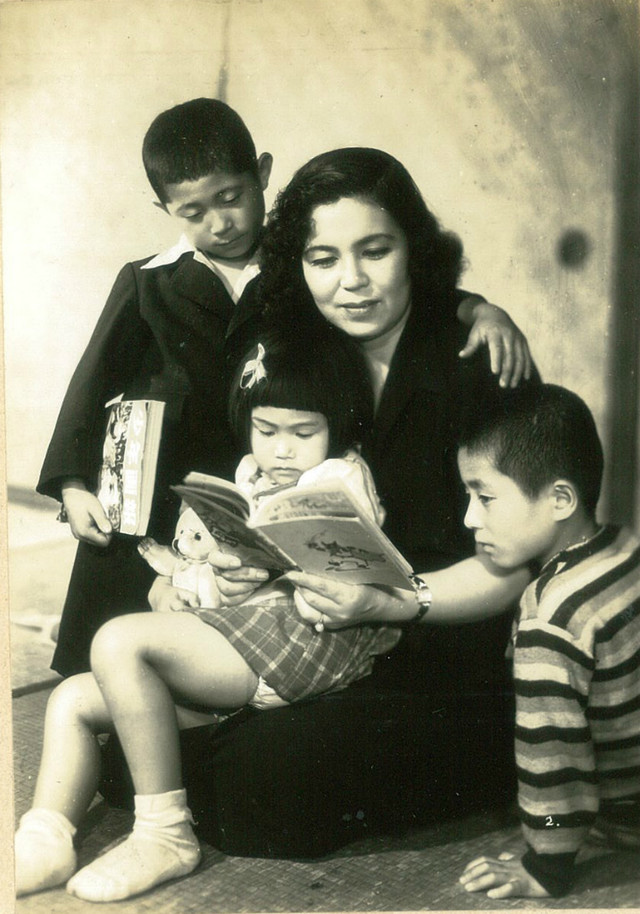
 Shimizu’s depression era work was not lacking in down on their luck single mothers forced into difficult positions as they fiercely fought for their children’s future, but 1950’s A Mother’s Love (母情, Bojo) takes an entirely different approach to the problem. Once again Shimizu displays his customary sympathy for all but this particular mother, Toshiko, does not immediately seem to be the self sacrificing embodiment of maternal virtues that the genre usually favours.
Tellingly, when we first meet Toshiko she’s asleep on a bus as her three children badger a friendly artist who’s entertaining them by drawing a picture of their pretty mother. The boys are quick correct themselves when talking about the woman they’re with – she’s their “aunt” not their mother, but the artist sees through the ruse. Toshiko is heading to visit her brother in the country in the hope that he will look after her children for awhile offering the explanation that she wants to get married again. Her brother is sympathetic to her problems, but has six children of his own already (and perhaps a seventh on the way) so taking in three extra mouths to feed is not really an option. Agreeing to look after the youngest girl, they suggest trying an elderly uncle but remind her that he has a rather conservative mindset and may ask all sorts of questions about Toshiko’s recent past which she might not want to answer.
Not to worry, the uncle seems to have mellowed with age though he can’t take in two growing boys either and suggests asking a friend of his who’s been trying for a baby for years but has been unable to have one. When that doesn’t work out Toshiko deposits her second son at the uncle’s and travels on with just her oldest boy, Fusao, but as time goes on Toshiko begins to rethink her decision to have her children fostered out and wonders if just being together might be worth more than a stable economic life founded on the pain of abandonment.
The protagonists of “hahamono” which praise the idea of the noble, self sacrificing mother are not universally saintly but the one thing they never do is consider leaving their children. In this regard Toshiko is not immediately sympathetic. Rejecting the name “mother” for “aunt” in the hope of hooking a prospective husband, Toshiko has already marked herself as falling outside of the idealised mother standards and her rather cool, snappy way of addressing the children does not go in her favour either. Her brother greets her warmly (even if he seems to suspect that she’s probably come because she wants something) and has no desire to drag up the past but points out that other people might not be so charitable given that all three children have different fathers and Toshiko has never revealed how she supported herself towards the end of the war and in its immediate aftermath. Nevertheless, Shimizu refuses to judge her. Her life has been a hard one and she herself was fostered out herself as a child. Toshiko’s decision may not be one everyone would agree with but that doesn’t mean it was an easy one for her to make, or that she feels nothing in giving up her children.
The biggest tragedy is that the kids will be separated. Apparently often left to fend for themselves at home whilst Toshiko works, the children are a mini band of three and it seems even more cruel that they will be deprived not only of a mother but of their siblings too. Though the youngest girl tries to run after her mother and brothers, and the second son cries so much that his brother goes back to give him one of his comic books to cheer him up, Fusao is even more upset and anxious as the last remaining child. Constantly wetting the bed which costs him his place at a few prospective new homes, Fusao is plagued by the idea that his mother is about to abandon him and finally pleads with her that he can take care of his siblings by himself if only they can all stay together.
Fusao’s pleas eventually soften his mother’s heart though she begins to think again after coming across a band of itinerant performers, one of whom is nursing an infant despite her poverty and the harshness of her life. The young woman seems devoted to her child and is determined to take care of it even though she has no husband to help her. The child’s grandmother urged her daughter to give the baby up to someone with more resources to raise it but the girl refused, no matter how hard it may turn out to be. Moved, and feeling even more guilty in witnessing the hardships another mother is bearing for her child, Toshiko’s resolve begins to weaken.
When Toshiko is taken ill at an inn and her friend from the city, Mitsuko, comes to visit her it is revealed that Toshiko’s plan is not another marriage but that the two women are in the process of opening a bar – hence why she needs to farm out her children. Mitsuko has also sent her daughter to a relative so that she can plow all her time and money into the enterprise though no one knows how long it will take until the place is successful enough to support the full families of both women. It may be, therefore, that Toshiko’s desire to run her own business is for the ultimate benefit of her children who will finally have a degree of economic security. On thinking again, she wonders if it isn’t selfish vanity and that she’s sacrificing her children to fulfil her own desires.
Shimizu takes a more conservative viewpoint than that found in his other work by encouraging Toshiko to reject the prospect of being her own boss to embrace the traditional values of her natural maternity. The old nurse Toshiko visits in the hope that she will take in Fusao (which she almost certainly would have done) remarks that a full belly isn’t everything and being together might be enough, but that doesn’t quite explain what the obviously desperate Toshiko is going to do to survive from here on in. One can only hope that she somehow finds a way to make the bar work (even if it takes a little longer) rather than be left with nothing all over again. Focusing less on the children than on the maternal conflict as Toshiko becomes torn by the traditional values as seen in her rural hometown and the less forgiving modernism of the city, Shimizu retains an understanding tone but also eschews the concessions to pragmatism which so often went hand in hand with his forward looking idealism, for a reassertion of conservative values which fly in the face of his usually compassionate acceptance of the very real difficulties faced by women in a conformist and male dominated society.
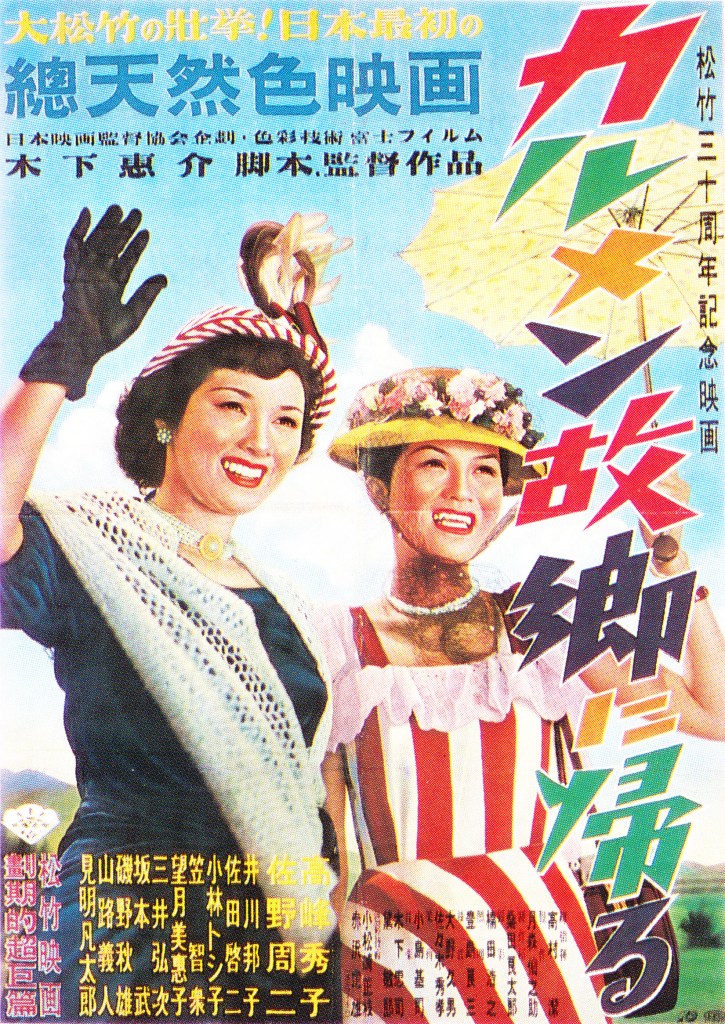 Shochiku was doing pretty well in 1951. Accordingly they could afford to splash out a little in their 30th anniversary year in commissioning the first ever full colour film to be shot in Japan, Carmen Comes Home (カルメン故郷に帰る, Carmen Kokyou ni Kaeru). For this landmark project they chose trusted director Keisuke Kinoshita and opted to use the home grown Fujicolor which has a much more saturated look than the film stocks favoured by overseas studios or those which would become more common in Japan such as Eastman Colour or Agfa. Fujicolour also had a lot of optimum condition requirements including the necessity of shooting outdoors, and so we find ourselves visiting a picturesque mountain village along with a showgirl runaway on her first visit home hoping to show off what a success she’s made for herself in the city.
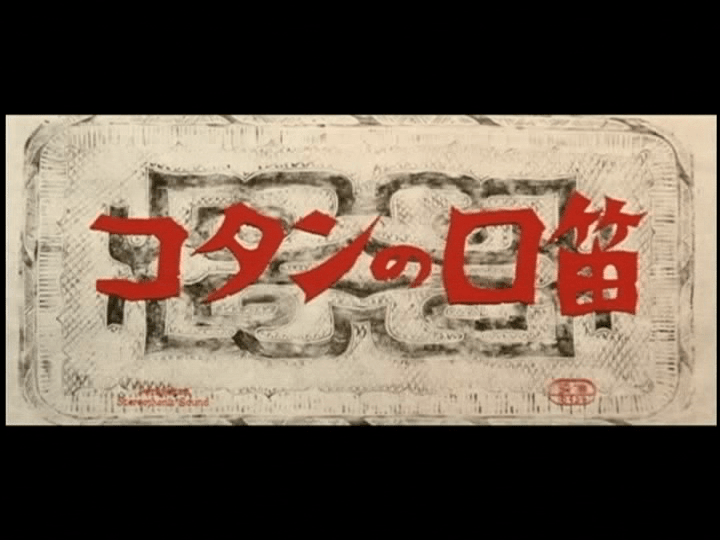 The Ainu have not been a frequent feature of Japanese filmmaking though they have made sporadic appearances. Adapted from a novel by Nobuo Ishimori, Whistling in Kotan (コタンの口笛, Kotan no Kuchibue, AKA Whistle in My Heart) provides ample material for the generally bleak Naruse who manages to mine its melodramatic set up for all of its heartrending tragedy. Rather than his usual female focus, Naruse tells the story of two resilient Ainu siblings facing not only social discrimination and mistreatment but also a series of personal misfortunes.
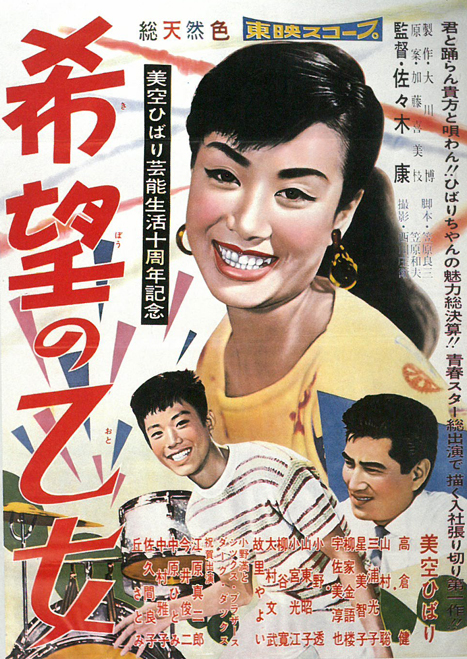 Another vehicle for post-war singing star Hibari Misora, With a Song in her Heart (希望の乙女, Kibo no Otome) was created in celebration of the tenth anniversary of her showbiz debut. As such, it has a much higher song to drama ratio than some of her other efforts and mixes fantasy production numbers with band scenes as Hibari takes centre stage playing a young woman from the country who comes to the city in the hopes of becoming a singing star.
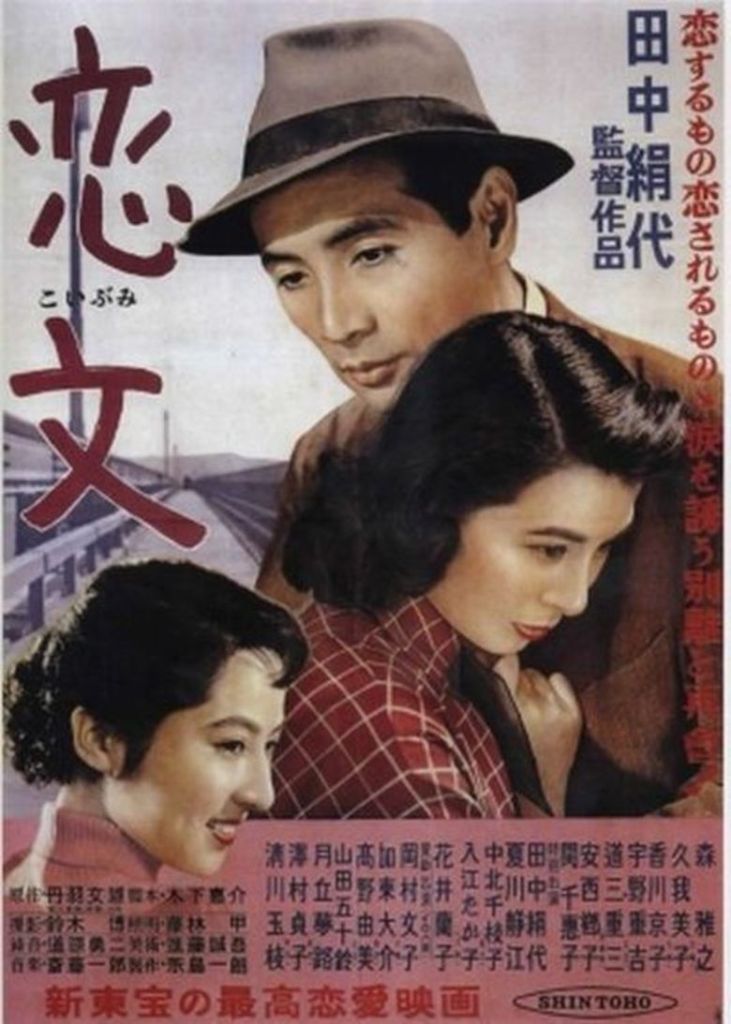 Kinuyo Tanaka was one of the most successful actresses of the pre-war years well known for her work with celebrated director Kenji Mizoguchi including several of his most critically acclaimed works such as Sansho the Bailiff, Ugetsu, and The Life of Oharu. However, post-war Japan was a very different place and Tanaka had a different kind of ambition. With 1953’s Love Letter (恋文, Koibumi) she became Japan’s second ever female feature film director, though her working and personal relationship with Mizoguchi ended when he attempted to block her access to the Director’s Guild of Japan. No one quite knows why he did this and he tried to go back on it later but the damage was done, Tanaka never forgave him for this very public betrayal. Whatever Mizoguchi may have been thinking, he was very wrong indeed – Tanaka’s first venture behind the camera is an extraordinarily interesting one which is not only a technically solid production but actively seeks a new kind of Japanese cinema.
 Hiroshi Shimizu is well known as one of the best directors of children in the history of Japanese cinema, equalled only by the contemporary director Hirokazu Koreeda. The Shiinomi School (しいのみ学園, Shiinomi Gakuen) is one of the primary examples of his genius as it takes on the controversial themes of the place of the disabled in society and especially how children and their parents can come to terms with the many difficulties they now face.
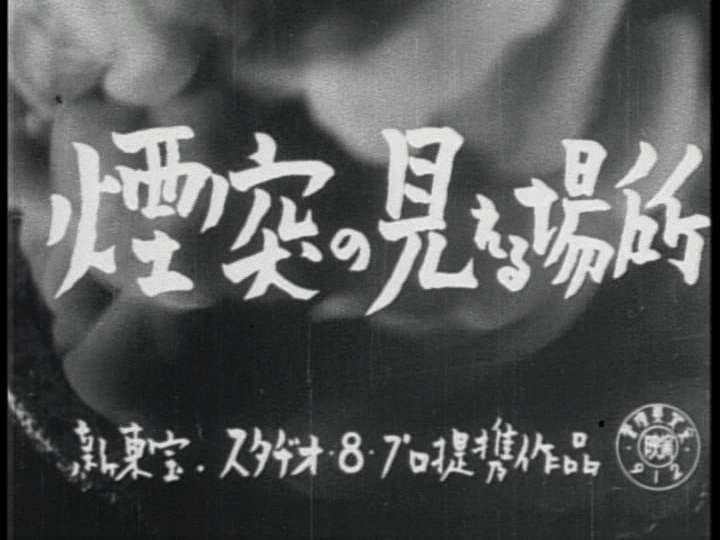 Where Chimneys are Seen (煙突の見える場所, Entotsu no Mieru Basho) is widely regarded as on of the most important films of the immediate post-war era, yet it remains little seen outside of Japan and very little of the work of its director, Heinosuke Gosho, has ever been released in English speaking territories. Like much of Gosho’s filmography, Where Chimneys are Seen devotes itself to exploring the everyday lives of ordinary people, in this case a married couple and their two upstairs lodgers each trying to survive in precarious economic circumstances whilst also coming to terms with the traumatic recent past.
 Hibari Misora was one of the leading lights of the post-war entertainment world. Largely active as a chart topping ballad singer, she also made frequent forays into the movies notably starring with fellow musical stars Izumi Yukimura and Chiemi Eri in the
 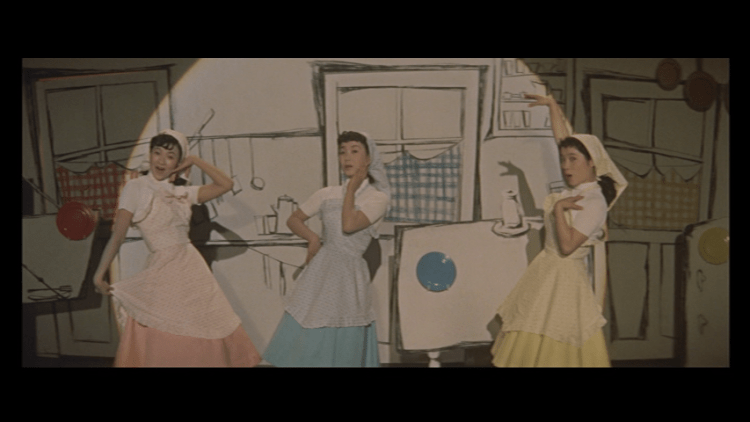 The Sannin Musume girls are growing up by the time we reach 1957’s On Wings of Love (大当り三色娘, Ooatari Sanshoku Musume). In fact, they each turned 20 this year (which is the age you legally become an adult in Japan), so it’s out with the school girl stuff and in with more grown up concerns, or more specifically marriage. Wings of Love is the third film to star the three Japanese singing stars Hibari Misora, Chiemi Eri, and Izumi Yukimura who come together to form the early idol combo supergroup Sannin Musume. Once again modelled on the classic Hollywood musical, On Wings of Love is the very first Tohoscope film giving the girls even more screen to fill with their by now familiar cute and colourful antics.
