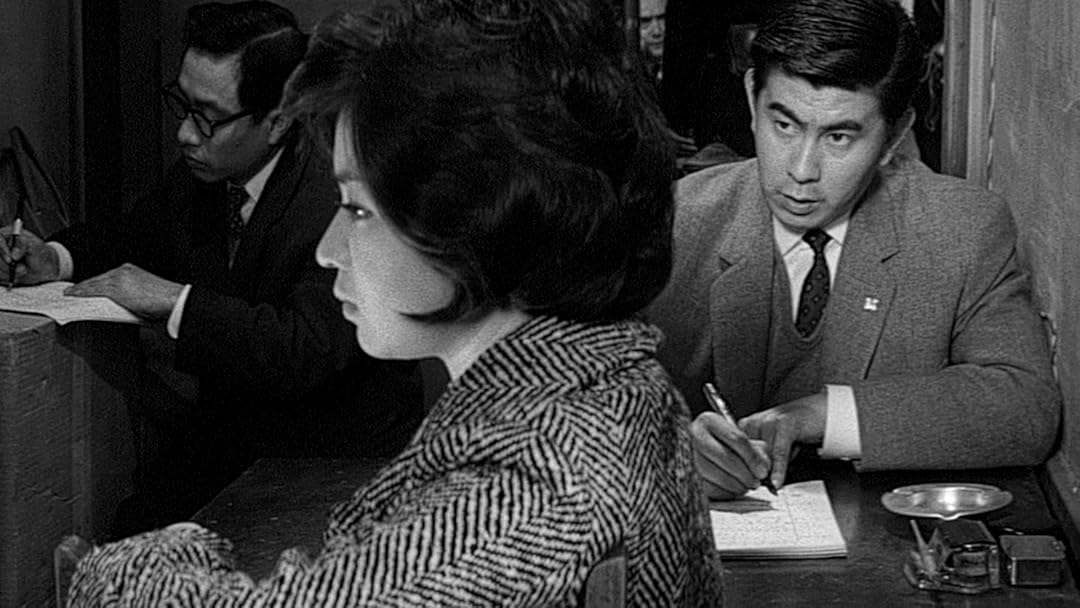
Bridge of Japan (日本橋, Kon Ichikawa, 1956)

Punishment Room, released in 1956 as Daiei’s attempt to get in on the Sun Tribe phenomenon, had provoked a moral panic that brought the whole short-lived movement to a close. In considering his next film, Ichikawa consulted with Daiei executive Matsutaro Kawaguchi, who is also the father of Punishment Room’s star Hiroshi Kawaguchi, and was offered the chance to direct one of two relatively safe and subdued literary adaptations, either Izumi Kyoka’s Nihonbashi, or Kafu Nagai’s Okamezasa. Ichikawa chose Nihonbashi (日本橋), though his wife and screenwriter Natto Wada feared adapting it maybe beyond her capabilities.

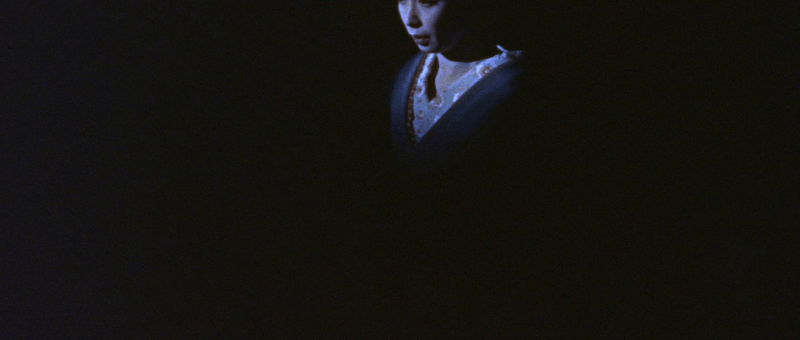
The film is generally known under the The Bridge of Japan in English-speaking territories. This is either an attempt to suggest a wider thematic importance that extends across the nation, or an overly literal translation of a place name. In any case, the significance of Nihonbashi is that, during the time the film is set, it was known as an area where there were many high-class geisha houses. On the other hand, Izumi was well known for incorporating supernatural themes in his work, which  is why the film opens like a ghost story with the curtain rising on a dark and gloomy alleyway through which a geisha walks until she finally dissolves leaving only a creepy song and the sound of her geta rattling along on the cobbles. 

The messages seems to be that this is a place that consumes women. The ghost is said to be that of Owaka who, according to rumour, cheated on her husband who left her after which she died of tuberculosis. Ambitious geisha Okoh (Chikage Awashima) has just moved into Owaka’s former giesha house, apparently unperturbed by its grim history or the the possibility that it is effectively cursed. Geisha come to a miserable end if they act selfishly, according to one of Okoh’s clients who will essentially prove correct further sealing Okoh’s unhappy fate. As is common in these tales she has an entirely one-sided rivalry with local favourite Kiyoha (Fujiko Yamamoto) who her is total opposite in terms of personality. Kiyoha is kind, gentle, and dislikes her life as a geisha, not because she disapproves of it, but because of the moral compromises it requires her to make and the happiness that it denies her.

She has taking a liking to a regular customer, university professor Shin, but when he asks her to marry him, she has no choice but to refuse. Then again, Shin’s proposal is seemingly driven by his incestuous desire for his older sister, who, perhaps having realised this, has disappeared from his life apparently in shame in having become the mistress of a married man to provide for his education. Shin then bears out a sense of hypocrisy in the relationship between men and geisha in that he insists he has never seen has as one but only as his sister who was of course another woman sexually exploited for material gain. As Kiyoha is unable to marry him because she must also financially support her mother and an illegitimate daughter, as well as being indebted to her primary patron, they will not meet again as a geisha and a client.

Okoh, meanwhile, has a tendency to pick up things Kiyoha as dropped as a way of getting back her meaning she is now determined to become Shin’s lover, though he is not interested in her. After she helps in him out with a predicament with a local policeman in which she claims to be his wife, she really considerers herself to be so, though again one-sidedly. She then faces the same thing with a clingy client, Daikichi, she nicknames “Red Bear,” who has convinced himself, one-sidedly, that she is his wife despite also having a legal wife and child.

Red Bear is presented somewhat grotesquely and really takes on the position of a monster within the story. He was once a wealthy seafood wholesaler from Hokkaido who set up shop in Tokyo before an economic downturn which has also impacted the geisha world. This, along with his foolish infatuation with Okoh has ruined him financially and may also have contributed to the later death of his wife which leads him to abandon his infant son ironically dropping him off at Kiyoha’s knowing she will care for him though she rejected Red Bear on the grounds of his ugliness. Driven into a kind of madness, he now subsists on grubs and maggots that live on his distinctive but poorly made bearskin coat.

Okoh is also driven into madness when Shin decides to become a wandering pilgrim and search for his sister in order to ease the tension between Okoh, Red Bear, and Kiyoha. For her, Shin may represent a way out of this geisha world as a respectable man’s wife, something which is otherwise unobtainable to her. While in some senses, a geisha could claim greater independence as a single woman through running her own house rather than being dependent on a patron, she may also be denied the possibility of a settled domestic life or romantic fulfilment. Even if Kiyoha cannot escape her life as a geisha, she does at least have her daughter and comes to dote on Red Bear’s son, though without knowing who his parents were. 

Her parting with Shin (Ryûji Shinagawa), who does not belong in this world and has undergone a religious conversion in deciding to become a monk permanently having given up on looking for his sister and symbolically accepting Okoh as his wife, is then bittersweet but not as much of a tragedy as the fate of Okoh. The geisha house appears to have been purified, released from its cursed legacy under the ownership of Kiyoha even if geisha gossiping about the constant flow of people in this ever changing area. The alleyway which was once dark and gloomy, is now brightly lit and has lost its sense of ominousness, if otherwise seeming rather ordinary.

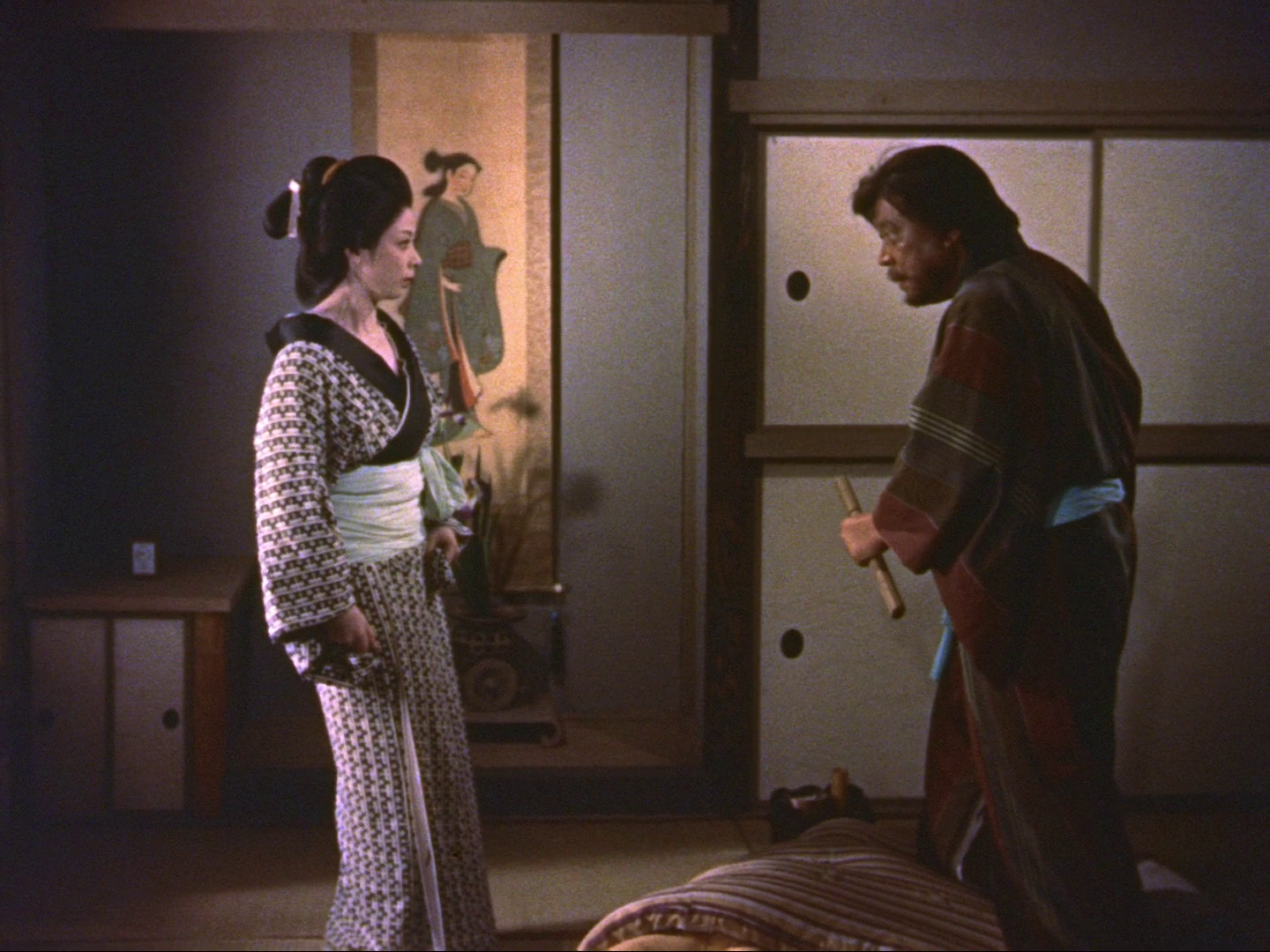
This was Ichikawa’s first colour film, though in order to recreate Izumi’s world he decided on a broadly grey colour palate for the props and sets, recreating all of the Meiji-era setting only to burn it down for real during the fiery climax. At that time, filming in colour also required additional lighting which meant that it was stiflingly hot on set. They eventually had to purchase industrial size air coolers of the kind that were only used in cafes, pushing up the production budget which was already high considering the painstaking attention to detail in the historical sets which included laying actual tracks to recreate the Meiji-era street car. Nevertheless, it all pays off in the exquisite visuals that bring that bring this world to life in all of its defeated hopes and melancholy. 


The Crowded Train (満員電車, Kon Ichikawa, 1957)

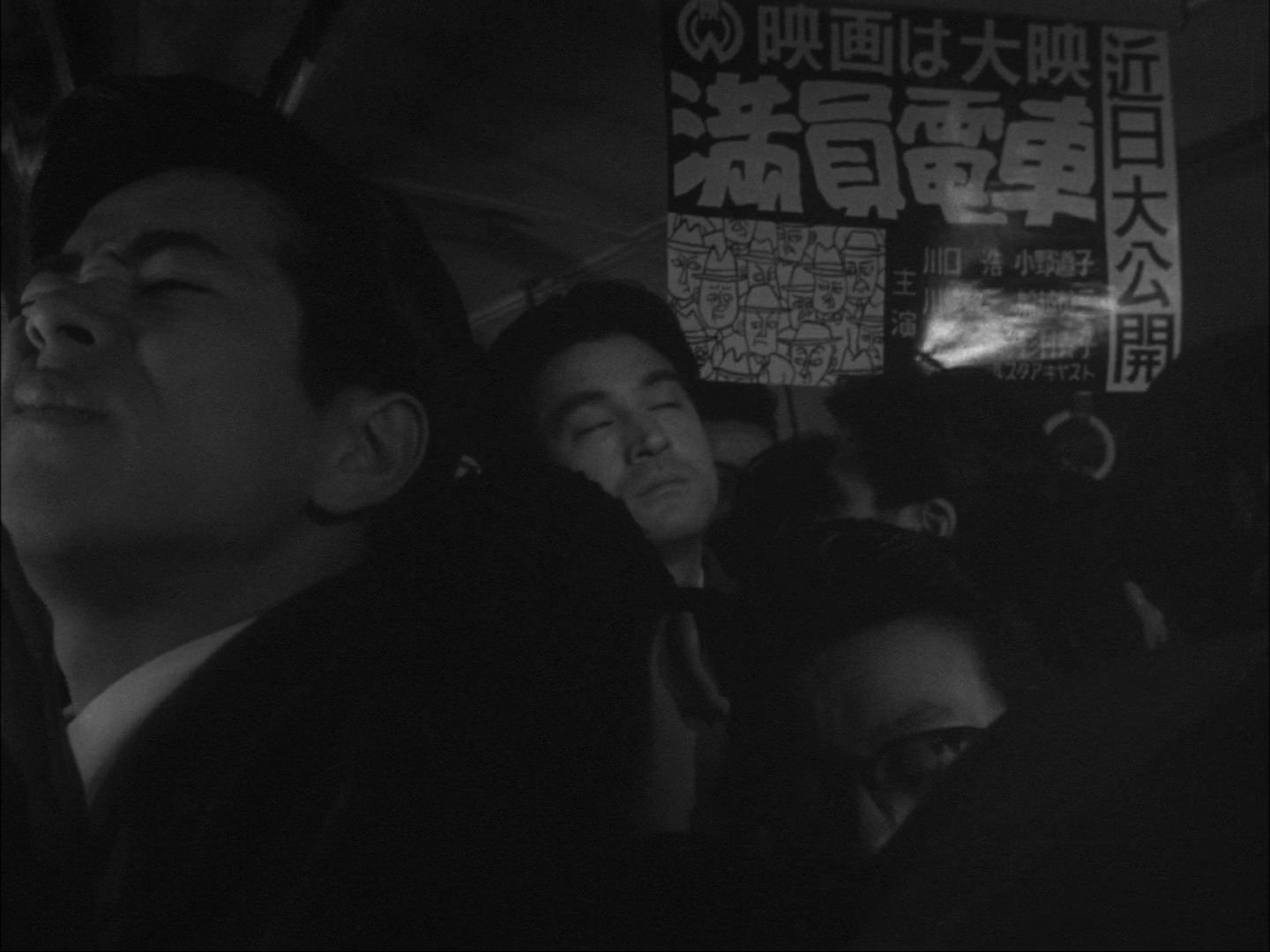
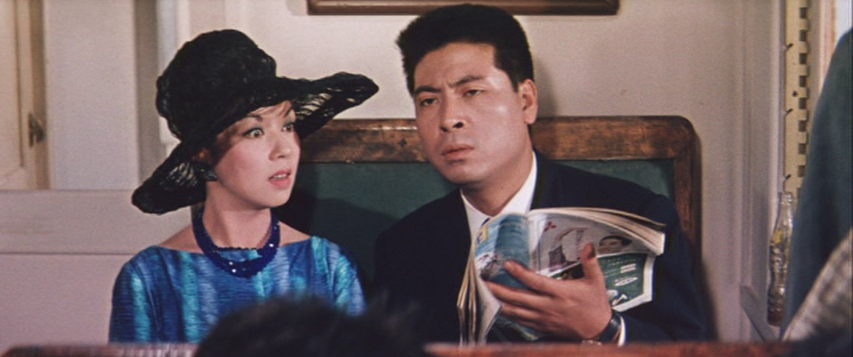
The Japan of 1957 moves like clockwork in Kon Ichikawa’s absurdist satire, The Crowded Train (満員電車, Manin densha). You can’t expect a seat to be there just because you want to sit down, according to go-getter Tamio, you have to fight for your place on the crowded train that is the post-war economy. His horologist father raised him to prize things like order, precision, and self-reliance, yet the irony is that in a nation like this, if everyone else’s clocks are wrong and only yours are correct, you may be better off resetting them.

Nevertheless, Tamio (Hiroshi Kawaguchi) comes to think of himself as part of the machine and does his best to slot himself into the rhythms of contemporary urban life. People move around in the same way as the bottles manufactured at the brewery where Tamio gets a job after graduating from a top university. But he soon learns fitting into the system requires a degree of compromise. On his first day at the office, he’s told off by his new boss for being overly efficient. He finished all his work before 10:30, but his daily quota is fixed and his productivity only makes things difficult for others. The head of brewery anticipates that increasing automation will allow them to increase efficiency through shedding personnel, only the unions and cultural practice won’t let them. Tamio is one of only three people was recruited for his skills. The other seven joining with him are nepotism hires that will likely drain resources due to their lack of ability, but will be promoted anyway because of their connections. 

In any case, he might have hoped for a better job after graduating from such a good university. A rational man like his father, Tamio meticulously works out how much he can expect to earn over a lifetime subtracting things likes taxes, insurance, and the costs of raising a family. It turns out, the salaryman life is rather disappointing and there’s relatively little reward at the end of it. His constant toothaches and mounting health problems are manifestations of his anxiety and buried desperation. He lives in a company dorm with no furniture surrounded by long corridors of identical rooms. Everyone leaves at the same time every morning to take their place on the train. His colleague Sarai (Eiji Funakoshi) tries to make friends with him, but also explains how most of the other men in the building have been ruined in one way or another by the salaryman life. One has returned to the dorm after his wife left him. Another has a heart condition, but has run through his sick leave and has no choice but to return to work. Tamio only got his position because the previous occupant of his room jumped from the window. 

Sarai says that he held off on making friends with Tamio because he was afraid of him. Graduates overthink things, he says, and are ill suited to the regimented life of a salaryman. The film opens with another kind of conveyor belt visualising the expansion of the educational sector beginning with a handful of graduates in the Meiji era to the present day in which there are so many the ceremony has to take place outdoors in the rain. Tamio loses his job after falling into a coma for month without giving prior notice and is told by a friend he asks for help that they just don’t need graduates from top universities. He’s eventually only able to get a job as a school caretaker by leaving his degree off resume, but is then abruptly fired when they find out. Despite the system apparently overproducing graduates it has no need for, all the teachers want their kids to university and are open to Tamio’s plan to set up school to teach people how to get in.

Meanwhile, Tamio’s father has since entered a mental institution and is apparently very happy there. Everyone else is mad except for me, he claims, but also appreciates the sense of order and precision he couldn’t find in the outside world. The doctors find it impossible tell patients apart from visitors suggesting lack of division between sanity and madness, while Tamio’s father had originally accused his mother of insanity simply for being cheerful. Cheerfulness or insanity seem to be the only ways out of this impossible situation as Tamio desperately tries to hold the roof on his shack during a storm while his mother is just happy to be able to live with her son and hopeful that her husband will get “better” so they can all live together again. “There is always another school year ahead of you,” the head teacher of the primary school tells his new charges somewhat omniously, suggesting that they too are destined to spend their lives fighting for a seat on a packed-out train with no clear destination.


The Woman Who Touched Legs (足にさわった女, Yasuzo Masumura, 1960)

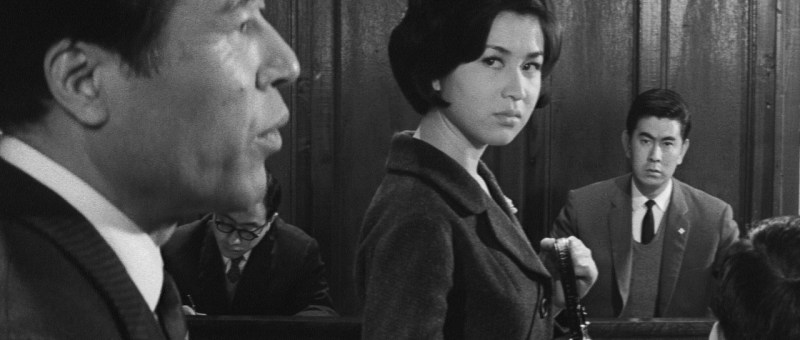
Busho Sawada’s serialised novel had been adapted several times before with the first released shortly after its publication in 1926, but this “modernised” version directed by Yasuzo Masumura, The Woman Who Touched Legs (足にさわった女, Ashi ni Sawatta Onna), is tailor-made for the post-war era as the titular woman heads off in search of the old Japan only to learn that it no longer exists and what little of it remains is being sold off for golf courses and ever expanding American airbases whose noisy aircraft fly constantly overhead.

To that extent, Saya (Machiko Kyo) is an embodiment of aimless post-war youth. Her father was accused of being a spy and took his own life while her mother worked herself to death when she was just a child. Though she travels with a rather dim young man who refers to her as his older sister, they are not actually related by blood and seem to have belonged to the same community of street criminals in Osaka along with their “big sister” Haruko (Haruko Sugimura) who has since moved back to Atsugi which is Saya’s “hometown”. Since her parents’ deaths, she’s been obsessed with the idea of revenge and pickpocketing money to save for a giant memorial service to show the relatives who chased her family out of town how well she’s done for herself. But when she arrives, she can’t even find the place she’s looking for. A policeman flips through a series of ancient, handwritten ledgers looking for evidence of people with her surname and suggests they’ve all left town. Even the last one left is the wife of an adopted son who plans to move to Tokyo after their house is purchased by developers who want to build a golf course.

The golf course may be a symbol of Japan’s increasing prosperity, but the airbases seem to hint more at a sense of corruption and oppression. Saya’s “hometown” is a mythical concept that belongs to an idealised vision of a pastoral Japan before the war that she unconsciously wants to return to. Her mother spoke of a small settlement of perhaps 30 houses, a village society with a river running through it. The village has now, however, been swallowed by the airbase and, in fact, erased so that no one even quite remembers it. Saya is left feeling that she no longer has a hometown, and ironically asks policeman Kita to arrest her so she can go back to prison, which is, perhaps, where her heart truly lies. At least, it’s much quieter than here without any noisy aircraft flying overhead.

Nevertheless, Kita (Hajime Hana) is a fairly bumbling policeman and the film opens with what turns out to be part of a book set in a lawless Japan where people gamble, party, and openly sell guns on an ordinary train. Kita is currently on holiday, which he’s been forced to take even though he doesn’t really want to. He’s technically powerless for the moment, but continually complains that he’s not allowed to arrest Saya unless he catches her in the act of pickpocketing. It’s clear that the pair have feelings for each other it’s inconvenient to admit, and all this talk of “arrest” maybe more a kind of metaphor in which Saya secretly wants to be caught by Kita with the snapping of the handcuffs akin to the putting of a ring on a finger. The pair effectively lead each other on a merry dance with Saya ironically eventually chasing the policeman rather than the other way around.

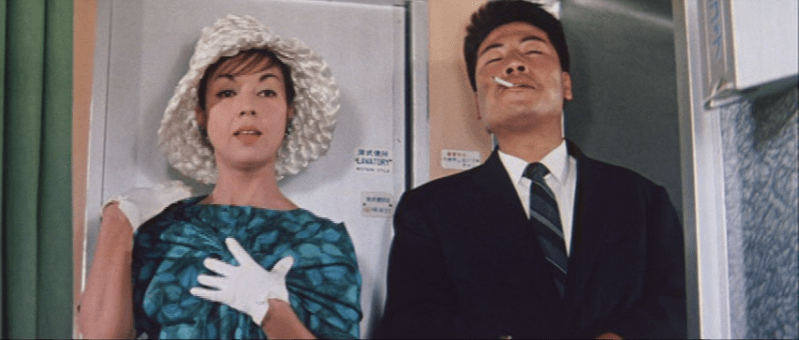
The film does open rather salaciously with a closeup of a woman’s legs in fishnet tights followed by a kickline, and Machiko Kyo does indeed play up her sexy image to play the beautiful pickpocket who uses her body as a tool to mesmerise much to Haruko’s disapproval. Besides Kita, she’s followed by a rather louche writer (Eiji Funakoshi) who declares that he doesn’t need models, though evidently captivated by her, while declaring himself too successful and overworked. He doesn’t want more money, he just wants some free time and no one seems to want to let him have any, though he doesn’t exactly get a lot of writing done on this wild goose chase looking for Saya’s missing hometown. Absurd as it is, this unlikely rom-com between a beautiful pickpocket and bumbling policeman does at least end in a moment both of constraint and liberation as Saya finds herself content with her famous legs cuffed and Kita content to wear a different hat as they ride off on a decidedly unusual honeymoon.


The Blue Sky Maiden (青空娘, Yasuzo Masumura, 1957)

blue sky maiden dvd coverYasuzo Masumura is generally remembered for dark, erotic and disturbing explorations of human behaviour but the early part of his career was marked by a more hopeful innocence and a less cynical yet still cutting humour. His debut, Kisses, was very much in the mould of the youth movie of the day but its themes were both more innocent and more controversial as a boy and girl bond after running into each other at the prison where both of their parents are serving time. Marked by darkness as it is, the worldview of Kisses is much kinder than Masumura would later allow as the pair of lovers seem to shake off their respective concerns to embrace the youthful joy and boundless freedom young love can offer.

The Blue Sky Maiden (青空娘, Aozora Musume), Masumura’s second film, does something similar but with added bite. Working for the first time with actress Ayako Wakao who would later become something of a muse, Masumura takes a typical melodrama storyline – the returned illegitimate child treated as a poor relation by her own “family”, and turns it into a genial comedy in which Wakao’s charming heroine shines brightly despite the often cruel and heartless treatment she receives. As far as the family drama goes, the genre was still in its heyday and the family unit itself fairly unquestioned yet as Masumura shows times were changing and perhaps the family is not the bedrock it initially seems to be.

18 year old Yuko (Ayako Wakao) stands at the gates of adulthood. Taking a last photo in school uniform with her high school friends as they prepare for graduation, Yuko expresses her nervousness about being sent to Tokyo to live with the family of a father she barely knows while her friends worry about getting married or getting stuck in their tiny village all alone respectively. Tragedy strikes when the girls’ teacher arrives on a bicycle and informs them that Yuko’s grandmother has been taken ill. On her death bed, the grandmother reveals the reason Yuko is the only one of her father’s four children to be raised in the country is not a concern for her health, but that she is illegitimate. Yuko’s father, unhappy in his marriage, fell in love with his secretary (Kuniko Miyake) who later gave birth to Yuko, but he was already married with two children and so Yuko’s mother went to Manchuria leaving her to be raised in secret in the country.

Having nowhere else to go, Yuko arrives at her father’s large Western style house to be greeted coldly by her half-siblings, and treated as a maid by her still angry step-mother while her father (Kinzo Shin) is away on business. It has to be said that this model middle class family are an extremely unpleasant bunch. Step-mother Tatsuko (Sadako Sawamura) is shrewish and embittered while oldest daughter Teruko (Noriko Hodaka) spends all her time chasing wealthy boyfriends (but failing to win them because she’s just as mean as her mother). The oldest brother (Yuji Shinagawa) idles away in a hipster jazz band while the youngest boy, Hiroshi (Yukihiko Iwatare), is rude and boisterous but later bonds with his new big sister when she is the only one to really bother interacting with him.

The Ono household has always been an unhappy one. Yuko’s father married his wife after being bamboozled into it by an overbearing boss trying to offload his difficult daughter. Feeling trapped and avoiding going home he fell in love with a kind woman at work, had an affair, and wanted to marry her but wasn’t strong enough to break off not only from his unwanted family but also from his career in pursuing personal happiness. By Masumura’s logic, it’s this failure to follow one’s heart which has poisoned the Ono family ruining not only the lives of Tatsuko and the children who have no respect for their father or capacity for real human feeling (as Yuko later tells them), but also that of Yuko’s poor mother  whose life has been one of constant suffering after being unfairly jettisoned by a man who was bold enough to have an affair, but not to defy social conventions and leave an unhappy home.

Yuko herself, however, refuses to allow her life to be ruined by the failings of others. Looking up at the bright blue sky with her teacher (Kenji Sugawara), she learns to create her own stretch of heaven if only in her own mind. Though others might have fought and complained at being forced into the role of maid in what is her own family home, Yuko bears her new circumstances with stoicism and good humour. Thanks to her kindness and enthusiasm, the family maid, Yae (Chocho Miyako), is quickly on her side and if Teruko’s latest target, Hirooka (Keizo Kawasaki) starts to prefer the “new servant girl” his defection is completely understandable. Unlike later Masumura heroines, Yuko’s “revenge” is total yet constructive. She refuses to be cowed by unkindness, remains pure hearted in the face of cruelty, and resolves to find her own happiness and encourage others to do the same. With a few cutting words offered kindly, Yuko gets to the heart of the Onos, essentially reminding her father that all of this unhappiness is his own fault – he made his bed 20 years ago, now he needs to lie it and be a full-time husband and father to the family of lonely misfits he created in the absence of love.

Light and bright and colourful, The Blue Sky Maiden is among Masumura’s more cheerful films, not least because it does seem to believe that true happiness is possible. Yuko does not so much defy social convention as ignore it. She lives openly and without rancour or regret. She takes things as she finds them and people (aside from the Onos) are good to her because she is good to them. Though Masumura’s later work would become increasingly dark and melancholy, Yuko bears out many of his most central themes in her steadfast claim to her own individuality and equally steadfast commitment to enabling the happiness of others in defiance of prevailing social codes.


Odd Obsession (鍵, Kon Ichikawa, 1959)

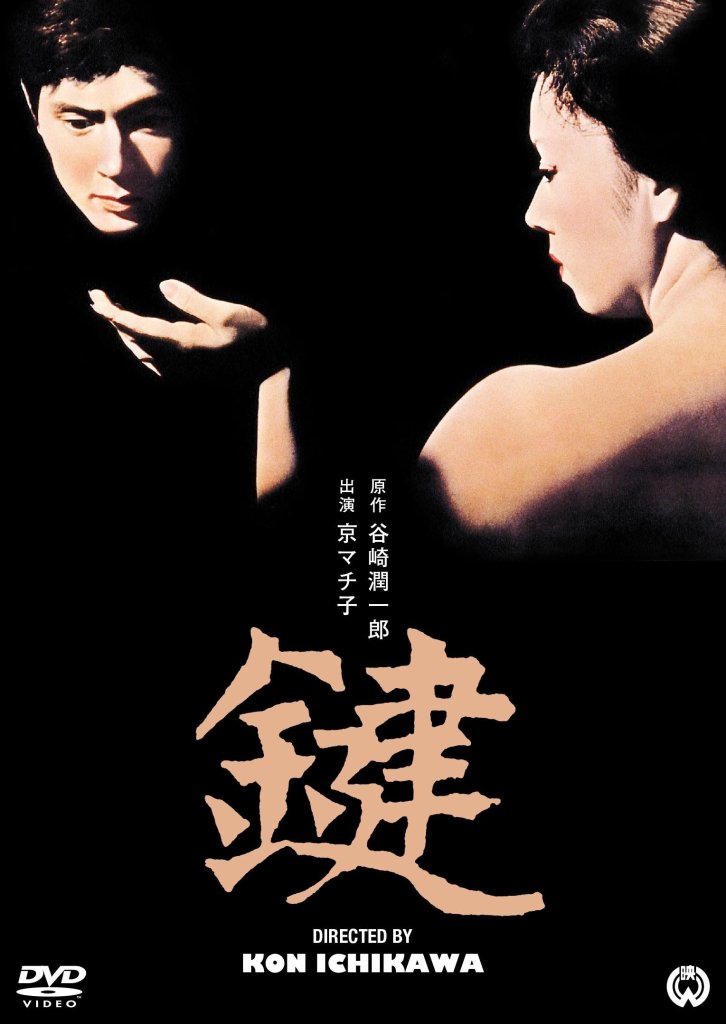
odd-obsessionJunichiro Tanizaki is widely regarded as one of the major Japanese literary figures of the twentieth century with his work frequently adapted for the cinema screen. Those most familiar with Kon Ichikawa’s art house leaning pictures such as war films The Burmese Harp or Fires on the Plain might find it quite an odd proposition but in many ways, there could be no finer match for Tanizaki’s subversive, darkly comic critiques of the baser elements of human nature than the otherwise wry director. Odd Obsession (鍵, Kagi) may be a strange title for this adaptation of Tanizaki’s well known later work The Key, but then again “odd obsessions” is good way of describing the majority of Tanizaki’s career. A tale of destructive sexuality, the odd obsession here is not so much pleasure or even dominance but a misplaced hope of sexuality as salvation, that the sheer force of stimulation arising from desire can in some way be harnessed to stave off the inevitable even if it entails a kind of personal abstinence.
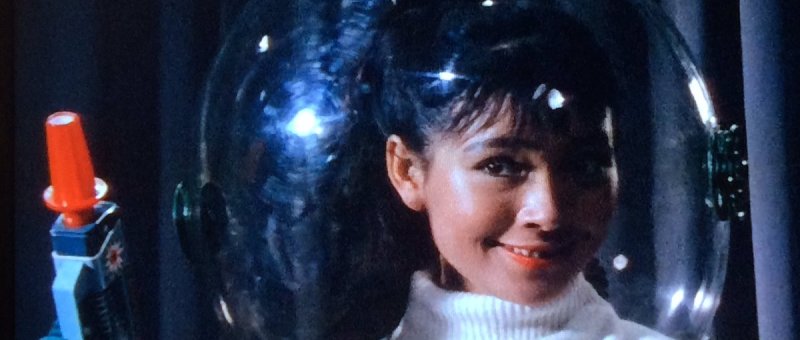
Our narrator for this sardonic tale is an ambitious young doctor, Kimura (Tatsuya Nakadai), who opens the film in an unusually meta fashion with a direct to camera address taking the form of a brief lecture on the decline of the human body (which begins at age ten and then gets progressively worse). Kimura reminds us that we too will grow old, but his warning is intended less to engender sympathy for the elderly patriarch who will become our secondary protagonist than it is to raise a grim spectre of the inescapability of death.

The story Kimura wants to tell us of a man who fought against senility centres on antiques expert and respected cultural critic Kenmochi (Ganjiro Nakamura). Advanced in years, Kenmochi is beginning to feel the darkness encroaching along with the desire to resist it through restored virility. For this reason, he’s been making regular appointments at Kimura’s clinic which he keeps secret from his wife who would be unhappy to know he’s been getting mysterious injections to help with his sex drive but which also come with a number of side effects including dangerously raising his blood pressure.

Eventually Ikuko (Machiko Kyo), Kenmochi’s slightly younger wife and mother of his grown up daughter Toshiko (Junko Kano), does indeed find out though what she does not appear to know is that Kenmochi has also been drugging her so that he can take photos of her naked body and enjoy his rights as her husband without her needing to be 100% present at the time. Kenmochi’s plan is to lure Kimura into having an affair with his wife so that the resultant jealousy will stimulate his system, staving off senility and other unwelcome effects of ageing. This would be strange enough on its own were it not that Kenmochi has also been trying to set up a marriage between Toshiko and Kimura who are already engaged in a discreet affair.

In contrast with the source material which takes the form of a number of diary entries providing differing perspectives on events, the film takes the point of view of the cynical and morally bankrupt doctor Kimura who feels himself above this “pathetic” old man with his sexual preoccupations and diminished prospects. As the narrator, Kimura evidently believes himself in control but Ichikawa is keen to play with our sense of the rules of storytelling to show him just how wrong he could be. Intrigue is everywhere. Kenmochi may think he’s using all around him in a clever game to prolong his own life but he’s entirely blind to a series of counter games which may be taking place behind his back.

Sex is quite literally a weapon – aimed at the heart of death. Kimura recounts a dream he sometimes has in which he is shot through the heart in an arid desert, only for this same scene to invade the mind of a paralysed Kenmochi on gazing at the naked body of his wife. The marriage of Kenmochi and Ikuko has apparently been a cold (and perhaps unhappy) one with Kenmochi berating his wife for remaining “priest’s daughter” all these years later, prudish and conventional. Nevertheless, Ikuko – the kimonoed figure of the traditional Japanese wife, subservient yet mysterious and melancholy, becomes the central pivot around which all the men turn, eclipsing her own daughter – a Westernised, sexually liberated young woman rendered undesirable in her very availability. Kimura is not quite the destructive interloper of Pasolini’s Theorem so much as he is a “key” used by Kenmochi to “unlock” a hidden capacity within himself but one which, as it turns out, opens many doors not all of them leading to intended, or expected, destinations.

Ichikawa continues with a more experimental approach than was his norm following the bold opening scene in which Kimura directly addresses the audience with a straight to camera monologue. A pointed symbolic sequence of a train coupling, freeze frames, dissolves and montages add to his alienated perspective as he adopts Kimura’s arch commentary on the ongoing disaster which is the extremely dysfunctional Kenmochi family home. Middle class and well to do, the Kenmochis’ lives are nevertheless empty – the house is mortgaged and the beautiful statues which taunt Kenmochi with their physical perfection have all already been sold though Kenmochi refuses to let the buyer take them home. Old age should burn and rave at close of day, but as the beautifully ironic ending makes plain it will be of little use, death is in the house wearing an all too familiar face which you will always fail to recognise.


Screened as part of the Japan Foundation Touring Film Programme 2017.

Opening scene (no subtitles)

Giants & Toys (巨人と玩具, Yasuzo Masumura, 1958)

91C6JzGDYTL._SL1500_

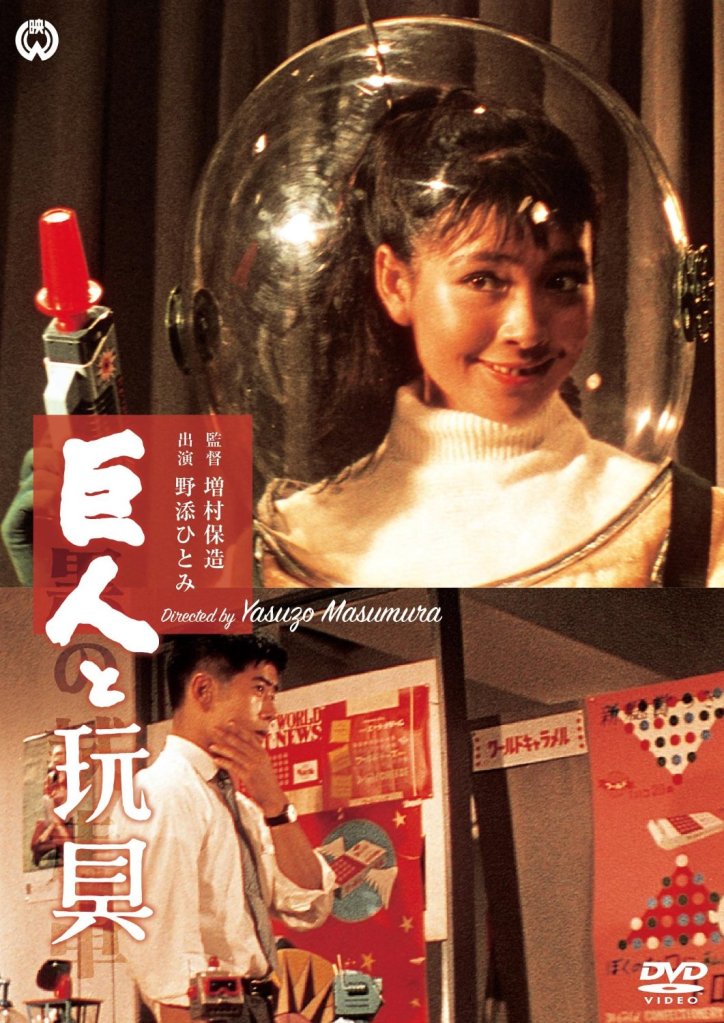
Less acerbic than Masumura’s later Black Test Car, Giants & Toys (巨人と玩具, Kyojin to gangu) is an altogether more humorous, if no less piercing look at post-war consumerism. This time the battle ground is confectionary as the Japanese sweets industry laments the all powerful American candies taking over the Japanese landscape. Three sweet companies are duking it out for the hearts of Japanese consumers and the hard working salarymen in the PR & marketing departments are becoming ever more desperate to find the key to becoming Japan’s top selling sweet maker.

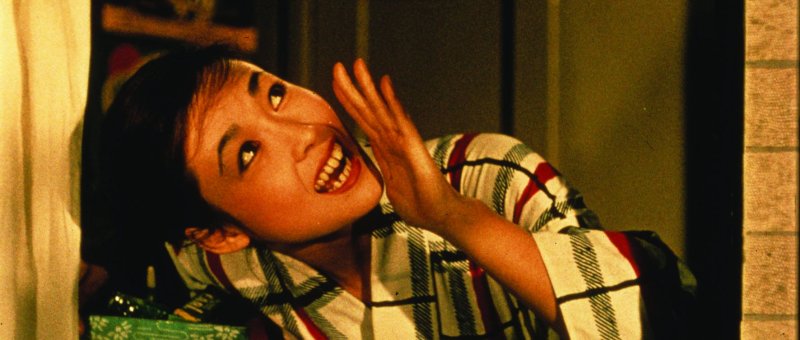
The three companies are Giant, Apollo and World, each of which is currently trying to come up with an advertising campaign which has a competition element that will really hook in the populace. Our main focus is with World whose top PR man, Goda, is currently stumped when he spots quirky hillbilly Kyoko in a bar and hatches on an idea to make her the central poster girl of his ad campaign. Kyoko is 18 with gap teeth and a childlike innocence that makes her a great fit for selling their confectionary products to the adult market. At the same time, Goda’s assistant Nishi meets an older female executive from Apollo who’s trying to shift a set of spacesuits. This fits in neatly with another of Goda’s space themed ideas and a suitably bizarre campaign is launched with the gangly Kyoko dressed up in a kitsch spacesuit and pointing a ray gun which is somehow supposed to encourage people to buy sweets. Kyoko is a hit! However, the more popular Kyoko becomes the more her innocent charms begin to dissipate. What will become of her, and of the campaign, as the competition mounts?

For an area that’s supposed to be so totally frivolous and cheerful, confectionary sales are serious business. Goda is working himself into an early grave just to sell sweets to grownups and old people. It’s advertising and marketing but like everything else in life it’s just so much spin. What they’re really trying to sell is frivolous fun and a return to childhood’s freedom all packed into a momentary suck on a salted caramel. In the Japan where “everyone works all the time” this may be quite an attractive idea, especially to the put upon members of the confectionary marketing board.

However, trivial as sweets are, they represent the fleeting unimportance of pop culture memes. During one of Kyoko’s recording sessions we meet one of the solitary female producers (labelled a “machine” by two of the other women waiting to be seen) who laments that a has been star keeps hassling her for work though her time has passed and no one’s interested. This is most likely how things will wind up for Kyoko, five minutes of being everywhere followed by a lifetime of being nowhere at all. After signing with World for their TV and radio advertising she becomes a break out personality attending events as a celebrity in her own right and later even becoming a pop star complete with a totally strange, South Pacific themed musical number referencing some kind of cannibalistic genocide where they’ll sell back the remains of the men they’ve killed to the native wives. Pointed satire in more ways than one.

Goda wants to build a kind of mass media dictatorship, cleverly controlling the public mood through all pervasive advertising (a prescient thought, if ever there was one). Having taken things too far, he’s taken to task by his underling, Nishi, who’s had a bit of a rethink following a series of heartbreaks involving friends and lovers. “I won’t sacrifice my dignity” he says, only to be shown doing just that a couple of minutes later as he himself dons the ridiculously camp space suit, takes the ray gun in hand and wanders out into the streets to be met by a series of bemused stares from the passersby. Eventually, the woman from Apollo with whom he’d been having an affair spots him and with an equally amused expression instructs him to “smile warmly”, at which point he grimaces before managing to turn it into a robotic grin.

Still oddly current, Giants & Toys is an absurdist’s guide to corporate politics where personal integrity is sacrificed on the altar of commerce. Everyone runs round in circles working hard to sell things no one really wants or needs to other hardworking people just to keep the wheel spinning. “Kanban Musume” come and go, one ridiculous meme follows another and we all just fall over ourselves to chase whichever unattainable ideal they pitch us. It would be nice to think the world has moved on since 1958, however…


Giants & Toys is available on R1 DVD with English subtitles courtesy of Fantoma.

Trailer