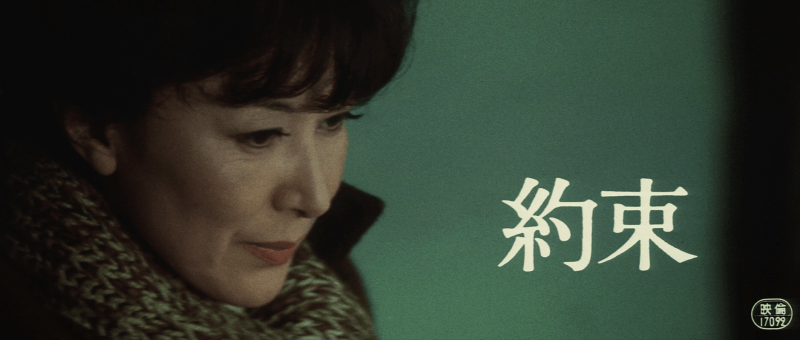
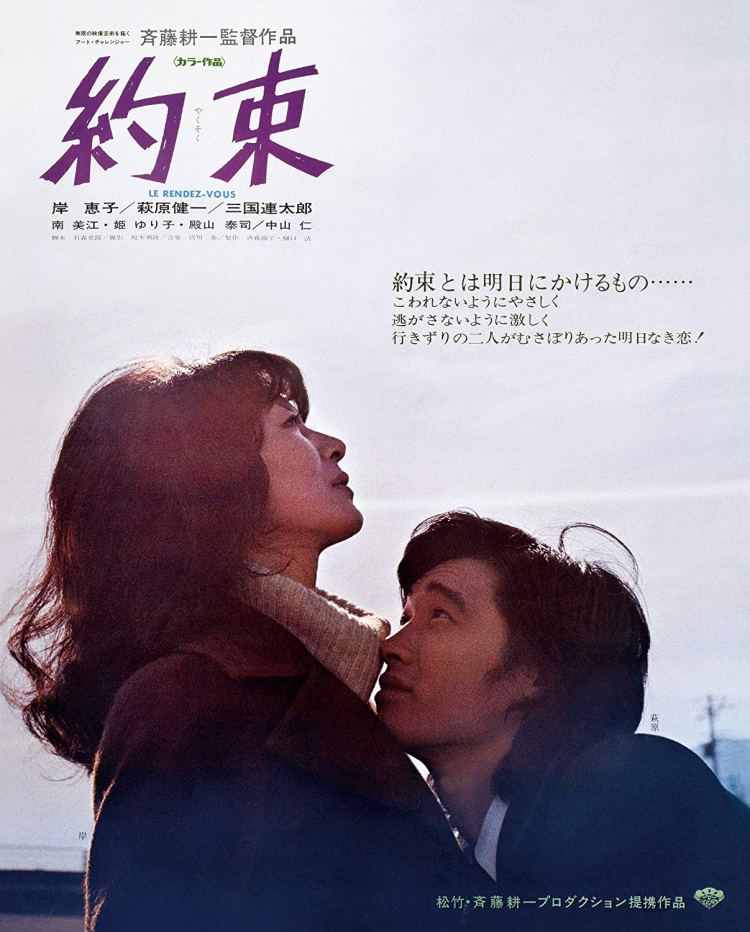
The Rendezvous (約束, Koichi Saito, 1972)

The Rendezvous poster“If human’s don’t trust each other, it’ll be the end of the world” – so says the cheerful hero at the heart of Koichi Saito’s The Rendezvous (約束, Yakusoku). Saito’s film is, somewhat unusually, a rare example of a Korean film remade in Japan. Inspired by Lee Man-hee’s Late Autumn (now sadly thought lost), The Rendezvous has been remade three times in Korea by such esteemed directors as Kim Ki-young (1975), Kim Soo-yong (1982) and most recently Kim Tae-young in 2010. There is indeed something particularly timeless in its tale of fate frustrating a fated love as each of our protagonists struggles to find the energy to rebel against their own sense of impossibility.

A brief framing sequence begins with a nervous, melancholy woman, Keiko (Keiko Kishi), sitting alone on a park bench, surrounded by the cheerful activity of athletes training, women pushing prams, and families enjoying the crisp sunshine. As she thinks back to what brought her here we travel back with her to a fateful train journey some years previously.

Keiko sits sadly by the window, impassively watching the sea stretch out as the train whizzes by. An older woman (Yoshie Minami) is sitting next to her, though they appear at least not to be on particularly friendly terms. At the first stop a younger man, Akira (Kenichi Hagiwara), gets on and sits down opposite Keiko, throwing a newspaper over his face, presumably to help him get some sleep (or, as we later wonder, perhaps just to better disappear). Intrigued, Keiko nevertheless shivers on catching sight of the paper’s headline – “Drunken Husband Stabbed to Death”. Knocking the paper off his head as she gets up to go to the bathroom, Keiko clips it back on for him with her hairpin – something that later gives him an excuse to talk to her when he eventually wakes up.

Akira, it turns out, is the chatty sort of person who enjoys making conversation with strangers. He makes a nuisance of himself trying to chat to Keiko and the old woman who ignore him, whilst accidentally frightening the bored little girl opposite by trying to entertain her. The ice finally thaws when Akira decides to buy everyone lunch – Keiko accepts and speaks to him if only to insist on paying him back (which the old lady then also feels compelled to do). Though very little actual conversation takes place on this first train journey, Akira is also travelling to the same small town as Keiko and continues to make a nuisance of himself by following her around. Nevertheless a connection begins to form between the pair, such perfect opposites in every way but one, though the time is always ticking and the encounter is one coloured by its impending end.

Keiko’s mysterious behaviour is later revealed to be more than just shyness or existential angst. Akira repeatedly asks for her trust, but she claims herself incapable of trusting anyone because in a sense she is already dead. Indeed, her entire aura is one of deliberate stillness, rarely speaking, and often leaning sadly against a more solid structure as if lacking the energy to fully support herself. Ironically enough, Keiko’s name is written with the character for “firefly” – a creature that burns out bright and then fades away. Keiko not only believes that her light has gone out, but that there are no more fireflies left. Akira, whose name is written not with the character for “bright” but with one for “cheerful”, begins to show her that there could be fireflies still, jokingly pointing to the lights from a nearby boat bobbing on the water.

We’re later told that the root of all Keiko’s suffering is “an absence of love”, that as passion cooled there was only emptiness in its place. “Emptiness” seems to be the force which defines Keiko’s existence, the reason her fire is out and her life apparently over. Though she feels a passionate attraction to Akira, she cannot bring herself to submit to it, both distrusting herself and afraid to face the possibility that it too will end. Both Keiko and Akira are fugitives from themselves, literally railroaded towards an inevitable conclusion they lack the courage to oppose. Akira wants to run, but Keiko knows she belongs on the train, incapable of escaping her self-imposed imprisonment and unwilling to step away from her unchanging destiny.

Fate follows them everywhere – violent headlines, prisoners being escorted, flashes of handcuffs, all reminding them that they are trapped, powerless in the face of an oncoming reckoning. Akira repeatedly asks Keiko to trust him, insisting that as long as she believes in him everything will be alright. Yet Akira is a flustered young man always in a hurry, running as if already late for the future. He makes Keiko a promise of a meeting and even gives her his watch to help her keep it, yet fails to appear. Akira’s heart may be trustworthy, but his body less so and even if he really wanted to come fate may have other plans. Love, it seems, is not enough. Saito returns to Keiko, sitting alone on the bench, waiting as the park empties and all the kids go home for tea. There’s no way to know if Akira can keep his promise even if he meant to, but perhaps there is something even so in the continued faith that he might simply bound in, hours late but as earnest as ever.

The central narrative seems to retain the Korean of sensibility of Lee’s original in its sense of dread and inevitability, and of passion repressed. Saito’s approach leans more towards misty European arthouse than your average Shochiku romance, making the most of its mystery as the time continues to run down for Keiko and Akira before they must prepare to meet their respective fates. Fate, at least, will wait for you and will always be there in the end. Impossibility defines the world of the defeated Keiko and the childlike Akira, but perhaps the most painful thing is hope itself, and the lingering faith that a promise will be kept despite the overwhelming odds.


Original trailer (no subtitles)
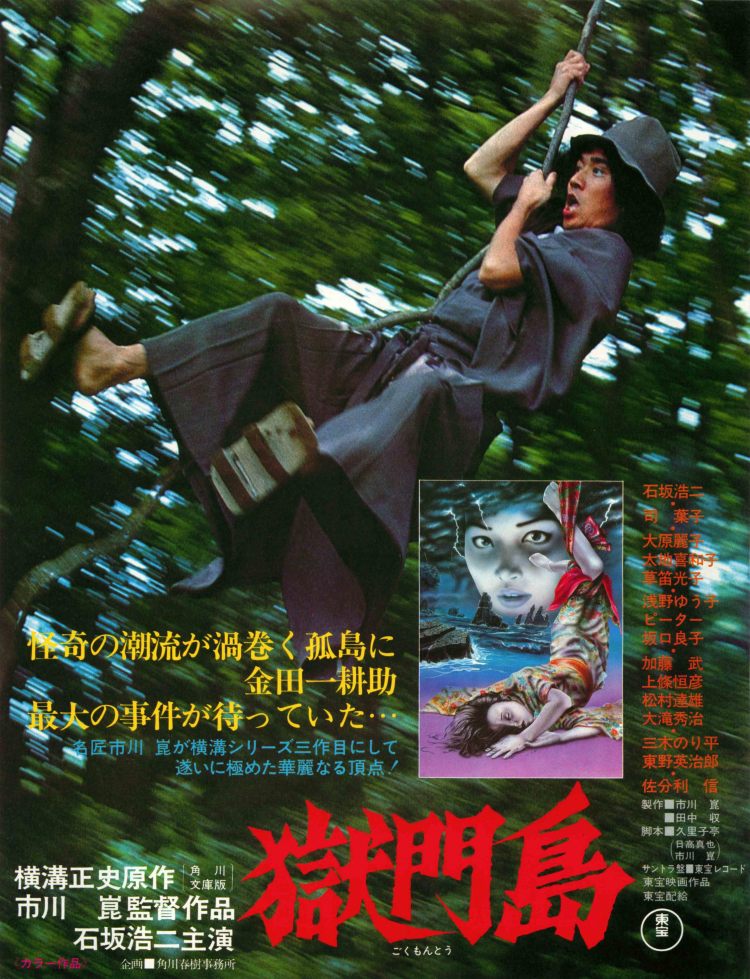
The Devil’s Island (獄門島, Kon Ichikawa, 1977)

Devil's Island posterKon Ichikawa revisits the world of Kosuke Kindaichi for the third time in Devil’s Island (獄門島, Gokumon-to). Confusingly enough, Devil’s Island is adapted from the second novel in the Kidaichi series and set a few years before Ichikawa’s previous adaptation The Devil’s Ballad (the twin devils are just a coincidence). As with his other Kindaichi adaptations, Ichikawa retains the immediate post-war setting of the novel though this time the war is both fore and background as our tale is set on profane soil, a pirate island once home to Japan’s most heinous exiled criminals, which is to say it is the literal fount of every social failing which has informed the last 20 years of turbulent militarist history.

In 1946, Kindaichi (Koji Ishizaka) travels to Kasaoka to catch the ferry to the island. On the way he runs into a demobbed soldier hobbling along on crutches only to catch sight of the man quickly picking his up crutches and running across the railway tracks when he thought no one was looking. Kindaichi is in luck – before he even reaches the boat he runs into the very man he’s come to see, Reverend Ryonen (Shin Saburi), for whom he has a message. Posing as a fellow soldier, Kindaichi reveals he has a “last letter” from a man named Chimata who sadly passed away right after the cessation of hostilities having contracted malaria. Chimata, as we later find out, was the legitimate heir of the island’s most prominent family. Kindaichi chooses not to reveal his true purpose, but the truth is that Chimata suspected his death would put his three younger sisters in danger from various unscrupulous family members attempting to subvert the succession.

Your average Japanese mystery is not, as it turns out, so far from Agatha Christie as one might assume and this is very much a tale of petty class concerns, island mores, and changing social conventions. The extremely confusing island hierarchy starts with the head of household who doubles as the head of the local fishing union and then shuffles out to the branch line and brassy sister-in-law Tomoe (Kiwako Taichi) who is keen claim all the authority she is entitled to. The old patriarch, Yosamatsu (Taketoshi Naito), went quite mad at the beginning of the war and is kept in a bamboo cage in the family compound where he screams and rails, only calmed by the gentle voice of Sanae (Reiko Ohara), a poor relation raised in the main house alongside her brother Hitoshi who hasn’t yet returned from the war. Aside from Yosamatsu, the absence of the two young men means the main house is now entirely inhabited by women, looked after by veteran maid Katsuno (Yoko Tsukasa).

Then again, Japanese mysteries hinge on riddles more than they depend on motives and there are certainly plenty of those on this weird little island where they don’t like “outsiders”. Ichikawa hints at the central conceit by flashing up haiku directly on the screen along with a few original chapter headings for Kindaichi whose eccentricities might seem less noticeable in such an obviously crazy place but strangely seem all the more overt, his trademark dandruff falling like rain from his tousled hair. It has to be said that Kindaichi fails in his otherwise pure hearted aims – he doesn’t make a great deal of effort to “save” the sisters and only attempts to solve the crimes as they occur, each one informing the next. This time around he gets trouble from both irritatingly bumbling detective Todoroki (Takeshi Kato) and his assistant Bando (Kazunaga Tsuji) , and the local bobby who immediately locks Kindaichi up and declares the crimes solved on the grounds that they only started happening after Kindaichi arrived.

Meanwhile, there are rumours of an escaped “pirate” running loose, demobbed soldiers, and a host of dark local customs contrasting strongly with the idyllic scenery and the strange “pureness” of this remote island otherwise untouched by the war’s folly save for the immediate events entirely precipitated by the absence of two young men taken away to die on foreign shores. Though the various motives for the crimes are older – shame, greed, classism, a bizarre dispute between Buddhists and Shamans, none of this would have been happening if the war hadn’t stuck its nose into island business and unbalanced the complex local hierarchy. Tragically, the crimes themselves all come to nought as a late arriving piece of news renders them null and void. Just when you think you’ve won, the rug is pulled from under you and the war wins again. Ichikawa opts for a for a defiantly straightforward style but adopts a few interesting editing techniques including fast cutting to insert tiny flashbacks as our various suspects suddenly remember a few “relevant” details. This strange island, imbued with ancient evils carried from the mainland, finds itself not quite as immune from national struggles as it once thought though perhaps manages to right itself through finally admitting the truth and acknowledging the sheer lunacy that led to the sorry events in which it has recently become embroiled.


Original trailer (no subtitles)

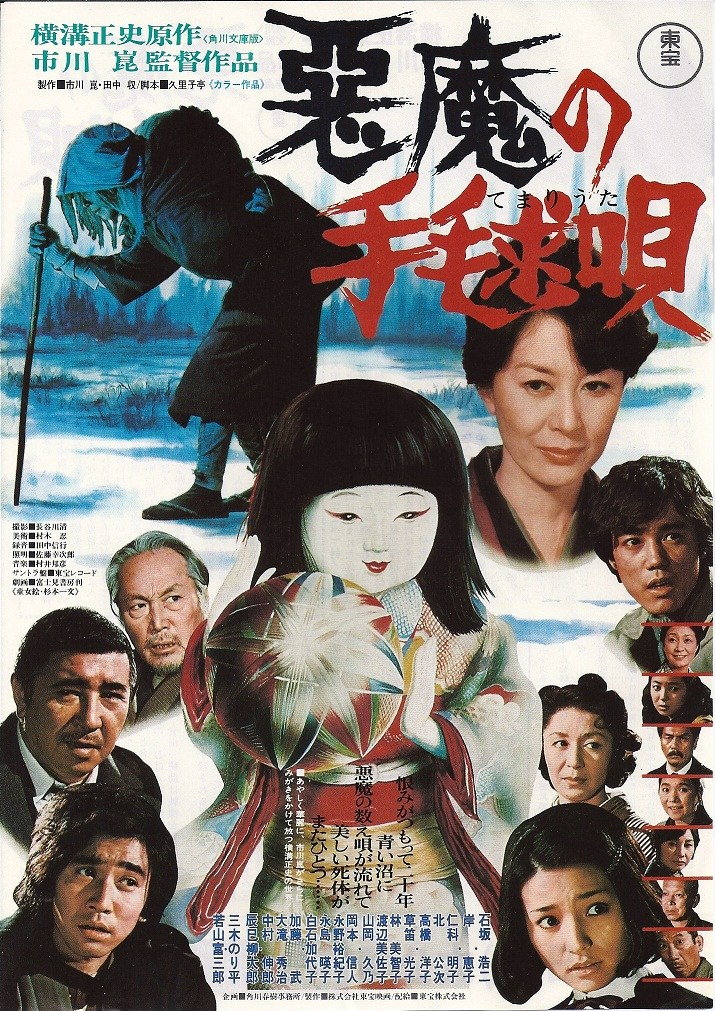
The Devil’s Ballad (悪魔の手毬唄, Kon Ichikawa, 1977)

Devil's Ballad posterA year after his box office smash The Inugami Family, Kon Ichikawa returns to the world of eccentric detective Kosuke Kindaichi with The Devil’s Ballad (悪魔の手毬唄, Akuma no Temari Uta). Like many a Kindaichi mystery, Devil’s Ballad finds him called upon to delve back into the past to satisfy an ageing detective’s anxiety about an old case, only to be faced with a series of new ones as a consequence. This time, however, the mystery leans less on buried secrets than deeply held grudges, betrayals, and lingering feudal feuds as the post-war society tries and fails to free itself from ancient oppressions.

The film opens with a tryst between two adolescent lovers in the ominously named “Devil’s Skull Village” in 1950. Yasu (Yoko Takahashi), the girl, is at pains to let her boyfriend, Kanao (Koji Kita), know that she is keen to take the relationship to the next level but he is old fashioned and wants to wait until their union is formalised. The pair are interrupted by some of their friends who are in the middle of planning a celebration for a visit from a girl who moved to the city, Chie (Akiko Nishina). Meanwhile, Kindaichi (Koji Ishizaka) has arrived at the inn owned by Kanao’s mother Rika (Keiko Kishi) on invitation from a retired policeman, Isokawa (Tomisaburo Wakayama), who wants Kindaichi to look into the murder of Rika’s husband twenty years ago. Isokawa, then a young rookie, is convinced that Rika’s husband was not the victim but the murderer and the corpse actually belonged to another man entirely – Onda, a drifter who defrauded half the village with a wreath making scam.

Rika and her children – 20-year-old Kanao and his younger sister Satoko (Eiko Nagashima) who has prominent facial birthmarks and rarely leaves the house, came to the village with her husband and are therefore slightly divorced from the longstanding social rivalries. The village has two noble families – the Yuras and the Nires. Feeling the need to modernise, the Nires bet everything on vineyards and it paid off. The Yuras, by contrast, were defrauded by Onda’s wreath scam and lost their fortune and social standing. Yasu, Kanao’s girlfriend, is a daughter of the Yuras, but the Nire’s have been petitioning Rika for quite some time to have her son marry their daughter, Fumiko (Yukiko Nagano), who also has a crush on him (though this is largely irrelevant to her father’s dynastic ambitions). When the younger generation start getting bumped off in ways eerily similar to a local folk song, Kindaichi and Isokawa are on the case, wondering if these new murders have anything to do with their old one.

Despite its 1950 setting, Devil’s Ballad is unusual in resolutely making an irrelevance of the war which only receives a brief mention as an explanation for why some of the case files have been destroyed and for why marriage is such a hot button issue given the lack of men and abundance of women. Nevertheless, the crimes span a turbulent 20 years of Japanese history with the original murder taking place in the early ‘30s during a period of economic instability following the Manchurian Incident. In the socially conservative pre-war era, it seems Onda also got around and may have fathered several illegitimate children with women in the village, some of them noble, some not. These buried secrets seem primed to bubble to the surface now that the children are coming of age and marriage again becomes an issue as worried parents try to think of acceptable ways to block potentially “inappropriate” matches without sending their children off into ruinous elopements or tipping off the wrong people that their kids may not be their kids.

The crimes themselves, old fashioned as they are, are partly reactions to a changing society. We discover that the reason Rika and her husband were forced to come back to the village was that their showbiz careers were stalling – she was a vaudeville performer specialising in shamisen, and he a “benshi” (narrator of silent films) who became convinced his job was obsolete after witnessing a subtitled print of Morocco. Likewise, the two rival families cannot let go of their petty provincial privileges, and as Kanao angrily snaps back at his mother, Japan is now a democratic country and he is free to choose his own wife at a time of his own choosing with or without parental blessing. This remote village is perhaps isolated from the privations of the post-war world but it’s also stuck in the past, hung up on past transgressions and unable to move forward into the new era. However, the primary motivations for murder are as old as time – guilt, humiliation, and self preservation.

Ichikawa keeps things simple but splices in a few strange, avant-garde sequences of kokeshi dolls menacingly bouncing balls coupled with shifts to black and white, fast-paced reaction shots, and stuttering still frame sequences all while Kindaichi showers innocent passersby with his famous dandruff, the idiot police officer continues to offer ridiculous theories while his sergeant dutifully follows him around, and the local bobby perfects a line in hilarious pratfalls. Overlong at two and a half hours and falling prey to the curse of the prestige crime drama in spoiling its mystery through casting, the Devil’s Ballad may not be the best of the Kindaichi mysteries but offers enough of a satisfying twist to prove worthy of the Kindaichi name.


Original trailer (no subtitles)
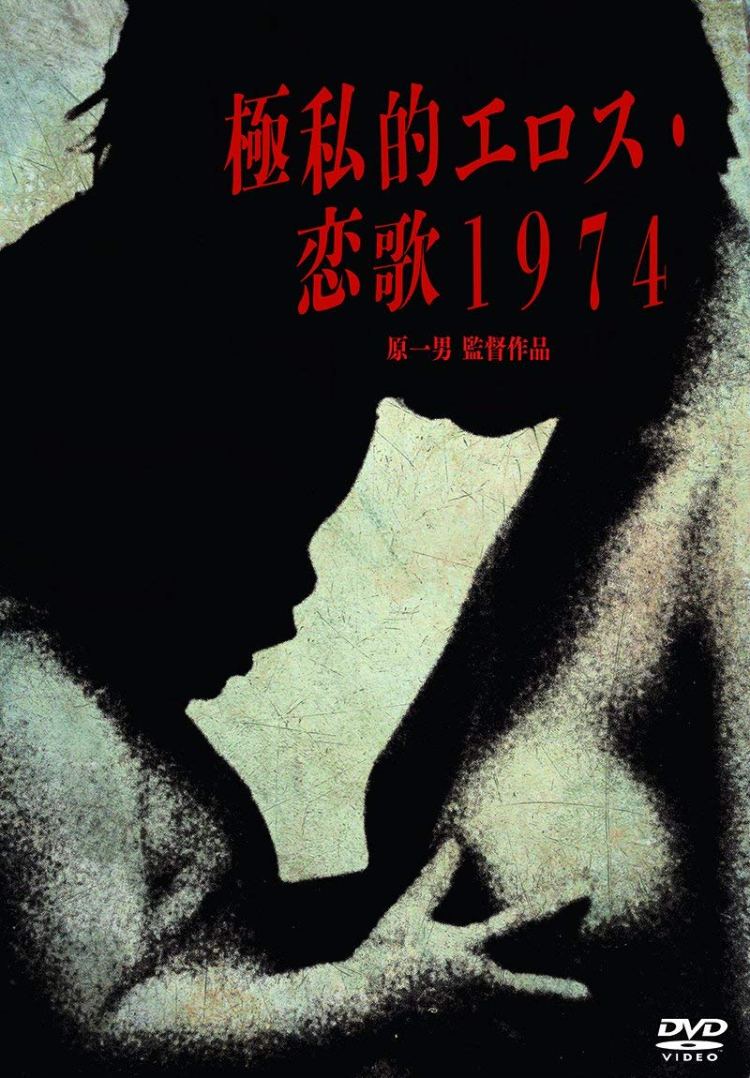
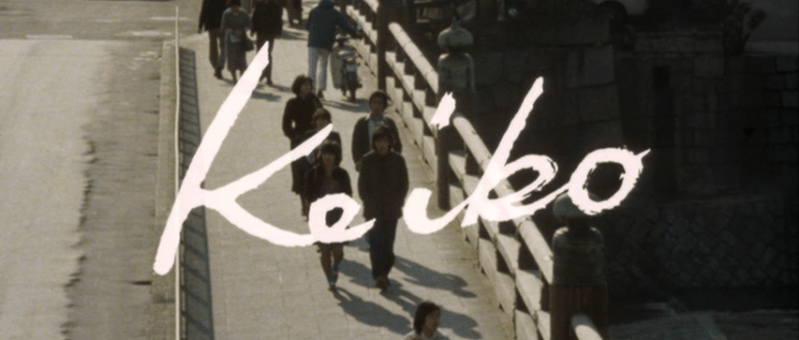
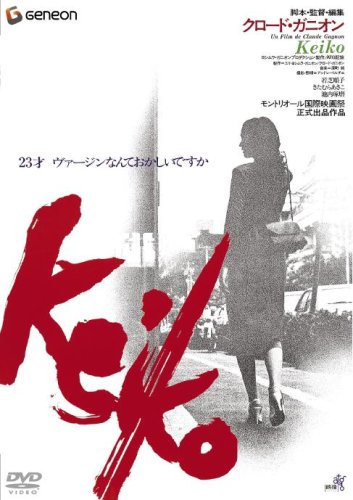
Keiko (Claude Gagnon, 1979)

Keiko DVD coverThe Art Theatre Guild of Japan found itself in an awkward position in the late ‘70s. The kind of politically charged art cinema which had been its mainstay throughout the ‘60s was now out of fashion in the post-Asama Sanso world. The studio was then looking for new, young, dynamic voices who could potentially have something equally new and radical to offer to the the mid-’70s Japanese cinema scene which increasingly leaned towards the populist. That is perhaps how they came to work with émigré French Canadian filmmaker Claude Gagnon, distributing his independently produced debut feature Keiko. Gagnon’s film was nothing if not atypical of the time, dealing with the relatively taboo subject of female sexuality and the patriarchal society and doing it with a lens influenced more by European arthouse and New American cinema than by that of Japan or by the avant-garde movement which had forged ATG’s central ethos.

As the title implies, the tale revolves around the titular Keiko (Junko Wakashiba) – a 23-year-old office worker preoccupied with her lack of romantic success. Hoping to find a potential boyfriend, she spends her evenings in cafes, often staying until closing before going home alone. Embarrassed to still be a virgin at 23, she invites her old high school teacher (married with two children) out for a drink and they wind up in a love hotel but if Keiko thought losing her virginity would give her more confidence in dating she couldn’t be more wrong.

Soon enough she ends up in another “relationship” with a guy she meets in cafe but it’s obvious to everyone but Keiko that he is just using her for sex. Masaru (Takuma Ikeuchi), a photographer, constantly talks about himself and his work, refusing to go “out” on dates and preferring to simply arrive at Keiko’s flat and then leave again once he gets what he came for, claiming that his “mother” is waiting up for him at home. Eventually Keiko’s suspicions get the better of her and she finds out he is already married with children. The affair ends, leaving Keiko resentful and broken hearted. She drifts into a relationship with a colleague (Toshio Hashimoto) who is nice enough but Keiko isn’t really interested in him. Then something unexpected happens – a drunken experience with a female colleague leads to the most fulfilling and happiest period of her life but she is also plagued by calls from home about arranged marriages and “settling down”.

Told from Keiko’s perspective, Gagnon’s film paints a bleak picture of female existence in ‘70s Japan. Keiko’s office lady job is only really a stop gap ahead of a marriage and even at 23 she’s beginning to panic about finding a husband before her father finds one for her. She is shy and demure, modest and innocent as her society demands her to be, but she is also lonely. The camera finds her sitting alone at tables meant for four, the bars and cafes often completely empty save for her as they approach closing time. Keiko waits until the last minute, telling the girl behind the counter that she’s nothing much to do at home, but there’s nothing much to do in the bar either and she simply sits there all alone not talking to anyone, waiting for someone to take an interest only they rarely do.

Following the first few unsuccessful encounters with men, Keiko is initially confused by the unexpected interest from female colleague Kazuyo (Akiko Kitamura). Kazuyo, free spirited and independent, is perhaps portrayed more stereotypically with her short hair and tendency to dress in an overtly “masculine” fashion outside of work but few seem to have picked up on these seemingly “obvious” clues and she remains free to live her life in the way in which she chooses. Unlike Masaru who left in the middle of the night, Kazuyo is still around the next morning and not only that, she offers to cook breakfast and even takes a trip to the pharmacy to pick up some aspirin for Keiko’s sore head. Somewhat mystified by the whole affair and Kazuyo’s kindly consideration the morning after, Keiko tells her it might be better to forget about what happened the night before which Kazuyo again accepts without rancour.

Touched by all this maturity, Keiko begins to look at Kazuyo differently, and eventually decides to take a chance on something different. Before long they’ve taken an apartment together a little way out of town and begun building a life for themselves. Kazuyo is thinking about the future – she wants to start her own business and wants Keiko to help her, but the need for additional capital has her staying out evenings working in bars to earn extra money while Keiko is still getting letters from home about marriages.

Told entirely from Keiko’s perspective, Gagnon’s script veers away from its most interesting questions – why someone would willing abandon the greatest happiness they have ever felt and are certain they ever will feel to succumb to societal pressure to conform. Keiko’s oppression is almost taken as read, a constant background presence that never thinks to explain itself. Yet she is a grown woman (as she tries to point out to her father) who could simply have refused to take phone calls or answer letters. She has the power to say no to an arranged marriage, even if she perhaps does not have the power to live openly with Kazuyo as a married couple might. The film offers few explanations why she continues to placate a father she doesn’t like very much who lives a long way away save for leaving it at a need to be accounted “successful” in the eyes of society even if that conventional “success” is destined to make her very unhappy.

Gagnon’s approach is informed by European arthouse and to a lesser extent by contemporary New American cinema in attempting to create a kind of cinematic naturalism that exists in direct contrast to the expressive acting styles often found in more populist entertainment. He demonstrates the inertia of Keiko’s life by capturing her stillness, the scenes remain the same – only the outfits have changed. The camera pulls away from her as if it’s almost painful to do so, emphasising her loneliness and isolation as she remains trapped and alone in a society which abhors individualism but in reality cares little for individuals. The conformist society and its entrenched patriarchal social codes conspire to destroy happiness in order to maintain “stability”, condemning each to a particularly individual kind of misery from which it seems impossible to escape.


Original trailer (no subtitles)
Extreme Private Eros: Love Song 1974 (極私的エロス 恋歌1974, Kazuo Hara, 1974)

Extreme private eros 1974If you’re going to use your camera to interrogate the world, perhaps it’s only fair to let the world interrogate you by means of your own camera. Kazuo Hara’s second documentary is about as personal as its possible to get – a detached, rational examination of the interplay between the director and his subject who happens to be his former lover and the mother of his child. A thinly veiled excuse to maintain contact with a woman who had abandoned him and taken his child with her, Extreme Private Eros: Love Song 1974 (極私的エロス 恋歌1974, Gokushiteki Eros: Renka 1974) is both a tiny snapshot of a nation in flux, and a timeless exploration of the end of love.

Hara and his former lover Miyuki Takeda had lived together for three years and even had a child when she abruptly announced that she no longer wanted to live under the authority of a man or as a member of a “traditional” family and intended to leave in order to live a life of complete independence. Although the relationship was officially over, Miyuki maintained contact with Hara and visited him more or less weekly so it was an additional shock when she suddenly announced she was moving to Okinawa. However, Miyuki made a strange request of her former lover – that he film her attempt to give birth without assistance. Hoping to remain close to her or perhaps to attempt to understand better the reasoning behind her erratic behaviour, Hara agrees.

In Okinawa, Miyuki has moved in with another woman, Sugako, but the relationship between them appears strained and ill defined. Hara’s arrival, he eventually realises, is yet another disruptive influence in this already fraught environment but it’s unclear whether his camera is a deliberate or accidental witness to a series of extremely difficult, not to mention private, conversations taking place in front of a third party in which Miyuki berates her silent roommate for rejecting her desire for a full and exclusive relationship in favour of continuing to sleep with her friend Tommy.

When the relationship with Sugako breaks down, Miyuki takes up with a black GI, Paul, who later becomes the father of the child she intends to birth alone. Though interviewing Miyuki alongside Paul (who speaks no Japanese) is a mild and dispassionate affair, interviewing Miyuki alone about her new lover and the basis of their relationship sends Hara into a spiral of jealousy and despair in which he eventually cedes control of his camera to an assistant and appears on screen breaking down in tears. Wondering if Miyuki is as accidentally jealous of him as he is of Miyuki, Hara muddies the waters by inviting his own new lover, Sachiko – who is also pregnant with his child, to assist him in the making of the documentary. Hara gets his wish. Miyuki is indeed jealous, angrily barking at Sachiko while running down her former lover in every conceivable way, and yet the two women eventually end up bonding, once again excluding Hara from his own attempt at narrative.

The perspective is indeed Hara’s – his weary voiceover and occasionally passive aggressive, exasperated intertitles making plain his own confusion and continued searching for the central question of what exactly he’s trying to achieve, but Miyuki wrestles with him for overall control and to assert her right of ownership over her own story (or at least the presentation of it). Miyuki’s quest seems to be one of total independence – she rejects the world of the patriarchal family, later rejecting love entirely and resolving to live without a man or woman, but remains firmly within its standard ideological parameters in recasting herself as the embodiment of selfless motherhood. She rejects the ideas of traditional Japanese femininity, insisting that her children are raised to be aggressive rather than meek or gentle or kind and going so far as to reject these supposedly feminised qualities as she sees them in her own son as reflections of those same qualities she eventually found unappealing in Hara. She becomes obsessed with the idea of mixed-race children, perhaps as an extension of her desire for a non-Japanese idea of individualism, but later tells her new born daughter that Japan is good and America bad, and pens a damning letter of advice to the women of Okinawa warning them off deceitful GIs.

Miyuki is a woman with scant respect for boundaries and so Hara is granted near unrestricted access to the entirety of her existence as she pursues her various desires and contradictory convictions. Hara’s camera is both unobtrusive and powerfully present, privy to extremely private thoughts and conversations and only occasionally inserting itself into the narrative but unafraid to embrace taboos while perhaps also conflicted in its own defiant pursuit of emotional honesty at all costs. In attempting to capture his subject Hara illuminates both himself and his society, exposing painful truths and unwelcome prejudices but perhaps allowing them to fester unresolved in a future which is both open yet also uncertain.


Extreme Private Eros: Love Song 1974 was screened as part of a Kazuo Hara focus at Open City Documentary Festival 2018.

Trailer (English subtitles)

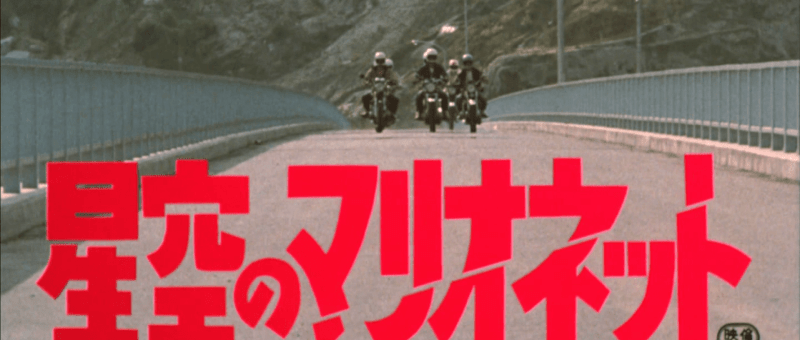
Puppets Under Starry Skies (星空のマリオネット, Hojin Hashiura, 1978)

Puppets under starry skies posterThe youth movie had been the populist rebellion against the stately Japanese cinema of the golden age, but many of its representative directors had quickly tired of the restrictive studio system. Some had decamped into the “independent” arena which offered relative artistic freedom if without the resources and financial rewards of the commercial sector. The Art Theatre Guild had provided a valuable outlet for experimental film since it began to shift from distribution of foreign films into production of Japanese language art movies, but paradoxically the early 1970s saw it shift again as the studio’s “arthouse” aims fell by the wayside and more conventional youth films made a gradual return. Puppets Under Starry Skies (星空のマリオネット, Hoshizora no Marionette), the first of three films directed by Hojin Hashiura for ATG (aside from an earlier 16mm independent effort, the only films Hashiura would ever make), is very much a youth movie in the new ATG mould which is to say its tone is one of sadness rather than anger as its protagonists find themselves adrift in the changing 1970s society, unable to find their place in the world their parents have been building for them.

Hideo (Yoichi Miura), leader of small biker gang, is best friends with Hiroshi (Kazuhito Takei) – an effeminate young man from a wealthy family who likes to wear makeup and dress in (slightly) flamboyant outfits. The trouble starts when Hideo picks a fight with a rival gang boss and then charges in for a rematch to avenge his honour only to be set on by thugs, stabbed, and beaten so badly he winds up in hospital for over a week. Humiliated, Hideo loses all his gang member friends with only Hiroshi sticking by him. Later he takes up with a local bar girl, Akemi (Ako), who has a promiscuous past and is already pregnant with another man’s child. Together the three attempt to find a way forward into a more conventional adulthood but struggle to find a place for themselves within a rigidly conformist society which has already rejected them.

Parental disconnection seems to be a recurrent theme in the lives of each of the troubled youngsters. Hideo lost his mother young, not long after they’d moved into the town from the mountains. Never having been able to come to terms with his mother’s death he has a difficult relationship with his father and takes out his frustrations through meaningless violence and male posturing. Akemi too has a difficult family background but this time with a single mother who is a former sex worker turned publican. Working in a local bar (not her mother’s) Akemi is harassed by the customers but is well known for being open to casual sex, suffering a degree of social stigma both because of her liberated attitude and because of her mother’s former profession.

Hiroshi’s problems are perhaps of a different order. From an “elite” family, he feels himself entirely disconnected from normal family life and has been raised in an atmosphere of cold austerity rather than parental love. Hiroshi believes this is partly because he has “bad blood” and is cursed beyond redemption. He is not his father’s biological son but the child of a sperm donor enlisted to ensure an heir for his father’s bloodline. Hiroshi, however, is gay and will not be able fulfil the purpose he was born for, at least not in the way that was expected of him. He is also effeminate, something of which his family do not approve, and feels himself excluded from mainstream society because of his sexual orientation. To combat his feelings of intense alienation, Hiroshi has become a drug user, sniffing glue in order to send himself on psychedelic trips to outer space in which he merges with the deep blue vacuum free of all worldly concerns.

Hideo too gets in on the glue sniffing act but feels himself becoming one with the river of life and death, feeling it flow through him as he flows with it. The river itself, and the idea of passive resignation that comes of simply allowing oneself to float, becomes a grim symbol of the futility that faces Hideo as he struggles to reassemble an identity in a world which consistently denies him one. The future looks bleak for each of our protagonists, the only one with any sense of hope once again investing it in the system which has already betrayed her – the family. Youth looks for new models, new standards by which to live, but does not find them. Puppets of fate, the trio dance under starry skies until the sun comes up and they realise that the day holds nothing for them except the nihilistic desire for its end.


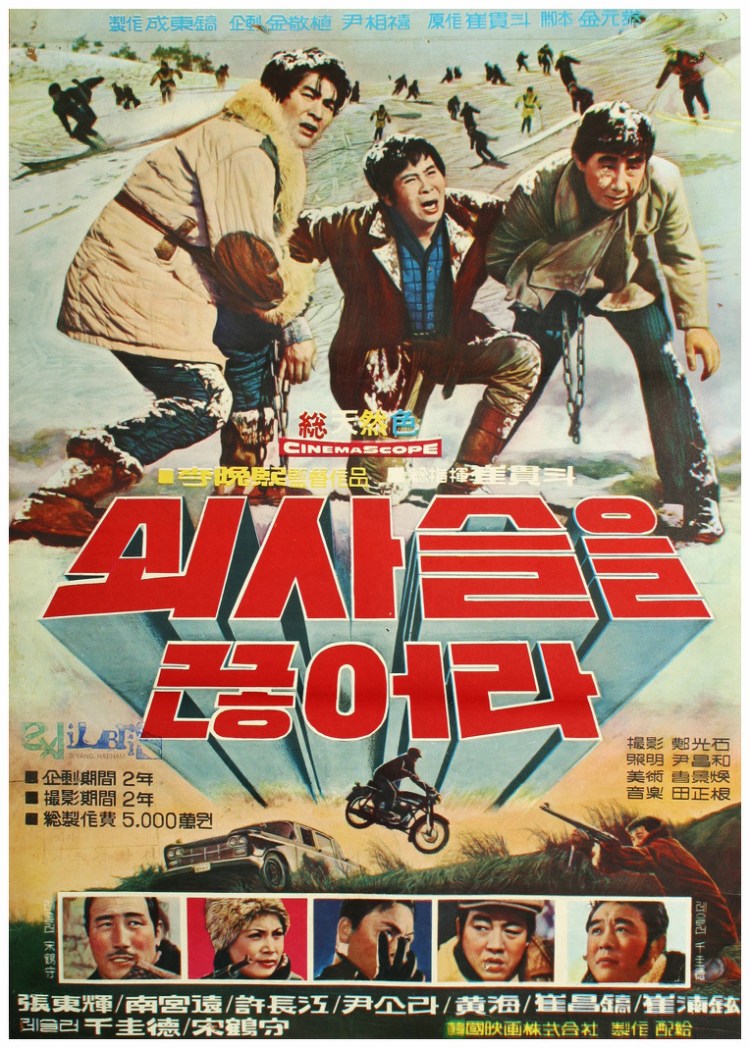
Break up the Chain (쇠사슬을 끊어라, Lee Man-hee, 1971)

Break Up the Chain poster1970 had been a difficult year for Lee Man-hee. A conflict on the set of The Goboi Bridge in which Lee intended to star against the advice of his regular team resulted in the end of his creative relationship with screenwriter Baek Gyeol and cinematographer Lee Suck-ki. Meanwhile, he’d also suffered a crisis in his personal life after parting ways with actress Moon Jeong-suk who had been both a lover and a muse. To top it all off he also had some financial problems and didn’t work at all for the year following Goboi Bridge’s release – a significant period of time in the high-speed world of early ‘70s Korean cinema in which it was not unheard of for a director to make as many as 10 films in one year. Break Up the Chain (쇠사슬을 끊어라, Shwisaseuleul Geunheola) was intended to be something of a “come back” but it finds Lee defeated, doing what he does best but also playing the game he never really wanted to play in succumbing to the patriotism epic (albeit a little tongue in cheek).

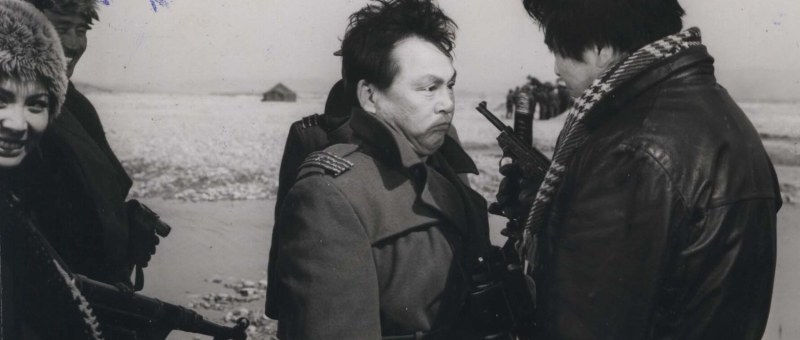
Riffing off Sergio Leone, Lee frames his resistance romp as a Manchurian western. A mysterious golden Buddhist statue has more than just monetary value as it also contains a list of the names of resistance operatives which can be revealed with the use of a special chemical formula. Three men are after it – Cheol-su (Namkoong Won), an adventurer for hire who might or might not be working for the resistance; Tae-ho (Jang Dong-hwi), a petty gangster; and Dal-geon (Heo Jang-kang), a collaborator working with the Japanese. The men are each interested in the statue for selfish reasons – Cheol-su for his reputation, Tae-ho for the money, and Dal-geon for the prestige. None of them is interested in the resistance movement itself, the statue’s importance in relation to it, or anything really beyond themselves and their day-to-day lives.

Of course, as this is a patriotism epic, the men eventually come round to the greatness of Korea as their individual quests converge and they find themselves alongside the resistance surrounded by the Japanese. The Japanese are largely a bumbling bunch who remain unaware of the statue’s “real” power even whilst holding it, thinking only of its monetary value as a lump of gold or work of art they could export abroad for financial gain. Confronted and faced with failure, the leader of the Japanese is firstly humiliated by his defeat at the hands of the resistance but then decides to show them the greatness of the Japanese army by committing Harakiri right there on the spot. Stripping off the captain begins to get cold feet, suddenly struck by the enormity of the moment when one of his lieutenants draws his sword ready for the beheading. The Japanese captain then seems to come down with “a cold” and resolves to visit the medical tent instead.

The early drama revolves around the interplay of the three self-interested outsiders as they scheme and plot to make use of each other and get the statue for themselves. Of the three, Cheol-su emerges as the most “noble” even though his quest is mercenary enough – his name is his business and thus he wants the statue to fulfil his contract and maintain his sense of integrity as a gun for hire. Tae-ho is merely interested in financial gain with a mild desire for social revenge and the thrill of outsmarting a rival, but both men are filled with an intense distaste for men like Dal-geon who have “betrayed” the countrymen they too have refused to serve. That aside, Tae-ho and Dal-geon begin to form a weak alliance of the opportunistic as they bond in their mercenary intentions, while Cheol-su lingers on the outside as his quest ties him more closely with the independence movement. Eventually the trio realise they have to work together to get the statue, even if their ultimate intention is to double cross the others and keep it for themselves. They do however suddenly rediscover their patriotic spirit, resolving to give the statue to the people who need to most while they ride off into the sunset in search of other ways to serve their country.

Set in dusty Manchuria (where the resistance movement operated in exile), Break Up the Chain is part of the short-lived boom of Korean “westerns” which were popular in the late ‘60s and early ‘70s. Lee abandons his experimental ambitions and aims squarely for the populist, reaching only for post-modern irony in his boys own adventure story filled with feats of daring do and flight on horseback. Yet he comforts himself with that sense of irony, pulling away from the absurd adventures of our heroes to show the faces of men dying in snow reminding us that their flight from the horror of war was perhaps a rational one rather than an act of cowardice or a failure of patriotism. Nevertheless, Lee seems to be at odds with himself as he gives in (to a point) and presents a silly story of amoral chancers suddenly rediscovering their “Koreanness” in the barren wastelands of Manchuria but does so with a sense of bitterness which conspires to rob the tale of its childish sense of fun.


Available to stream online via the Korean Film Archive’s YouTube Channel.

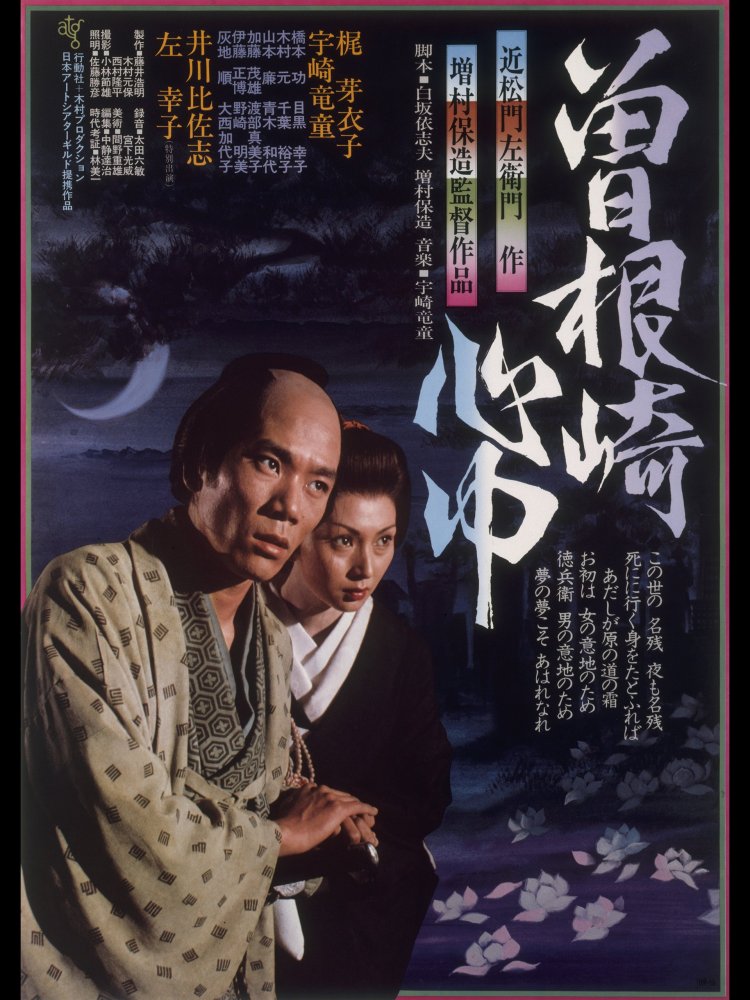
Double Suicide at Sonezaki (曽根崎心中, Yasuzo Masumura, 1978)

Love Suicides at Sonezaki posterAfter spending the vast majority of his career at Daiei, Yasuzo Masumura found himself at something of a loose end when the studio went bankrupt in the early ‘70s. Working as a freelance director for hire he made the best of what was available to him, even contributing an instalment in former Daiei star Shinataro Katsu’s series of period exploitation films, Hanzo the Razor: The Snare. There is, however, a particular shift in the famously fearless director’s point of view in these later films as his erotically charged grotesquery begins to soften into something more like an aching sadness in the crushing sense of defeat and impossibility which seems to consume each of his heroes. Maintaining the contemporary groove of Lullaby of the Earth – an uncharacteristically new age inflected tale of a naive orphan from the mountains tricked into the sex trade through a desire to see the sea, Double Suicide at Sonezaki (曽根崎心中, Sonezaki Shinju, AKA Love Suicides at Sonezaki / Double Suicides of Sonezaki, Double Suicide in Sonezaki) is a melancholy exploration of the limitations of love as a path to freedom in which the demands of a conformist, hierarchical society erode the will of those who refuse to compromise their personal integrity on its behalf until they finally accept that there is no way in which they can possibility continue to live inside it.

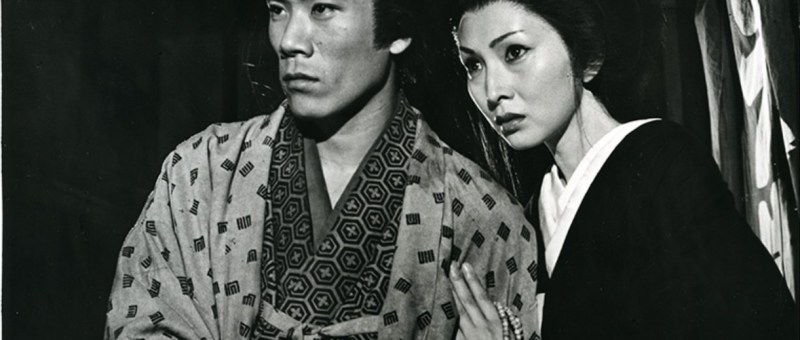
Ohatsu (Meiko Kaji), the geisha, has fallen in love with a client – Tokubei (Ryudo Uzaki), who is a humble man taken in by an uncle with the intention that he take over his soy-sauce shop. No longer the relationship between a prostitute and a customer, Ohatsu refuses to take Tokubei’s money which begins to cause friction with her “master” at the brothel to whom she still owes a significant debt. Tokubei does not possess the resources to redeem her, nor is he ever likely to. Matters are forced to a crisis point when each of them is offered what would usually be thought the best possible option for their respected social paths. Tokubei is offered the hand in marriage of his aunt’s niece and the chance to set up his own shop in Edo but it isn’t what he wants because he wants Ohatsu. Similarly, Ohatsu is sought by a wealthy client who wants to buy her and take her home as a mistress – she tries to refuse but has to play along given her relative lack of agency, longing to be with Tokubei or no one at all. Tokubei is thrown out by his uncle for refusing the marriage and finds himself the difficult position of having to reclaim dowry money from his greedy step-mother only to be conned out of it by an unscrupulous “friend”, Kuheiji (Isao Hashimoto), who later frames him to make it look like Tokubei cheated him. Beaten and ostracised, Tokubei sees no escape from his shame other than through an “honourable” death and Ohatsu sees no life for herself without her love.

Inspired by Chikamatsu’s world of double suicides, Masumura adopts a deliberately theatrical method of expression in which the cast perform in a heightened and rhythmic style intended to evoke the classical stage of Japan. Yet he also makes a point of scoring the film with contemporary folk and jazz as if this wasn’t such an old story after all. Times may be more permissive, but perhaps there’s no more freedom in love than there ever was and the pure dream of happiness in romantic fulfilment no more possible.

The forces that keep Tokubei and Ohatsu apart are only partly those unique to the feudal world – debt bondages and filial obligations being much weakened if not altogether absent in the post-war society, but are almost entirely due to their lack of individual agency and impossibility of freeing themselves from the various systems which oppress them. Tokubei is a poor boy from the country whose father has died. He has been taken in by an uncle and trained up as an heir – something he is grateful for and has worked hard to repay, but will not sacrifice his individual desire in order to accept the path laid down for him.

Ohatsu, in a more difficult position, is oppressed not only by her poverty but by her gender. Sold to a brothel she is subject to debt bondage and viewed only as a commodity, never as a person. When she intervenes to stop Tokubei being beaten by Kuheiji’s thugs, her patron panics but only because he will lose his money if she is “damaged”. Similarly, the brothel owner complains for the same reason after some ruckus at the inn. Neither of them are very much bothered about Ohatsu in herself but solely in her functionality as tool for making money or making merry respectively.

“Money is better, money means everything” claims Tokubei’s angry step-mother and she certainly seems to have a point as both of our lovers struggle through their lack of it. In the end it’s not so much money but “shame” which condemns them to a sad and lonely death as they realise they can no longer live with themselves in this cruel and unforgiving world which refuses them all hope or possibility for the future. An honourable man, Tokubei cannot live with such slander – men die for honour, and women for love, as Ohatsu puts it. Ironically enough there was a chance for them but it came too late as Kuheiji’s machinations begin to blow back on him and Tokubei’s uncle begins to regret his overhasty disowning of his nephew, but the world is still too impure for such pure souls and so they cannot stay.

Unlike some of Masumura’s earlier work, there’s a sadness and an innocence implicit in Double Suicide at Sonezaki that leaves defiance to one side only to pick it up again as the lovers decry their love too pure to survive in an impure world. The world does not deserve their love, and so they decide to leave it, freeing themselves from the “shame” of living through the purifying ritual of death. Softer and sadder, the message is not so far from the director’s earlier assertions save for being bleaker, leaving no space for love in an oppressive and conformist society which demands a negation of the soul as the price for acceptance into its world of cold austerity. 


Opening (no subtitles)

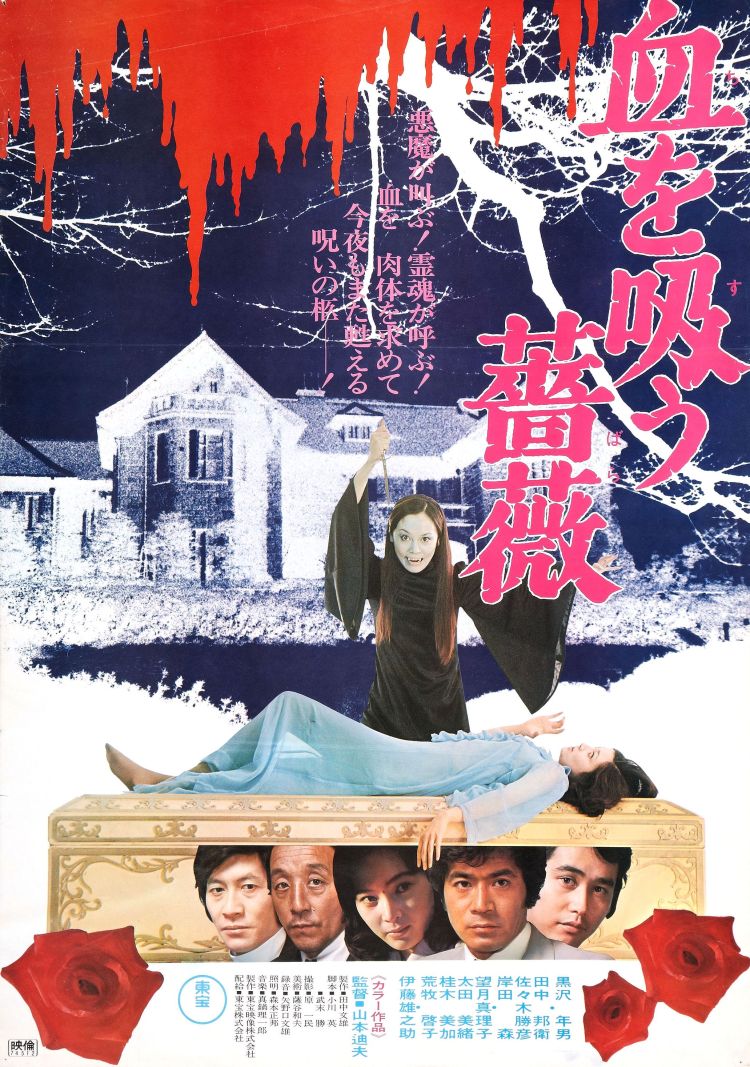
Evil of Dracula (血を吸う薔薇, Michio Yamamoto, 1974)

Evil of Dracula posterThe first two of Michio Yamamoto’s “vampire” movies for Toho made a valiant attempt to repurpose the idea of the bloodsucking ghoul to explore something other than their usual reason for being. In The Vampire Doll, the vampiress at the centre was a knife wilding, grudge bearing ghost of vengeance in keeping with the familiar image from Japanese folklore. In Lake of Dracula, Dracula was (uncomfortably) a bearer of bad blood and a symbol of the destructive capabilities of a repressed memory. Evil of Dracula (血を吸う薔薇, Chi wo Su Bara) takes us back to source as this time Dracula really is a sex crazed, bloodsucking maniac with a sideline in strange ambitions which include being the headmaster of an all girls’ high school in a no horse town somewhere in the frozen north.

Professor Shiraki (Toshio Kurosawa) gets off the train in a tiny provincial town but there’s no welcoming party there to great him. The station seems to work on an honour system and he drops his money in the box, but when Shiraki walks past the ticket office there is an employee, only he seems to be allergic to customers. The attendant gruffly explains that there are no busses running today and goes back to his paper, leaving Shiraki to wonder what to do next. Someone from the school he’ll shortly be working at eventually comes to fetch him but Mr. Yoshii (Katsuhiko Sasaki) is a bit strange too. It’s nothing, however, next to his new employer (Shin Kishida) whom, he learns, was widowed a few days ago when his wife died in a terrible car accident. In fact the headmaster’s wife is still at rest in the cellar – a “local custom” apparently demands holding off on burial for seven days while praying for the deceased’s “resurrection”. Shiraki is surprised to learn from the headmaster that he is being groomed as a potential successor which is why he asks him to stay over so they can get to know each other better. Whilst there, however, Shiraki has a “dream” in which he’s attacked by (he presumes) the headmaster’s wife and another much younger woman dressed in blue…

Evil of Dracula situates itself neatly in the middle of the girls’ school exposé, upping the camp factor with its overexcited adolescent girls apparently chomping at the bit for a little male attention. Shiraki is the new psychology teacher and one would expect him to be a paragon of ethics and an astute judge of character. He is, however, very much of his time and has a distinctly ‘70s approach to sexual politics. When the girls, flirting with him while he (refusing to deflect) appears flattered, complain to him about the “creepy” Mr. Yoshii who keeps leering at them from behind chainlink fences, he tells them Yoshii can’t be blamed because the girls are all so pretty to which they giggle and turn coy. Of course, they’ve all instantly fallen in love with Mr. Shiraki but unbeknownst to them there’s much more going on with creepy guys at the school than they could ever have guessed.

Shiraki finds out a girl recently went missing (apparently that’s something that happens often enough that no one thinks much of it), and can’t get it out of his mind that that’s the girl he saw in his “dream” even though he obviously didn’t know what she looked like. Meanwhile another of his charges, Kyoko (Keiko Aramaki), has turned pale and entered a semi-catatonic state. Her friends have agreed to stay behind and look after her while everyone else goes on vacation but Shiraki remains worried, especially as the school’s folklore obsessed doctor (Kunie Tanaka) has told him what happened to his predecessor.

Yamamoto goes back to source in partially blaming the girls for being led to destruction, allowing their nascent sexuality to pull them into the path of a supernatural evil rather than remaining chaste and innocent as schoolgirls should, punishing them for being flattered when Shiraki (with a slightly condescending air) tells them they can’t be annoyed by men looking them because that’s their fault too in being so very “pretty”. This time around the vampires like to bite their prey above the heart which takes us into the artier realms of exploitation as blood drips salacious from the girls’ bared breasts, though Yamamoto does his best to mitigate the sleaze factor by pushing a heavily romanticised gothic aesthetic complete with innocent white roses which ultimately turn a violent blood red once the vampires have had their way.

Once again, the “corruption” is foreign born though this time it has a Japanese catalyst, as folklore expert Dr. Shimomura explains. Long ago, a European washed up in Japan after a shipwreck, but he was a Christian when Christianity was illegal. He was persecuted, they made him betray his god and it turned him into a bloodsucking demon whose rage has lived on through a succession of Japanese hosts for more than a century. Why he particularly wants to be the headmaster of an elite girls boarding school in the middle of nowhere is never explained but it does at least seem to give him ready access not only to young and innocent victims, but also to weak willed minions.

The police, deciding vampires aren’t in their remit, declare themselves disinterested leaving Shiraki all that stands between the innocent young girls and the bloodsucking predator. The atmosphere is florid in the extreme, each frame filled with a macabre beauty as bodies fall artfully and vampires move with the elegance of dancers, but Yamamato also gives free reign to Hammer-inflected camp humour as hands almost wave from an open coffin behind the still unsuspecting Shiraki and the headmaster comes to a sticky end on the point of his own poker. Repeating the death motif from the second film which itself echoed Christopher Lee’s demise in the 1958 Hammer classic, romanticism is where Yamamoto chooses to end as his vampires decay, melting into skeletons but together, caught in one last gesture of an oddly eternal “love”.


Evil of Dracula is the third of three films included in Arrow’s Bloodthirsty Trilogy box set which also includes extensive liner notes by Jasper Sharp detailing the history of vampires and horror cinema in Japan.

Original trailer (no subtitles)

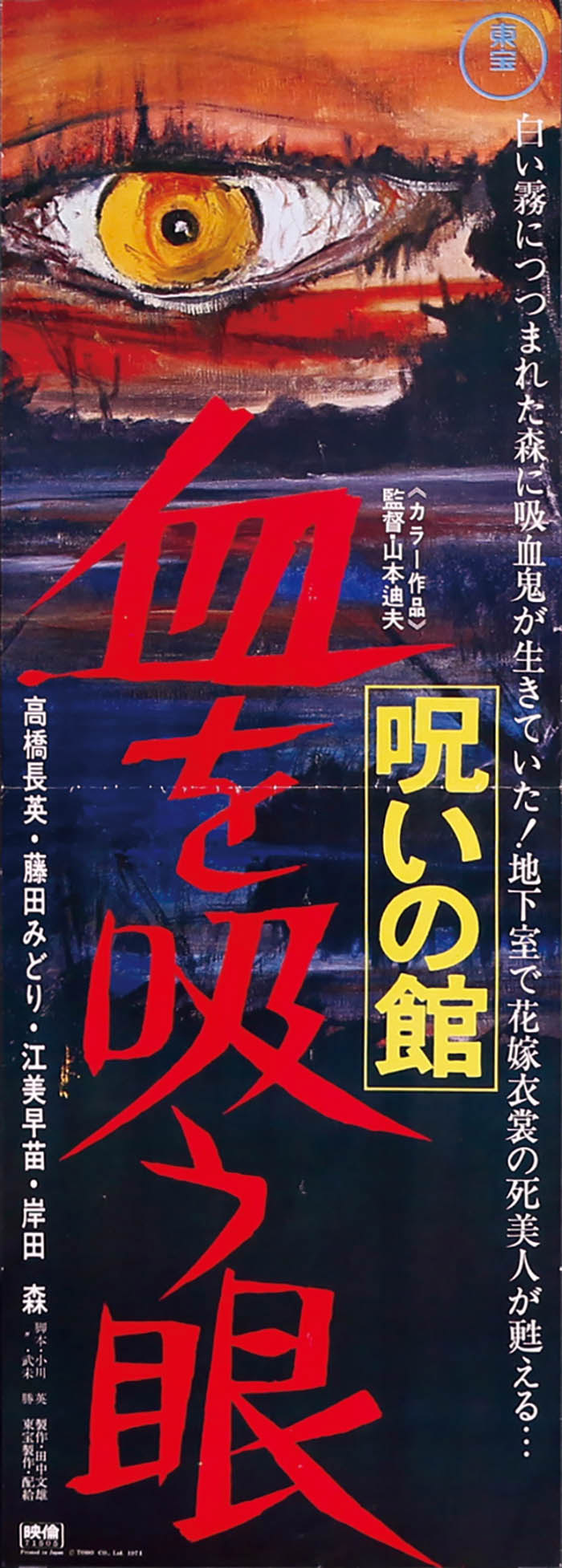
Lake of Dracula (呪いの館 血を吸う眼, Michio Yamamoto, 1971)

Lake of Dracula posterThe Vampire Doll, the first in a loose trilogy of films along vampiric themes released by Toho in the 1970s, had done its best to relocate Hammer-style horror to contemporary Japan. Adopting the best of the gothic from thundery skies to creepy mansions in the middle of nowhere, Vampire Doll successfully merged the Japanese longhaired grudge bearing ghost with the “romantic” bloodsucking tragedy of a young woman corrupted by illicit desires (though in this case for revenge). Returning to the theme a year later, Michio Yamamoto steps away from Japanese folklore altogether and positions his “foreign” Dracula as a “living” embodiment of repressed trauma, sucking the life out of his unwitting enemy until she finally learns to remember him, burning him away in the bright sunlight of his own eye.

Unlike Vampire Doll, Lake of Dracula (呪いの館 血を吸う眼, Noroi no Yakata: Chi wo Su Me) begins with a short prologue in which some children play on a rocky outcrop underneath a strangely ominous pink sky. When little Akiko’s pet dog Leo uncharacteristically runs off, she follows him and he leads her straight into the path of danger. Finding herself in a creepy mansion complete with stained glass windows and a dead body posed at a piano, the last thing that Akiko remembers is the pale face of a strange man with golden eyes and blood staining his chin.

Flashforward 20 years and Akiko (Midori Fujita) is a school teacher still living with her younger sister Natsuko (Sanae Emi) in their childhood home. She is convinced her traumatic childhood incident must have been a dream though it continues to haunt her enough to be a frequent subject in her artwork including a striking canvas she has just completed featuring a frightening golden eye looming over a tiny girl and her dog. Akiko has nice boyfriend, Takashi (Choei Takahashi), who is a doctor in the city, and all things considered a pretty nice life. Sadly it is not to last.

The trouble begins when someone randomly delivers a coffin to the local boathouse. First Akiko’s dog goes missing, then her trusted uncle figure tries to attack her before running off never to be seen again. Meanwhile, at Takashi’s hospital, a young “runaway” has been brought in in a catatonic state though no one can find much wrong with her until Takashi spots two suspicious bite marks on her neck. In case you’d forgotten about Natsuko, she has also begun behaving strangely – offering snide comments to her sister, going out alone in the middle of the night, and most alarmingly she has begun to grow pale.

Like Vampire Doll, Lake of Dracula is also an experimental vampire movie hybrid – a B-movie stalker picture in which Dracula is the creepy guy who can’t seem to take no for an answer. Yamamoto films the “naturalistic” action in standard Toho fashion but shifts into a higher register for his conception of heightened vampiric romanticism as Akiko’s “dream” erupts under a blood red sky and eventually leads her to an artfully appointed gothic cottage in which even the dead bodies are tastefully arranged.

Yet what Dracula comes to represent is the soul sucking power of the repressed past. Akiko has largely been able to move past her traumatic childhood adventure, convincing herself it was nothing more than a dream, and seems to be living a pleasant enough life even if her paintings betray her continuing anxiety. As we later find out, it is not quite so much the episode itself as the refusal to accept it which has caused Akiko so many problems – not least a buried rift with her treasured sister resulting from unfortunate sibling rivalry never fully dealt with both because of the incident and the early death of their parents. Akiko, resentful of having a new sister who had “displaced” her in her parents’ affections, sought to win back her rightful place by being the ideal child – good and obedient. Hence when no one believed her about the creepy house and strange man, she backed down, let them tell her it was only a dream to avoid being thought argumentative. Now she wonders if Natsuko harboured ill will towards her too for “stealing” back her parents’ love through her crazy story and perhaps relegating her to second place when she had become used to first.

Familial love becomes an odd kind of theme as we discover Dracula had a father of his own – a descendent of non-Japanese immigrants who had purposefully built a creepy mansion in the middle of nowhere in order to limit the possibility of his “bad blood” wreaking havoc in the world. The bad blood apparently skips a generation here and there and so Dracula, the third generation, is the first to be affected by it. His father tried to sacrifice himself to control his son, but now the demon is loose and is after Akiko who, creepily enough, seems to have caught his eye all those years ago (when she was five!) and he is determined to make her his “wife”. Vampirising someone’s sister is probably not a good way to win their heart, but Dracula, oddly, has never been very good at conventional romance.

Dracula’s “foreign” origins are perhaps an uncomfortable nod back to the xenophobic nature of the vampire myth. Despite being 3/4 Japanese and born and raised in Japan, Dracula’s late in the game exposure as not properly “Japanese” enough unfortunately reinforces the idea that “mixed” blood is somehow “impure”, even dangerous, and that even those who’ve spent their lives in Japan are not the same as those who are descended from long lines fully recorded 100% Japanese ancestors. Thus the danger becomes a “foreign object” which must be expelled to restore the integrity of the whole.

Restoring integrity is Akiko’s quest as she, along with her doctor boyfriend, attempts to solve the mystery through revisiting her traumatic childhood incident and finally learns to put it behind her. Yamamoto’s direction shifts between standard B-movie naturalism and florid avant-garde compositions but perhaps fails to capitalise on their inherent theatricality. Picking up the pace for the final set piece, Yamamoto also allows himself to go grim in taking a leaf directly out of the Hammer book by lifting the final death scene from the Christopher Lee starring Hammer Horror from 1958 in his crumbling, melting vampire, not to mention the other decomposing corpse resting in the house whose skin slides sickeningly from his body. A strange, hybrid adventure, Lake of Dracula makes an early attempt to pair the vampire chiller with serial killer thriller and does so moderately successfully even if its psychology remains firmly within the realms of the B-movie.


Lake of Dracula is the second of three films included in Arrow’s Bloodthirsty Trilogy box set which also includes extensive liner notes by Jasper Sharp detailing the history of vampires and horror cinema in Japan.

Original trailer (no subtitles)