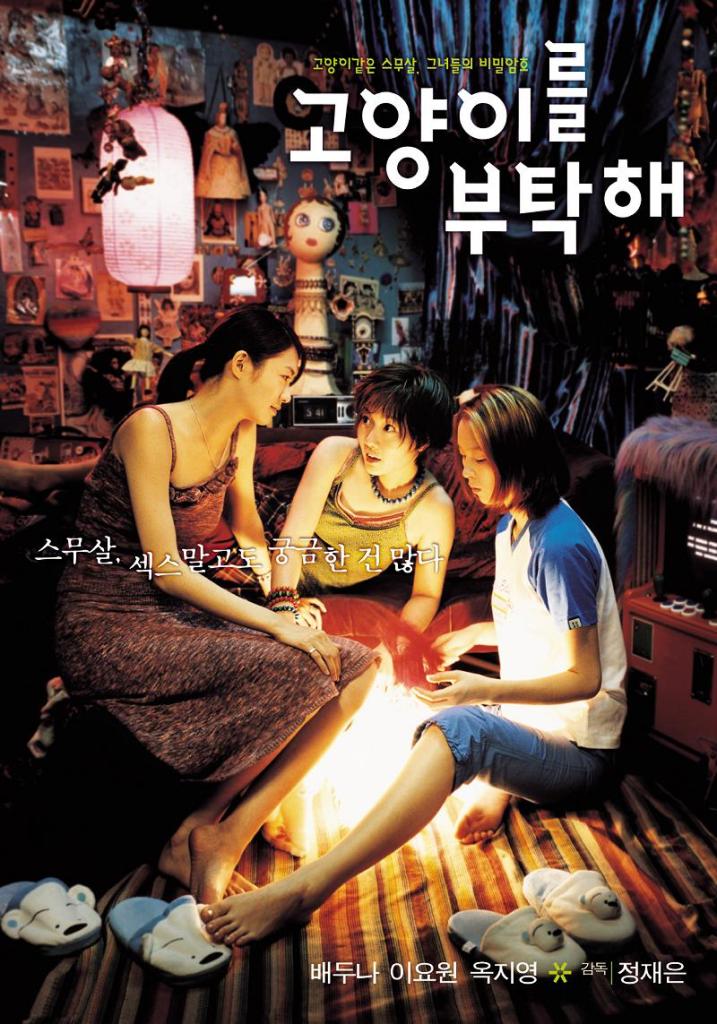
 The time after high school is often destabilising as even once close groups of friends find themselves being pulled in all kinds of different directions. So it is for the group of five young women at the centre of Jeong Jae-eun’s debut feature, Take Care of My Cat (고양이를 부탁해, Goyangileul Butaghae). All at or around 20, the age of majority in Korea, the girls were a tightly banded unit during high school but have all sought different paths on leaving. Lynchpin Tae-hee (Bae Doo-na) is responsible for trying to keep the gang together through organising regular meet ups but it’s getting harder to get everyone in the same place and minor differences which hardly mattered during school grow ever wider as adulthood sets in.
Cheerful scenes of high school mischief give way to the uncertain present as five old friends prepare to celebrate the 20th birthday of the group’s self appointed star, Hye-joo (Lee Yo-won). Hye-joo, however, has moved on to a high level office job in Seoul and is about to blow off her high school friends to hang out with her possibly sleazy boss, only to revert back to plan A when he cancels on her. Too cowardly to ring her friends in person, Hye-joo leaves the business of calling off the party to the chief organiser, Tae-hee, who rings round letting the other three girls – jobless Ji-young (Ok Ji-young), and half Chinese twins Bi-ryu (Lee Eun-sil) and Ohn-jo (Lee Eun-ju), know (and presumably has to then ring them all back to tell them the party’s back on).
Hye-joo moved farthest away from her roots both in terms of location and of her social ambitions through taking a well paid admin job in the city. Increasingly materialistic and status orientated, her friendship with the other girls suffers as she sees herself as transitioning to a higher social class. Ironically, her views are equally deluded as she continues to believe that her dedication and willingness to work hard can make up for her lack of a degree but quickly finds herself displaced when the next batch of newbies arrive.
This growing desire for material status has also contributed to a seemingly unbridgeable rift with Ji-young whose economic status is the most vulnerable. Orphaned and living in a shack with her elderly grandparents, Ji-young has recently lost her job and is having difficulty finding another one precisely because of her circumstances – one firm even point blank refuses her application because both of her parents are dead and they need a direct family member to vouch for her. Hye-joo is insensitive in the extreme and often flashes her money around whilst rubbing salt in Ji-young’s wounds by emphasising her lack of it and pouring cold water over her ideas of saving money to study abroad. Small digs like these and insisting that all the girls leave their home town to visit her in Seoul (leaving aside the additional costs for Ji-young whom she knows is having difficulty making ends meet) point to Hye-joon’s own sense of neediness and insecurity.
As a result, Ji-young distances herself from her friends, ashamed of her desperation and feeling unable to ask them for help. It is she who finds the cat of the title when she hears it mewing whilst trapped behind debris on her way home. The cat becomes almost a mirror of Ji-young – alone and abandoned on the streets with no one to look after her. Originally, Ji-young tries to give the kitten to Hye-joon as a birthday present only to have it immediately returned. The cat is then passed around among each of the friends looking for a more permanent kind of affection, but finding little in the way of stability.
The longest and most devoted guardian turns out to be Tae-hee who is perhaps most affected by the loss of her friends and changing circumstances. Tae-hee is from a moderately well off middle class family and has been helping out in her father’s business since leaving school (apparently without pay). Despite her lack of worry over material comforts, she finds herself feeling restless and increasingly interested in the “foreign” with dreams of taking off alone for adventures overseas. Her desire for freedom is partly down to her domineering father who simply overrules all of her decisions even down to ordering food in a restaurant. Tae-hee is the only one to reach out to Ji-young when she realises she might be in trouble and is the only one still there for her at the end. Their economic and familial circumstances may be different, but in their desire to escape the confines of the rundown Incheon for something outside of what it might have planned for them, the two girls are a perfect match.
Of the group of friends the twins receive the least attention, hovering on the sidelines, separate from the mini dramas erupting between the insensitive and self obsessed Hye-joo and the increasingly desperate Tae-hee and Ji-young. As a unit of two they have their own little world which seems much happier and more solid than that of any of the other girls and arguably have less need for the immediacy of their old friendships. They are therefore the ideal place to deposit them, in the form of a stray cat finally finding a home. The past has its place – in the past, the memories are warm and fluffy and deserve to be taken care of, but there comes a time you have to surrender full custody and be content to visit from time to time.
An extraordinarily well composed debut feature, Take Care of My Cat has a more European feeling than many a Korean coming of age drama but is filled with realistic detail such as the constant ringing of the girls’ ever present mobile phones and the onscreen representation of their straightforward text based conversation. There’s a kind of sadness associated with the transition from carefree adolescence to the difficult journey into adulthood with each of the girls discovering what it is they want out of life, or more aptly what it is they don’t want. Hye-joo emerges as the quasi-villain of the piece as she makes an obvious, superficial choice to follow the consumerist trend over valuing human relationships though it’s hard not to feel sorry for her when it appears she’s being set up for disappointment. Ending on a note of hopeful uncertainty, Jeong’s debut feature is a hymn to the theme of moving on but is careful to admit the bittersweet quality of a new beginning.
International trailer (English subtitles)
 The family drama is a mainstay of Japanese cinema, true, but, it’s a far wider genre than might be assumed. The rays fracture out from Ozu through to
  Sometimes God’s comic timing is impeccable. You might hear it said that love transcends death, becomes an eternal force all of its own, but the “love story”, if you can call it that, of the two characters at the centre of Song Hae-sung’s Failan (파이란, Pairan), who, by the way, never actually meet, occurs entirely in the wrong order. It’s one thing to fall in love in a whirlwind only to have that love cruelly snatched away by death what feels like only moments later, but to fall in love with a woman already dead? Fate can be a cruel master.
 Kenji Uchida travelled to America’s San Fransisco State University to study filmmaking before returning to Japan and making this, his debut film, Weekend Blues (ウィーク エンド ブルース) which later went on to claim two awards at the prestigious Pia Film Festival for independent films earning him the scholarship which enabled his next film,
  There are nine million bicycles in Beijing (going by the obviously very accurate source of a chart topping song) but there are 11.5 million inhabitants so that’s at least two million people who do not own a bike. Still, if you’re in the unlucky position of having your bike stolen by one of the aforementioned two million, your chances of finding it again are slim. Luckily for the protagonist of Wang Xiaoshuai’s Beijing Bicycle (十七岁的单车, Shí Qī Suì de Dānchē), he manages to track his down through sheer perseverance though even once he gets hold of it again his troubles are far from over.
