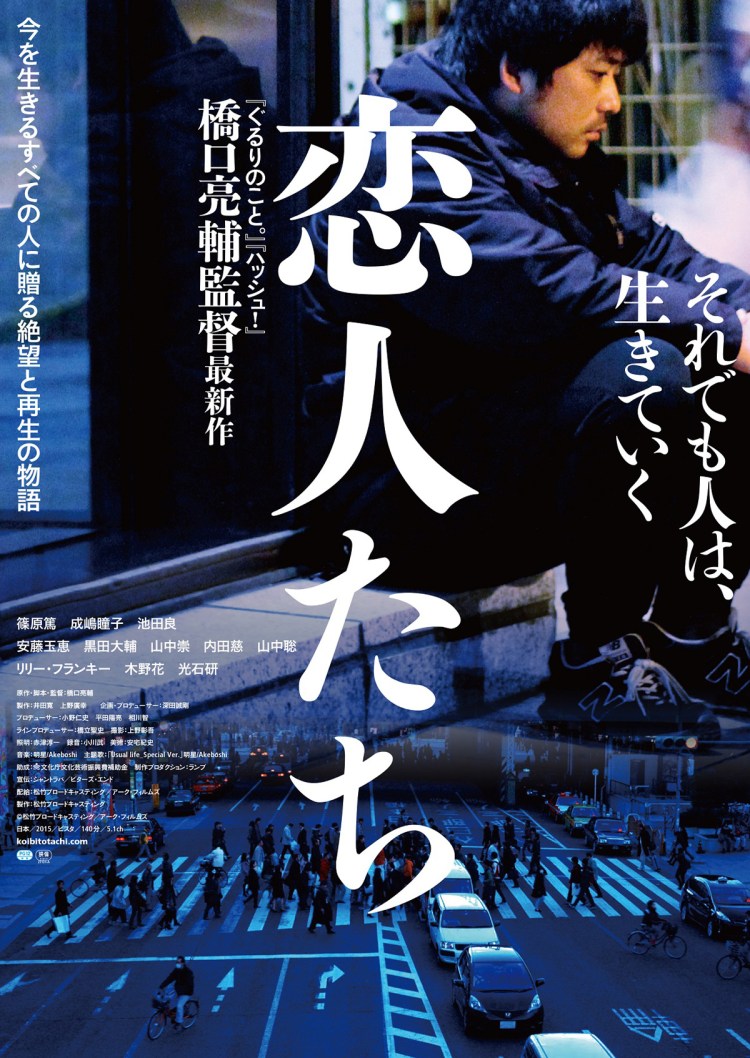
Three Stories of Love (恋人たち, Ryosuke Hashiguchi, 2015)

Three Stories of Love posterRyosuke Hashiguchi began his career with a collection of sometimes melancholy but ultimately hopeful tales of gay life in contemporary Japan. In 2008 he branched out with the finely tuned emotional drama All Around Us which followed an ordinary couple’s attempt to come to terms with the loss of a child. Three Stories of Love (恋人たち, Koibitotachi) finds him in much the same territory as he takes three very different yet equally burdened romantics and sets them on a path towards a kind of acceptance while suffering inside a system where everyone seems to be intent on exploiting other people’s unhappiness.

The first of our heroes, Atsushi (Atsushi Shinohara), is a bridge inspector whose wife was murdered in a random street attack three years previously. Ever since then he’s suffered with depression and found it difficult to hold down a job or a life and has become obsessed with getting personal revenge on the killer who pleaded the insanity defence and was committed to psychiatric care rather than to prison. Meanwhile, across town, listless housewife Toko (Toko Narushima) is trapped in a loveless marriage to a domineering husband and living with her snooty mother-in-law. Toko’s only outlet is compulsively rewatching a shaky video of the time she and her friends witnessed Princess Masako briefly exit a building. The third of our heroes, Shinomiya (Ryo Ikeda), is a self involved lawyer with a longstanding crush on his straight best friend from college who has since married and had a young son.

The three strands are only loosely interconnected, occurring as they do in the same city at the same time, though they do each share a sense of defeat and impossibility as each of our heroes struggles either to escape from or come to terms with their difficult circumstances. Atsushi’s case is perhaps the most extreme as he deals not only with his grief and anger but with the persistent stigma of being involved with violent crime. Visited by his bubbly sister-in-law he idly remembers to ask after the man she was about to marry last time they met only to be told that he abruptly dumped her after her sister’s death and not only that, all her friends abandoned her too. Getting revenge has become Atsushi’s only reason for living – he stopped paying his health insurance to get money together for fancy lawyers like Shinomiya who convinced him he could lodge a civil case but were only ever stringing him along to fleece him of money he never really had.

Shinomiya is, in a sense, our villain. He listens dispassionately to his wealthy clients – including one woman seeking a divorce (Chika Uchida) because her husband forgot to tell her he was burakumin until after they were married, but privately mocks them and is so unpleasant to his colleagues that someone eventually pushes him down a flight of stairs, breaking his leg. Intensely self-involved, he cares little for other people’s feelings save for those of his forlorn love Satoshi (So Yamanaka). Satoshi’s wife Etsuko, originally friendly and understanding, eventually takes against Shinomiya either because she doesn’t like the way he fiddled with her son’s ears or resents the two men cooing over the child and accidentally making her feel like an unwelcome outsider. Introducing his much younger boyfriend only seems to make matters worse, though the relationship does seem to have its problematic dimensions even if not in the way Etsuko decides to interpret them as Shinomiya takes pains to run down his partner in public and berate him at home. It’s difficult to resist the interpretation that Shinomiya prefers younger lovers because he can boss them around and, in truth, he doesn’t even seem very attached to this one, but he’s about to get a very rude awakening when it comes to learning that he’s not as permanent a part of everyone else’s lives as he seems to think.

Atsushi is fleeced by the Shinomiyas of the world and his heartless health insurers, but he’s wily enough to spot the obvious scam in the lovelorn office boy’s sudden enthusiasm for magical beautifying water which turns out to be part of a bar lady’s (Tamae Ando) nefarious scheme to resell the tapped variety with some of her own glamour shots attached to the front. Toko is wily enough to see it too, though she eventually succumbs when would-be-chicken-farmer Fujita (Ken Mitsuishi), whom she met at work during a difficult moment with her boss, delivers her some on spec. Lonely and insecure, Toko appreciates the unexpected interest but Fujita is not the white knight she first assumes him to be and is eventually exposed as yet another scam artist gunning for the little money she might have been able to hide away in her rabidly penny pinching home.

Shinomiya might feel himself proud to be among the fleecers rather than the fleeced, but he soon gets a comeuppance in realising he has wilfully pulled the wool over his own eyes, blinded in a sense by love. Toko, meanwhile, has learned to accept the latent feudalism of the modern society in her obsession with royalty though a brief attempt to transcend her feelings of innate inferiority seems destined to end in failure if perhaps engineering a mild improvement in her familial circumstances. Atsushi alone, a man whose job it is to assess the foundations, begins to find a degree of equilibrium thanks largely to nothing more than a good friend willing to listen and share his own suffering. Exploitation of others’ misfortunes and a series of social prejudices conspire against our three lovers but perhaps there is something to be said for learning to find the blue sky from whichever vantage point you happen to be occupying no matter how small and distant it may be.


Three Stories of Love was screened as part of the 2019 Japan Foundation Touring Film Programme.

Original trailer (no subtitles)
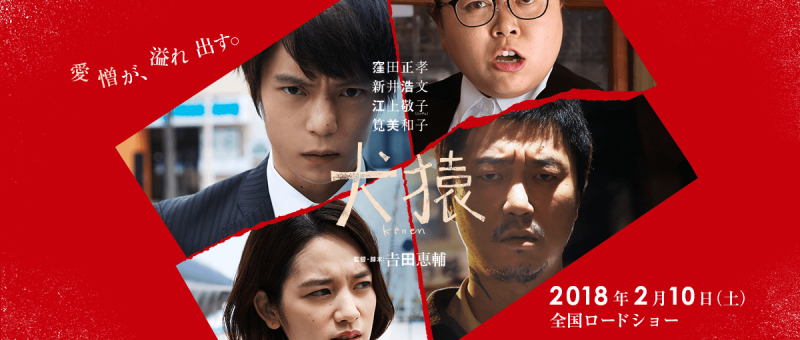
Thicker than Water (犬猿, Keisuke Yoshida, 2018)

Thicker than Water posterIn the long history of the Japanese family drama, the tensions are generally vertical rather than horizontal. Siblings are often engaged in trying to broker the peace or snatch a little bit of independent living away from an all consuming family environment. Then again, we meet most families when the kids are gown up and struggling with their approaching transition into other families or other lives. Kids fight, but grown up brothers and sisters are supposed to find a degree of civility at least even if the petty resentments of childhood never quite go away. For the parallel pairs of mismatched siblings at the centre of Thicker than Water (犬猿, Kenen), however, the reverse is true.

Older sister Yuria (Keiko Enoue) has taken over the family print shop now that her father is bedridden while her younger, prettier sister Mako (Miwako Kakei) is struggling to make it as an actress. Often resentful of her sister’s domineering, business-like attitude, Mako wilfully targets her weaknesses by making barbed comments about her weight and appearance of which she knows Yuria is insecure. Yuria, meanwhile, treats her sister as a foolish child, immediately taking over rather than let Mako do something “wrong” and thereby chipping into her insecurities about a lack of intelligence.

The spiky dynamic between the two sisters intensifies when Yuria develops a crush on a handsome young salaryman who makes regular visits to the shop to get his posters printed. Kazunari (Masataka Kubota), however, predictably falls for Mako (who is only interested in him as a way of annoying her sister). Meanwhile, he has sibling drama of his own in that his no good, thuggish older brother Takuji (Hirofumi Arai) has just been released from prison and made an unwelcome reappearance in his life.

What exists between the siblings isn’t quite “rivalry”, mostly they aren’t fighting over parental affection or esteem so much reacting against their obviously complimentary characteristics. Yuria envies Mako’s beauty, while Mako secretly envies her sister’s intellectual confidence even if she also resents her bossiness and affectation of superiority in order to mask her insecurity. Kazunari makes a show of his earnestness, that he’s doing everything “properly” – working hard, living within his means, paying off his parents’ debts and saving for his retirement, while underneath it all he envies his brother’s non-conformity even if its risks terrify him. Thus they snipe at each other. The thing about family is they know where all the buttons are and find pressing them extremely hard to resist.

That said, the familial bond is a strong one and perhaps they can snipe cruelly at each other precisely because it is unlikely to break. Nevertheless, when pettiness and cruelty intensify there can hardly be a positive outcome save perhaps to hit the reset button and send our warring siblings back to their idyllic childhoods in which they played together happily free from their adult resentments. Like children fighting over toys, each wants what the other has and seethes over the injustice of not being the one to have it. An extreme situation might seem to clear the air, repair the relationships and restore them to their original condition with each reaching an understanding of themselves and their opposite number, but old habits are hard to break and any thaw in relations is likely to be extremely temporary.

No stranger to extremes, Yoshida opens with a humorous sequence spoofing a trailer for a cheesy Japanese teen romance which is enthusiastically recommended by a series of vox pop champions, not least among them Mako who who somewhat unethically plays the part of a lovestruck young woman who over identifies with the movie’s themes. The trailer promises a “parallel love story” which, in truly Yoshida-esque irony, is more or less what we get as we witness the symmetrical tales of our two sets of warring siblings whose animosity almost tips over into co-dependency. Mirrors of each other, they love and loathe but remain unable to reconcile themselves to the various faults they see reflected in their opposing number and therefore unable to break free from the petty jealousies and resentments which define family life. There may be no escape from the intense self loathing unfairly projected onto an equally burdened sibling, but perhaps there is faint hope in the enduring continuity of their quietly simmering warfare even as it binds them in mutual misery.


Thicker than Water was screened as part of the 2019 Japan Foundation Touring Film Programme.

Original trailer (English subtitles)

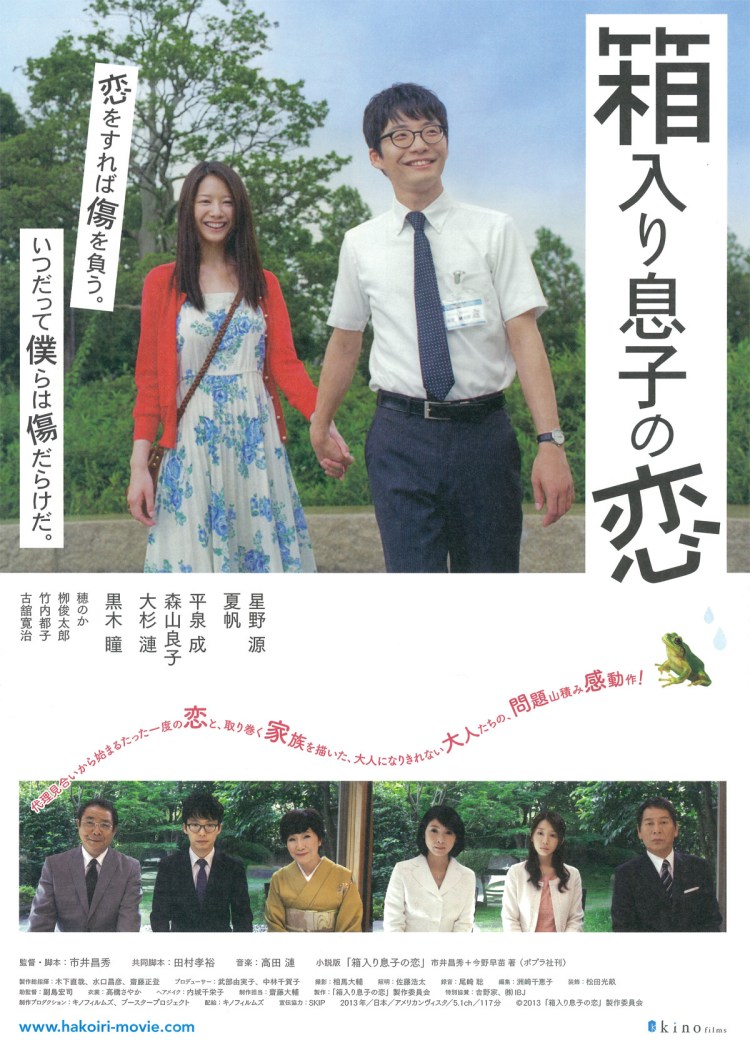
Blindly in Love (箱入り息子の恋, Masahide Ichii, 2013)

Blindly in love posterPost-war Japanese cinema was intent on investigating whether father really did know best while his children strived to find their place in a changing society. Contemporary Japanese cinema may feel as if the question has been more than well enough answered already but then again Japanese society remains conformist in the extreme and arranged marriage still an option for those who find it difficult to find a match on their own (remaining single, it seems, is still an option requiring intense justification). The protagonists of Blindly in Love (箱入り息子の恋, Hakoiri Musuko no Koi) find themselves in just this position as their well meaning (to a point) parents attempt to railroad them into the futures they feel are most appropriate while perhaps failing to deal with the various ways their own behaviour has adversely affected their children’s ability to function independently.

Kentaro (Gen Hoshino) is 35. He has a steady job as a civil servant and still lives at home with his parents which is hardly an unusual situation in contemporary Japan save for the fact he is not married and seems to have no interest in dating. Rather than eat with his colleagues, Kentaro comes home for lunch every day and returns straight after work, retreating into his bedroom to spend quality time with his pet frog and play video games. His parents, worrying that he may be lonely when they are gone, decide to find him a wife by effectively going speed dating on his behalf with a host of other parents in a similar position.

There they meet the Imais who are keen to marry off their 23-year-old daughter Naoko (Kaho). The elephant in the room is that everyone at this meeting is there because they believe there is something “wrong” with their children that makes them difficult prospects for marriage. Consequently, the Imais have decided not to disclose the fact that Naoko is blind until later in the negotiations.

The Imais’ ambivalent feelings towards their daughter’s disability speak to a persistent social prejudice which views those who have different needs as somehow less. Mr. Imai is a high flying company CEO who puts on a show of only wanting the best for his little girl, but he’s also a snob and a bully. He keeps trying to set Naoko up with “elites” like him, but those elites will also share his own prejudices in feeling that his daughter is “imperfect” and therefore not a prime match in the arranged marriage stakes. Kentaro, who unbeknownst to everyone except Mrs. Imai has already enjoyed a love at first sight meet cute with Naoko, is the only one brave enough to call Mr. Imai out on his hypocrisy when he accuses him of neglecting his daughter’s feelings in favour of asserting his own paternal authority. As you can imagine, Mr. Imai is not happy to have his faults read back to him.

Making the accusation at all is extremely hard for Kentaro who has just spent the last ten minutes getting a dressing down from Mr. Imai who has read out a list of his perceived imperfections from his unbreakable introversion to his lack of career success. Mr. Imai wants to know if a man like Kentaro who has basically been the office coffee boy for the last 13 years can keep his daughter in the manner to which she’s been accustomed. Kentaro has to admit that he probably can’t and that Imai has a point, but unlike Imai he is thinking of Naoko’s happiness. He sees her disability but only as a part of her personality and respects her right to a fully independent life which is something her father seems to want to deny her, not out of a paternalistic (or patronising) worry for her safety but simply as a means of control.

Conversely, Kentaro is attracted to Naoko precisely because he feels as if she might be able to see him in greater clarity in being unable to judge him solely on appearance. In a rare moment of opening up as part of his defence against Mr. Imai, Kentaro reveals the pain and suffering that have led him to withdraw from the world, admitting that after years of being taunted or ignored, branded an oddball and mocked for his rather robotic physicality he simply decided it was easier to be alone. It might be safe to say that Kentaro’s parents are being overly intrusive, that they are trying to impose their idea of a “normal” life on their son who may be perfectly happy playing video games alone for the rest of his days. Kentaro, however, is not quite happy and as is later pointed out to him had merely given up on the idea of any other kind of existence as an unattainable dream.

Giving up has been Kentaro’s problem and one that recurs throughout his awkward courtship. Like his pet frog, Kentaro has been perfectly contained within his own tank and somewhat fearful to crawl outside but is slowly finding the strength thanks to his bond with Naoko who struggles to overcome her conservative patriarchal upbringing and escape her father’s control. Yet it isn’t only the youngsters who have to learn to leave the nest but the parents who have to learn to let them go. Kentaro’s mum and dad have perhaps enabled his sense of disconnectedness by keeping him at home with them as a treasured only son, while the Imais’ problems run deeper and hint at a deeply dysfunctional household with a father who is controlling and eventually violent while Mrs. Imai tries to effect her daughter’s escape from the same patriarchal conservatism which has succeeded in trapping her. Blindly in Love refuses either of the conventional endings to its unconventional romance but edges towards something positive in affirming its protagonists’ continued determination to fight for their own happiness even if opposed at every turn.


Blindly in Love was screened as part of the 2019 Japan Foundation Touring Film Programme.

Original trailer (English subtitles)

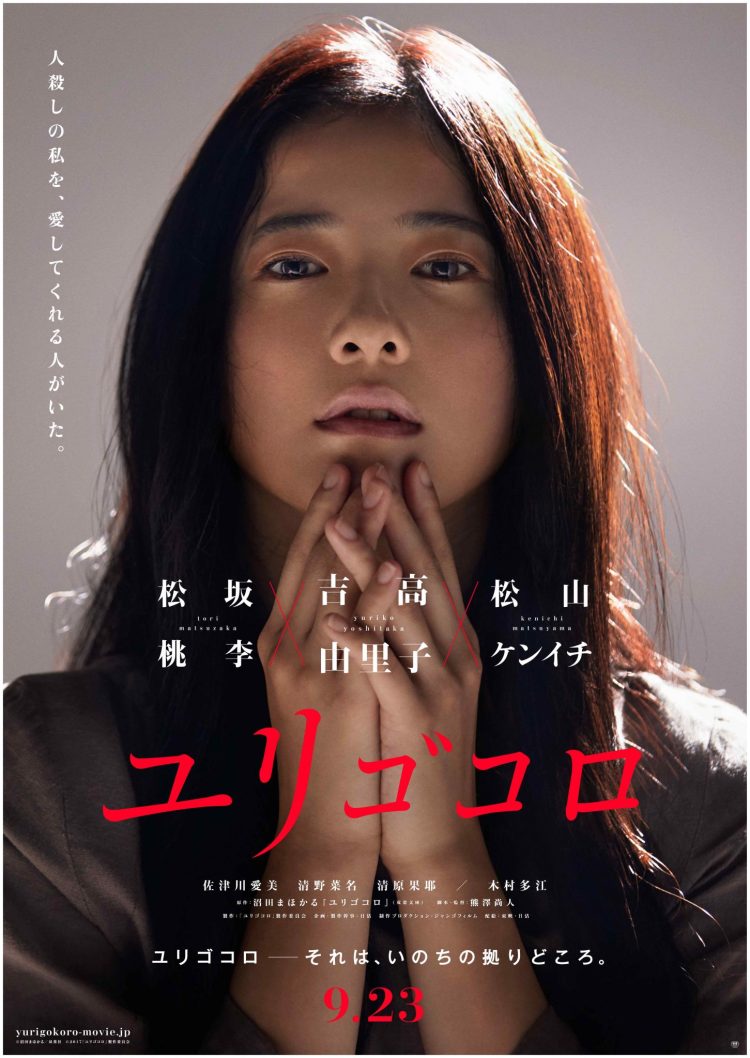
Yurigokoro (ユリゴコロ, Naoto Kumazawa, 2017)

Yurigokoro posterThose who cannot remember the past are doomed to repeat it, as they say, but is it better to acknowledge the dark parts of yourself as part of an inherited legacy or ignore a nagging sense of incompleteness in favour of a harmonious existence? The hero at the centre of Naoto Kumazawa’s Yurigokoro (ユリゴコロ), adapted from the mystery novel by Mahokaru Numata, is about to discover a side of himself he might not like just as storm clouds seem to gather over his previously idyllic childhood home.

For Ryosuke (Tori Matsuzaka), everything had been looking up. He’d set up his own business – a charming cafe and summer lodge, with the woman he intended to marry, Chie (Nana Seino). However, no sooner has he introduced his fiancée to his father than she disappears, gone without trace. Meanwhile, his father informs him that he has stage four pancreatic cancer. Suddenly everything is falling apart and the braver the face he tries to put on it, the worse he seems to feel. Perhaps that’s why he can’t resist opening up a mysterious old box hidden in a cupboard in his father’s study that almost calls out to him to be opened. Inside the box is an old exercise book with the title “Yurigokoro” pencilled on the front. Ryosuke only reads the first few pages but they’re enough to disturb and fascinate him. The book, written in the first person, recounts the dark history of a murderess (Yuriko Yoshitaka) from silent, disconnected child to vengeful spirit.

“Yurigokoro” as the diary’s protagonist later explains is a made-up word, one she childishly misheard from the mouth of a well meaning doctor (who probably meant “yoridokoro” which means something like grounding). It could, however, almost translate as a shaking heart – something the doctor seems to imply the child does not quite have which is why she feels disconnected from the world around her and unable, or unwilling, to speak. The girl in the book travels through life looking for something that makes her heart beat and originally finds it only in the strange pleasure of watching something die, at first by accident and later by design. She drifts into an intense relationship with a damaged young woman (Aimi Satsukawa) who, like her in a fashion at least, resorts to self harm in order to feel alive. She thinks she finds her home, but it slips away from her or perhaps changes in form as it succumbs to inevitable disappointment.

Yet, in the grownup crimes at least, there is a kind of love in amongst grudging resentment. Ryosuke reads the diary and declares he does not relate to it at all but something about it gets under his skin and he can’t let it rest. He hears from an older woman (Tae Kimura) that Chie may have a past he knew nothing about, largely because he failed to ask, and that she may be in danger. He begins to feel rage surfacing within him like the dark violence of the diary’s protagonist and it both frightens and enthrals him.

The owner of the diary likens her experience of existing in the world to being prickled by hundreds of tiny thorns. She seeks relief through bloodletting and violence, as if she could shake herself free of the tiny stings that remind her of nothing other than her sense of emptiness. Later she discovers that love too can shake the heart, but the old darkness remains and even the most positive of emotions may require an act of violence in order to sustain it. The diarist remains ambivalent, knowing that there is no salvation for her except death and that any attempt to stave off the darkness with light will eventually fail, but determined to cling on to her brief moment of wholeness however inauthentic for as long as it lasts.

Ryosuke, meanwhile, who’d apparently never sensed in himself the kind of gaping emptiness that the diary’s owner describes, is forced to wonder if the diary is legacy and destiny, if he too is destined to commit random acts of inescapable violence as someone unfit for living as a human being among other human beings. Love might not have “cured” the darkness inside the diarist, but it did change it in quite a fundamental way, a way that eventually provided him with the means of his “salvation” perhaps at the cost of her own if only he is willing to accept it. Ryosuke might wish he’d never opened that particular box, but in doing so he discovers not only the path towards a fully integrated self but that his own darkness can be tempered precisely because of the sacrifice that was made on his behalf.


Yurigokoro was screened as part of the 2019 Japan Foundation Touring Film Programme.

Original trailer (no subtitles)
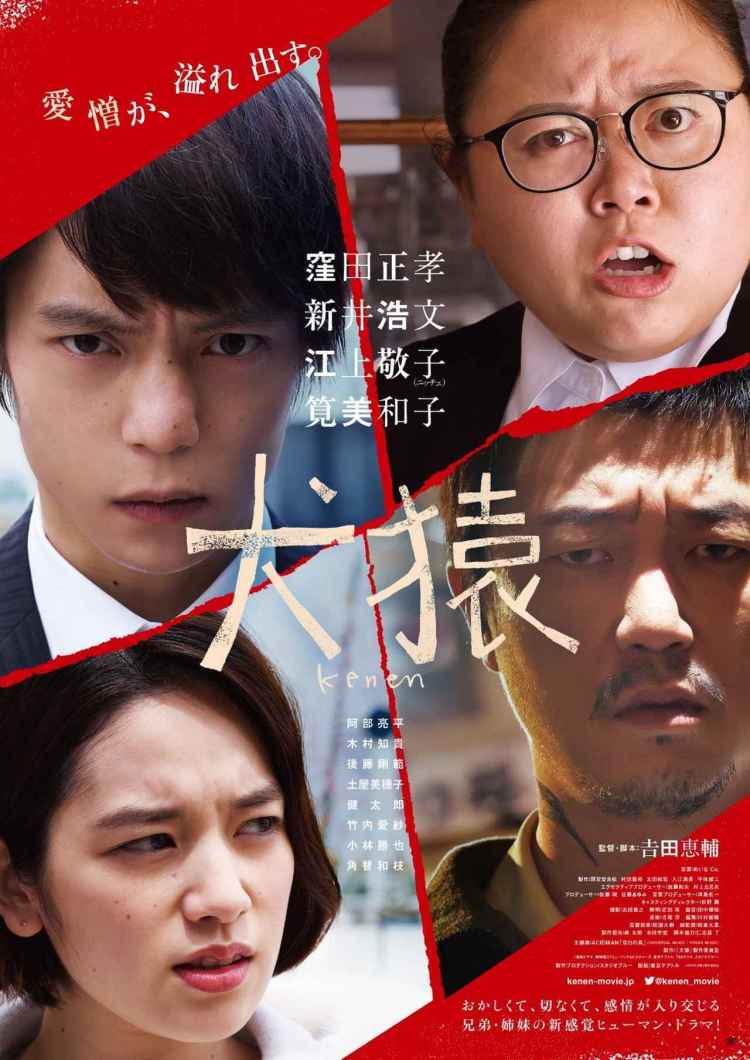
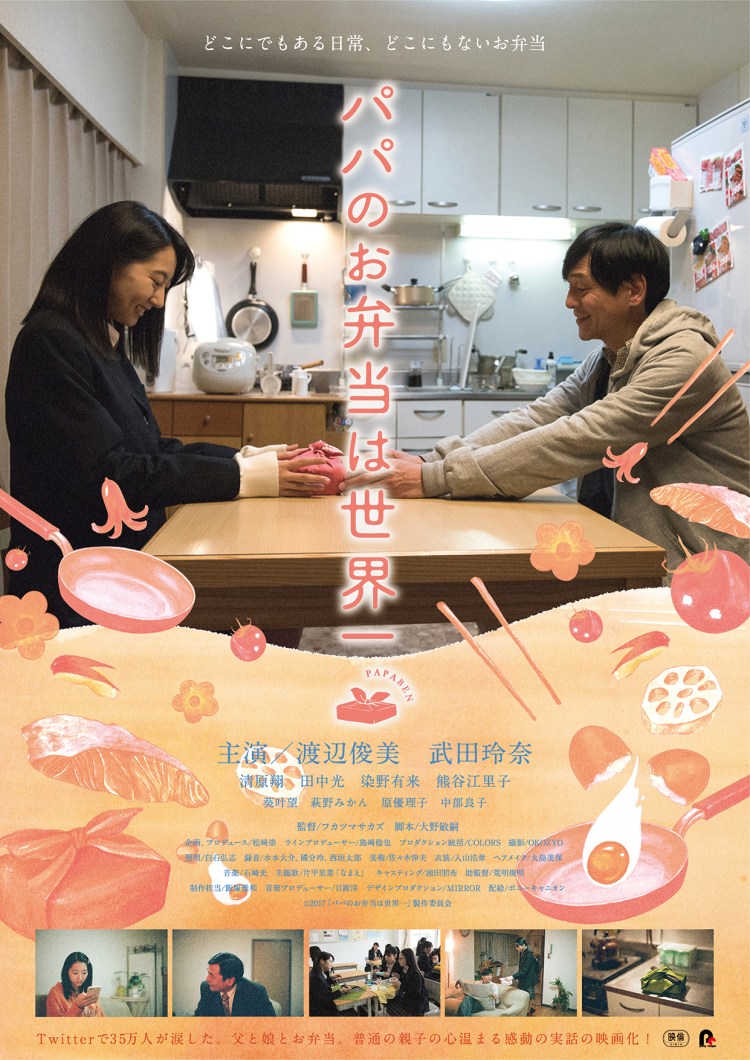
Dad’s Lunch Box (パパのお弁当は世界一, Masakazu Fukatsu, 2017)

Dad's Lunchbox posterLunch is serious business in Japan, but perhaps those adorable character bento have a dark side, forcing already frazzled mothers to get up before dawn in order to ensure their child’s lunch box will be sufficiently “cute” or risk being made to feel like a cold and unloving parent. It goes without saying that it’s usually mums who are expected to take care of food preparation, salaryman dads are a rare sight in a kitchen, but then a recent phenomenon known as “papaben” has been taking the internet by storm and somewhat normalising the idea that fathers too can channel their love for their kids into visually appealing, nutritionally balanced meals.

Dad’s Lunch Box (パパのお弁当は世界一, Papa no Obento wa Sekai Ichi), the debut feature from Masakazu Fukatsu, is inspired by a viral Tweet posted by a high school girl on her graduation which thanked her father for taking the trouble of making a handmade bento for her every day of her high school life. The Tweet also included a photo of his risible first effort and his final high school lunch box crafted after three years of trial and error. Fukatsu’s film version follows a recently single salaryman known only as “Father” (Toshimi Watanabe) who decides to make the creation of bento his primary method of demonstrating that he is perfectly fine bringing up his teenage daughter Midori (Rena Takeda) all alone.

The film does not dwell on the circumstances which led to Father’s wife leaving and there does not appear to be any animosity between himself and his daughter on account of it, nor does Midori suffer any particular stigma at school because of having a single dad save for the unfortunate quality of her daily bento. Father, having lived a regular salaryman life, is not exactly a great cook and has an uphill journey ahead of him when it comes to mastering the basics let alone creating the Instagrammable lunches of his daughter’s dreams. Taking a few tips from a friendly lady at work, Father eventually realises that for a teenage girl bento are an important social signifier and must, in all cases, be cute. Nevertheless, he struggles with fundamental hygiene concerns that leave him unaware of why you shouldn’t put sashimi in a lunch box which is going to be sitting around at room temperature all day.

The most important component in a bento is, however, love which is why Father started making them in the first place. It’s not so much that he eventually masters the art of cooking, nor that of learning how to make his dishes aesthetically pleasing, but that he is able to connect with his increasingly distant teenage daughter as he does so. Midori, having grown to like her dad’s previously embarrassing lunchtime fare, tricks him into making two bento lunches passing one off as her own work in order to give to a boy she likes and sort of (though incorrectly) assumes is her boyfriend. The boyfriend is, it has to be said, quite cheeky and extremely ungrateful when one considers he’s getting a 100% free lunch every day, but in any case his decision to rudely criticise Father’s by now beautiful bento is the one which finally sets alarm bells ringing in the mind of the romantically naive Midori and her supportive friends. Father remains oblivious until the lady at work helps him out again by keying him in to Midori’s likely source of teenage angst. When giving her a gentle opportunity to open up doesn’t yield results, Father realises he needs to give his daughter space to figure things out, leaving tiny notes of encouragement along with the food to make sure she knows he’s there if she needs him.

In a strange turn of events, actor Toshimi Watanabe who plays the father (previously known as a ‘90s hip hop star) himself made quite a splash in the papaben world when he released a book of his own bento recipes in 2014 crafted for his teenage son through his high school years. Dad’s Lunchbox may be low on plot detail, but it’s high on heart in its earnest tale of a doting dad just so happy to be making headway in conquering the most of domestic of tasks while finding the way to his daughter’s heart through her stomach.


Dad’s Lunchbox was screened as part of the 2019 Japan Foundation Touring Film Programme.

Original trailer (no subtitles)

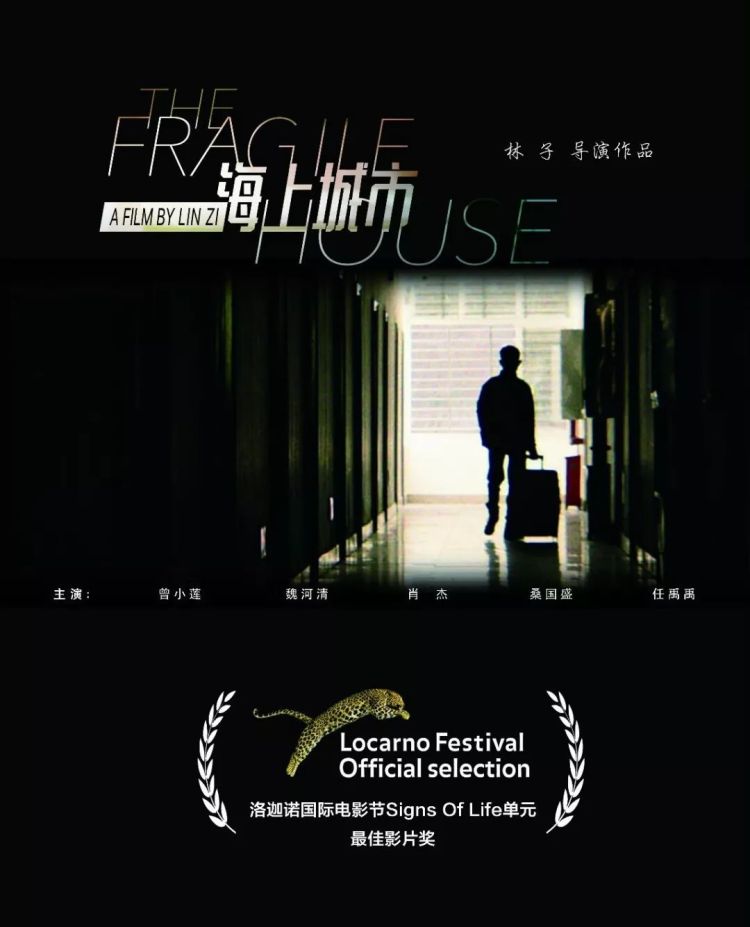
The Fragile House (海上城市, Lin Zi, 2018)

thefragilehouseposterAmong the many concerns of recent Chinese cinema, economic inequality and the fate of the family loom large. Lin Zi’s debut, The Fragile House (海上城市, Hǎishàng Chéngshì), neatly brings the two together in the tale of one ordinary family who’ve managed to carve out a degree of comfort for themselves but at great cost. Economic strain threatens the very idea of family, or at least of “family” as has traditionally been defined. The Huangs pay their respects to their elders and enact the rituals expected of them, but remain mere individuals drifting endlessly without direction in pursuit of an inflated ideal of middle-class respectability.

Lin opens on the most important family occasion of all – New Year’s Eve. The Huangs have gathered together as expected with even oldest son and heavily pregnant daughter-in-law in attendance, but there is an unexpected visitor. Cui Ying’s sister Cui Na has come calling but not to join the festivities – she’s come to claim a debt and is refusing to leave the Huang’s sofa until she gets her money. In an extreme power move, the Huangs have called the police to have her removed – an act of intense pettiness which results in little more than ruining everyone’s New Year by getting half the family detained at the local police station.

Originally from the country, Cui Ying and her husband work for a construction firm but there’s trouble on the horizon because Cui Ying, who seems to be in charge of payroll, hasn’t been given the construction funding by the developers who keep fobbing her off meaning she can’t pay her workers. The workers are understandably upset and angry, some resorting to thieving materials in lieu of their wages while quietly seething with resentment towards Cui Ying who swans around in her fancy car while they can’t pay their bills or feed their families.

Likewise, Cui Na finds it difficult to accept her sister’s excuses when she takes in her lovely middle-class family home. If she really has no money why doesn’t she sell the house or her car? Cui Na thinks it’s adding insult to injury when the Huangs throw a party to celebrate the birth of their first grandchild rather than paying her back, but then holding a celebration on the one month anniversary of a child’s birth is one of the many things which a “family” must do to be a family.

Yet this family is one already divided. Lin splits the screen in three, imprisoning the Huang’s in their own individual bubbles on a night devoted to the idea of togetherness. While Cui Ying and her sons pointedly do not eat their New Year dinner at a table in the back, her husband Jian perches on the edge of the sofa, while her sister remains petulantly all the way over to the side. The Huang’s have worked hard for this house, but this evening is one of the few times they will all occupy it at the same time. Jian will soon depart to play nightwatchman at the yard – they’ve no money to pay someone else to watch the place, while youngest son Chaochao has developed the habit of going to the local internet cafe to play games online rather than come home to an empty house, neglecting his studies in the process.

Though his father is more sympathetic and encourages him to find something else to do if he finds school does not interest him, Cui Ying eventually decides to send her son away, absenting him from the family altogether. She does this in the hope of training him to become a model citizen – something the school’s prominently displayed signs declaring “one lifestyle” seem to promise, but does not stop to consider the weakening bond between herself and her children with her oldest son already in the city and, like she with her own family, only coming home for the obligatory family occasions.

Chaochao seems to have picked up on his parents’ plight, that their constant search for success has left them with little more than constant anxiety and exhaustion. You couldn’t blame him for a desire to drop out, declining to fight a battle it’s impossible win. Lin’s constantly shifting aspect ratios, letterboxing, and colour variations highlight the claustrophobic quality of the Huangs’ existences as they go about their individually boxed lives while clinging fast to the idea of familial connection to provide some kind of framework in an increasingly chaotic world but even this is not immune from the corruption of money and the fragility of the house rests on the very forces which constructed it.


Screened as part of the BFI’s 2019 Chinese New Year programme.

Original trailer (English subtitles)

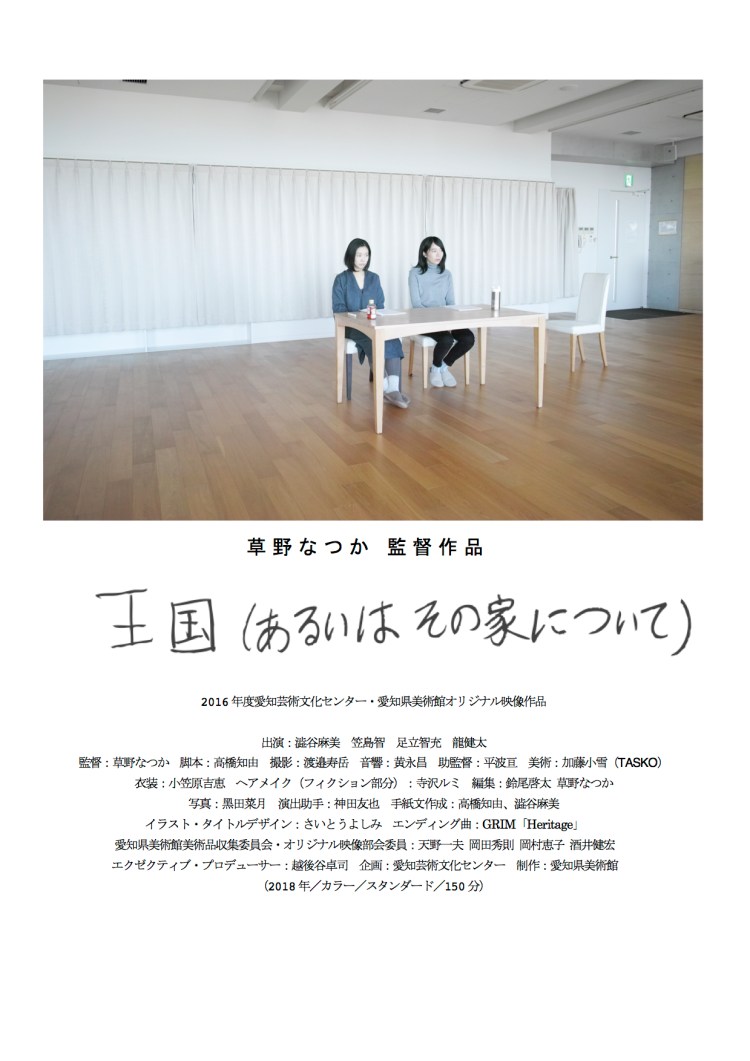
Domains (王国(あるいはその家について), Natsuka Kusano, 2019)

domains posterMost of us like to feel as if we’re connected to something. Not merely floating islands, but anchored to the world by strong connections to others – only when we feel as if the world is not holding on as tightly as we’d like do we begin to feel as if perhaps there are as many worlds as people and many of them barred to those who have no right to enter. Natsuka Kusano’s second feature, Domains (王国(あるいはその家について), Okoku (Arui wa Sono Ie ni Tsuite)), tackles this conflict head on in a tragic tale of rage, madness, and jealousy driven by a series of mutual resentments as a collection of middle-aged men and women struggle to accept the “intrusion” of an unwanted third party into the kingdom of their intimate relationships.

Kusano opens boldly with the film’s most straightforward, though infinitely shocking, scene as a woman in her late 20s, Aki (Asami Shibuya), sits impassively while a police officer (Ryu Kenta) politely tries to explain to her that she is being held on suspicion of murder. Not quite present, Aki accepts all the charges against her and admits her crime though is puzzled by the policeman’s assertion that she has been “brought to justice”, explaining that she already feels herself to have been “brought to justice” by “something like time”. In any case, she has already said everything she wishes to say in a letter to the mother of her victim. In a brief moment of madness, Aki pushed the three year old daughter of her childhood best friend into a swelling river in the midst of a typhoon.

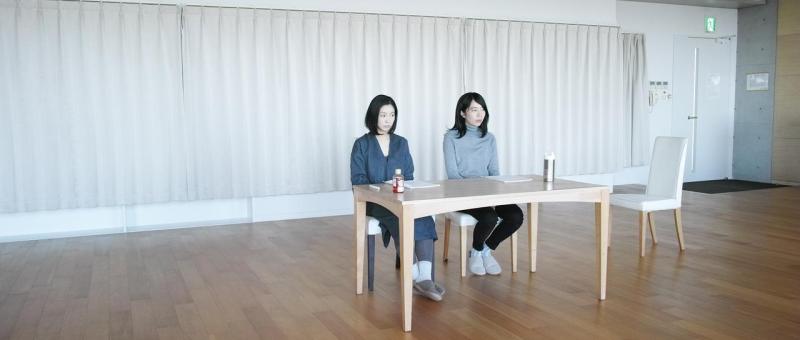
Leaving us with this disturbing moment, Kusano then shifts back to what looks like a rehearsal room where the woman we have just seen is now dressed in more casual clothing and seated at a table next to another woman who will read in the lines of Aki’s childhood best friend and later mother of the murdered little girl, Honoka, Nodoka (Tomo Kasajima). Travelling back a few months before the incident, the two women read over the undramatic events which led up to it as if engaged in an act of emotional excavation.

The strange fact that had fascinated the policeman in Aki’s written testimony was her seemingly random allusion to a castle made out sheets and chairs the mention of which sends her into a refrain of the gloomy Japanese folksong Moon over Ruined Castle. As we later ascertain, the the make-believe castle, constructed in her childhood home with soon-to-be best friend Nodoka, became something like a safe place, the eye of typhoon raging in her mind. Aki saw the castle as her rightful “kingdom”, a sacred space into which only she and Nodoka were permitted to enter and which was permanently available to each wherever they happened to be.

Nodoka, however, has moved on – formed a new kingdom with a husband and a child into which Aki has no right to step. After having something like a breakdown and returning to her hometown, Aki reconnected with Nodoka whom she had not seen since her wedding to her husband Naota (Tomomitsu Adachi) – a mutual friend from university, four years previously. Naota, now a school teacher, like Aki is intensely jealous of his own kingdom which he has given physical form in the solid existence of his house. Aki noticed this fact immediately in the pitch perfect attention to temperature and humidity of Nodoka’s new home, but she couldn’t help seeing that her friend now looked tired, harried, and that the marriage was perhaps only a superficial act of performance rather than a real emotional connection.

Ironically enough, it’s Naota himself who accidentally brings this up when explaining that a family can collapse without warning and revert to being merely a collection of individuals living under the same roof. Nodoka accuses him of using a schoolteacher’s logic to rule his home, and there is certainly some of that in there as his rigid authoritarianism seems primed to hold on so tight that it squeezes the life out of the very thing he’s trying to protect, but there’s an ugly kind of conservatism in it too as he angrily tries to expel the unwelcome intrusion of Aki into their lives, blaming her for the cracks in his marriage which her presence has perhaps exposed.

Naota wants Aki gone because he thinks she’s a bad influence, a shirker or a mad woman who will eventually infect his house with whatever it is she has like some kind of ill will virus. In an odd and terrifying way he may be “right”, but his resentment runs deeper in that he, like Aki, cannot accept that Nodoka once belonged in someone else’s kingdom to which he has no access. He resents that the two women are so close as to have largely abandoned language and share a much longer history than he and his wife, while Aki perhaps resents the presence of Honoka who represents a bond between Naota and Nodoka that she could never match even if her concern over the coldness of her friend’s new life and her seemingly hidden misery is nothing but altruistic.

Aki surveyed the kingdom of her friend and discovered it was flawed and vulnerable, that the kingdom she and her husband were building would eventually destroy them. Yet the overwhelming force which compelled her towards her unforgivable transgression was not so much resentment, or loneliness, or jealousy, or even a desire for freedom, as embarrassment. She felt as if she had betrayed her kingdom’s existence to someone who was not supposed to see it and acted without thinking in order to cover up an emotional crime, little realising the pain and destruction her act would cause.

Words encircle Aki like a typhoon, leaving her permanently in its eye trying to make sense of what has happened. Kusano stages a rehearsal after the fact, reading over the same lines with added nuance, occasionally digging deeper to expose a new clue either so trivial as not to be worth remembering or so delicate as not to be remembered out loud. To Aki, the spoken has no weight – her kingdom is made is feelings, but for Naota the reverse is true. Nodoka remains caught in the middle, perhaps secretly and uncomfortably yearning for freedom and a kingdom of her own while the storm clouds gather all around her and all that remains is the inescapable impossibility of an unselfish yet whole connection.


Domains made its world premiere at the 2019 International Film Festival Rotterdam and is available to stream online via Festival Scope until 24th February.

Rotterdam trailer (English subtitles)

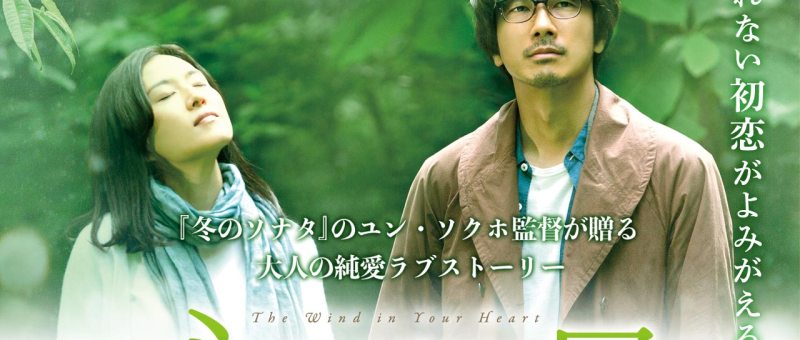
The Wind in Your Heart (心に吹く風, Yoon Seok-ho, 2017)

the wind in your heart posterYoon Seok-ho is best known for his work in Korean television drama which included several of the series thought of as kickstarting the “Hallyu” wave. Chief among these is Winter Sonata which proved extremely popular in Japan and is also cited as a major inspiration for the short-lived boom of “junai” or “pure love” movies in the early 2000s. The Wind in Your Heart (心に吹く風, Kokoro ni Fuku Kaze) brings things full circle – making his feature debut, Yoon brings his brand of romantic melodrama to Hokkaido for a re-evaluation of first love, middle-aged regrets, and an escape from real world cynicism to a world of beauty and innocence.

Video artist Ryosuke (Hidekazu Mashima) has been in living in London for many years but is currently staying with a friend in Hokkaido on a working holiday. When his pick up truck breaks down in the middle of nowhere he chances in to a nearby cottage in the hope of using the phone, only to find a ghost from the past standing in the doorway – Haruka (Masumi Sanada), his high school sweetheart whom he has not seen in 23 years. Obviously a lot has happened – Haruka is married with a grown-up daughter, but seems sad and lonely. Ryosuke is only in town for a couple more days, but the pair make the most of their time to reconnect and think about what might have been and why it wasn’t, as well as what might still be if someone finds the courage to boldly pursue their desires.

Well, that might be a little strong – this is a story of innocent, chaste love, rather than a hot and passionate affair. The Wind in Your Heart does indeed share much in common with the classic “junai” in its nostalgic look back to innocent teenage romance and yearning to return to a time when everything seemed so simple and love was all that mattered. It is, however, sadder – we’re not told exactly what made Haruka decide to forget Ryosuke after he left for university in Tokyo, only that she went through some tough times. Likewise we don’t really know why Ryosuke didn’t try harder to find out, save that perhaps he thought that was what she wanted and respected her decision. Nevertheless, Ryosuke has remained unmarried and apparently still carries a torch 23 years later. All the pair have are mutual regrets and a shared sense of nostalgia for a future they feel they lost because of things that happened to them in their youths.

Now, things might be different. Haruka is obviously miserable in her marriage. Her daughter has left for university, her husband is working away in Taiwan, and she’s left at home all alone with her horrible mother-in-law. Ryosuke asks her if she’s happy and she can’t answer. She doesn’t want to talk about her husband whom she doesn’t seem to like very much. When we eventually meet him he is drunk, bossy, and insensitive. It’s no wonder Haruka might dream of running off with her idealised first love but when all is said and done she lacks the conviction to do it. She is simply too conventional, too bound by social obligation, to consider throwing caution to the wind and embracing her own happiness.

It might be patronising to suggest that Haruka is a stand-in for the expected audience – unhappy, under appreciated middle-aged women who perhaps feel trapped by a conservative society and long for escape from their humdrum lives through an innocent romance, but then that does very much seem to be the screenwriter’s intention. Haruka hesitates – her hand always hovering over door handles as if they were triggers, unsure which door to open and which direction to choose, ultimately making her decisions far too late. Unlike the more positive resolutions of a junai romance which allow the left behind to come to terms with their loss and resolve to live on with happy memories rather than sorrow, Haruka is left only with the crushing realisation that it really might be too late and she’s made a lifetime’s worth of poor choices though she does at least begin to find a degree of fulfilment in re-embracing her youthful dreams previously crushed by the unforgiving attitudes of her family.

Filming in Hokkaido, Yoon maintains a notably Korean sensibility in his static camera and straightforward composition which prioritises simple conversation between two people, only occasionally wandering off into poetic reveries in which the sun embraces the wind in a bracing Hokkaido spring. Reaching for something deeper than it manages to grasp, The Wind in Your Heart lands in standard melodrama territory, never quite managing to lend its central romance the weight it seems to want, but nevertheless doing its best to strain the heart with a tale of inescapable middle-aged misery in lives lived through the power of what might have been.


Original trailer (no subtitles)
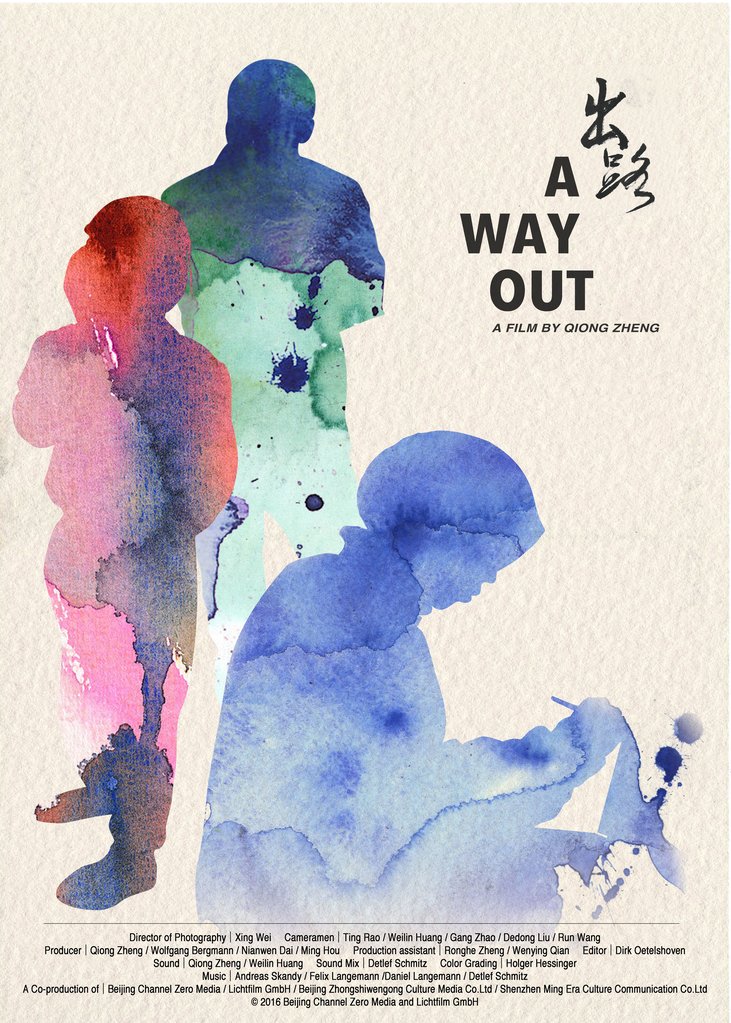
A Way Out (出路, Zheng Qiong, 2016)

a way out posterThe duplicitous dichotomies of the modern China have become a permanent fixture in the nation’s cinema though mostly as a symbol of conflicted ideologies as some yearn for a return to an imagined past egalitarianism and others merely for a brake on the runaway train of capitalist materialism. Zheng Qiong’s documentary A Way Out (出路, Chūlù) follows the lives of three youngsters chasing the “Chinese Dream” albeit in their own particular ways only to discover that, in the end, despite the best intentions of those who might seek to lessen the advantages of privilege, birth may be the biggest factor in deciding one’s destiny.

Zheng opens with a little girl, Ma Baijuan, in rural Gansu. Her sing-song voice playing over her cheerful stride to school through the narrow mountain paths hints at a natural curiosity, a desire to know the “why” of everything, but Baijuan is only reciting by rote what it is says in her school book. Her education, which is received at a village school segregated by sex where she is one of only two little girls learning simple facts about the world around her while the boys next-door get a crash course in elementary maths, is largely a matter of questions and answers rather than thought or enquiry. Nevertheless, she excitedly tells us that she will soon be going on to the middle school in the nearest town and then hopefully to a college in Beijing after which she will make a lot of money and buy a new house for her family with a proper well so they can get water.

Meanwhile, 19-year-old Xu Jia has already repeated the final year of high school twice in the hope of bettering his exam grades to get into a good university. Like many of his contemporaries, Xu sees a degree from a reputable institution as the only “way out” of small town poverty. He is willing to sacrifice almost anything to make it happen and thinks of little else than achieving his dream of a getting a steady job at a stable company and then getting married in order to reduce the burden on his ageing single mother.

Xu may think that a white-collar job is the only path to success but others do not quite see things the same way. Yuan Hanhan is introduced to us as a 17-year-old “high school drop out” but is in fact a talented artist and bona fide free spirit. After brief stint in a hippy cafe, she eventually achieves her dream of studying abroad at art school in Germany where she struggles to adapt to the relatively laidback quality of European society, affirming that in a developed nation like Germany no one sees the need to go on developing. She complains that Germans only need to do their routine jobs like little stones arranged in a line by the country – perhaps an ironic statement given the restrictive nature of Chinese society but also one with its own sense of logic which places the insistent work ethic clung to by Xu on parallel with an economic model which may already be out of date.

Xu gets his start as a telephonist making cold call insurance sales where the staff are drilled like a military cadre to regard their pencils as machine guns as their mics as grenades, their jobs not means of survival but an enterprise for the common good which drives tax receipts to benefit the entire nation. In a sense he has found his “way out” though his life will be one of soulless corporate drudgery, a fact brought home by his mother’s casual appraisal of his wedding album which features her son in a series of intensely romantic photographs in which he has “absolutely no expression”. Meanwhile, Hanhan remains a free spirit. Even if she never quite felt at home in Germany, she maintains a healthy interest in the wider world and is determined to forge her own path rather than become simply one of many identical “little stones”. For Baijuan, however, the future is much less rosy. Her grandfather, commiserating that perhaps she didn’t have the kind of aptitude for schooling that she might have liked, regards a woman’s education as unimportant, as Baijuan’s only “way out” is a “reliable” man whom they would like to find for her as soon as possible.

As Hanhan puts it in her philosophical closing speech, when it comes down to it birth is the most important factor of all. Simply by being born wealthy in Beijing she had advantages that others do not have. Baijuan’s fate is sealed in being born to a poor farming family in a remote rural region, while Xu constantly refers to his “family situation” as the reason he feels he has to become a success as soon as possible, hitting all the social landmarks at all the expected junctures. Each of our protagonists is looking for a “way out” of their unsatisfactory circumstances, and each of them finds it, but perhaps not quite in a way everyone would view as ”satisfactory”. Zheng’s vision of the new China is one in which the old ideology has failed, leaving behind it only an entrenched social hierarchy from which there may be no “way out” save a willing refusal to comply.


A Way Out was screened as part of the Chinese Visual Festival’s New Year programme at the BFI Southbank and is also available to rent online via Vimeo.

Trailer (English subtitles)

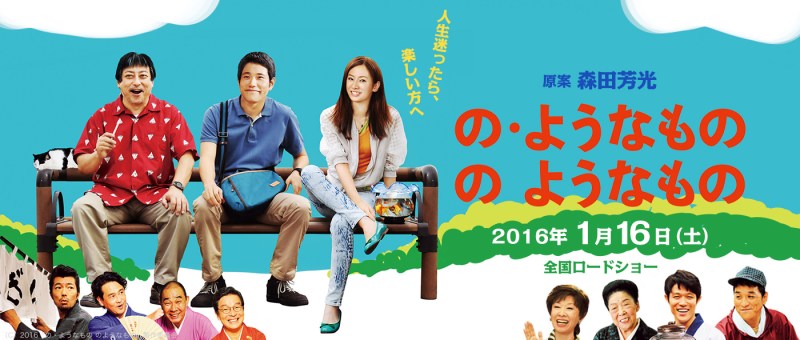
Something Like, Something Like It (の・ようなもの のようなもの, Taiichi Sugiyama, 2016)

something like, something like it posterSadly passing away at the young age of 61 in 2011, Yoshimitsu Morita had been relatively prolific in his 25-year career, leaving behind him a hugely varied back catalogue that ran from zany idol movies to prestigious literary adaptations. His recurrent concerns, however, were relentlessly populist – he wanted to make films that ordinary people could enjoy which intensely reflected the time in which they were made. Five years after his death, one of his early ADs chose to pay tribute to his mentor by drawing inspiration from Morita’s 1981 feature debut, Something Like It. Something Like, Something Like It (の・ようなもの のようなもの, No Yona Mono no Yona Mono) brings the original cast back together with a few new faces from the late director’s more recent works to recreate yesterday’s pleasures for today’s audiences.

Our hero this time round is young Shinden (Kenichi Matsuyama). Well, he’s not really all that young despite being the lowest ranking rakugoka on the roster. Now 30 and beginning to lose hope, Shinden is a former salaryman well known for taking his time. Meanwhile, the 13th memorial service for the late master is fast approaching and the troupe’s patron has decreed she wants to see the return of an old friend – Shintoto (Katsunobu Ito) who abruptly disappeared right after the funeral. Seeing as Shinden is not so hot at rakugo, the other guys task him with tracking down Shintoto in the hope of convincing him to make a return to the stage so the patroness doesn’t decide to remove her patronage.

Rakugo – the traditional art of comic storytelling, is a rarefied affair. It requires extreme rigour from the performer in order to make often extremely familiar tales funny in all the right places. Shinden isn’t very good at it because he’s too stiff all over. Poor at reading social cues, he has an urge to point out tiny and embarrassing mistakes like a slightly frayed curtain or a wonky sign. He might not be best placed for finding and then convincing a sad old man to take back up the career he’d sworn to lay down. Nevertheless, once Shinden manages to find Shintoto and realises he’s made an extremely circular journey, he makes himself his disciple and commits himself to doing all Shintoho’s odd jobs in the hope he’ll finally finish the “Pop-Eyed Goldfish” routine that the patroness so wants to hear.

Taiichi Sugiyama* was an AD on Something Like It but is only making his own feature debut 25 years later. Reassembling the old cast, Sugiyama remains true to an old formula and his genial retro comedy certainly has an old fashioned quality right down to the cutesy jazz score which feels right out of the ‘80s. More modern additions come in the form of Kenichi Matsuyama (who starred in Morita’s final film, Train Brain Express) back on comedy form with a typically left of centre performance as the archetypal “cannot read the air” aspiring rakugoka whose tendency towards literalism as well as that to be distracted by minor imperfections threatens to ruin his career before it’s even really begun. That’s not to mention his nascent crush on his mentor’s daughter Yumi (Played by Keiko Kitagawa who made her feature debut in Morita’s Mamiya Brothers) and mild jealousy over the other various young and good looking men she seems to take an interest in.

Through getting closer to the now somewhat schlubby but basically good hearted Shintoto, Shinden learns to loosen up a bit and his Rakugo perhaps improves even if he also figures out when it’s best to make a sacrifice on someone else’s behalf. Shintoto too rediscovers his talent for comedy, if not the love. Morita never had much of a “signature” style – his films were in a sense tailor made to suit a particular purpose, but Sugiyama remains firmly within the world of early ‘80s comedy, allowing the everyday to brim with silliness as Shinden pursues his roundabout quest before coming quite literally full circle and then finding his feet again. A man pays tribute to his late mentor, mentors someone else, and then absents himself from the frame to let his pupil grow. One generation retreats and another rises – an age old story, but one that like a rakugo tale shines in the telling.


*IMDB and some other sites list his name as Yasukazu but according to the JFDB and Shochiku the official reading of his name is Taiichi.

Chinese release trailer (English & Traditional Chinese subtitles)