Tokyo Nightfall (トーキョーナイトフォール, Yuto Shimizu, 2026)

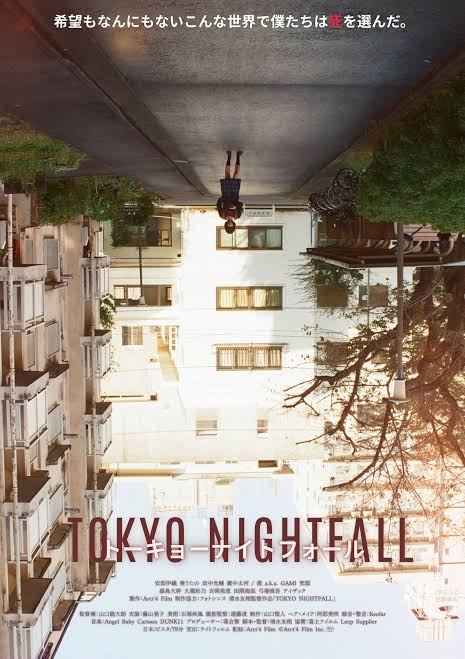
Struggling to deal with his feelings of grief and guilt following his younger sister’s suicide, a young man finds himself at an end of the world party for those who want to end their lives in Yuto Shimizu’s melancholy urban drama Tokyo Nightfall (トーキョーナイトフォール). The Tokyo these young people inhabit is one of loneliness and futility in which there is no real hope for future and the past holds only painful memories. 

The bleakness might best be demonstrated by Anna’s (Utano Aoi) reply that her happiest moment in life was her parents’ divorce. The pair hint at a childhood marked by domestic violence, but any hope they might have had for a better future was cut short when Anna witnessed the suicide of a friend of her brother Amenashi (Iori Abe) who jumped from their eighth floor flat. This even seems to have changed Anna who relates that it wasn’t so much the horror or the blood but the fact that she saw a person turn into an object in real time. It made her feel as if being alive wasn’t all that important. 

Working a soulless job as a delivery driver where his clients are often similarly withdrawn or hostile, Amenashi blames himself for Anna’s death and wonders if there was something more he could have done to prevent it while drawn into the same kind of darkness she was. Amenashi’s friend, Hattori (Taiga Hironaka), even states that he is worried about him because his erratic behaviour reminds him of that of Anna shortly before she died. It seems that the party he goes to a gathering for those planning to end their lives where they can have one last night of fun before they go.

Amenashi goes to the party, but is followed by his friends Hattori and Nozu (Kosuke Tanaka) who don’t quite know what the party is, but just want to find their friend. While Nozu, otherwise a comic relief character giving lewd and disgusting answers to the questions put to him, Nozu too sets out to enjoy the night even bonding with a young woman, but is also drawn into the darkness of the evening and reconsiders his own life. Others in the club react with irritation, telling Hattori he should respect his friend’s decision and has no business being here. Haunted by visions of Anna, Amenashi remains uncertain not quite knowing whether to live or die. Another guest at the club tells him that he should forget about this cold world and stay with them, dragging him over to the side of death, while Hattori does him best to encourage him to live.

The video camera sequences play out as a kind of will as Anna, Hattori, and Nozu look back over their lives. Shimizu sometimes replays the same video only to let the conversation run to add more information that changes our impressions of what’s gone before. Speaking about their happiest and saddest moments, the friends paint a bleak picture of familial disconnection and loneliness but are saved only by their bond with each other as Hattori names his happiest moment as spending time on the roof with them.

The irony is that may not be enough. The ghost of Anna tells Amenashi that neither choice is wrong and the film is non-judgemental about the idea of suicide, perhaps feeling that those who make the deacon to leave should be allowed to do so while Amenishi wrestles with himself about the right thing to do. Others may have the decision taken away from them, but he does at least have the power to decide his own future. Hattori had told him that there may be no point in thinking. People are full of contradictions and don’t even understand themselves. “We are here for each other,” Nozu adds, offering the only possible source of salvation in a world that otherwise seems hopeless and devoid of possibility. As Amenashi cycles around the city, he looks on at young couples and is struck by a sense of urban disconnection and loneliness, but does perhaps begin to rediscover something of the will to live in the power of friendship and the memories of those he’s lost, if perhaps only too late.


Tokyo Nightfall screened as part of this year’s Raindance Film Festival.

Trailer (English subtitles)
Dad’s Lunch Box (パパのお弁当は世界一, Masakazu Fukatsu, 2017)

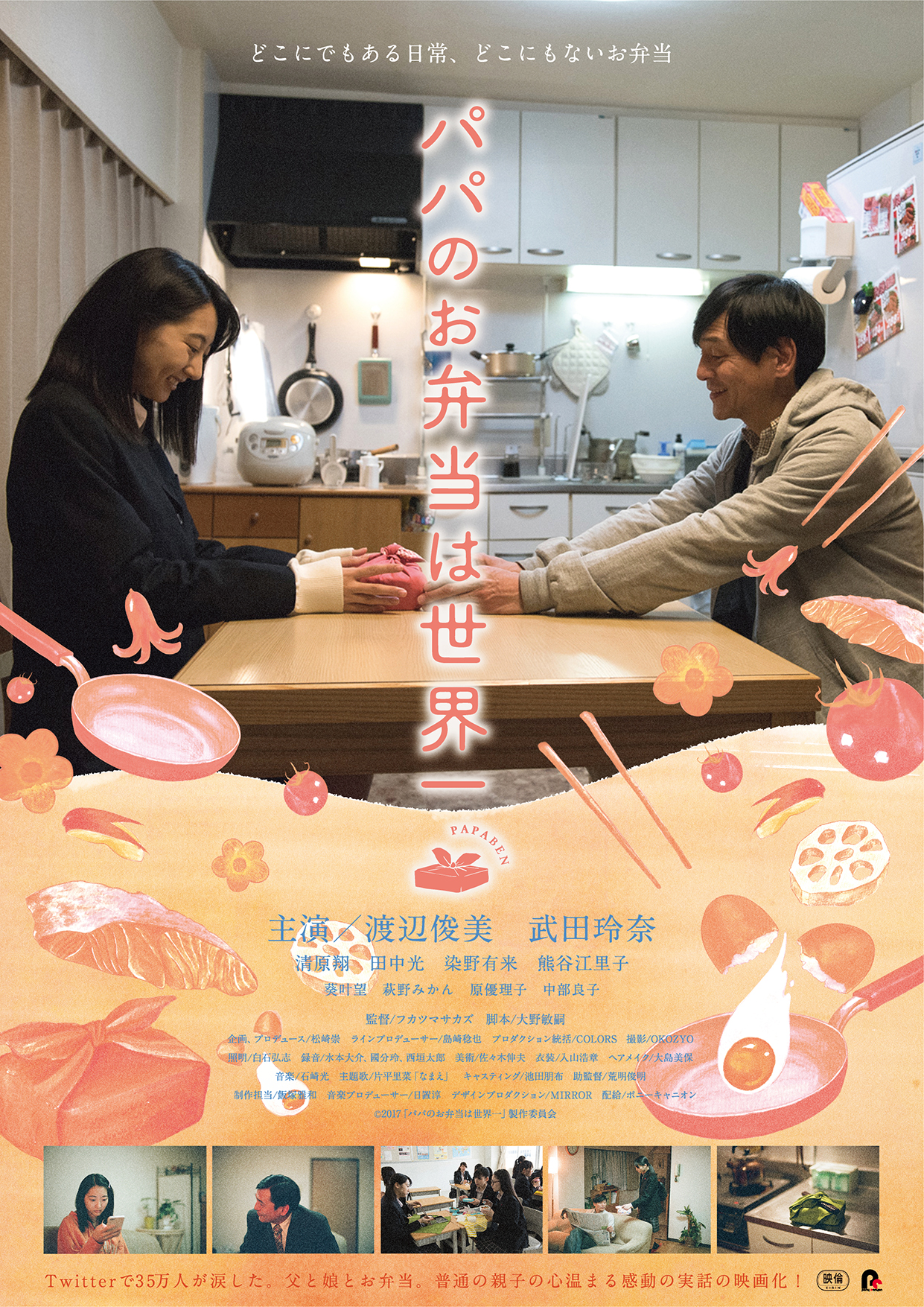
Dad's Lunchbox posterLunch is serious business in Japan, but perhaps those adorable character bento have a dark side, forcing already frazzled mothers to get up before dawn in order to ensure their child’s lunch box will be sufficiently “cute” or risk being made to feel like a cold and unloving parent. It goes without saying that it’s usually mums who are expected to take care of food preparation, salaryman dads are a rare sight in a kitchen, but then a recent phenomenon known as “papaben” has been taking the internet by storm and somewhat normalising the idea that fathers too can channel their love for their kids into visually appealing, nutritionally balanced meals.

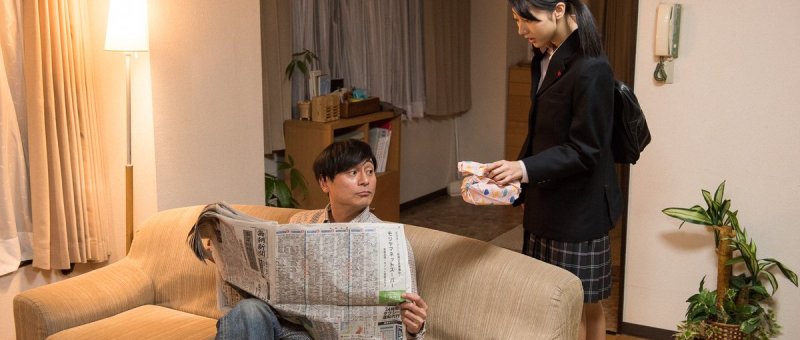
Dad’s Lunch Box (パパのお弁当は世界一, Papa no Obento wa Sekai Ichi), the debut feature from Masakazu Fukatsu, is inspired by a viral Tweet posted by a high school girl on her graduation which thanked her father for taking the trouble of making a handmade bento for her every day of her high school life. The Tweet also included a photo of his risible first effort and his final high school lunch box crafted after three years of trial and error. Fukatsu’s film version follows a recently single salaryman known only as “Father” (Toshimi Watanabe) who decides to make the creation of bento his primary method of demonstrating that he is perfectly fine bringing up his teenage daughter Midori (Rena Takeda) all alone.

The film does not dwell on the circumstances which led to Father’s wife leaving and there does not appear to be any animosity between himself and his daughter on account of it, nor does Midori suffer any particular stigma at school because of having a single dad save for the unfortunate quality of her daily bento. Father, having lived a regular salaryman life, is not exactly a great cook and has an uphill journey ahead of him when it comes to mastering the basics let alone creating the Instagrammable lunches of his daughter’s dreams. Taking a few tips from a friendly lady at work, Father eventually realises that for a teenage girl bento are an important social signifier and must, in all cases, be cute. Nevertheless, he struggles with fundamental hygiene concerns that leave him unaware of why you shouldn’t put sashimi in a lunch box which is going to be sitting around at room temperature all day.

The most important component in a bento is, however, love which is why Father started making them in the first place. It’s not so much that he eventually masters the art of cooking, nor that of learning how to make his dishes aesthetically pleasing, but that he is able to connect with his increasingly distant teenage daughter as he does so. Midori, having grown to like her dad’s previously embarrassing lunchtime fare, tricks him into making two bento lunches passing one off as her own work in order to give to a boy she likes and sort of (though incorrectly) assumes is her boyfriend. The boyfriend is, it has to be said, quite cheeky and extremely ungrateful when one considers he’s getting a 100% free lunch every day, but in any case his decision to rudely criticise Father’s by now beautiful bento is the one which finally sets alarm bells ringing in the mind of the romantically naive Midori and her supportive friends. Father remains oblivious until the lady at work helps him out again by keying him in to Midori’s likely source of teenage angst. When giving her a gentle opportunity to open up doesn’t yield results, Father realises he needs to give his daughter space to figure things out, leaving tiny notes of encouragement along with the food to make sure she knows he’s there if she needs him.

In a strange turn of events, actor Toshimi Watanabe who plays the father (previously known as a ‘90s hip hop star) himself made quite a splash in the papaben world when he released a book of his own bento recipes in 2014 crafted for his teenage son through his high school years. Dad’s Lunchbox may be low on plot detail, but it’s high on heart in its earnest tale of a doting dad just so happy to be making headway in conquering the most of domestic of tasks while finding the way to his daughter’s heart through her stomach.


Dad’s Lunchbox was screened as part of the 2019 Japan Foundation Touring Film Programme.

Original trailer (no subtitles)