Let’s Go Karaoke! (カラオケ行こ!, Nobuhiro Yamashita, 2023)

Singing is serious business. In Nobuhiro Yamashita’s adaptation of the manga by Yama Wayama Let’s Go Karaoke! (カラオケ行こ!Karaoke Ikou!), it’s matter of life and death, metaphorically at least, for a young man confronting adolescence and a zany gangster who seems kind of lonely but is desperate to learn how not to embarrass himself at the boss’ big sing off so he won’t be subjected to a homemade tattoo of his most hated motif.

The irony is perhaps that this kind of yakuza at least doesn’t really exist anymore and “Crazy Kid” Kyoji (Go Ayano) is in many ways a ghost of bygone days inhabiting a Showa-era shopping arcade soon to be torn down and replaced by a luxury hotel. Meanwhile, high schooler Satomi (Jun Saito) is also facing a kind of apocalypse in that he’s a boy a soprano whose voice has begun to change. His encroaching puberty leads him to blame himself when the school choir only places third during the nationals not making it to finals. But it’s at this concert that Kyoji first hears his “angelic” voice and decides he’s the perfect person to teach him how sing, intimidating him into an impromptu karaoke session.

As Satomi later points out, adults don’t invite kids to karaoke and this arrangement would be odd even if Kyoji were not an old school yakuza with a severed finger in his glove compartment. Of course, Satomi’s frightened but cannot really say no offering a few words of advice by daring to tell Kyoji that his falsetto is  “sickening” and he should stop waving his hands around if he wants to master the art of singing. It is also doesn’t help that his choice of song, Kurenai by X Japan, a hair rock epic mostly written in broken English, is a song of manly melodrama which requires a good deal of screaming. Despite having enlisted Satomi, Kyoji talks about one of his fellow footsoldiers as if he’s died when he’s only decided to get some professional singing lessons in an effort not to come last and end up with a lame tattoo.

Yamashita frames both their challenges as the same, Satomi fearing a social death and the death of his youth if he takes to the stage at what he’s sure would be his final concert and his voice cracks while Kyoji, ironically enough, does not really fear a literal death but the pain and humiliation of being branded by the boss for being bad at karaoke. Despite their differences a genuine a sense of friendship does arise between them, if also a possibly inappropriate homoerotic tension, as they support each other towards their shared goals and learn to sing from the heart which was apparently the real problem with Satomi’s school choir seemingly more obsessed with technique and correctness than the simple joy of singing. 

Hovering on a precipice, Satomi exists in a liminal space in his own way as ghostly as Kyoji surrounded by the obsolete. In his school film club, of which he is an honorary member, they watch VHS tapes of classics such as White Heat, Casablanca, and Bicycle Thieves which can only be watched once because the player’s broken and you can’t rewind anymore. His world’s on the brink of eclipse, and his friendship with Kyoji is a harbinger of a darker, more adult world but also one that’s less frightening than it ought to be with its admittedly scary gangsters obsessed with karaoke and bad tattoos. He starts to wonder if Kyoji was even real or some kind of imaginary friend appearing to help him deal with his impending adolescence and what it means for his singing career, but is finally reassured by a piece of concrete evidence confirming at least that it did really happen if leaving him with a sense of loneliness once their quests have come to an end. Surreal in its cheerful darkness, Yamashita’s heartfelt drama is an advocation for the for the healing powers of karaoke and the importance of singing from from the heart no matter how it might sound to those you who may themselves shed a few manly tears over a song about lost love and absent friends.


Let’s Go Karaoke! screened as part of this year’s Nippon Connection

Original trailer (English subtitles)
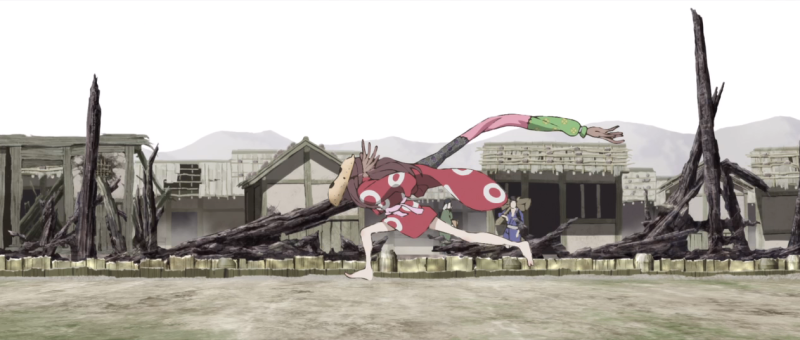
Inu-Oh (犬王, Masaaki Yuasa, 2021)

“Unity demands order” according to an ambitious politician near the end of Masaaki Yuasa’s stunning anime prog rock opera, Inu-Oh (犬王). Inspired by Hideo Furukawa’s novel Heike Monogatari Inu-Oh no Maki, Yuasa’s spirited drama is as much about the liberating power of artistic expression as it is about the danger it presents to those in power, while reclaiming the stories wilfully hidden in history or as the narrator puts it “stolen and forgotten” in order to exorcise a degree of historical trauma lingering in the cultural aura.

Set in the Muromachi period in which two imperial courts contested hegemony, the tale opens with the retrieval of a set of cursed remnants buried at the bottom of the sea after the battle of Dan-no-ura in which the Heike clan were famously defeated. Ashikaga Yoshimitsu (Tasuku Emoto) is convinced that possessing imperial treasures would lend credence to his claim, but their resurfacing creates nothing but misery leaving the boy who discovered them, Tomona (Mirai Moriyama), blind and his father dead. Setting off for Kyoto in search of revenge, Tomona is taken in by an elderly Biwa player and eventually runs into a strange creature wearing a gourd mask and behaving like a dog, striking up a friendship that later leads to the realisation that the boy is also cursed, haunted by the spirits of fallen Heike warriors desperate for their stories to be told. 

In true fairytale fashion, curse later begins to dissipate as the pair exorcise the ghosts by telling their stories never singing the same song twice but always in search of new songs to be sung. Tomona changes his name several times, adopting that of “Tomoichi” in keeping with the requirements of his Biwa school and later choosing for himself that of “Tomoari” in his partnership with Inu-Oh in emphasis of the fact that “we are here”. Yet as the ghost of his father reminds him, changing his name makes him difficult to find literally losing touch with his roots in becoming invisible to friendly spirits. He and the cursed boy Inu-Oh are interested in a new kind of Biwa that is opposed by the Biwa priests for its transgressive modernity some feeling that Tomona’s transformation with his long hair and makeup brings the profession into disrepute though the act proves undeniably popular with Inu-Oh the biggest star of the age. 

Having begun in the classical register with images resembling ink painting and a score inspired by traditional noh, Yuasa introduces electric guitar as the film shifts into rock opera, the pair’s stagecraft incredibly modern as they adopt all kinds of elaborate staging to add atmosphere to their tales including at one point a large lantern silhouette mimicking the big screen graphics of the present day. Yet Inu-Oh’s fame comes with a price. His popularity threatens both the pride of a jealous rival and the ambitions of the Ashikaga clan who fear his tales of the Heike are simply too bold and radical, later condemning them as an affront to the glory of the shogun and insisting that their official version must be the only record of the Heika warriors. 

The sense of freedom the pair had felt in their ability to express themselves through music and dance is quickly crushed by cultural authoritarianism, Inu-Oh reduced to a kind of court jester performing only for the lord while as the closing credits tell us becoming the biggest popular star of his age though now too forgotten along with his songs while his more elegant counterpart, Fujiwaka, is remembered for shaping the art of contemporary noh though there is perhaps something in Tomona’s defiant reclaimation of his name along with the essential right to choose it for himself that grants him a greater liberty in simply refusing to allow himself to be subjugated by feudal power. A psychedelic rock opera set in 14th century Japan that remembers even noh was once new and malleable, Inu-Oh insists on art’s danger in its capacity to challenge the status quo not only directly but through a series of internal revolutions born of the masks we choose to wear and those we choose to remove in the radical act of self-expression which is in its own way the truest form of liberty. 


Inu-Oh screened as part of this year’s Glasgow Film Festival 

International trailer (English subtitles)

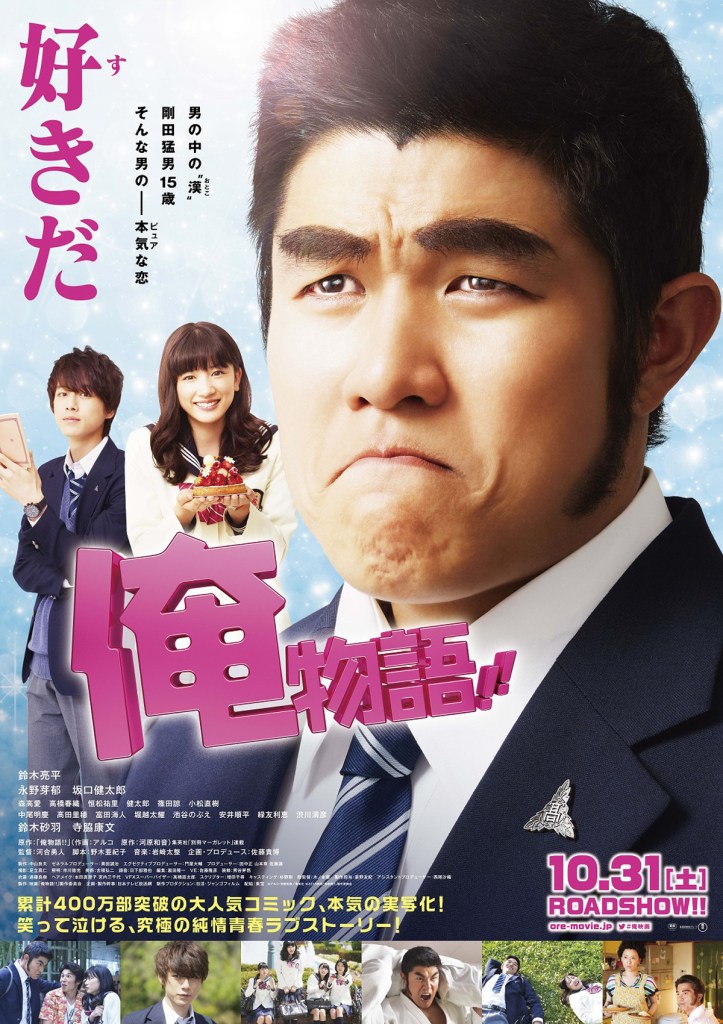
My Love Story!! (俺物語!!, Hayato Kawai, 2015)

my-love-storyThey say the way to a man’s heart is through his stomach, but for some guys you’ll have to do a whole lot of baking. Based on the popular manga which was also recently adapted into a hit anime (as is the current trend) My Love Story!! (俺物語!!, Ore Monogatari!!) is the classic tale of innocent young love between a pretty young girl and her strapping suitor only both of them are too reticent and have too many issues to be able to come round to the idea that their feelings may actually be requited after all. This is going to be a long courtship but faint heart never won fair maiden.

Takeo (Ryohei Suzuki) has been best friends with next-door neighbour Suna (Kentaro Sakaguchi) ever since they were small and he made a point of becoming his defender when Suna was the new kid in town and the other boys made fun of him. However, Taeko is a big lug of a guy, adored by the his male classmates for his off the charts level of coolness, but often shunned by the ladies thanks to his impulsive nature and booming voice. Suna, by contrast, is massively popular and finds himself surrounded by swooning girls everywhere he goes. Being the big hearted guy he is, when Takeo notices his middle school crush confessing her love to Suna on graduation day, he makes sure Suna lets her down gentle and chooses to break his own heart instead.

You see, being the big guy is not exactly easy. A little slow on the uptake but also extremely sensitive, Takeo has been hearing gorilla jokes his whole life and so has internalised an intense feeling of being completely unloveable. Despite this, he remains an extremely good person who just wants everyone else to be happy even if he’s convinced himself he’s not allowed to be. Thus when he saves timid high school girl Rinko (Mei Nagano) from a persistent street harasser and falls in love at first sight, it doesn’t really occur to him that the same thing might have happened to her. Mistaking Rinko’s attempts to get his attention for a backhanded way to get to his more conventionally handsome friend, Takeo resolves to get the two together no matter what!

It would be difficult to find a romance quite as innocent as My Love Story!! which (successfully) strings out one wilful misunderstanding for around two hours. There are no great scenes of jealous exes or sudden arranged marriages to contend with, just two people entirely incapable of speaking plainly. Takeo is so invested in the idea of his own ugliness that it just doesn’t make sense to him that anyone would choose him over the conventionally handsome Suna. Likewise Rinko is quite a timid girl, bowled over by the cool way Takeo dealt with her street harasser and subsequent acts of heroism throughout the film. Though her friends may crack gorilla jokes behind her back, Rinko can see straight through to Takeo’s giant heart and is always ready to defend him, even if her own diffidence means she can’t just tell Takeo how she really feels in a way he understands.

Meanwhile, Suna is very bored by all of these missed messages as his well meaning buddy tries to foist the girl he himself loves on his obviously disinterested friend. As for why Suna is so disinterested, the film is also a somewhat coy. A little shy and awkward himself, Suna is uncomfortable with all the attention his ridiculous good looks bring him, as well as additional resentment from the other guys and often needing to deflect praise for Takeo’s heroism which people often seem to attribute to him. It may just be that Suna is over the superficial and is waiting for someone to see past his pretty boy face but his refusal to talk about the kind of girl he likes aside from going for “big and strong” perhaps hints at an altogether different reason. In any case, Suna getting fed up with being persistantly gooseberried becomes the final catalyst for finally explaining to Takeo what exactly has been going on these past few months.

Before you know it, enough baked goods to feed a small army have been consumed but Takeo is still having trouble realising that they each had a secret ingredient – love! Sometimes nice guys do get the girl, even if it involves shielding them from a falling coffin in a haunted house that’s on fire which is not as good of a metaphor as you’d think but it’ll do for now. Old fashioned and innocent, My Love Story isn’t going to set the world on fire, but it might just light a flame in your heart.


Original trailer (no subtitles)

https://www.youtube.com/watch?v=iRRlwzgOArY

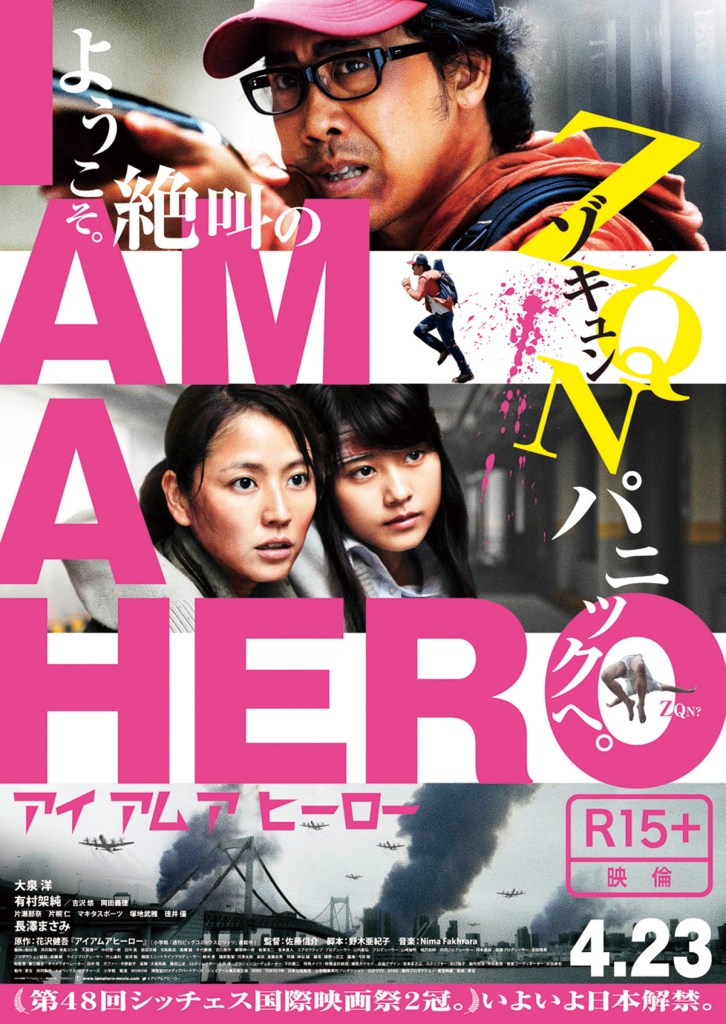
I Am a Hero (アイアムアヒーロー, Shinsuke Sato, 2016)

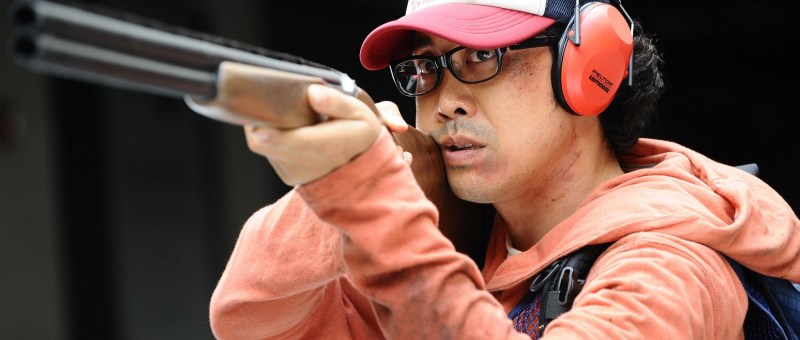
i-am-a-heroJapan has never quite got the zombie movie. That’s not to say they haven’t tried, from the arty Miss Zombie to the splatter leaning exploitation fare of Helldriver, zombies have never been far from the scene even if they looked and behaved a littler differently than their American cousins. Shinsuke Sato’s adaptation of Kengo Hanazawa’s manga I Am a Hero (アイアムアヒーロー) is unapologetically married to the Romero universe even if filtered through 28 Days Later and, perhaps more importantly, Shaun of the Dead. These “ZQN” jerk and scuttle like the monsters you always feared were in the darkness, but as much as the undead threat lingers with outstretched hands of dread, Sato mines the situation for all the humour on offer creating that rarest of beasts – a horror comedy that’s both scary and funny but crucially also weighty enough to prove emotionally effective.

Strange things are happening in Tokyo. The news has just had to make a correction to their previous item – apparently, it was the woman who bit the dog and no, they don’t as yet know why. Hideo Suzuki (Yo Oizumi), sitting in the corner apart from his sardonic colleagues, is a 35 year old manga assistant with dreams of creating his very own franchised series. Sadly, his ideas are always shot down by the publisher who barely remembers his name but does note that there’s always the same problem with his protagonists. They’re just too…”normal’? Returning home to his previously patient girlfriend with the news that he has, once again, failed, Hideo is unceremoniously thrown out as Tekko (Nana Katase) charges him with exactly the same complaint as his publisher had – only special people can achieve their dreams, she says. You’re not special, you’re just ordinary. Throwing out his ridiculous shotgun purchased for “research” alongside him, Tekko slams the door with an air of frustrated finality.

A short time later, some of Hideo’s co-workers are feeling unwell, as is Tekko who calls him to apologise but when he arrives at her flat what he finds there is obviously not Tekko anymore. Returning to work, Hideo also finds one of his colleagues wielding a bloody bat next to the body of another assistant. Heroically cutting his own throat on realising he’s been bitten, his friend passes the bat(on) to Hideo, now on the run from a falling city. Teaming up with high school girl, Hiromi (Kasumi Arimura), he heads for Mt. Fuji where it’s hoped the virus may not be able to survive but the pair eventually run into another group of survivors holed up in a outlet mall where the undead may be the last of their worries.

Sato gleefully ignores the genre norms, refusing to give in to cinematic rules by consistently moving in unexpected directions. Thus, Hideo remains a cowardly fantasist throughout much of the film. In an odd kind of way, this refusal to engage is his manner of heroism. Though he is afraid and avoids reality through frequently trying write his way out of a situation, cleverly manifested by nicely integrated fantasy sequences, Hideo does not run away and consistently refuses to abandon those around him even if might be to his own advantage. Eventually he does get his hero moment, finally finding the courage to fire the shotgun which has so far remained an empty symbol of his unattainable dreams, stopping to pick up his all important hat as every bona fide hero must, but his true moment of realisation comes when he’s forced to acknowledge his own ordinariness. Having been accustomed to introduce himself with the false bravado that his name is Hideo – written with the character for hero, his post-zombie warrior persona can finally consent to just being “the regular kind of Hideo”. Heroes are not a magic breed, they’re regular guys who are OK with who they are and are prepared to risk all for someone or something else.

The fact that Hideo has a gun at all is a strange one when guns are so rare in Japan though his devotion to the precise rules of his license even in this quite obviously lawless environment proves an ongoing source of comedy. It also makes him an unwitting target for the unscrupulous and puts him in danger with the unpredictable leader of the survivor community he accidentally wanders into. As with any good zombie tale, the undead are one thing but it’s the living you have to watch out for. Holing up in an outlet store of all places can’t help but recall Dawn of the Dead and Sato does, indeed, make a little of its anti-consumerist message as expensive trinkets firstly seem pointless trophies, unceremoniously heaped together in Tupperware, but ultimately prove a kind of armour against zombie attack.

The ZQN are classic zombies in many ways – you need to remove the head or destroy the brain, but they’re also super strong and have a poignant tendency to engage in repetitive actions from their former lives or repeatedly make reference to something which was obviously in their mind as they died. Thus Tekko has enough time to ring Hideo before the virus takes hold and a politician to vent about the incompetence of his colleagues but the ZQN turns salarymen into babbling choruses of “thanks for everything”, dooms shop assistants to exclaim “welcome” for eternity and leaves baristas stuck with “What can I get you today?”. Unlike your usual zombies, the ZQN retain some buried consciousness of their inner selves, able to recognise those close to them but condemned to devour them anyway.

Placing character development ahead of the expected genre trajectory, Sato weaves a nuanced essay on the nature of heroism and humanity as Hideo is forced to confront himself in order to survive. Though he tantalises with a possible deus ex machina, Sato never gives in to its use – if our heroes are going to survive, they have to save themselves rather than wait for someone with the hero genes to suddenly appear. Of course, they do so in an elaborate blood soaked finale which more than satisfies in the zombie action stakes. Witty yet heartfelt, if I am a Hero has a message it’s that if I am a Hero then you can be too – no one is coming to save us, except us, but if we’re going to do so then we have to conquer ourselves first so that we might help each other.


Original trailer (English subtitles)

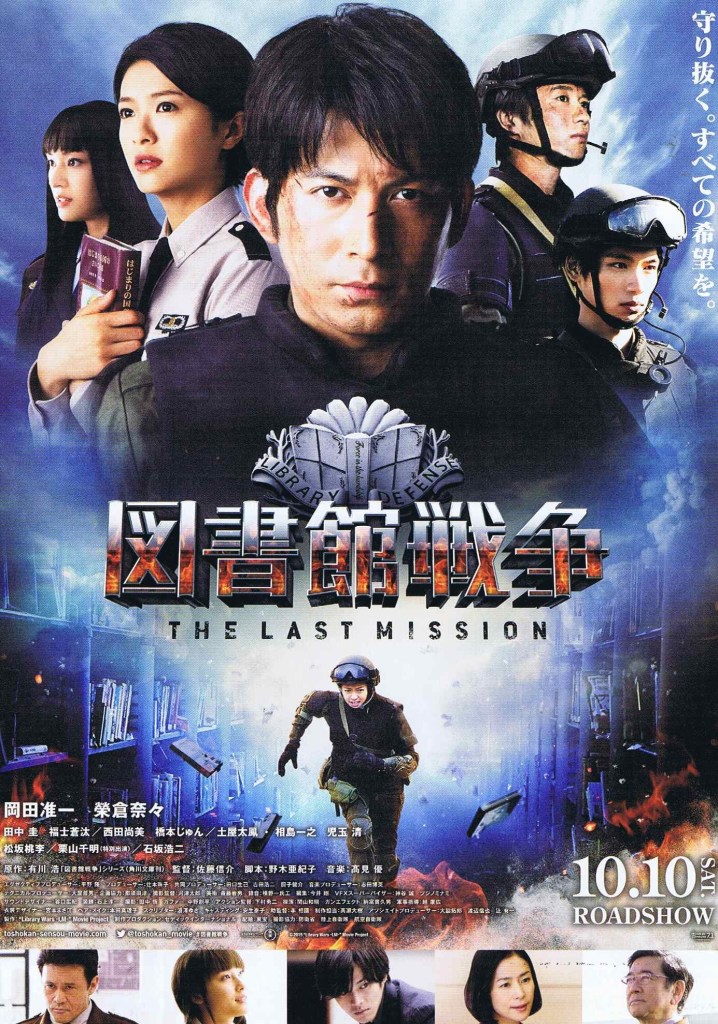
Library Wars: The Last Mission (図書館戦争-THE LAST MISSION-, Shinsuke Sato, 2015)

library-wars-last-missionWhen Library Wars, the original live action adaptation of Hiro Arikawa’s light novel series, hit cinema screens back in 2013 it did so with a degree of commercial, rather than critical, success. Though critics were quick to point out the great gaping plot holes in the franchise’s world building and a slight imbalance in its split romantic comedy/sci-fi political thriller genre mix, the film was in many ways a finely crafted mainstream blockbuster supported by committed performances from its cast and impressive cinematography from its creative team. Library Wars: The Last Mission (図書館戦争-THE LAST MISSION-, Toshokan Senso -The Last Mission-) is the sequel that those who enjoyed the first film have been waiting for given the very obvious plot developments left unresolved at the previous instalment’s conclusion.

18 months later, Kasahara (Nana Eikura) is a fully fledged member of the Library Defence Force, but still hasn’t found the courage to confess her love to her long term crush and embittered commanding officer, Dojo (Junichi Okada). As in the first film, The Media Betterment Force maintains a strict censorship system intended to prevent “harmful” literature reaching “vulnerable” people through burning all suspect books before they can cause any damage. Luckily, the libraries system is there to rescue books before they meet such an unfortunate fate and operates the LDF to defend the right to read, by force if necessary.

Kasahara is an idealist, fully committed to the defence of literature. It is, therefore, a surprise when she is accused of being an accomplice to a spate of book burning within the library in which books criticising the libraries system are destroyed. Needless to say, Kasahara has been framed as part of a villainous plan orchestrated by fellow LDF officer Tezuka’s (Sota Fukushi) rogue older brother, Satoshi (Tori Matsuzaka). There is a conspiracy at foot, but it’s not quite the one everyone had assumed it to be.

In comparison with the first film, The Last Mission is much more action orientated with military matters taking up the vast majority of the run time. A large scale battle in which the LDF is tasked with guarding an extremely important book containing their own charter (i.e. a symbol of everything they stand for) but quickly discovers the Media Betterment Force is not going to pass up this opportunity to humiliate their rival, forms the action packed centrepiece of the film.

The theme this time round leans less towards combating censorship in itself, but stops to ask whether it’s worth continuing to fight even if you feel little progress is being made. The traitorous officer who helps to frame Kasahara does so because he’s disillusioned with the LDF and its constant water treading. The LDF is doing what it can, but it’s fighting to protect books – not change the system. This is a weakness Satoshi Tezuka is often able to exploit as the constant warfare and tit for tat exchanges have begun to wear heavy on many LDF officers who are half way to giving up and switching sides. Even a zealot like Kasahara is thrown into a moment of existential despair when prodded by Satoshi’s convincing arguments about her own obsolescence.

Satoshi rails against a world filled with evil words, but as the head of the LDF points out in quoting Heinrich Heine, the society that burns books will one day burn men. The LDF may not be able to break the system, but in providing access to information it can spread enlightenment and create a thirst for knowledge among the young which will one day produce the kind of social change that will lead to a better, fairer world.

As in Library Wars all of these ideas are background rather than the focus of the film which is, in essence, the ongoing non-romance between Kasahara and Dojo. Remaining firmly within the innocent shojo realm, the romantic resolution may seem overly subtle to some given the extended build up over both films but is ultimately satisfying in its cuteness. Library Wars: The Last Mission masks its absurd premise with a degree of silliness, always entirely self aware, but gets away with it through sincerity and good humour. Shinsuke Sato once again proves himself among the best directors of mainstream blockbusters in Japan improving on some of the faults of the first film whilst bringing the franchise to a suitably just conclusion.


Original trailer (No subtitles)

https://youtu.be/8Bqgn4icG5M