Tokyo Burst: Crime City (TOKYO BURST-犯罪都市-, Eiji Uchida, 2026) [Fantasia 2026]

Ma Dong-seok’s popular Roundup series has a rather convoluted history in terms of its titling. The first film was screened under the literal translated title “Crime City” before being retitled with the ironic “The Outlaws” while all subsequent instalments in the series have adopted the title of the first sequel. Nevertheless, this Japanese spin-off set in 2015 which is two years before the first film’s release, comes with the subtitle “Crime City” and though a Korean co-production does not actually feature Ma Dong-seok but rather attempts to tell a similar story set in the world of Kabukicho.

Which is to say that it takes its equally from delinquent high school manga such as Be Bop High School which is name checked within the film rather than the maverick cop hamstrung by bureaucracy trope that lies at the centre of the Korean series. Though The Roundup may itself have become increasingly less gritty as the series continues to expand, it largely remains grounded within a more concrete reality which is not really something you can say about Tokyo Burst: Crime City even if does hint at the ways in which the crackdown on yakuza has accidentally led other kinds of organised crime groups flourishing.

In this case, that would the incongruity of a crime syndicate led by a greedy host who heads the club Dreaming and presses those who work for him into petty crime if they can’t make their onerous quotas. In general, the stereotypical image of a “host” who earns money by drinking with women in dedicated bars, is of someone slightly effeminate and sensitive. Their livelihood depends on at least appearing non-threatening while providing the illusion of unconditional love and acceptance to their customers while also perhaps coming across as young, vulnerable, and in need of looking after. Though legislation has now been brought in to help stop hosts exploiting women financially until the point that they force them into sex work, the kind of masculinity they present is gentle and non-violent, which makes them a surprising presence in the ruthless world of organised crime.

Yet as is explained to Korean detective Si-won the major difference between the two nations is the extent to which police build relationships with underworld figures in order manage rather than eradicate crime in order to prevent large-scale violence breaking out, though Ma had also been doing something similar in the first Roundup film. The political corruption angle so common in Korean films in which the sons of chaebol families are effectively above the law plays a less well in the Japanese setting while a subplot about a land rights for casino construction,  and upcoming election, the thuggishness of the Deputy Prime Minister’s son, and their collaboration with organised crime facilitated by the familiar face of Ma’s sometime sidekick Jang Yi-soo, seems underdeveloped and impossible to take seriously given the film’s cartoonish tone.

Nevertheless, The Roundup’s uncomfortable tendency to make light of police brutality is fully carried over as violent cop Shiro actively covers up security cameras to interrogate suspects, while the police are also guilty of making use of connections to speed up or frustrate justice. They are otherwise a comically bumbling bunch as is yakuza boss hold-out Iwaki frustrated at the loss of his turf to the host club upstarts. Shiro stands somewhere in the middle as a bruiser cop with a strong sense of justice but perhaps not so much ethics. Nevertheless, he eventually bonds with his new Korean partner through singing Linda, Linda at karaoke while becoming invested in his quest to catch those responsible for his late partner’s murder before they return to the safety of Korea where they are otherwise above the law. Despite the overarching silliness, there is an endearing sense of lived-in community in the Kabuchiko environment of which Shiro is at the very centre and even if the film refuses to take anything else to seriously, it does at least commit to the ferocity and carnage of its intermittent action scenes.


Tokyo Burst: Crime City screened as part of this year’s Fantasia International Film Festival.

Trailer (no subtitles)

All You Need Is Kill (Kenichiro Akimoto, 2025)

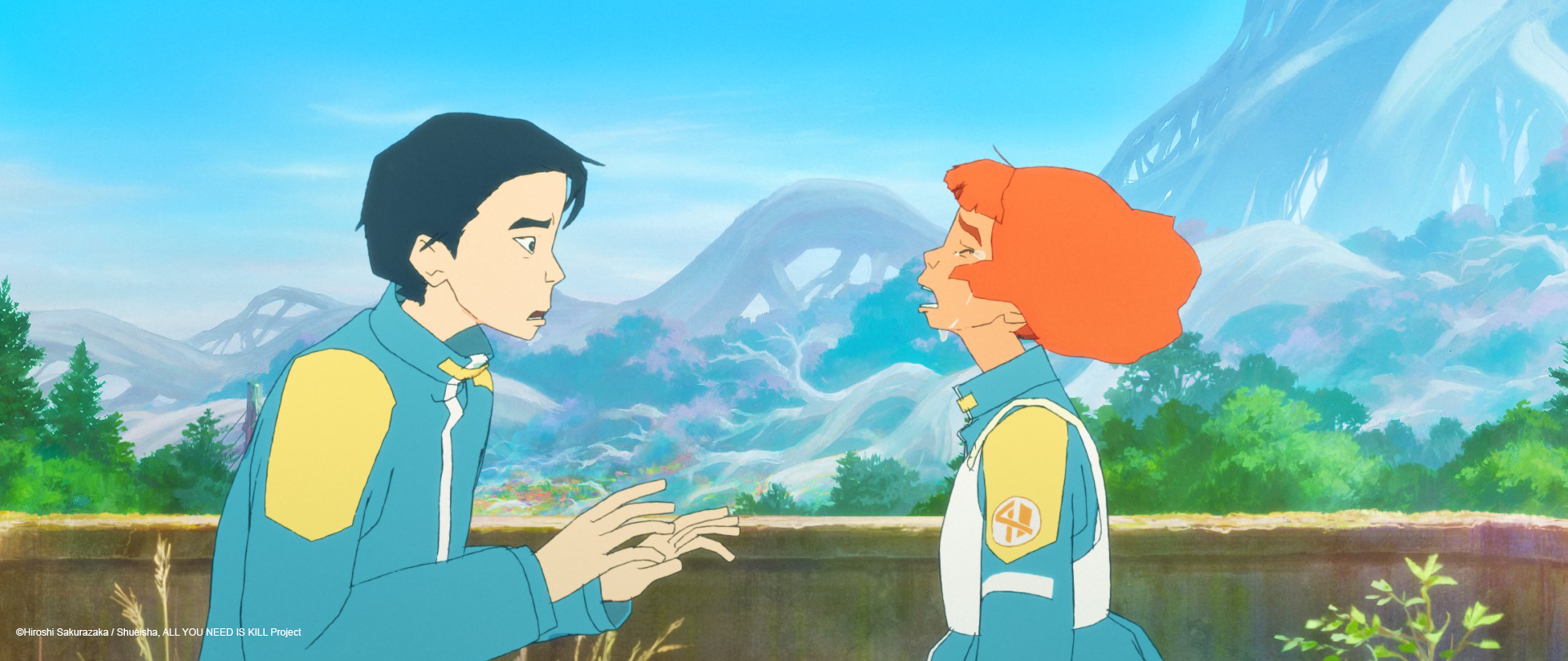
Ever get the feeling that every day is the same and nothing you do makes any difference? Rita’s (Ai Mikami) been feeling like that most of her life. Just going through the motions waiting for something to happen that would give her an excuse to change. And now she has her opportunity, because the world’s been invaded by a plant-like structure and no one yet knows quite why. All she and a team of other youngish people can do is poke around at the roots, but nothing really changes and no progress is made, which might be one reason Rita’s not really bothering. She’s sullen with her teammates and barely knows how to use her exosuit to the extent that even walking around in it is physically difficult. 

When Darol suddenly turns evil and sends out plant-like soldiers to massacre humanity, Rita is powerless but unexpectedly wakes up the next morning to discover the day is repeating. Every day, she must go fight Darol again, get killed, and then wake up to do the same thing. Perhaps it’s not so different from the way things were before in which each day was filled only with labour to the extent that one was indistinguishable from another, but it’s also a maddening loop from which Rita fears she cannot escape. Though taking liberties with its source material, Kenichiro Akimoto’s anime adaptation of Hiroshi Sakurazaka’s light novel is another in a series of films expressing a sense of emptiness felt among the younger generation hamstrung by a stagnant economy and conservative society where self-fulfilment and satisfaction feel at odds with a commonly held notion of success. Rika goes to battle every day, but achieves nothing before everything resets and she has to start again.

Just as she’s beginning to lose hope, she discovers another looper who has been secretly watching her exploits and supporting from the sidelines yet essentially hiding. Like her carrying childhood trauma and a sense of powerless inferiority, tech whiz Keiji (Natsuki Hanae) spent most of his first few loops trying to run away, which is understandable, only to be ironically inspired by Rita’s determination. She figures out not only that she needs a plan rather than just battling away on instinct alone, but also that she needs help. Her attempts to warn the others of Darol’s impending transformation fail, but looping with Keiji shows her the value of solidarity and the relief of sharing her burdens with someone else. As she says, she’d been selfish and self-involved, unable to see the meaning in anything until she finally realised that there was no point waiting around for the world to change. If she changed herself, the world would change around her if only that she would start to look at it differently.

These are the kinds of rebirth the pair are headed towards through their infinite karmic cycle of trying to figure out how to stop Darol and save the world. Nevertheless, the fact that Keiji is manipulating Rita’s suit and is able to programme his own to act in certain ways undercuts the notion of Rita being the arbiter of her own destiny, given that certain things are already being decided for her by an outside force other than the cosmic accident of the loop by which they are both connected. Then there’s also the implication that each of them are chosen ones that Darol particularly wants to absorb because they’re already strong, they just didn’t know it. But what really matters is that the pair begin to believe in the possibility of tomorrow enough to stop actively holding it back. Rita used to wish tomorrow would never come, and then it did stop coming, and that wasn’t any better. In fact, it was worse. At least now they each have the desire to proceed in the direction of tomorrow, together. Akimoto’s somewhat retro-inspired designs add to the sense of stopped time while the kinetic action sequences lean in to the feeling that Rita’s life is an inescapable slog against overwhelming odds and enemies that constantly respawn validating the nihilistic futility in which she is mired until finally realising that only she, with Keiji’s help, can break herself out of this cycle and finally find the way to a new tomorrow.


All You Need Is Kill is in UK cinemas from 27th February courtesy of Anime Limited.

Trailer (English subtitles)

Let’s Go Karaoke! (カラオケ行こ!, Nobuhiro Yamashita, 2023)

Singing is serious business. In Nobuhiro Yamashita’s adaptation of the manga by Yama Wayama Let’s Go Karaoke! (カラオケ行こ!Karaoke Ikou!), it’s matter of life and death, metaphorically at least, for a young man confronting adolescence and a zany gangster who seems kind of lonely but is desperate to learn how not to embarrass himself at the boss’ big sing off so he won’t be subjected to a homemade tattoo of his most hated motif.

The irony is perhaps that this kind of yakuza at least doesn’t really exist anymore and “Crazy Kid” Kyoji (Go Ayano) is in many ways a ghost of bygone days inhabiting a Showa-era shopping arcade soon to be torn down and replaced by a luxury hotel. Meanwhile, high schooler Satomi (Jun Saito) is also facing a kind of apocalypse in that he’s a boy a soprano whose voice has begun to change. His encroaching puberty leads him to blame himself when the school choir only places third during the nationals not making it to finals. But it’s at this concert that Kyoji first hears his “angelic” voice and decides he’s the perfect person to teach him how sing, intimidating him into an impromptu karaoke session.

As Satomi later points out, adults don’t invite kids to karaoke and this arrangement would be odd even if Kyoji were not an old school yakuza with a severed finger in his glove compartment. Of course, Satomi’s frightened but cannot really say no offering a few words of advice by daring to tell Kyoji that his falsetto is  “sickening” and he should stop waving his hands around if he wants to master the art of singing. It is also doesn’t help that his choice of song, Kurenai by X Japan, a hair rock epic mostly written in broken English, is a song of manly melodrama which requires a good deal of screaming. Despite having enlisted Satomi, Kyoji talks about one of his fellow footsoldiers as if he’s died when he’s only decided to get some professional singing lessons in an effort not to come last and end up with a lame tattoo.

Yamashita frames both their challenges as the same, Satomi fearing a social death and the death of his youth if he takes to the stage at what he’s sure would be his final concert and his voice cracks while Kyoji, ironically enough, does not really fear a literal death but the pain and humiliation of being branded by the boss for being bad at karaoke. Despite their differences a genuine a sense of friendship does arise between them, if also a possibly inappropriate homoerotic tension, as they support each other towards their shared goals and learn to sing from the heart which was apparently the real problem with Satomi’s school choir seemingly more obsessed with technique and correctness than the simple joy of singing. 

Hovering on a precipice, Satomi exists in a liminal space in his own way as ghostly as Kyoji surrounded by the obsolete. In his school film club, of which he is an honorary member, they watch VHS tapes of classics such as White Heat, Casablanca, and Bicycle Thieves which can only be watched once because the player’s broken and you can’t rewind anymore. His world’s on the brink of eclipse, and his friendship with Kyoji is a harbinger of a darker, more adult world but also one that’s less frightening than it ought to be with its admittedly scary gangsters obsessed with karaoke and bad tattoos. He starts to wonder if Kyoji was even real or some kind of imaginary friend appearing to help him deal with his impending adolescence and what it means for his singing career, but is finally reassured by a piece of concrete evidence confirming at least that it did really happen if leaving him with a sense of loneliness once their quests have come to an end. Surreal in its cheerful darkness, Yamashita’s heartfelt drama is an advocation for the for the healing powers of karaoke and the importance of singing from from the heart no matter how it might sound to those you who may themselves shed a few manly tears over a song about lost love and absent friends.


Let’s Go Karaoke! screened as part of this year’s Nippon Connection

Original trailer (English subtitles)