Seemingly drawing influence from the series of Arabian fantasy films from Hollywood, Senkichi Taniguchi’s Lost World of Sinbad: Samurai Pirate (大盗賊, Dai Tozoku), sees the director reunite with Toshiro Mifune who had made his debut in the director’s Snow Trail which could not be more different from this crowd-pleasing adventure movie. The film is loosely based on the life of 16th century merchant Luzon Sukezaemon who eventually fled to Cambodia after all his possessions were seized by Hideyoshi Toyotomi and he was condemned on some trumped up charges.
The film’s opening scenes perhaps reflect this incident as Luzon (Toshiro Mifune) is branded a pirate and set to be burned at the stake, narrowly escaping after bribing an official with drugs. Resentful, Luzon decides he might as well become a pirate after all as he’s pretty sick of Japan and fancies seeking his fortune on the open seas only his ship is quickly destroyed in a storm and all his crew killed while the treasure he was carrying is seized by the fearsome Black Pirate (Makoto Sato). Washing up in a mysterious place aesthetically a mashup between South East Asia and the Middle East, Luzon is cared for by a hermit and then becomes embroiled in intrigue on finding out that the tyrannical king has been seizing local women in exchange for unpaid taxes and imprisoning them within his harem.
Luzon’s dreams are for riches and status so his sudden discovery of a love of justice is a bit of a surprise, but then he’s also most interested in the princess Yaya (Mie Hama) because he spotted one the necklaces from his treasure chest around her neck which suggests she might have a lead on the Black Pirate. Princess Yaya is engaged to a prince from the Ming kingdom which threatens a wider kind of geopolitical destabilisation should anything go wrong with this marriage which is a distinct possibility seeing as the corrupt Chancellor (Tadao Nakamaru) has been colluding with an evil witch to kill the king and seize the kingdom.
Rather than a pure pirate movie the film contains fantasy elements such as the presence of a Western-style castle which is clearly modelled on the one from Disney’s Snow White along with a weird hermit whose powers are weakened every time he sees an attractive woman. It is not, however, the kind of tokusatsu the English title bestowed by the US release implies as it contains no real monsters instead focussing its special effects on the magic used by the witch, who can turn people to stone with her eyes, and the hermit who can turn himself into a fly or disappear in a puff of blue smoke. Despite the prominent inclusion of SFX master Eiji Tsuburaya these effects are repeated several times are really the only ones featured in the film.
In any case, what’s in play is famous merchant Luzon’s redemption arc in which he recovers the treasure but gives it back to the people, symbolically abandoning his dreams of wealth and status for something a little more community minded in vowing to sail the seven seas pursuing justice throughout the world. Having been a victim of authoritarianism in Japan, he rises up against tyranny abroad while teaming up with a group of local bandits and several times proudly proclaiming himself as Japanese though in a movie conceit everyone speaks his language including the Black Pirate who is later exposed as a snivelling fool tricked by the Chancellor on the promise of a chance to marry the Princess Yaya. Most of the derring do is reserved for the final sequence in which Luzon and the bandits storm the castle to defeat the evil chancellor but the screenplay also packs in genre elements such as trap doors and secret dungeons which keep Luzon busy as he does his best to overthrow an oppressive regime if only to put the rightful king back on the throne in the hope that might be better. Taniguchi certainly makes the most of his elaborate sets and costumes, creating a sense of tempered opulence along Middle-Eastern themes while adding a touch of the mythic in the attempt to weave a legend around the real life figure of Luzon Sukezaemon as a bandit revolutionary selling dreams of freedom on the sea as a pirate more interested in justice than money in otherwise corrupt society.
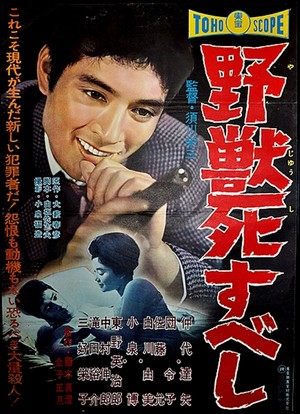
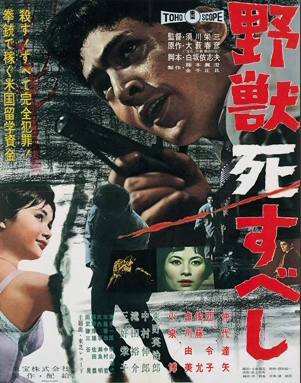
“He’s not a beast. No, he’s a robot. A machine created by a modern, twisted society” according to a frustrated policeman acknowledging that a sociopathic killer is going to get away with his crimes because when it comes right down to it he’s just that good. Eizo Sugawa’s The Beast Shall Die (野獣死すべし, Yaju Shisubeshi) is the first of several adaptations of the hardboiled novel by Haruhiko Oyabu, Sugawa would himself direct a “sequel” 15 years later while a better-known version would prove a hit for Toru Murakawa in 1980 with action star Yusaku Matsuda in the leading role, and a two-part V-cinema adaptation would follow in 1997. The 1959 edition however is very much an expression of the anxiety of its times, a slightly reactionary take on the post-Sun Tribe phenomenon hinting at a generational divide between the nihilistic, hyper individualist post-war generation and their confused though morally compromised forbears.
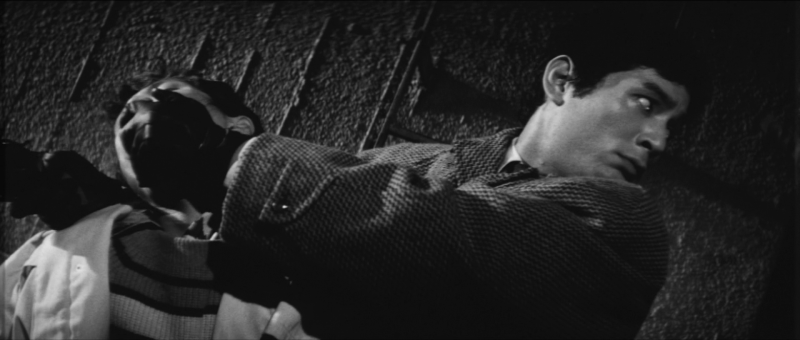
As the film opens, three policemen meet in a pub one of whom proudly shows off a Robby the Robot toy he’s picked up for his young son and is intending to give him on returning home from work. Sadly, however, Okada (Akira Sera) will never make it home because, for largely unexplained reasons, he is shot dead by nihilistic American literature student Date (Tatsuya Nakadai) who bundles the body into the boot of a car which he then simply abandons. Date never reveals much of a motive for this first murder, but he does later use Okada’s warrant card and service weapon to facilitate later crimes.
The problem, at least for earnest policemen Kawashima (Eijiro Tono), a veteran cop and father of seven, and idealistic rookie Masugi (Hiroshi Koizumi) who is engaged to barmaid Yoko (Yumi Shirakawa) but drags his feet over the marriage because of his precarious life as a law enforcement officer, is an ideological divide within the contemporary police force. “Investigations are about science. And science is the best” according to their boss, reflecting a new faith in forensics prioritising physical evidence from the crime scene over a policeman’s intuition. From a modern perspective, this seems to be the right call though Kawashima and Masugi appear to find it both restrictive and mildly insulting as if their experience on the job now counts for nothing. They also worry that such rigid thinking prevents thorough investigation, and they might have a point in the boss’ continued insistence that the crimes must be down to “gang activity” even though the evidence clearly points at someone connected to the university or perhaps a disgruntled salaryman with access to the uni gun club.
Kawashima and Masugi lament that they feel powerless to act because they don’t have the right to arrest someone on the basis of a “hunch”, and the film seems to agree with them as Date continues to commit his crimes unbothered by law enforcement though really who wants to live in such an authoritarian society that the police can haul you in solely because they think there’s something odd about you and “feel” you must be guilty of a crime even in the absence of conclusive evidence? Nevertheless it’s precisely these ideological divides that Date wilfully exploits while planning his hits, his second targets also reflecting the continuing Sinophobia of post-war cinema in impersonating a police officer to rob, but interestingly not kill, a pair of Chinese gangsters running an illegal gambling racket.
Hearing Date’s back story, we realise that society has in a sense warped him in witnessing an injustice done to his father which later led to his suicide while his mother was apparently engaging in an affair with the man who framed him. He strongly argues that the only response to the “chaos, madness, and contradictions” of the modern society is to “show our beastly nature”, wilfully abandon humanistic morality and conventional civility in favour of an individualistic satisfaction of one’s personal desires above all other concerns. Date is certainly an amoral man who has no problem with sacrificing those he determines to be lesser beings for his own gain, but as even Masugi reveals his thinking may not be out of line with that of his generation. Many people are driven to murderous rage, he argues, but do not act on it because of a social taboo.
As the film opens, a group of left-wing students is holding a rally in support of the anti-ANPO protests ahead of the treaty’s imminent renewal, though the professors mock them from inside insisting that their politics is not genuine only a reflection of the despair they feel in their society knowing that even if they graduate all that awaits them are low-level salaryman jobs with little promise of advancement. Those who can’t even manage that, they joke, turn to academia. Date’s professor (Nobuo Nakamura) affects sympathy with his poverty but also wilfully exploits him, getting him to do translations of novels which will later be published under his own name while it seems to be an open secret that he owes much of his success to the fact that he married into a prominent family which allowed him to spend five years studying abroad in America.
Meanwhile, his students philosophise on the psychology of crime insisting that a “robotic, truly ruthless personality” can only come from a “mechanistic society like the US” while Japanese criminals are generally “emotional” in that crimes are committed because of “love affairs, resentment, finances”, “petty humanistic motives” which society can easily understand if not exactly condone. Date, admittedly a student of American literature with his eyes firmly set on going abroad, entirely disproves this theory. His crimes appear to be dispassionate and committed largely for practical reasons, the later ones at least with money as the motive even if he also derives a thrill from his amoral rebellion against the system. His poverty is offered as a justification yet we also see him abuse and manipulate those weaker than himself, humiliating an old lady trying to sell flowers in the bar where Yoko works while later talking a fellow student suffering with TB and unable to pay his tuition into helping him commit a robbery.
Perhaps in someways uncomfortably in continuing a motif associating homosexuality with sadistic criminality, it’s also heavily implied that Date is bisexual, encountering an effeminate young man on the street with whom it is clear from their conversation he has previously been intimate to later use him as cannon fodder when engaging in a firefight with Chinese gangsters, while there is also an obvious homoerotic charge to his relationship to the student who later becomes a temporary accomplice. His relations with women are somewhat caddish and perfunctory, his sometime girlfriend Tae (Reiko Dan) telling the police that Date is a player who only sleeps with the same woman three times before becoming bored with her. Date’s attitude, though interestingly enough not his crimes, may reflect a societal misogyny, impoverished medical student Tae later refused access to the morgue because it’s not something a woman should see, though Tae herself later claims that it’s Date’s coldness and cruelty that draw her to him. Seemingly unable to feel genuine emotion for others, it nevertheless appears that Date is in a sense moved enough by Tae’s ability to embrace his inner darkness to eventually decide to alleviate her poverty on realising he no longer needs his ill-gotten gains because he’s secured his passage to America through more legitimate means.
A reaction to the post-Sun Tribe sense of moral panic about disillusioned post-war youth, The Beast Shall Die suggests that for the moment at least those like Date are in an unassailable position thanks to an overly liberal justice system as the two policemen lament their inability to prevent his escape through judicial means while turning their attention to Tae though there’s no real way they can know that Date gave the stolen money to her rather than taking it with him or depositing it in some other location even if she’s walking around with an ugly handbag that might be full of cash. Alternating between an acceptance of Date’s nihilistic, crypto-fascist philosophy in implying that those who obey the rules of civility are doing so solely because they are too weak to break them, and advocating for a more authoritarian society in which policemen are free to act on their “hunches”, Sugawa’s take on Oyabu’s hard boiled tale of societal corruption and warped post-war morality has its reactionary qualities even as it ends on a note of ambiguity that implies order will eventually triumph though not, it seems, today.


 Windows on Worlds