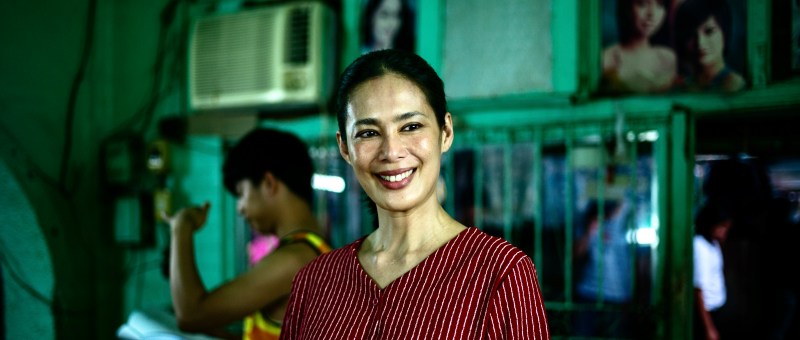
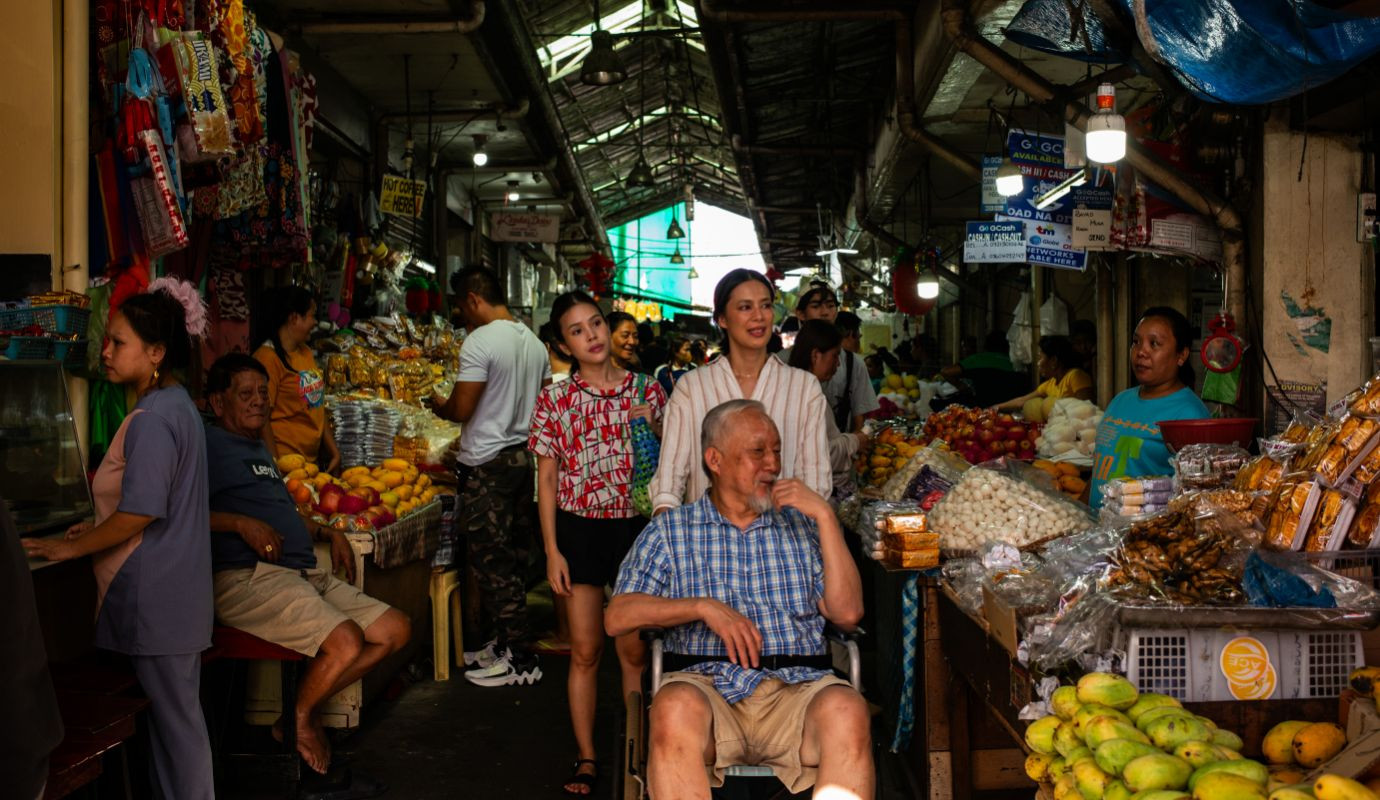
Ah-Ting (Zhang Xiao-xiong), an elderly man whose children mistakenly think is living with dementia because they just don’t really have anything to say to each other, says that he feels like a ball no one wants that they’re trying to kick as far away as possible. When his long-term carer April (Angel Aquino), who they call “Ah-po” because they can’t really be bothered with her name, wants to go back to the Philippines to see her dying mother, the children are reluctant to let her go and even go as far as saying that dying takes ages, so there’s no need to rush back. They have their own lives and don’t want to take care of their father nor do they want to have to pay someone else to cover April’s absence.
In the end, the only way that April can return to the Philippines is if she takes Ah-Ting with her. It’s an unusual arrangement, but highlights the way in which each of them has become somewhat abstracted from their families and exists only as a shadow presence hovering on the edges. Ah-Wei (Liu Kuan-ting), Ah-Ting’s youngest son who has just been released from prison, also feels like an unwanted ball to be kicked down the road, and may ironically come to identify with his father despite the animosity that’s existed between them since he was a child. Having nowhere else to go, Ah-Wei goes home, but is sort of relieved that his father isn’t there while the empty house gives him a place to reset and figure out how to start again as someone with a criminal conviction who can’t find conventional employment and is viewed with suspicion.
The irony is that, as someone who worked abroad looking after someone else’s family, April was separated from her own but fails to see the gulf that’s emerged between her children and herself. While she resumes her role as their birth mother, they point out that she didn’t raise them. The image she has of her son and daughter is self-constructed, while she is fixated on providing a “better” future for them that neither of them want. In her absence, her daughter Luisa has essentially been forced to take on a maternal role looking after the house and her younger brother as well as her bedridden grandmother. April keeps pushing her son Diwa to study, citing a childhood dream of becoming a police officer which is quite obviously not what he wants to do now, while Luisa needles her that there was never any money available for her to study nor would she have been able to with all of these other responsibilities.
Still just as Ah-Ting rejected Ah-Wei, April reasserts her authoritarian parenting style in trying to push her children towards futures she thinks are better while her husband reminds them that everyone’s happy as they are, which is presumably what she wanted when she decided to sacrifice herself for the family by going abroad. In an ironic touch, Ah-Ting had told the neighbours Ah-Wei had become a doctor in Taipei rather than have them know his son was in prison, while April had wanted to be a doctor but had to give up her studies because she became pregnant with Luisa, had to get married, and resign herself to domesticity. Her life was defined by the conservative and patriarchal social codes of the Philippines, yet she pushes them onto her children at the same time harbouring a degree of resentment that she had to sacrifice her dreams for motherhood. She makes her husband fire his apprentice after finding out he’s dating Luisa because she thinks she can do “better”, while disparaging her husband’s line of work by complaining that he’s “just” a carpenter. She tells her neighbours that she works in a factory rather than admit she’s a maid as if she were ashamed to be working in service.
It’s not exactly that the children are ungrateful, but as Diwa points out they never asked for this sacrifice to be made on their behalf and may have perhaps preferred a less comfortable life with their mother as opposed to feeling indebted as if they’re expected to do as their mother wants because of all she’s done for them. But what both April and Ah-Ting learn is that their rigid parenting styles haven’t done them any favours. They have to let their children be free and support them on their own paths rather than insisting that they do as their parents say. Through spending time with April’s family, Ah-Ting begins to learn to embrace his own, while Ah-Wei begins to accept himself by being accepted by a local woman. Which is to say, there’s an implication that this kind of care probably shouldn’t be outsourced, but no real solution proposed for how to manage caring for each other with all the economic pressures of the contemporary society. Nevertheless, there is a genuine sense of warmth in the remaking of these families as supportive and accepting rather than ruled by a sense of obligation or aspiration.
April screens in Chicago 2nd April as part of the 20th edition of Asian Pop-Up Cinema.
Trailer (English subtitles)
 Lav Diaz’s auteurist break through, Batang West Side is among his more accessible efforts despite its daunting (if “concise” by later standards) five hour running time. Ostensibly moving away from the director’s beloved Philippines, this noir inflected tale apes a police procedural as New Jersey based Filipino cop Mijares (Joel Torre) investigates the murder of a young countryman but is forced to face his own darkness in the process. Diaspora, homeland and nationhood fight it out among those who’ve sought brighter futures overseas but for this collection of young Filipinos abroad all they’ve found is more of home, pursued by ghosts which can never be outrun. These young people muse on ways to save the Philippines even as they’ve seemingly abandoned it but for the central pair of lost souls at its centre, a young one and an old one, abandonment is the wound which can never be healed.
 Windows on Worlds