Detective Chinatown 1900 (唐探1900, Chen Sicheng & Dai Mo, 2025)

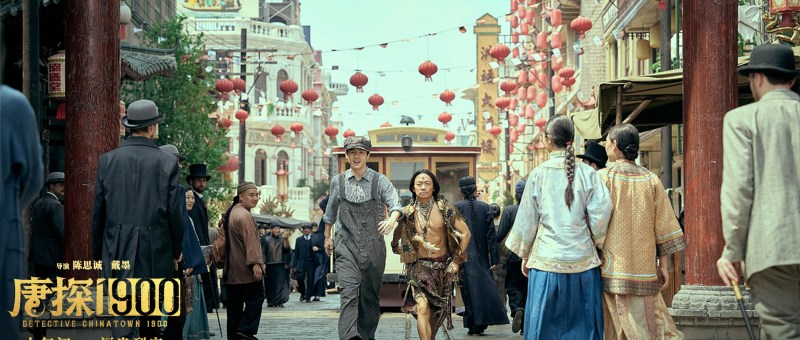
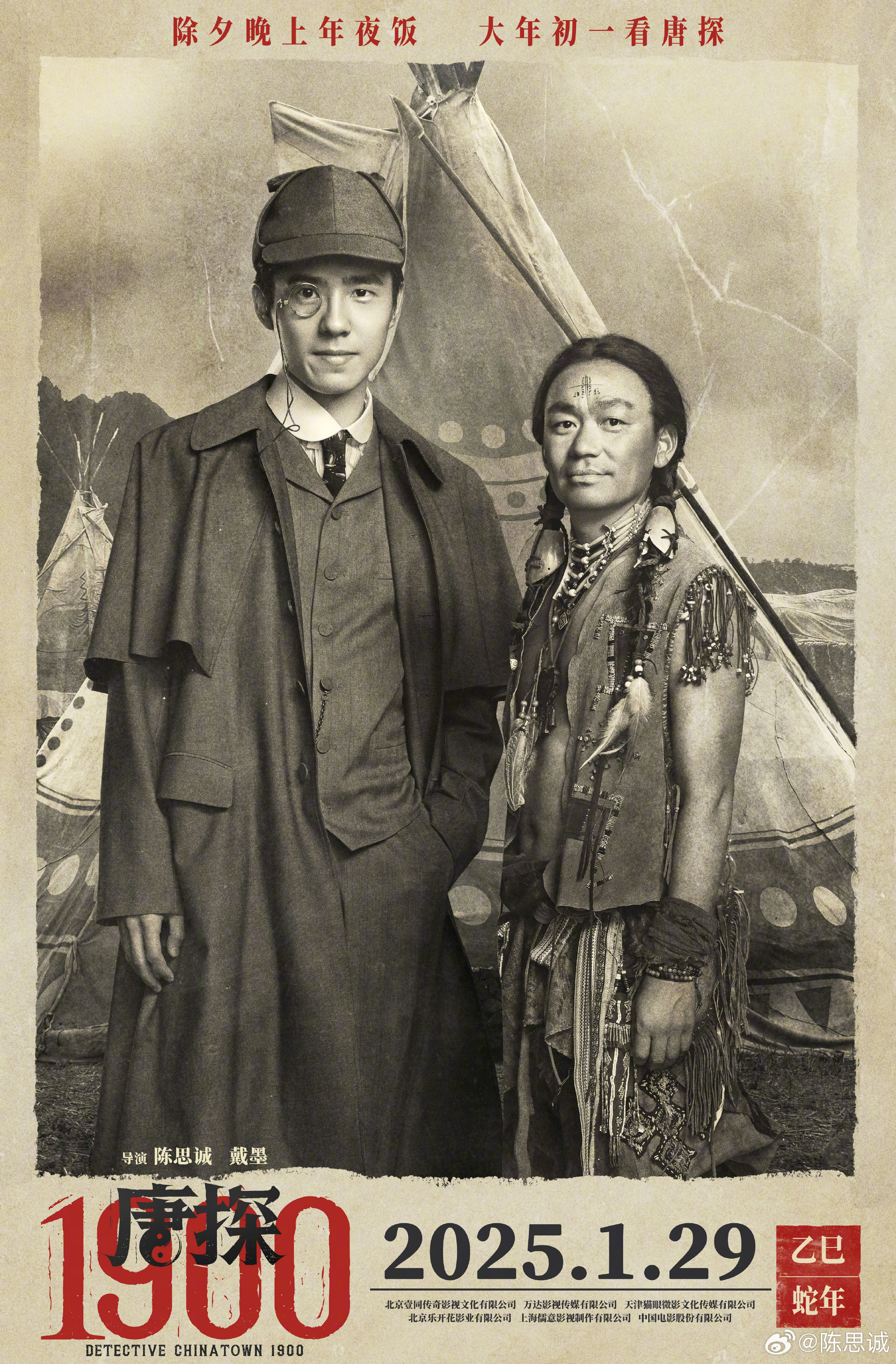
The Detective Chinatown team head back to turn of the contrary San Francisco in the latest instalment of the mega hit franchise, Detective Chinatown 1900 (唐探1900, Tángtàn 1900). Like many recent mainstream films, its main thrust is that Chinese citizens are only really safe in China, but also implies that diaspora communities exist outside the majority population and therefore can only rely on each other. Nevertheless, there’s something quite uncanny in the film’s ironic prescience as racist politicians wax on about how here rules are made by the people rather than an emperor and plaster “make America strong again” banners on their buses. 

The crime here though is the murder of a young white woman, Alice (Anastasia Shestakova), the daughter of Senator Grant (John Cusack) who is attempting to push the renewal of the Chinese Exclusion Act through government and destroy all the Chinatowns in the United States. An older Native American man was also found dead alongside her. Some have attributed the crime to Jack the Ripper as Alice was mutilated before she died and some of her organs were taken. The son of local gangster Bai (Chow Yun-Fat), Zhenbang (Zhang Xincheng), is quickly arrested for the crime while his father hires Qin Fu (Liu Hairan) to exonerate him believing Qin Fu to be Sherlock Holmes. 

What Qin Fu, an expert in Chinese medicine recently working as an interpreter for the famous consulting detective, finds himself mixed up in is also a slow moving revolution as it turns out Zhenbang is involved with the plot to overthrow the Qing dynasty (which would finally fall in 1912). As the film opens, corrupt courtiers to sell off large golden Buddha statues to American “allies” who are later seen saying that they plan to fleece China and then renege on their promises to protect it. Meanwhile, the Dowager Empress has sent emissaries to San Francisco to take out the revolutionaries in hiding there including Sun Yat-sen.

Of course, in this case, the Qing are the bad guys that were eventually overthrown by brave Communist revolutionaries that paved the way for China of today which is alluded to in the closing scenes when Zhenbang’s exiled friend Shiliang (Bai Ke) says that China will one day become the most powerful country in the world implying that no-one will look down on the Chinese people again. But on the other hand, they are still all Chinese and so the emissary tells Qin Fu to “Save China” as he lays dying having met his own end shortly after hearing that the British have invaded Peking signalling the death blow for the Qing dynasty. 

Nevertheless, there is a degree of irony in the fact that the secondary antagonist is an Irish gang who have signs reading “no dogs, no Chinese,” mimicking those they themselves famously face. The Irish gang is in league with Grant and content to do his dirty work, while Bai is supported by another prominent man who speaks Mandarin and pretends to be a friend to the Chinese but in reality is against the Exclusion Act on the grounds he wants to go on being able to exploit cheap Chinese labour. In this iteration, Ah Gui (Wang Baoqiang) is “Ghost,” a man whose parents were killed building the American railroad and was subsequently taken in and raised by a Native American community. In Bai’s final confrontation with the authorities, he takes them to task for their hypocrisy reminding them how important the Chinese have been in building the society in which they alone are privileged while “equality” does not appear to extend to them.

Through reinforcing these messages of prejudice and exploitation, the film once again encourages Chinese people living abroad to return home. Though set in 1900, the scenes of protest can’t help but echo those we’ve seen in the wake of the Covid-19 pandemic when racist hatred towards Asian communities has become much more open and pronounced. Qin Fu and Ghost do at least succeed in solving the mystery through scientific principles while ironically assisted by an earnest American policeman who says he thinks it’s important to uphold the law even as we can see the head of the golden Buddha sitting behind the victorious politician’s banquet table and realise that in reality taking out Grant has made little difference for the Exclusion Act will still be renewed (it was repealed only in 1943). They may have saved Chinatown, but Bai must sacrifice his American wealth and return to China much the way he left it having reflected on his life in light of the revolutionary course charted by his more earnest son. As Ghost and Qin Fu remark, if things were better there no one would want to come here though they themselves apparently elect to stay, solving more crimes and making sure that their descendants know they were here and where they were from.


International trailer (Simplified Chinese / English subtitles)

Good Autumn, Mommy (尋她, Chen Shizhong, 2023)

A family tragedy forces a grieving mother to confront the sexism and hypocrisy of mid-90s China in Chen Shizhong’s biting rural drama, Good Autumn, Mommy (尋她, xún tā). Quietly simmering with an internal rage her society convinces her she must repress, Fong-tai (Shu Qi) finds herself constrained by the intensely traditional atmosphere of her small-town home and more than that by her husband’s eternally passive attitude in which he resolutely refuses to rock the boat or make any attempt to stand up for himself. 

Fong-tai is warned by her brother, in a nice way, that her personality may make it difficult to live somewhere like this where a woman is clearly intended to know her place and keep her peace. Not that she particularly blames him for it, but Fong-tai is resentful towards her birth family who fostered her out and saved their money to send her brother to university. For this reason she remains an outsider in the village (a sentiment rammed home by the casting of Taiwanese actress Shu Qi whose accent quite clearly stands out in Cantonese-speaking Guangdong) and not least because of her feisty temperament and tendency to speak her mind. 

Often, however, it does her little good. Pregnant with her second child she begs her mother-in-law to take her to a modern hospital but she insists on doing everything the old fashioned way taking both her and her similarly pregnant friend Lam San to a disused clinic only to be trapped there by an encroaching storm. Both babies are born healthy, but battered by the high winds the dilapidated clinic collapses plunging them into the lake. Fong-tai manages to save one but the other disappears without trace. As she had put a bangle on her newborn child and the rescued baby doesn’t have one, she assumes it’s Lam San’s but later comes to doubt herself. 

Part of the problem is that Fong-tai assumes no one is really looking for her baby because it is a girl and if it had been a son they’d have left no stone unturned. As her desperation mounts, many of those around her imply that the loss of her daughter is a kind a kind of blessing for, as the couple have one daughter already, it frees them up to try again for a son given the restrictions of the One Child Policy which allowed a second child if the first had been a girl. One even tells them that a second daughter kills off the family name given that Fong-tai’s husband Yiu-cho was also an only son, and that they should simply have another child as soon as possible to produce a male heir. 

Ironically this might also be why Kong-yan, Lam San’s husband, is prepared to accept the rescued baby as his own and reluctant to submit to a DNA test given that in that sense it doesn’t matter as much whether or not he is the biological father because this child is not expected to continue his line in the same way a son would be. Yet Kong-yan also embodies another side of a changing China in that he has become rich under the new economic reforms but largely by exploiting local sugar cane farmers. Kong-yan leverages his wealth in insisting Fong-tai pay for the DNA test knowing full well she can’t and then refusing to buy any of her sugarcane out of pettiness thereby destroying her livelihood. 

While looking for her daughter and frightened enough to take note of an urban legend about wild men living in an old banana plantation, Fong-tai is confronted with the borders of her world after venturing to the edge of it and discovering a construction site she had no idea existed because she doesn’t venture out of the village. She begins to wonder what the outside world is like and if she’s been trapped here by outdated notions of filiality and patriarchal social codes that conspire to keep women in their place while becoming sick of Yiu-cho’s complicity and refusal stand up for their family even when it’s their child that is missing. 

When she decides to drain the supposedly sacred lake herself by destroying the dam it’s as if she’s pulling down the borders of that world and removing the source of her oppression in breaking free of “tradition”. The villagers that were hostile to her just minutes before, begin to reflect that it’s just a lake and sympathise with Fong-tai as a bereaved mother rather than a troublemaker who didn’t know her place. Highly critical of ingrained sexism and the hubristic behaviour of the nouveau riche elite in changing 90s China the film’s haunting yet hopeful ending suggests at least that Fong-tai was able to ensure that her older daughter was freer than she had ever been even if she can never escape the wounds of the past or regain what was taken from her.


Good Autumn, Mommy screens in Chicago April 13 as part of the 18th Season of Asian Pop-Up Cinema.

Original trailer (Simplified Chineses & English subtitles)

Art College 1994 (艺术学院, Liu Jian, 2023)

In the opening title sequence of Liu Jian’s animated dramedy Art College 1994 (艺术学院, yìshùxuéyuàn), a beetle tries to climb a decaying wall but repeatedly fails until it falls on its back and flails wildly trying to right itself. It might in a way stand in for Liu’s protagonists, each of whom are floundering in various ways amid the contradictions of the rapid social changes of mid-90s China. A potent sense of place lends weight to what is obviously an autobiographically inspired tale of youth’s end coloured by rueful nostalgia. 

The rebellious Xiaojun clashes with his tutors who think he’s overly influenced by Western art movements and lacks the maturity to understand that there is also truth in traditionalism, while his best friend Rabbit begins to worry about more practical matters and their future in a changing society. The boys eventually develop a friendship with music students Lili and Hong who find themselves similarly at odds. Brash and brimming with false confidence, Hong dreams of becoming a famous opera singer and resents the patriarchal social mores of a still conservative China. “Sooner or later we all have to marry someone.” Lili sighs as if feeling the walls closing in on her, only for Hong to ask why no one ever realises they’re “someone” too. 

They have grand conversations about the nature of art, beauty, tradition and modernity, conservatism and social change, belying their naivety but still filled with a sense of freedom and curiosity that is only beginning to be coloured by a concurrent anxiety. “I thought I knew everything. The truth is I know nothing.” Hong finally concedes after a failed romance, arguing with Lili with whom she may always have been on a different page. Shy and bespectacled, Lili is a realist amid a group of dreamers. She nurses a nascent crush on Xiaojun but is courted by a condescending bore who comes with her mother’s approval. Perhaps she’s merely afraid of the risks involved when real feeling is in play, but for all her talk of “freedom” makes her choices intellectually and leans towards the pragmatic. Xiaojun is a penniless painter, but her suitor is a wealthy man who can take her to Paris to study. Amid the contradictions of mid-90s China, who could really blame her for making a “sensible” choice even it means the sacrifice of her emotional fulfilment? 

Xiaojun lets his chance slip away from him, failing to say anything meaningful before revealing he’s going away on a study trip for an extended period of time. But like Lili he meditates on art and the soul while romanticising a poverty he may never really have experienced. The boys hang out with eccentric drifter Youcai who repeatedly failed the entrance exams but hangs around on campus anyway soaking up the atmosphere while prone to sudden attacks of performance art. After a stint living in the artist community in Beijing he returns in the company of crooks and conmen, working as a sign painter to get by while lamenting his own lack of talent. He says he makes money in order to make art, while Xiaojun disapproves of his moral duplicity insisting that it’s right for an artist to be starving because suffering fosters art.

Youcai asks him how you can make art if you can’t eat while insisting that art is one big business, just like everything else it too is suspect because it is dependent on money. Xiaojun disagrees, claiming that that art is the only escape from reality that can bring people spiritual satisfaction. Ironically enough, he says this while sitting directly underneath a billboard advertising Michael Jackson’s Bad, while we’ve already seen him ride his bicycle past a conspicuous piece of graffiti featuring the characters for CocaCola in Chinese. When Lili’s suitor says he’ll buy them dinner, Liu ironically cuts to the two girls sitting outside a McDonald’s eating ice cream. This does seem to be a very dubious sense of “modernity”, mediated through Western consumerism that in contrast to the values Xiaojun places in “art” is spiritually empty. 

Even so his disapproving teacher reminds him that great art is born of sincerity, hinting at a degree of affectation in his insistence that art should change with the times when not all truths need to be revolutionary. In any case, each of the students learns a few hard lessons about life and disappointment as they too succumb to unavoidable realities and accustom themselves to an uncertain society. Liu ends the film with a series of title cards that feel very much like those often added to placate the censors, usually detailing that wrongdoers were caught and punished for their crimes but this time conjuring more wholesome futures for the students that undercut the sense of the frosty melancholy in the closing scenes which leave Xiaojun all alone as he takes up brush and ink. Yet in Liu’s achingly potent sense of place, there is both a poignant nostalgia and an inescapable sense of loss and regret for the missed opportunities of youth. 


Art College 1994 screened as part of this year’s Red Lotus Asian Film Festival.

Trailer (English subtitles)

Hero (世间有她, Li Shaohong, Joan Chen, Sylvia Chang, 2022)

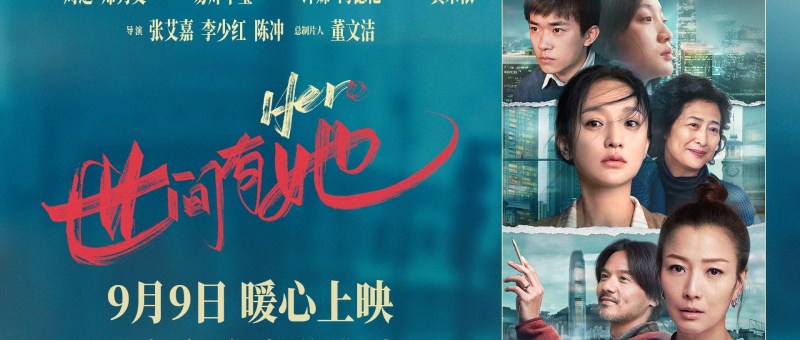
The latest addition to the growing sub-genre of Chinese pandemic movies, tripartite anthology film Hero (世间有她, Shìjiān Yǒu Tā, AKA Her Story) is the first to root itself in the lives of contemporary women just as they are disrupted by the arrival of COVID-19. As might be expected, the themes are largely those of love and endurance which draw additional poignancy from a Lunar New Year setting that prioritises family reunion but may also be in their way reactionary in reinforcing patriarchal social codes while implying that it might be the women who need  to give a little and reassess their notion of what’s really important. 

Directed by Li Shaohong, the opening sequence pits 30-something mother Yue (Zhou Xun) against her domineering mother-in-law, Ju (Xu Di), whose love and care for her son and grandson borders on the destructively possessive. Yue is the first to contract the mysterious new form of pneumonia then taking hold in Wuhan, prompting Ju to immediately try and kick her out of her own flat while insisting her son, Kai, and grandson, Dongdong, come back with her to another city further north. When lockdown is declared in Wuhan, the grandmother is trapped with the family but her acrimonious relationship with Yue adds to an already stressful situation. After Ju comes down with COVID too, Kai and Dongdong take refuge in the empty flat of a friend leaving the two women alone but mainly phoning Kai to complain about each other. 

A phone call from Yue’s parents eventually forces Ju into a reconsideration of her corrupted filiality as she remembers that Yue is also someone’s daughter and a mother herself. She accepts that Yue’s criticism of her as overly invested in her son’s life is fair and mostly born of her loneliness rather than an attack on her otherwise conservative values that imply she exists only in service of the men of the family, while realising that by failing to take proper care of herself she accidentally increases the burden on those around her and should instead agree to care and be cared for as a part of a harmonious community. 

This question of interdependence also raises its head in the third chapter directed by Sylvia Chang set in Hong Kong and filmed in Cantonese. Chang’s segment is not really much about the pandemic save for the additional strain it places on the relationship between press photographer Chelsea (Sammi Cheng Sau-man) and her husband Daren (Stephen Fung Tak-lun) with whom she is in the process of separating. When their son develops a fever, they end up in a blazing row discussing the reasons their marriage is falling apart which relate mostly to differing views of contemporary gender roles with Daren apparently reluctant to do his fair share at home while lowkey resentful that Chelsea has not only continued to work but is professionally ambitious especially as, it’s implied, his salary is not really enough to support a family of four on its own. The family also have a Filipina helper who in a rather poignant moment is heard singing happy birthday to her own child back in the Philippines whom she cannot see because she’s earning money taking care of Chelsea’s. Like Yue, Chelsea is also prompted to consider what’s most important, but the implication seems to be that she’s the one in the wrong and should learn to prioritise her family while her husband is more or less vindicated rather than encouraged to change. 

Only the middle section, directed by Joan Chen, attempts to deal with the gaping losses of the pandemic era as a young woman, Xiaolu (Huang Miyi), tries to gather the courage to tell her parents, who are still hoping she’s going to hook up with a now successful childhood friend, that she’s going to marry her uni boyfriend, Zhaohua (Jackson Yee), who’s stayed behind in Wuhan to look after their cat while she returns to Beijing for Lunar New Year. Xiaolu keeps in regular contact by phone but soon discovers that Zhaohua has become ill with a mysterious illness. She immediately decides to return to Wuhan but he warns her not to because it isn’t safe and shortly thereafter the city is locked down while she and her family are placed under quarantine in Beijing. Shot in a washed out black and white only the various FaceTime conversations between the young couple are in colour hinting at the greyness that now surrounds Xiaolu’s existence and the distance between herself and the happy life in Wuhan which has now been taken away from her. 

The film’s Chinese title more literally means “the world has her” or maybe more simply implies that she is in the world, more of an everywoman contending with the extraordinary than the “hero” of the title though the survival of the three women is in its own way also of course “heroic”. This concept of heroism may however be somewhat problematic in its emphasis on patriarchal social codes which insist that their first and only duty is to the family even if the message of holding your friends and relatives closer in the wake of disaster is universally understandable. Nevertheless, it does perhaps pay tribute to the women’s perseverance and determination to seek kindness and love even in the most difficult of times. 


Hero streams for free in the US and Canada until Feb. 5 as part of Asian Pop-Up Cinema’s Lunar New Year celebration.

Original trailer (English subtitles)