Kakashi (案山子, Norio Tsuruta, 2001)

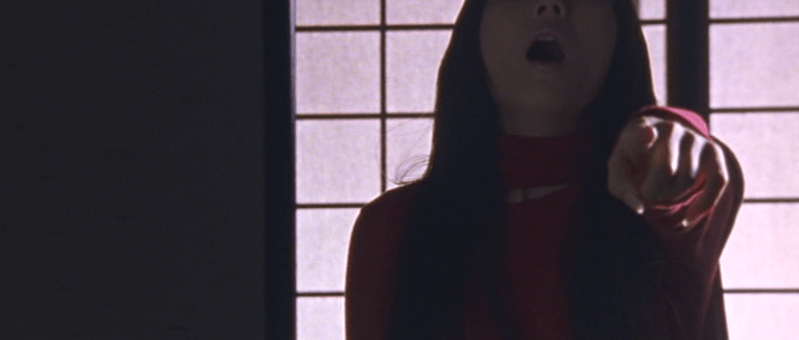
There’s a village in Japan that’s mostly inhabited by scarecrows. One of the last remaining residents began creating them to replace something that had been lost, fashioning effigies of those who had passed away and immortalising them as if clinging to a distant past long before the shadows of rural depopulation were cast over the village. In a way, it’s an expression of grief or at least a lament for a loss of community and a sense of increasing loneliness and isolation. 

Adapted from Junji Ito’s manga, Norio Tsuruta’s Kakashi is also in its way about grief and the way in which it can consume those left behind so that they too have no more desire to live. Dr Miyamori (Kenzo Kawarasaki) later explains that in the village they co-exist with death and he returned to his home town in the hope that he could save his daughter, Izumi (Ko Shibasaki), through its peculiar magic of resurrecting the deceased as human scarecrows. As he freely admits, he could not accept his daughter’s death and so has chosen to stay here in the village though alive himself rather than attempt to remake his life without her.

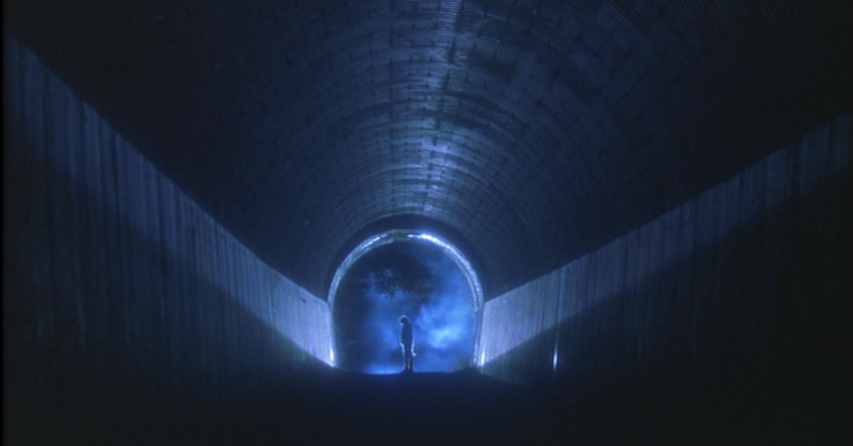
The village itself appears to exist slightly outside of the mortal realm as Kaoru (Maho Nonami) discovers on encountering the long tunnel that leads to its entrance. Her car breaks down half-way through signalling her liminal status as one who does not yet belong on either side. It’s not quite grief that’s brought her here but still a nagging sense of foreboding in that she’s come in search of her missing brother, Tsuyoshi, after discovering a letter from an old school friend, Izumi, next to his telephone. Kaoru appears confused as to why the letter should be there and travels to the village hoping for answers, assuming that Tsuyoshi (Shunsuke Matsuoka) may have travelled there in search of Izumi.

As the landlady lets her into his empty flat, Kaoru explains that she is his only family and there’s a suggestion that her attachment to him is unnatural, bordering on the incestuous. A policeman taking a look at the photo Kaoru hands him remarks that they look like a couple, which they do, leading her to stuff the photo back in her pocket as if she were embarrassed. To that extent, she’s come to reclaim Tsuyoshi, not just from death, loneliness, grief, and depression, but from Izumi or at least the spectre of her. In life, she feared that Izumi would take him away from her and at least in Izumi’s mind frustrated their romance out of romantic jealously. Dr Miyamori implies it was this sense of despair that contributed to her death and it’s clear that Izumi’s mother also blames Kaoru while Izumi accuses Kaoru of being forever in her way.

But then again, she did not bring Kaoru to the village and is not targeting her personally out of vengeance. Rather, she has moved beyond that as she finally’s about to become “herself” thanks to the village’s dark magic and the following day’s scarecrow festival, and therefore no longer needs to care about the resentments of her mortal life even if her father says that her evil spirit has empowered the town. There is definitely something quite creepy in this weird village with its shades of the Wicker Man in its strange ritual and humanoid effigies where improbable numbers of children softly blow pinwheels under a large windmill that seems to be moving time itself. Tsuruta even borrows a particularly eerie shot from Don’t Look Now and emphasises the liminal qualities of the village in Dr Miyamori’s advice that Kaoru leave as soon as her car is fixed otherwise she may no longer wish to.

The village is apparently full of those like him who are trapped but wilfully so because they no longer desire to leave. Kaoru attempts to help one of them, a young living woman from Hong Kong unable to let go of the memory of her late father whose scarecrow eventually tells her to go. It’s a place for those who have no other place to go to because they cannot let go of their grief and despair. Thus Kaoru is pulled towards the edge of the tunnel, not so much to free her brother as, in a way, herself by allowing her grief to consume her and consenting to live this empty life alongside death rather than allow herself to accept her loss.


Trailer (no subtitles)

Spring In Between (はざまに生きる、春, Rika Katsu, 2023)

A struggling editor at a magazine gains a new perspective while falling in love with an autistic artist in Rika Katsu’s romantic drama Spring In Between (はざまに生きる、春, Hazama ni ikiru, haru). Spring is coming in the lives of artist and reporter alike, yet as Haru’s (Sakurako Konishi) professional life begins to come into focus she finds herself romantically confused and ever more obsessed with the mysterious painter while largely unable to ascertain what the extent of his feelings for her may be assuming that he has any at all. 

Haru’s obsession begins when she becomes immersed in one of Tohru’s (Hio Miyazawa) paintings which like much of his work depicts a vast blue sea. Three years on the job, she’s still making rookie mistakes and is constantly berated by her boss who offers little in the way guidance. Nevertheless, she catches a break when he brings her on to assist with an interview of a top artist who is known to be “eccentric”. Never having much exposure to neurodiversity, Haru finds herself captivated but also somehow on the same wavelength while drawn to what she sees as Tohru’s profundity and poeticism. 

The film does at times fall into the trap of fetishising Tohru’s “unique” way of seeing of the world while otherwise keen to lay bare the extent to which neurodiversity continues to be stigmatised. Haru’s partner on the magazine article repeatedly describes Tohru as “odd” in a slightly mocking way, while the journalists assigned to interview him have little patience and do not even bother to hide their exasperation when he flies off on tangents about plastic bottles or tree bark. The magazine is interested in him precisely because of his neurodiversity and learning disability hoping to sell an inspirational story of someone overcoming the odds to find success but in private continue to laugh at him.

Even Haru struggles to comprehend some of the unhelpful information she looks up while researching Asperger’s Syndrome which talks of an inability to empathise leaving her wondering if Tohru has the capacity for romance despite his directly telling her that he has fallen in love before because he is after all human though he never said anything because he did not want to get hurt. A more experienced colleague noticing Haru’s increasingly erratic behaviour tries to give her some advice, but it isn’t to the effect that it might be unethical and irresponsible to fall in love with your subject for a piece but only that she’ll wind up getting hurt because Tohru is autistic and therefore unable to return her feelings, implying that in any case she views a relationship between them as as inappropriate given what she sees as Tohru’s disability. 

In revealing Haru’s own potentially autistic traits, such as her preference to have someone stand on her left and never her right, the film strays into a potentially uncomfortable implication that everyone is a little bit autistic while otherwise trying to eliminate the line has that been placed between Tohru and everyone else. Introducing a romantic rival in the form of an equally eccentric, larger than life photographer who also does not fit into “conventional” society, also implies that neurodiverse people can only date each other while Haru struggles to define her feelings both for Tohru and for uni boyfriend Nao who appears to be both possessive and disinterested telling her that she should get over her left side only thing in the same way some talk about a “cure” for Tohru’s neurodiversity. 

Haru can’t state her feelings any more directly than Tohru can while simultaneously unable to find a way through to him to find out if he likes her at all or is just being friendly and considerate, unlike Nao making a map to figure out the acceptable dimensions of her personal space and promising to always stay at a comfortable angle. Yet in the end it’s curiosity that builds connection, the simple desire to know more about another person and to see the world from another perspective. Promises are kept, and a message delivered if in a roundabout way. As they say, spring will always get there in the end even if summer is right around the corner. A sweet and innocent romance, Spring in Between is as much about self-revelation as it is about mutual understanding and the still currents of a deep blue sea.


Spring in Between screened as part of this year’s Nippon Connection

Original trailer (no subtitles)

Ring Wandering (リング・ワンダリング, Masakazu Kaneko, 2021)

“Don’t forget me” pleads a mysterious young woman guiding the hero of Masakazu Kaneko’s Ring Wandering (リング・ワンダリング) towards the buried legacy he is unwittingly seeking. In this metaphorical drama, the aspiring manga artist hero is on a quest to discover the true appearance of the long extinct Japanese wolf, but is confronted by a more immediate source of unresolved history while working on a construction site for the upcoming Tokyo Olympic Games. 

The manga Sosuke (Show Kasamatsu) is working on is about a wolf and a hunter, Ginzo (Hatsunori Hasegawa), whose daughter Kozue was killed by one of his own traps. Though praising the general concept, his workplace friend points out that his manga lacks human feeling but Sosuke claims it’s unnecessary in a story that’s about a duel to the death between man and nature while matter of factly admitting that Kozue is merely a plot device designed to demonstrate Ginzo’s manly solitude. Yet Soskue complains that he can’t make progress because the Japanese wolf is extinct and he can’t figure out how to draw it. 

His quest is in one sense for the soul of Japan taking the wolf as a symbol of a prehistoric age of innocence though as it turns out he knows precious little about more recent history. The workers at the construction site have heard rumours about a stoppage at another build and joke amongst themselves that if they should find any kind of cultural artefact they’ll just ignore it rather than risk the project being shut down or any one losing their job. The site itself symbolises a tendency to simply build over the buried past erasing traces of anything unpleasant or inconvenient. When Sosuke comes across an animal’s skull buried in a pit he has recently dug, he is convinced it’s that of a Japanese wolf only later realising it is more likely to be that of a dog killed in the fire bombing of Tokyo during the war along with thousands of others on whose bodies the modern city is said to lie. 

Then again, impassive in expression Sosuke is particularly clueless when it comes to recent history. While searching for more wolf cues he comes across a young woman (Junko Abe) looking for her missing dog but completely fails to spot her unusual dress aside from assuming the old-fashioned sandals she is wearing are for the fireworks show set to take place that day incongruously in the winter. Similarly in accompanying her to her home he is confused by all her references to things like the metal contribution and her brother having been sent to the country. He wonders if she might be a ghost, and she wonders the same of him, but still doesn’t seem to grasp that he’s slipped into another era fraught with danger and anxiety only realising the truth on exiting the dream and doing some present day research. 

The fallacy of violence works its way into his manga in the fact that Ginzo’s traps eventually lead to the death of his daughter while he becomes on fixated on besting the wild wolf as a point of male pride though others in the village are mindful to let it live. A pedlar meanwhile explains that the wolf has been forced down towards the village because of the declining economic situation as more people hunt in the mountains for food and fur depriving him of his dinner. He tells Ginzo that the country has been “brainwashed in militarism” and the gunpowder that killed Kozue and will one day be repurposed to create joy and awe is now his most wanted commodity. In the end Ginzo too is saved by a kind of visitation, a ghost from the past offering a hand of both salvation and forgiveness along with an admonishment forcing him to take responsibility for his role in his daughter’s death.

In forging a familial relationship with a lost generation Sosuke comes to a new understanding of more recent history and in a sense discovers the connection he was seeking with his culture, weaving the anxieties of 1940s into an otherwise pre-modern fable about the battle between man and nature in which wolf becomes not aggressor but casualty in a great national folly. Like Kaneko’s previous film Albino’s Trees deeply spiritual in its forest imagery and oneiric atmosphere, Ring Wandering finds its hero transported into the past while unwittingly discovering what it is he’s looking for without ever realising that it has always been right beneath his feet. 


Ring Wandering streamed as part of this year’s Nippon Connection.

Original trailer (English subtitles)

Images: ©RWProductionCommittee

You’re Not Normal, Either! (まともじゃないのは君も一緒, Koji Maeda, 2021)

What’s so great about being “normal” anyway? As the title of Koji Maeda’s quirky screwball comedy You’re Not Normal, Either! (まともじゃないのは君も一緒, Matomo Janai no wa Kimi mo Issho) suggests neither of its heroes is quite in tune with the world around them but then again, is there really such a thing as “normal” or is it more that most people are making themselves unhappy by settling for less simply because they think that’s just how things are and resistance only makes you seem awkward? 

Nerdy cram school maths teacher Yasuomi (Ryo Narita) thought he was OK with being a little different, but just recently he’s begun to feel lonely and fears the possibility of being alone for the rest of his life. Perhaps inappropriately, he looks to one of his students, forthright high schooler Kasumi (Kaya Kiyohara), for romantic and life advice hoping that she will teach him how to be, or at least present as, more “normal”. Unbeknownst to him, however, Kasumi is not quite “normal” herself and is in fact obsessed with a tech entrepreneur, Isao (Kotaro Koizumi), who is all about a new and freer future in which humanity is freed from the burden of labour. Finding out that her crush is already engaged to Minako (Rika Izumi) the daughter of a hotel magnate, Kasumi hatches a plan to break them up while training Yasuomi in the art of seduction. 

Kasumi’s insecurities seem to be down to her failure in her middle school exams, attracted to Isao’s philosophies because they offer a possibility of freedom outside the rigid demands of academic success in Japan. She tells Isao in a not quite by chance meeting that she wants to become a teacher in order to expand children’s minds rather than force them into a fixed perspective as the rather authoritarian, rote learning system of education often does. Yet she also feels out of place among her peers whom she sees as vacuous always gossiping about part-time jobs and boys. She frowns at Yasuomi when he accidentally cuts the conversation dead with an awkward comment while attempting to chat up a pair of bubbly office workers in a bar, but often does the same thing herself while sitting with her high school girl friends who fall silent and then change the subject after she injects a little realism into their mindless chatter. 

Yasuomi had viewed himself as “normal” and never understood why others didn’t, noticing that people often stopped associating with him but not knowing the reason why. Obsessed with pure mathematics, over literal, and overstimulated by the complications of life he takes refuge in the forest and the sensory overload of its nocturnal creatures speaking quite eloquently about the beauty of numbers and actually fairly emotionally intelligent in his understanding of the two women. Resolutely failing at Kasumi’s Cyrano act, he comes into himself only when speaking more honesty much to Kasumi’s annoyance actually hitting it off with Minako who is herself just as lonely and alienated but perhaps wilfully trapped. 

Predictably enough, Isao isn’t exactly “normal” either or perhaps he is but only in the most depressing of ways, his rosy vision of the future delivered with more than a little snake oil and just as much sleaze. Minako may know what sort of man Isao is, that her marriage is largely a dynastic affair set up by her overbearing, authoritarian father, but she too may think this is “normal” and might have preferred not to have to confront her sense of existential disappointment while attempting to fulfil the role of a “normal” woman content with creating a comfortable space in which her husband can thrive.  

Romantically naive, Kasumi wonders how people come to fall in love informed by two relatively mature classmates that for them at least falling in love is a gradual process of increasing intimacy generated through casual conversation. This turns out to be pretty much true for Kasumi too, though in ways she didn’t quite expect watching as Yasuomi opens up to Minako and finding herself unexpectedly jealous while reluctant to let go of the idealised vision she had of Isao as some kind of messiah for a better Japan. There is something a little uncomfortable in the potentially inappropriate relationship between a student and her teacher even as the roles are, on one level at least, reversed but there’s also a kind of innocence in their childish friendship and later determination to start small and let things grow while abandoning the idea of the “normal” altogether to embrace their true selves in a freer future of their own creation. 


You’re Not Normal, Either! screens in Chicago on Oct. 7 as part of the 13th season of Asian Pop-Up Cinema 

Original trailer (English subtitles)